
You have two choices when you enter the cryptocurrency market. You can buy a coin, lock it away, and ignore the noise for years. Or, you can stare at charts all day, trying to catch every tiny price jump. These are not just different habits; they are fundamentally different ways of making money-or losing it. The debate between HODLing is a passive long-term investment strategy where investors hold assets regardless of short-term volatility and active trading is a high-frequency approach involving buying and selling assets over short periods to profit from price fluctuations defines how most people interact with digital assets today.
If you want to know which one is better, the answer depends entirely on your personality, your time, and your tolerance for stress. There is no magic bullet that works for everyone. Let’s break down exactly what these strategies cost you in time, money, and mental energy so you can decide which path fits your life.
The HODL Philosophy: Patience Over Precision
The word HODL started as a typo. In 2013, a user named GameKyuubi posted on BitcoinTalk during a market crash, shouting "I AM HODLING" instead of "holding." It stuck because it captured the raw emotion of the moment. Today, it represents a specific mindset: conviction despite chaos.
Bitcoin is the original cryptocurrency launched in 2009, often used as the benchmark for long-term HODL performance has grown by more than 280% since 2020, even though it crashed hard multiple times along the way. If you had held through those drops, you would be up significantly. Compare that to gold, which returned about 30% over five years. The math favors patience if you pick the right asset.
But HODLing is not just sitting there. It requires emotional armor. When Bitcoin dropped 80% in 2018, many people sold at the bottom. They didn’t lack knowledge; they lacked nerve. The biggest risk here isn’t daily price swings-it’s catastrophic failure. Remember TerraUSD? It went to zero in 2022. If you HODL a bad project, you lose everything. That is why experts suggest sticking to established coins like Bitcoin or Ethereum for this strategy.
- Time Commitment: Minimal. Check your portfolio once a week or month.
- Costs: Low. Fewer trades mean fewer exchange fees.
- Skill Level: Beginner friendly. You need basic wallet security knowledge.
- Risk: High exposure to single-asset failure, low daily stress.
Active Trading: The Grind for Gains
On the other side of the spectrum is active trading. This includes day trading (closing positions within 24 hours), swing trading (holding for days or weeks), and scalping (snatching tiny profits from minute-by-minute moves). This is not a hobby for most people; it is a job.
Studies show that only 1% to 4% of day traders make consistent profits over the long term. Why? Because you are fighting against algorithms, institutional players, and your own emotions. Every trade costs you money. On major exchanges like Binance, fees range from 0.1% to 0.6%. If you trade ten times a day, those fees eat into your margins quickly. Add slippage-the difference between expected price and execution price-and it gets worse.
Technical Analysis is the study of price charts and patterns to predict future market movements, essential for active traders is your main tool here. You need to read candlestick patterns, understand volume spikes, and set stop-loss orders to protect yourself. Without these skills, you are gambling, not trading.
Active trading shines in volatile markets. Crypto swings 5% to 10% daily compared to the S&P 500’s 0.5%. That volatility creates opportunity. But when the market goes flat-like Bitcoin did in 2019-traders bleed money waiting for a move that never comes.
- Time Commitment: High. Expect 15-20 hours a week analyzing charts.
- Costs: High. Frequent fees, software subscriptions, and data costs.
- Skill Level: Advanced. Requires months of dedicated learning.
- Risk: Constant market risk, but losses can be capped with discipline.
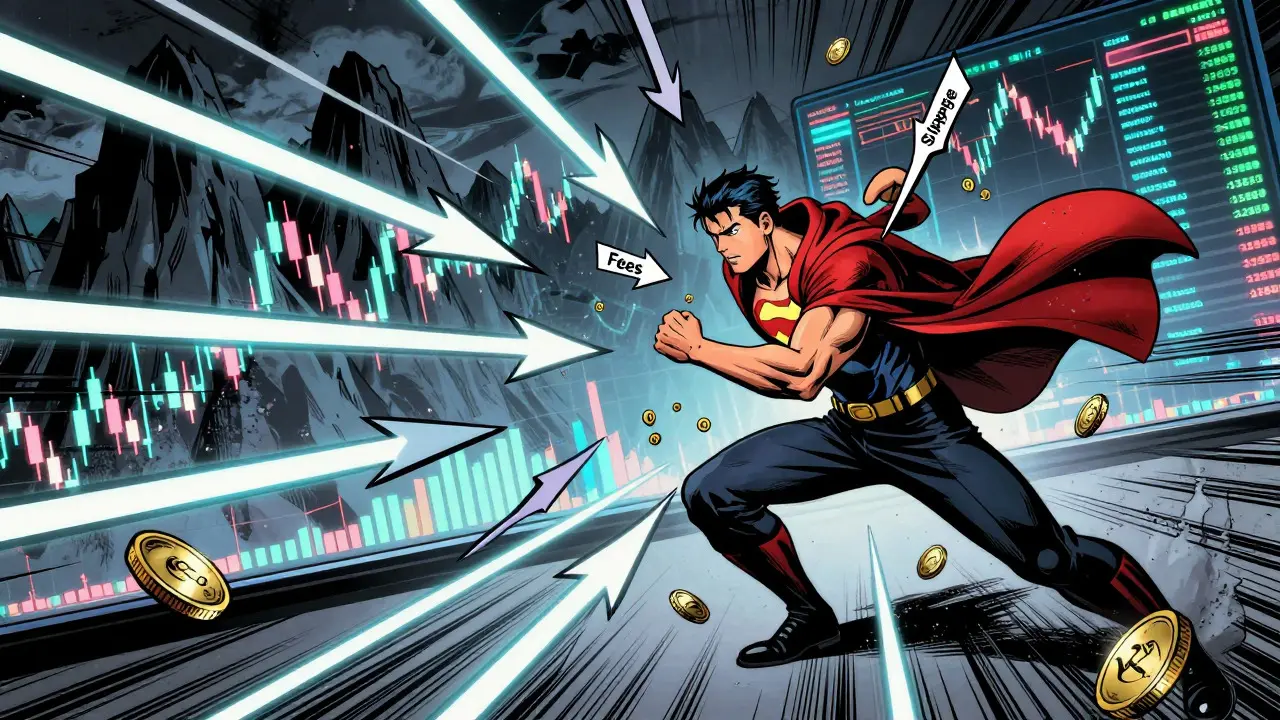
Head-to-Head: Costs, Stress, and Returns
Let’s look at the numbers. A typical HODLer saves $500 to $2,000 annually in trading fees compared to an active trader with a similar portfolio size. That is real money staying in your pocket. Then there is stress. Surveys indicate that 78% of long-term holders report lower anxiety levels than active traders. Makes sense. You sleep while your coins sit in a cold wallet.
However, HODLers miss out on short-term gains. During Bitcoin’s 2021 bull run, active traders caught multiple 20% to 30% swings in months. HODLers watched the price go up, then down, then up again, experiencing the full rollercoaster without locking in profits along the way.
| Feature | HODL Strategy | Active Trading |
|---|---|---|
| Time Required | Low (Weekly checks) | High (Daily screen time) |
| Transaction Fees | Minimal | Significant (0.1%-0.6% per trade) |
| Stress Level | Low to Moderate | Very High |
| Profit Potential | Long-term compound growth | Short-term rapid gains |
| Success Rate | High for major coins | Low (1-4% consistently profitable) |
| Required Tools | Hardware Wallet (Ledger/Trezor) | Charting Software (TradingView), APIs |
The Hybrid Approach: Best of Both Worlds?
Does it have to be one or the other? Many experienced investors say no. Michael van de Poppe, a well-known industry analyst, suggests a "core/satellite" strategy. Keep 70% to 80% of your portfolio in long-term HODL positions. Use the remaining 20% to 30% for active trading.
This approach gives you the stability of HODLing with the excitement and potential upside of trading. If your active trades fail, your core holdings protect you. If they succeed, you boost your overall returns. It requires more discipline, but it balances risk effectively.
In 2026, tools make this easier. Dollar-Cost Averaging (DCA) bots automate your HODL purchases, removing emotion from entry points. Meanwhile, AI-powered analytics help traders identify trends faster. The gap between professional and retail tools is closing, but the human element-discipline-remains the biggest hurdle.

Security and Taxes: The Boring Stuff That Matters
No matter which path you choose, security is non-negotiable. For HODLers, this means using hardware wallets like Ledger or Trezor. Chainalysis estimates that 20% of all Bitcoin is lost forever due to misplaced keys. Don’t be part of that statistic. Write down your recovery phrase. Store it offline. Never share it.
For active traders, security involves protecting your exchange accounts and API keys. Two-factor authentication is mandatory. Phishing attacks target traders constantly because they hold liquid cash.
Taxes are another headache. In many jurisdictions, including the US under IRS guidelines, every trade is a taxable event. If you swap Bitcoin for Ethereum, that is a sale. You owe capital gains tax on any profit. HODLers only pay taxes when they sell their entire position, potentially years later. Active traders file dozens or hundreds of transactions each year. Consider using tax software designed for crypto to avoid audits.
Which Strategy Fits Your Life?
Ask yourself these questions:
- Do you have a full-time job outside of crypto?
- Can you handle seeing your portfolio drop 20% in a day without panic-selling?
- Are you willing to spend months learning technical analysis?
- Do you prefer simplicity or complexity?
If you answered yes to having a job and preferring simplicity, HODL is likely your best bet. Pick strong projects, store them safely, and wait. If you love puzzles, enjoy fast-paced environments, and have extra time to dedicate to learning, active trading might suit you. But start small. Treat your first year as tuition, not income.
Remember, the market changes. What worked in 2021 may not work in 2026. Regulations like MiCA in Europe are tightening rules on leverage and lending. SEC actions continue to shape the landscape. Stay informed, adapt slowly, and never invest money you cannot afford to lose.
What does HODL stand for?
HODL stands for "Hold On for Dear Life." It originated from a 2013 BitcoinTalk forum post where a user misspelled "hold" during a market crash. The term now describes a strategy of holding cryptocurrency long-term regardless of price volatility.
Is active trading better than HODLing for beginners?
Generally, no. Active trading requires advanced skills in technical analysis and risk management. Studies show only 1-4% of day traders are consistently profitable. Beginners usually benefit more from HODLing established assets like Bitcoin or Ethereum, which requires less time and skill.
How much time does active trading require?
Active trading is demanding. Professional traders often spend 15-20 hours per week analyzing markets, monitoring positions, and executing trades. Day trading specifically requires constant attention during market hours, making it difficult to maintain alongside a full-time job.
What are the biggest risks of HODLing?
The primary risks are project failure and emotional distress. If you HODL a weak cryptocurrency, it could go to zero, as seen with TerraUSD in 2022. Additionally, watching significant paper losses during bear markets can lead to panic selling if you lack conviction.
Can I combine HODL and active trading?
Yes, many investors use a hybrid "core/satellite" strategy. They keep 70-80% of their portfolio in long-term HODL positions for stability and use 20-30% for active trading to capture short-term gains. This balances risk and reward effectively.
 Cryptocurrency Guides