

You’ve probably heard of Bitcoin and Ethereum. They are the giants of the crypto world. But have you heard of Polymath, a project that tries to bring strict financial rules into the wild west of blockchain? It’s not just another coin hoping for a quick pump. Polymath (ticker: POLY) is built for something much heavier: regulated securities.
If you are looking at POLY, you need to understand that it isn’t designed for anonymous trading or meme culture. It is a utility token for a platform that helps companies issue bonds, stocks, and other assets on the blockchain while staying legal. This article breaks down what Polymath actually does, how the POLY token works, and whether it has a future in today’s market.
The Core Problem: Crypto vs. The Law
For years, Initial Coin Offerings (ICOs) raised billions by selling tokens to anyone with a wallet. But regulators like the U.S. Securities and Exchange Commission (SEC) stepped in. They said many of these tokens were unregistered securities. Selling them without following laws was illegal.
This created a gap. Financial institutions wanted to use blockchain technology because it is fast and transparent. But they couldn’t ignore compliance laws. They needed a way to tokenize real-world assets-like real estate shares or corporate bonds-without breaking the law. That is where Polymath came in.
Polymath is an institutional-grade platform designed to create, issue, and manage regulation-compliant security tokens. Founded around 2017 by Trevor Koverko and Chris Housser, the team aimed to build a bridge between traditional capital markets and blockchain. Instead of ignoring regulations, Polymath bakes them directly into the code.
How Does the Polymath Platform Work?
To understand POLY, you first need to understand the platform it powers. Polymath provides the infrastructure for Security Token Offerings (STOs). An STO is like an IPO, but on the blockchain. It allows companies to sell fractional ownership in assets to investors who meet specific legal criteria.
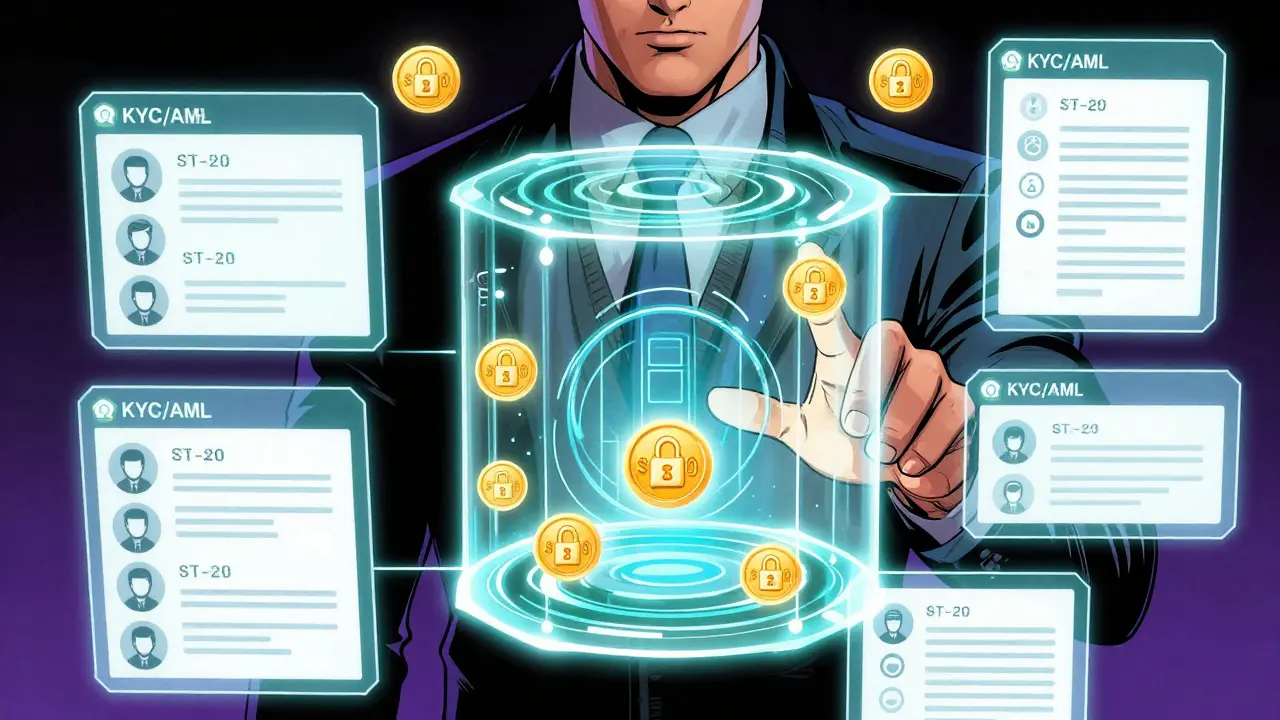
The magic happens through smart contracts. These are self-executing programs on the Ethereum blockchain. In a normal ERC-20 token transfer, if I send you coins, the network doesn’t care who you are. With Polymath, the system checks your identity before allowing the transfer. If you aren’t an accredited investor in the allowed jurisdiction, the transaction fails. This prevents illegal sales automatically.
The platform involves three main groups:
- Issuers: Companies creating the security tokens (e.g., a real estate firm).
- KYC/AML Providers: Third-party services that verify investor identities and check for money laundering risks.
- Legal Delegates: Entities that define the legal rules for the token, such as which countries can participate.
POLY acts as the fuel that keeps this machine running. It is used to pay fees for issuing tokens, managing compliance, and handling corporate actions like dividend payments.
The ST-20 Standard: Compliance Built-In
Ethereum has the ERC-20 standard for generic tokens. It is simple and flexible. But it lacks controls. To solve this, Polymath developed the ST-20 standard, a specialized token standard for security tokens that embeds regulatory requirements directly into the token's logic.
Think of ST-20 as a smart upgrade to ERC-20. When a company issues an ST-20 token, they attach conditions to it. For example, "Only investors verified by Provider X in Country Y can hold this token." The smart contract enforces this rule every time someone tries to move the token.
This reduces the burden on issuers. They don’t need to manually track every investor’s status. The blockchain does it for them. This makes ST-20 attractive for institutional players who deal with strict reporting requirements.
| Feature | ERC-20 (Standard) | ST-20 (Security) |
|---|---|---|
| Identity Check | No | Yes (KYC/AML required) |
| Transfer Restrictions | None (Anyone can send/receive) | Enforced by Smart Contract |
| Use Case | Meme coins, Utility tokens, Stablecoins | Stocks, Bonds, Real Estate Shares |
| Regulatory Compliance | Manual (Off-chain) | Automated (On-chain) |
What Is the POLY Token Used For?
POLY is an ERC-20 utility token on the Ethereum blockchain. It doesn’t represent ownership in the Polymath company. Instead, it is a tool used within the ecosystem. Here is how it functions:
- Paying Fees: Issuers spend POLY to create new security tokens. They also use it to pay for ongoing management tasks.
- Compensating Service Providers: KYC/AML verification companies receive POLY as payment for checking investor identities.
- Corporate Actions: When a security token pays dividends or undergoes liquidation, POLY may be used to facilitate these processes on the platform.
Because POLY is required for these essential services, its value is tied to the usage of the Polymath platform. If more companies issue security tokens using Polymath, demand for POLY should theoretically increase.
Market Data and Price Volatility
Crypto prices change fast, and POLY is no exception. As of mid-2026, data across exchanges shows significant variation. This is common for mid-cap tokens with lower liquidity.
Some platforms list POLY trading around $0.02 to $0.06 USD. Others might show higher snapshots depending on recent volume spikes. You will often see discrepancies in circulating supply numbers too. Some sources report over 900 million tokens in circulation, while others show less than 110 million. This confusion often stems from how different exchanges count locked tokens, migrated tokens, or those held in cold storage.
Always check multiple sources before making a decision. Look at the 24-hour trading volume to gauge liquidity. Low volume means large buy or sell orders can drastically swing the price. Keep an eye on major aggregators like CoinMarketCap or CoinGecko for the most aggregated view.

Polymath vs. Polymesh: What’s the Difference?
If you research Polymath, you will eventually hear about Polymesh, a separate, purpose-built blockchain for institutional digital assets. This causes a lot of confusion. Are they the same thing?
Not exactly. Polymeth started as a protocol on Ethereum. As the security token industry grew, the founders realized that Ethereum’s general-purpose nature had limitations for high-frequency, compliant trading. So, they launched Polymesh as a dedicated Layer-1 blockchain optimized for securities.
Polymesh has its own native token, POLYX. There was a migration path from POLY to POLYX in earlier stages. Today, POLY remains active on Ethereum, serving the legacy user base and specific ST-20 use cases. However, much of the institutional development focus has shifted toward the Polymesh network. Understanding this distinction is crucial for investors evaluating the long-term roadmap.
Is Polymath a Good Investment?
Investing in POLY is different from buying Bitcoin or Solana. You aren’t betting on a global currency or a high-speed gaming chain. You are betting on the adoption of regulated asset tokenization.
Bull Case: Governments worldwide are exploring Digital Asset frameworks. If banks and hedge funds start moving trillions of dollars into tokenized bonds and equities, platforms like Polymath could become essential infrastructure. If ST-20 becomes the industry standard, POLY usage will rise.
Bear Case: Adoption has been slower than predicted in 2017. Traditional finance moves slowly. Competitors like Securitize or newer chains like Polymesh may capture more market share. Additionally, if regulatory clarity disappears or becomes overly restrictive, the entire STO sector could stall.
Price predictions vary wildly. Some analysts suggest multi-dollar targets over five years based on massive adoption scenarios. Others point to the current low market cap as a sign of limited interest. Always do your own due diligence. Never invest money you cannot afford to lose.
How to Buy and Store POLY
Buying POLY is straightforward since it lives on Ethereum. You can purchase it on major centralized exchanges that support ERC-20 tokens. Alternatively, you can use decentralized wallets like MetaMask.
Here is a quick guide to buying via MetaMask:
- Open your MetaMask wallet.
- Click the "Buy" button.
- Select "POLY" from the search bar. Ensure it says "POLY on Ethereum Network" to avoid scams on other chains.
- Enter the amount in USD or ETH you wish to spend.
- Choose a payment method (Credit Card, Bank Transfer, etc.).
- Review the quote from the provider and confirm the transaction.
Once bought, store your POLY securely. Hardware wallets like Ledger or Trezor offer the best protection against hacks. Since POLY is an ERC-20 token, any wallet that supports Ethereum will work.
What is the main difference between POLY and regular crypto coins?
Unlike typical cryptocurrencies that aim for anonymity and free transferability, POLY is a utility token for a platform focused on compliance. It facilitates the creation of security tokens that must follow strict legal rules regarding who can own and trade them.
Is Polymath still active in 2026?
Yes, the Polymath platform continues to operate on Ethereum, supporting the ST-20 standard. However, significant development resources have also moved to the separate Polymesh blockchain, which is designed specifically for institutional securities.
Can I stake POLY to earn rewards?
POLY itself is an ERC-20 token on Ethereum, so it doesn't have native staking like Proof-of-Stake blockchains. However, some exchanges or third-party platforms may offer staking-like products or yield farming opportunities involving POLY. Always verify the legitimacy of such offers.
What is the ST-20 token standard?
ST-20 is a technical standard created by Polymath for issuing security tokens on Ethereum. It extends the basic ERC-20 functionality by adding built-in compliance checks, ensuring that only verified investors can hold or transfer the tokens.
Why do price quotes for POLY vary so much between exchanges?
POLY has relatively lower trading volume compared to top-tier cryptos. This means small trades can cause larger price swings. Additionally, differences in data feeds, latency, and how exchanges calculate circulating supply can lead to temporary discrepancies in listed prices.
 Cryptocurrency Guides