
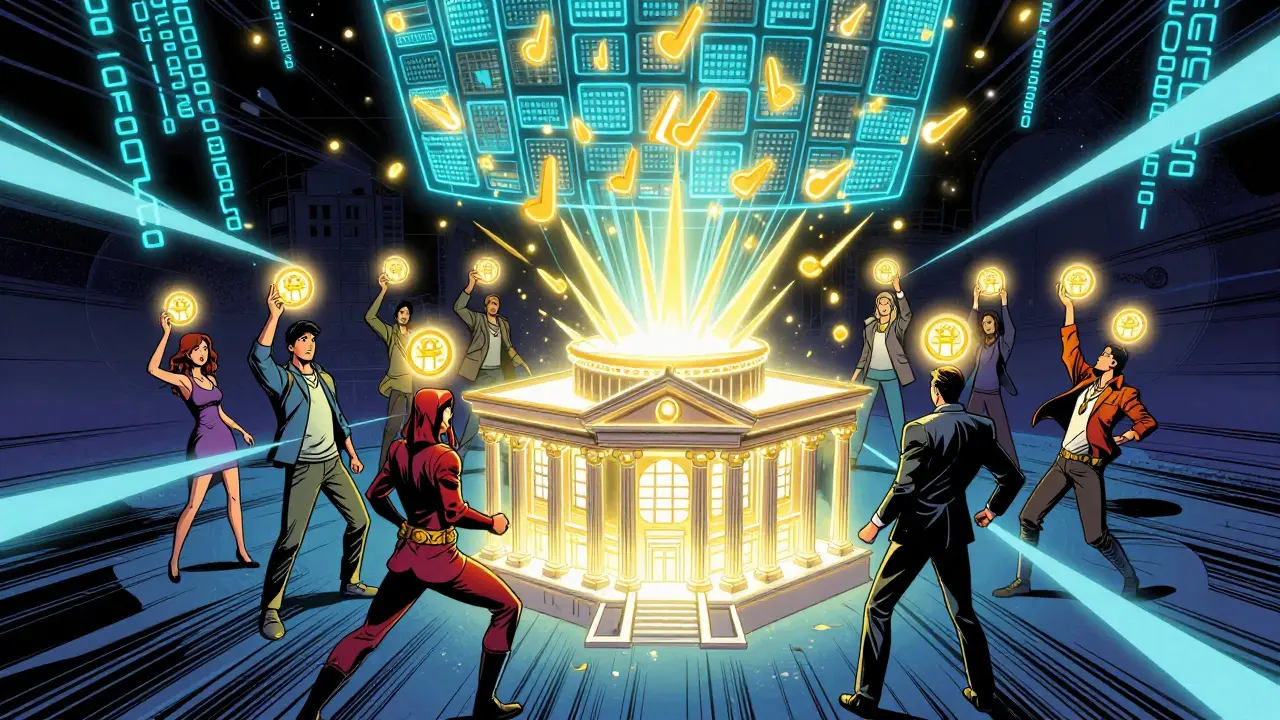
Imagine a company with no CEO, no managers, and no office. No one owns it. No one hires anyone. Yet it runs smoothly, makes decisions, spends millions, and even funds new projects - all because a group of strangers on the internet voted on it. That’s a DAO. And how it works? It’s not magic. It’s code, tokens, and votes.
What Is DAO Governance?
A DAO, or Decentralized Autonomous Organization, is an online group that runs on blockchain rules. It doesn’t have a board of directors. It doesn’t have a headquarters. Instead, it has a set of smart contracts - self-executing programs on a blockchain - that do exactly what the community agrees on. DAO governance is the system that lets members vote on changes, from spending money to updating rules.
Think of it like a digital town hall where every member gets a vote. But instead of raising your hand, you use your governance tokens - digital assets that give you voting power. The more tokens you hold, the more weight your vote carries. That’s the core idea: ownership equals influence.
DAOs aren’t just for crypto projects. They’re used to manage treasuries, fund open-source software, run social clubs, and even buy rare NFTs. The common thread? No central authority. Everything is decided by the group.
The Four Pillars of DAO Governance
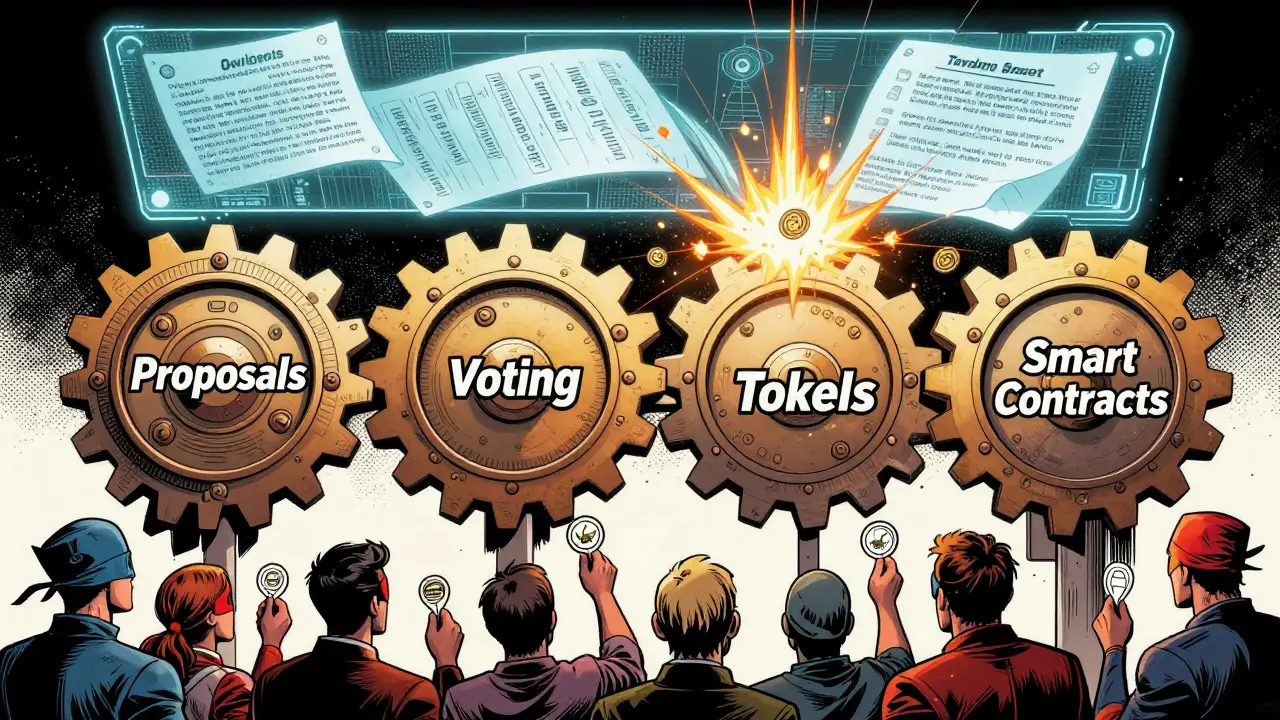
Every DAO runs on four key parts. Miss one, and the whole system breaks.
- Proposals - These are the ideas. Anyone can submit one: "Let’s spend $50,000 on a new marketing campaign," or "Change the voting threshold from 50% to 60%." Proposals are written in plain language and posted on forums or Discord channels.
- Voting Mechanisms - How do people vote? Most DAOs use token-weighted voting. But not all are the same. Some require a minimum number of voters. Others let people "rage quit" if they disagree. The method shapes who wins and who gets ignored.
- Governance Tokens - These aren’t like Bitcoin. They’re not meant to be traded for profit. They’re voting rights. Holding 100 DAO tokens means you have 100 votes. You can earn them by contributing code, staking funds, or participating in events. Some DAOs even give them away just for showing up.
- Smart Contracts - This is the magic. Once a proposal passes, the smart contract automatically carries it out. No human has to press "approve." No middleman. If the vote passes, money moves, rules update, or new features launch - all on-chain, instantly, and permanently.
These four pieces work together like gears. Proposals start the process. Tokens give people a voice. Voting decides the outcome. Smart contracts make it real.
How a Proposal Moves Through a DAO
Here’s what actually happens when someone wants to change something in a DAO:
- Submit - A member writes a proposal. It’s posted on a governance platform like Snapshot or Tally. It includes the what, why, and how much it costs.
- Discuss - The community talks. Threads pop up on Discord, forums, or Twitter. People ask: "Is this safe?" "Who benefits?" "What if it fails?" This stage can last days or weeks.
- Vote - During a set voting period (usually 3-7 days), token holders cast their votes. Each token = one vote. Some DAOs require a quorum - like 10% of all tokens must vote - or the proposal dies.
- Execute - If it passes, the smart contract triggers automatically. The treasury sends funds. The code updates. The change goes live. No one can stop it.
This is the big difference from traditional companies. In a normal org, a CEO says "do it," then a team executes. In a DAO, the members say "do it," and the code does it - no exceptions.
Types of Voting Systems in DAOs
Not all DAOs vote the same way. Here are two common models - and why they matter.
Permissioned Relative Majority
This is the simplest: whoever votes wins. If 51% vote "yes," the proposal passes. No minimum turnout needed. Sounds fair? Not always.
Imagine a DAO with 1 million tokens. One person holds 500,000. They vote "yes." That’s 50% - just one vote away from passing. No one else votes. The proposal passes. That’s not democracy. That’s a solo takeover.
That’s why many DAOs now use sponsorship or quorum requirements to stop this. A proposal might need 5 members to back it before voting opens. Or, at least 20% of all tokens must vote.
Rage Quit Voting
This one’s clever. It’s used by DAOs like Moloch. Here’s how it works:
- A proposal is submitted and sponsored.
- Voting opens. Members vote "yes" or "no."
- If it passes, there’s a grace period - say, 48 hours.
- During that time, anyone who voted "yes" can change their mind. They can "rage quit" - meaning they withdraw their tokens and leave the DAO.
- If too many leave, the proposal fails.
Why? It protects minorities. If a big holder pushes a risky move, others can leave before it locks in. It’s a safety valve. But it’s slow. Not great for urgent fixes.
Real DAOs, Real Examples
DAOs aren’t theoretical. They’re running right now.
- Ethereum Name Service (ENS) DAO - Manages .eth domains. It votes on protocol upgrades, fee changes, and treasury use. Over $100 million in funds are managed by its members.
- Friends With Benefits (FWB) DAO - A social club. To join, you need tokens. Members vote on events, art purchases, and community rules. It’s like a private club, but run by code.
- JuiceboxDAO - Built for crowdfunding. It lets groups raise money and vote on how to spend it. Artists, developers, and activists use it to fund projects without banks.
- ConstitutionDAO - Raised $47 million in 72 hours to bid on a rare U.S. Constitution copy. It didn’t win - but showed how fast DAOs can mobilize.
These aren’t just crypto experiments. They’re real organizations with real money, real people, and real impact.
The Big Problems With DAO Governance
DAOs promise democracy. But reality is messier.
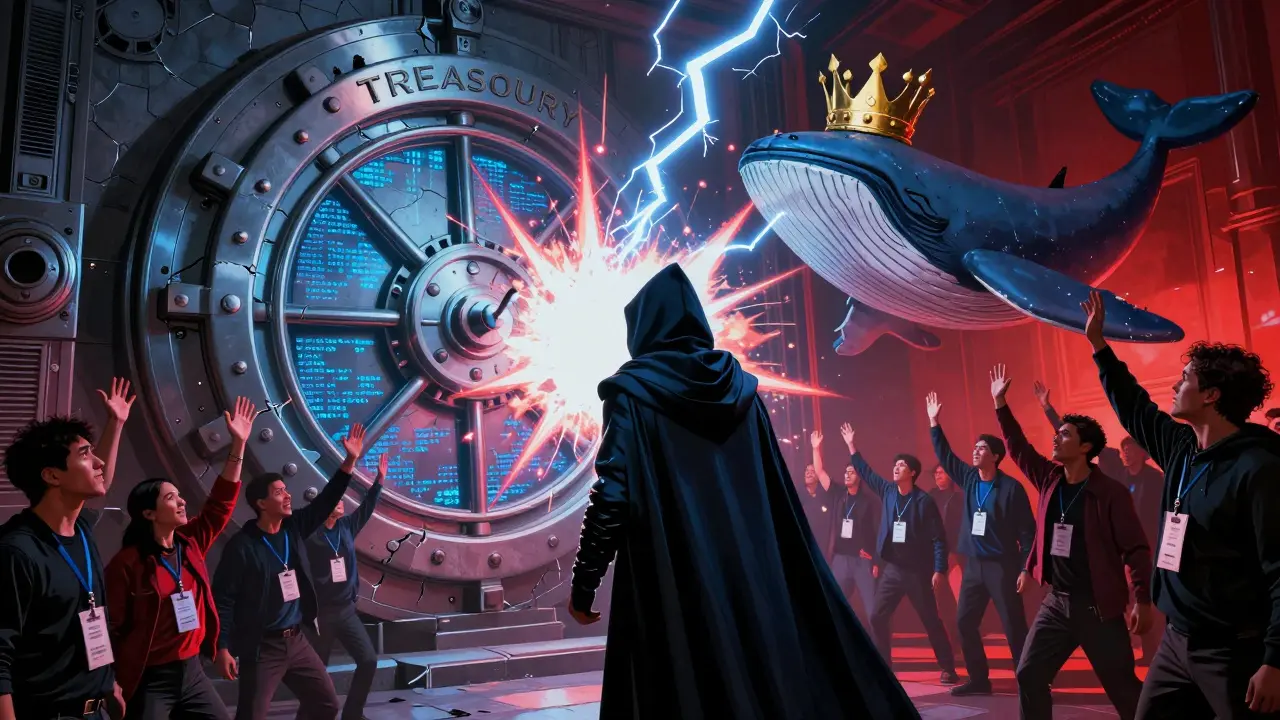
Whale Dominance
One wallet holding 10% of all tokens can sway votes. That’s not decentralization - that’s plutocracy. Some DAOs try to fix this with quadratic voting (each extra token costs more voting power) or by capping individual votes. But there’s no perfect fix yet.
Low Participation
Most DAOs have voting turnout under 5%. Why? Most token holders don’t care. Or they don’t understand. Or they’re waiting to sell. That means a tiny group - maybe 20 people - controls everything. That’s not a community. It’s a cabal.
Slow and Clunky
Waiting 7 days for a vote? Not great if you need to fix a security flaw. DAOs are trying to improve with off-chain voting (Snapshot) and faster on-chain tools. But speed and security still fight each other.
No Legal Shield
If a DAO loses money because of a bad vote, who’s liable? No one. That’s why some DAOs are registering as legal entities - like LLCs in Wyoming - just to protect members.
Why DAO Governance Matters
DAOs are the first real test of digital self-governance. They prove that groups of strangers can manage money, build software, and make decisions without bosses.
For developers, it means building tools that are truly owned by users. For investors, it means your money doesn’t just sit in a fund - it helps shape what happens next. For everyday people, it means having a voice in projects you care about - not just consuming them.
It’s not perfect. But it’s working. And it’s growing. DAOs are managing over $10 billion in assets worldwide. And as more people join, the systems will get smarter - faster, fairer, and more resilient.
What’s Next for DAO Governance?
The future isn’t about more tokens. It’s about better incentives.
- Reputation-based voting - Not just how many tokens you have, but how much you’ve contributed.
- Delegated voting - Let experts vote on your behalf if you’re busy.
- On-chain identity - Stop sybil attacks by proving one person = one vote.
- Hybrid systems - Combine on-chain votes with off-chain discussions to balance speed and depth.
DAO governance is still young. But it’s the closest thing we have to a truly democratic digital society. And it’s not coming tomorrow. It’s here.
What is the main purpose of governance tokens in a DAO?
Governance tokens give holders the right to vote on proposals that affect the DAO’s direction - like spending treasury funds, updating rules, or launching new features. They’re not meant for trading profit; they’re voting power. The more tokens you hold, the more influence you have.
Can a DAO change its own rules?
Yes - but only if the smart contracts allow it. Most DAOs have a built-in upgrade path where members vote to change the rules. Once approved, the new rules are automatically written into the code. But if the original code doesn’t allow changes, then no one - not even the founders - can alter it.
Do you need to own tokens to participate in a DAO?
You can join discussions and contribute without owning tokens - many DAOs welcome developers, writers, and designers. But to vote on proposals, you need governance tokens. No tokens, no vote. That’s how ownership is tied to decision-making.
What happens if a DAO vote fails?
If a proposal doesn’t get enough votes, it’s rejected and usually can’t be resubmitted for a set time - often 30 to 90 days. This prevents spam and repeated attempts. Some DAOs allow modified versions to be resubmitted after feedback.
Are DAOs legal?
Legally, it’s complicated. Most DAOs operate without formal registration, which creates risk. Some, like ConstitutionDAO, have created legal entities (like LLCs) to protect members. In places like Wyoming and Switzerland, DAOs can now register as legal organizations. But in most countries, they still exist in a gray zone.
 Cryptocurrency Guides
Konakuze Christopher
March 18, 2026 AT 17:09S F
March 19, 2026 AT 12:44Angelica Stovall
March 19, 2026 AT 23:21Prakash Patel
March 21, 2026 AT 13:30Elizabeth Kurtz
March 23, 2026 AT 02:09Ann Liu
March 23, 2026 AT 13:01Jerry Panson
March 24, 2026 AT 09:06Anastasia Danavath
March 24, 2026 AT 13:39anshika garg
March 25, 2026 AT 23:00Bruce Doucette
March 27, 2026 AT 08:35Marie Vernon
March 29, 2026 AT 04:29Billy Karna
March 30, 2026 AT 08:46Cheri Farnsworth
March 30, 2026 AT 17:54Gene Inoue
March 31, 2026 AT 03:04Arlene Miles
March 31, 2026 AT 10:43Jessica Beadle
April 2, 2026 AT 07:56Patty Atima
April 3, 2026 AT 18:19Lucy de Gruchy
April 4, 2026 AT 02:11Carol Lueneburg
April 5, 2026 AT 14:47Brenda White
April 5, 2026 AT 21:33