
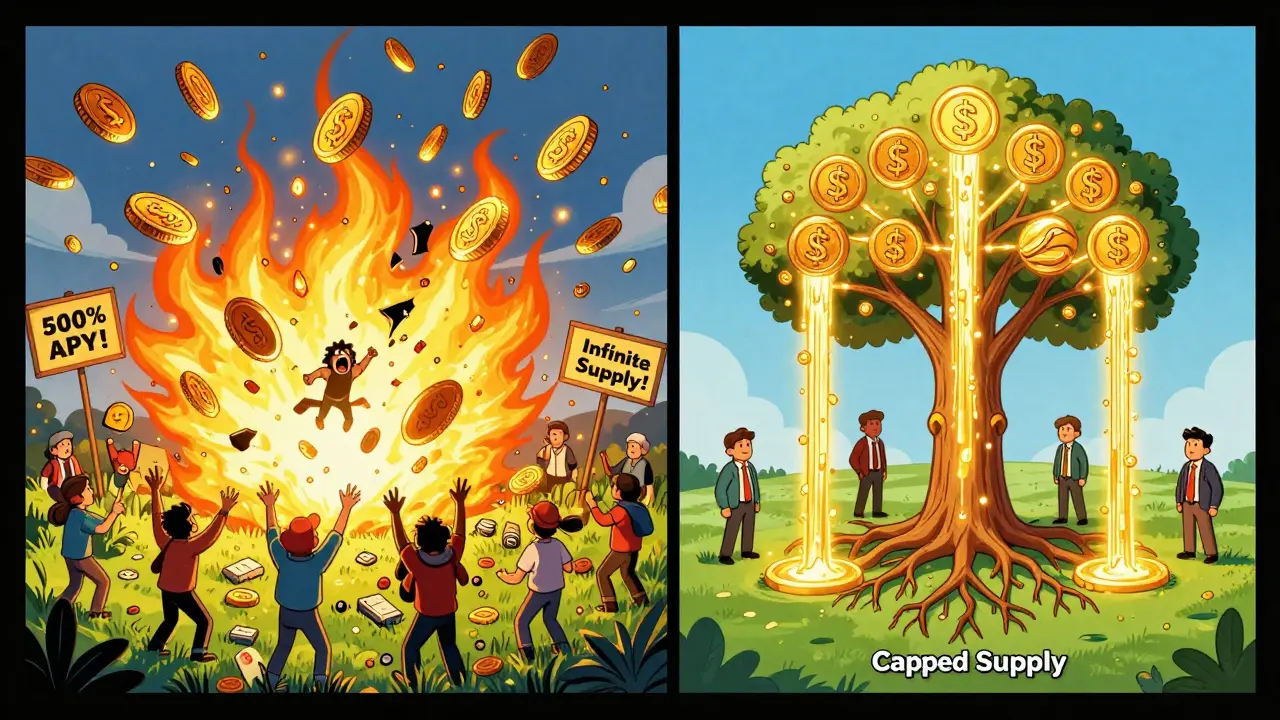
When you hear "yield farming," you probably think of high APYs, instant rewards, and the thrill of watching your crypto balance grow overnight. But here’s the quiet truth most guides won’t tell you: sustainable yield farming isn’t about the biggest number on your screen-it’s about what lasts. And right now, the DeFi space is full of farms that look amazing on paper but collapse faster than a house of cards in a hurricane.
Unsustainable yield farming is the digital equivalent of clear-cutting a rainforest for a single season’s timber harvest. You get a massive payout today, but tomorrow? The soil is dead, the ecosystem is broken, and there’s nothing left to harvest. Sustainable yield farming, on the other hand, is about nurturing the land-building protocols that reward users without burning through their own token economies. It’s not flashy. It doesn’t make headlines. But it’s the only way DeFi survives beyond 2026.
What Makes Yield Farming Unsustainable?
Unsustainable yield farming usually follows the same pattern: a new protocol launches, dumps massive token incentives to attract liquidity, and promises 50%, 100%, even 500% APY. Investors rush in. TVL spikes. The price of the native token surges as demand for farming rewards drives buying pressure. Then-boom-the incentives run out. Or worse, the token supply is infinite, and inflation crushes the value of every reward.
Take the 2021 DeFi summer. Do you remember Pickle Finance, SushiSwap’s early days, or the dozens of meme-token farms that vanished in weeks? Those weren’t failures of technology-they were failures of economics. They relied on continuous new money inflows to pay existing users. That’s a Ponzi structure dressed up as DeFi. No real revenue, no tokenomics that scale, just burning through liquidity pools until the last person gets stuck holding worthless tokens.
Here’s how to spot an unsustainable farm:
- APY above 100% with no clear revenue model
- Token emissions are increasing month over month
- Token supply has no cap or inflation control
- Most of the TVL comes from incentivized pairs, not organic demand
- The team is selling tokens early or has a large locked supply that’s about to unlock
These aren’t just red flags-they’re warning sirens. And they’re louder than ever in 2026, as new protocols try to copy the old playbook with AI-driven yield aggregators and cross-chain rewards. The pattern hasn’t changed. Only the packaging has.
What Defines Sustainable Yield Farming?
Sustainable yield farming doesn’t promise the moon. It doesn’t need to. It works because it’s built on real value-not hype.
Think of it like a healthy forest. Trees grow slowly. The soil regenerates. The ecosystem supports itself. That’s what sustainable yield farming looks like: protocols that earn fees from real usage, not just token giveaways.
Take Curve Finance. It doesn’t offer 200% APY. Its yields are modest-often under 10%. But it’s been around since 2020. Why? Because it earns real trading fees from billions in daily swaps between stablecoins. Those fees fund its CRV rewards. Users aren’t being paid in newly minted tokens-they’re being paid from actual protocol revenue.
Another example: Aave. Its lending pools generate interest from borrowers. That interest is distributed to liquidity providers. There’s no need to inflate the AAVE token supply to pay users. The system is self-sustaining because it’s tied to real economic activity.
Here’s what makes a yield farm sustainable:
- Revenue from fees, not token emissions
- Token supply is capped or has controlled inflation
- APY is stable, not artificially inflated
- Tokenomics are transparent and audited
- Protocol has a long-term treasury or governance fund to weather downturns
The difference? One system runs on real demand. The other runs on speculation.
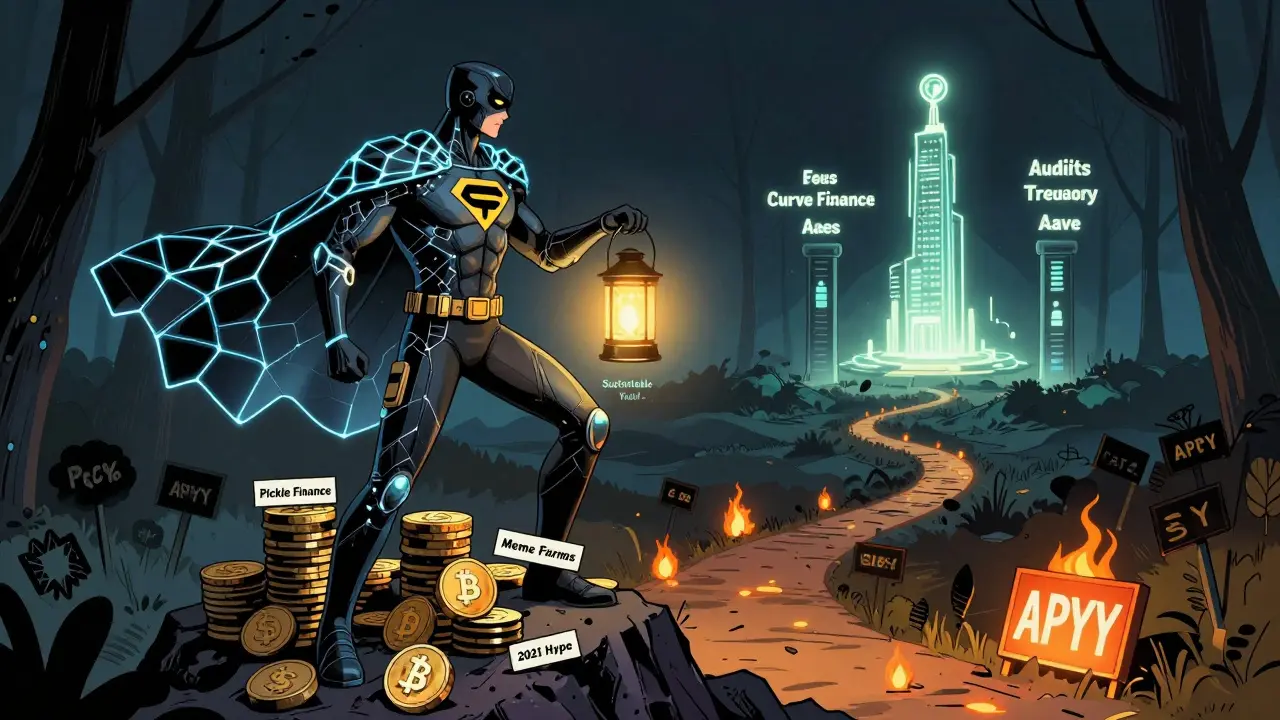
The Hidden Cost of High APYs
People think they’re making money when they farm a 300% APY token. But they’re often losing more than they gain.
Here’s a real example from 2025: A new Ethereum L2 launched a farm with 450% APY. Within two weeks, $180 million flowed in. The token price doubled. Users were ecstatic. Then, the emissions schedule ended. The token price crashed 82% in 72 hours. Those who held through the crash lost over 60% of their total investment-even after collecting rewards.
Why? Because the rewards were paid in the same token that collapsed. You didn’t earn $10,000 in value-you earned $10,000 in a token that became worth $1,800.
This is called "impermanent loss on steroids." You’re not just losing value because the price dropped. You’re losing value because the entire incentive structure was built on a bubble.
Meanwhile, users in sustainable farms like Yearn Finance or Balancer saw their rewards drop from 15% to 8% after a market correction. But their token prices held steady. Their positions didn’t collapse. They didn’t need to chase the next hype farm. They stayed in because the system kept working.
How to Build or Choose a Sustainable Farm
So how do you find-or even help build-a farm that lasts?
Start by asking three questions:
- Where does the yield come from? Is it from protocol fees, trading volume, or just new token issuance?
- What’s the emission schedule? Is the token supply being inflated at a decreasing rate? Or is it exploding?
- Who’s backing the protocol? Is there a treasury? Are there audits? Is the team vested long-term?
Look at the tokenomics sheet-not the marketing page. If the project doesn’t publish a clear emission curve, walk away. If the APY changes every week, it’s not a farm-it’s a casino.
Also, check the ratio of TVL to revenue. A farm with $100 million in TVL but only $500,000 in monthly fees is unsustainable. A farm with $20 million in TVL and $1.2 million in monthly fees? That’s a real business.
And don’t ignore governance. If users can vote to reduce emissions or adjust rewards, the system has a self-correcting mechanism. That’s a sign of maturity.
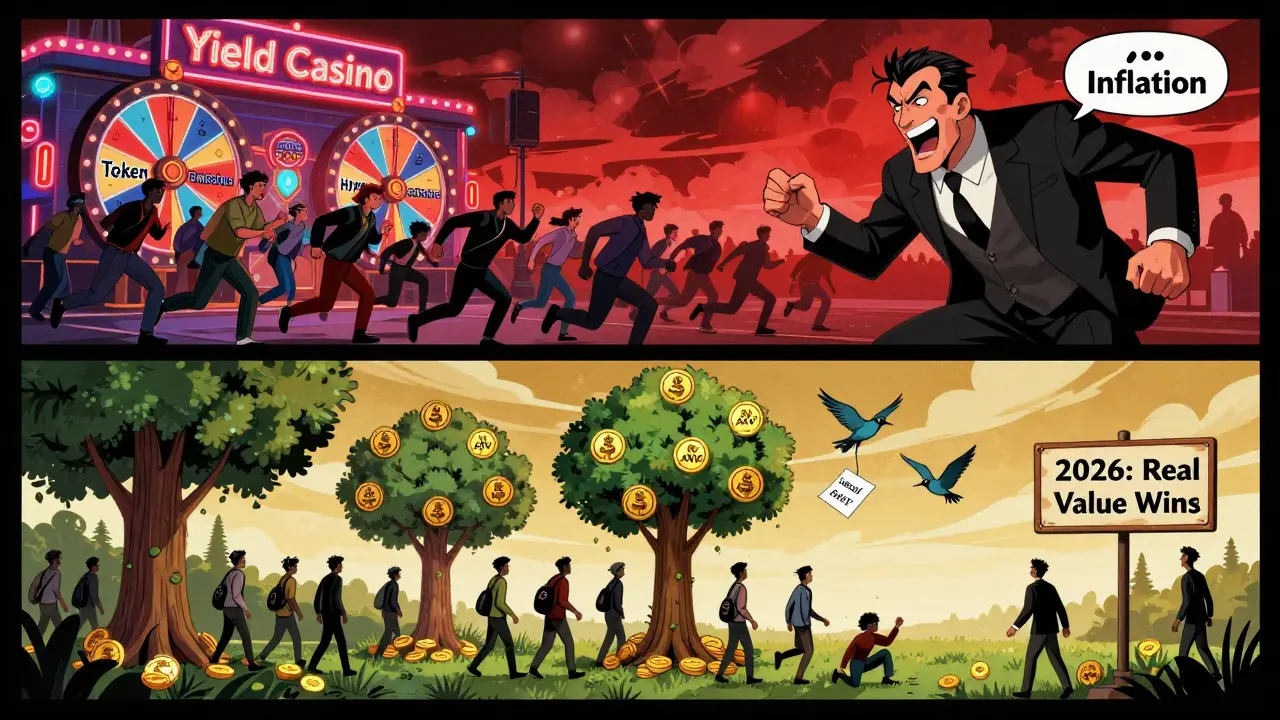
What’s Changing in 2026?
The market is waking up. In 2026, investors aren’t chasing the highest APY-they’re looking for the most resilient.
Protocols are starting to shift. Instead of dumping tokens, they’re building revenue streams: subscription-based lending, on-chain insurance, decentralized derivatives, and even tokenized real-world assets. Yield is no longer just a marketing tool-it’s becoming a measurable output of real utility.
Regulators are also paying attention. In the EU and parts of the U.S., new rules require DeFi projects to disclose token emission schedules and revenue sources. That’s forcing transparency. Projects that were hiding behind “community incentives” now have to prove they’re not just printing money.
And users? They’re learning. The days of hopping from farm to farm are fading. People are holding longer. They’re choosing quality over quantity. And that’s the biggest shift of all.
Final Thought: It’s Not About Yield. It’s About Value.
Yield farming isn’t broken. It’s just been hijacked by short-term greed. The real winners in DeFi won’t be the ones who cashed out during the 2025 hype cycle. They’ll be the ones who stayed in the quiet farms-the ones that didn’t scream for attention but kept delivering, year after year.
Sustainable yield farming doesn’t make you rich overnight. But it keeps you rich long-term. And in a space where 90% of protocols die within a year, that’s the only edge that matters.
 Cryptocurrency Guides
Jennah Grant
January 7, 2026 AT 01:02Let’s be real-most DeFi projects are just token vending machines with a whitepaper. The ones that last? They don’t need to scream. They just keep collecting fees like a quiet utility company. APY isn’t the metric. Revenue per TVL is. And nobody talks about that.
Dave Lite
January 7, 2026 AT 02:50Bro I literally just pulled out of a 700% APY farm last week after seeing their token emissions triple in 30 days. I thought I was winning until my rewards were worth less than my gas fees. Now I’m only in Curve, Aave, and Yearn. No drama. No panic dumps. Just steady drip. 🤝
Tracey Grammer-Porter
January 8, 2026 AT 17:32So many people think yield farming is a get rich quick scheme but honestly it’s more like gardening. You plant seeds, you water them, you wait. Some plants die fast, others grow slow but last decades. If your farm feels like a slot machine, walk away. If it feels like a community project with real revenue? Stick around. You’ll thank yourself in 2027
jim carry
January 9, 2026 AT 16:37YOU’RE ALL WRONG. THIS ISN’T ABOUT SUSTAINABILITY. IT’S ABOUT SPEED. THE MARKET IS A WAR ZONE. IF YOU’RE NOT HARVESTING 500% APY BEFORE THE BUBBLE BURSTS, YOU’RE ALREADY LOSING. THE ‘SAFE’ FARMS ARE JUST FOR COWARDS WHO DON’T WANT TO BE RICH.
Don Grissett
January 10, 2026 AT 19:49frankly i dont care if its sustainable if the token pumps 10x in a week. i cash out and move on. the rest of you are just overthinking this like it’s a college econ class. its crypto. its chaos. embrace it.
Katrina Recto
January 12, 2026 AT 11:44That Jim Carry comment is exactly why DeFi is broken. People think risk is a feature not a bug. The real edge isn’t chasing yield-it’s avoiding ruin. And most don’t even know how to measure ruin.
Jordan Leon
January 12, 2026 AT 22:37There’s a philosophical layer here that rarely gets discussed. Yield farming, in its current form, mirrors our broader economic obsession with extraction over regeneration. We optimize for short-term gain because we’ve lost faith in long-term systems. The sustainable farms aren’t just economically sound-they’re ethically coherent. And that’s worth more than any APY.
Allen Dometita
January 14, 2026 AT 18:21bro just look at the tokenomics sheet like a cheat code. if it says ‘infinite supply’ or ‘emissions go up every week’-close tab. no cap = no future. simple. 🚫📈
Brittany Slick
January 16, 2026 AT 01:41I used to chase fireworks. Now I just want the candle that stays lit. Quiet farms feel like home. No hype. No panic. Just consistent warmth. That’s the kind of crypto I believe in.
greg greg
January 16, 2026 AT 04:30It’s interesting how the entire narrative around yield farming has shifted from speculative gambling to something resembling real financial infrastructure, but what’s rarely acknowledged is that even the so-called sustainable protocols still rely on speculative capital to bootstrap liquidity-so the paradox remains: you need unsustainable behavior to enable sustainable outcomes, which means the entire system is structurally contradictory unless you assume perfect rational actors-which we know is absurd in crypto markets where FOMO and fear are the dominant drivers.
Denise Paiva
January 17, 2026 AT 09:03Actually the whole sustainable argument is a marketing ploy by old-school finance bros who can’t handle volatility. The real innovation is in the chaos. The farms that die fast? They’re the ones clearing out the weak hands. The survivors? They’re the ones who rode the collapse. Sustainability is just the story you tell after you won.
Sabbra Ziro
January 19, 2026 AT 04:44Love this post. Seriously. It’s like someone finally said what we’ve all been whispering in the Discord channels. The farms that last? They don’t need to be loud. They just need to be honest. And that’s rare. Thank you for writing this.
Emily Hipps
January 20, 2026 AT 10:44Y’all need to stop thinking of yield as income and start thinking of it as participation. The real reward isn’t the token-it’s being part of a system that works. That’s why I’m still in Balancer after 3 years. Not because I made bank-but because I still believe in it.
Jessie X
January 20, 2026 AT 21:21APY is dead long live APR
Kip Metcalf
January 22, 2026 AT 16:19My first farm crashed and I lost everything. My second farm paid me in stablecoins and I stayed. Lesson learned. Don’t chase the hype. Chase the cash flow.
Frank Heili
January 22, 2026 AT 17:35Here’s a pro tip: check the token’s circulating supply vs. total supply. If more than 20% is locked for unlocking in the next 90 days and the APY is above 40%, you’re not farming-you’re playing Russian roulette with your portfolio. I’ve seen this movie before. It ends with a 90% dump and a ‘community vote’ to ‘rebase’ your losses.
Jon Martín
January 23, 2026 AT 07:22Y’all are missing the point. The real innovation isn’t in the yield-it’s in the governance. When users can vote to reduce emissions before the collapse? That’s not DeFi. That’s democracy. And that’s what’s going to save this space. Not APY. Not tokenomics. Just people having a say.
Danyelle Ostrye
January 24, 2026 AT 09:35Just because a farm is sustainable doesn’t mean it’s not a scam. Some of these ‘quiet’ projects are just slower burn rug pulls. Do your own research. Always. Even the boring ones.