

Portugal used to be the go-to place for crypto investors who wanted to avoid taxes. No capital gains tax on Bitcoin, Ethereum, or any other cryptocurrency - as long as you held it and didn’t trade frequently. That changed in 2023. Now, if you sell crypto you’ve held for less than a year, you pay 28% in taxes. It’s not a huge surprise - the EU was pushing for clearer rules, and Portugal needed to keep up. But for many, it felt like the rug was pulled out. So what does this actually mean for you if you live in Portugal or are thinking about moving there?
What Counts as Short-Term Crypto in Portugal?
The rule is simple: if you sell or trade cryptocurrency you’ve owned for 365 days or less, you owe 28% on the profit. That’s it. No deductions, no complex calculations - just the gain multiplied by 0.28. The clock starts the day you buy or receive the crypto, whether it’s from an exchange, airdrop, or mining reward. The day you sell, swap, or cash out is when the clock stops.
Here’s a real example: You bought 0.5 BTC for €15,000 in March 2025. In January 2026, you sell it for €22,000. Your profit? €7,000. Since you held it for less than a year, you owe 28% of €7,000 - that’s €1,960. If you’d waited until March 2026 to sell, you’d owe nothing.
This rule applies to all crypto-to-fiat sales, crypto-to-crypto trades, and even using crypto to buy goods or services. If you trade your ETH for SOL and the value went up since you bought ETH, that’s a taxable event. Many people don’t realize this - they think only cashing out to euros counts. It doesn’t.
Long-Term Holds Are Still Tax-Free
This is the big exception that keeps Portugal competitive. If you hold your crypto for 366 days or more, any profit is completely tax-free. No questions asked. No forms to fill out. No reporting needed. This is still one of the best deals in Europe.
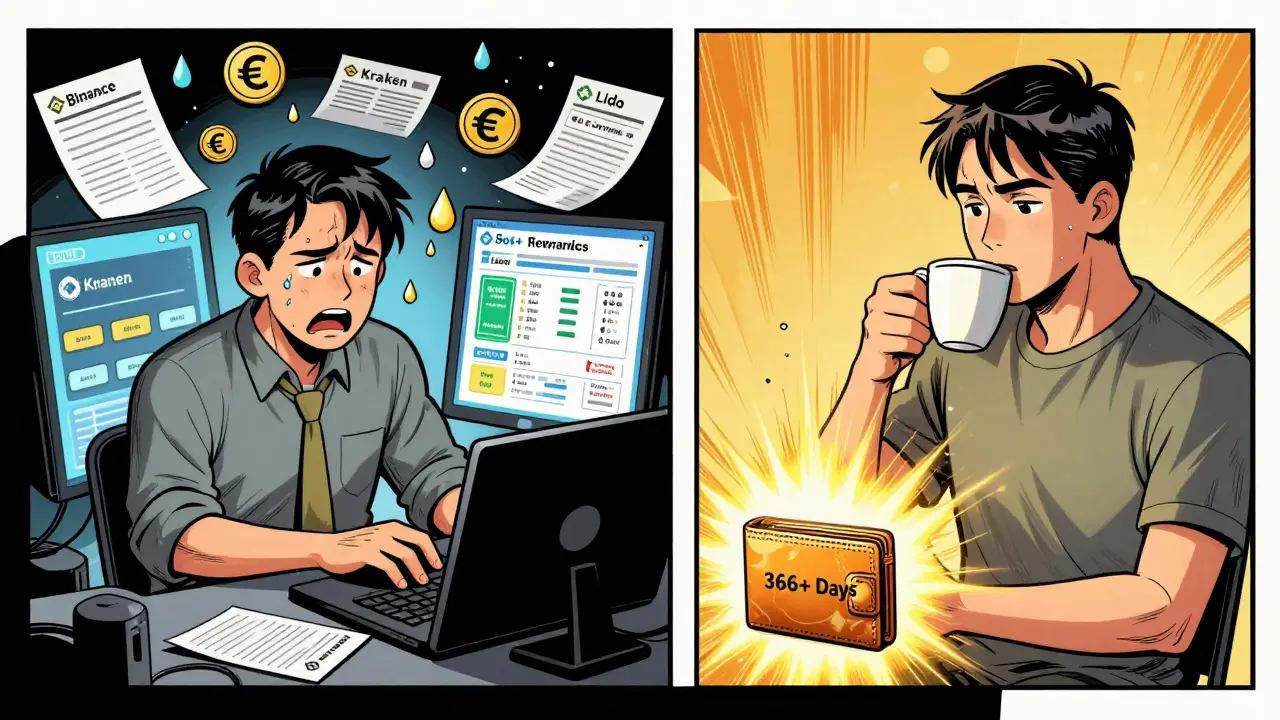
That’s why so many investors in Portugal have shifted to a buy-and-hold strategy. Instead of trading weekly or monthly, they’re waiting. They’re setting reminders. They’re using tools to track holding periods across wallets and exchanges. Some even split their portfolios - one wallet for short-term trades (and the 28% tax), another for long-term holds that will never be touched until the year mark hits.
It’s not just about saving money. It’s about behavior. The tax law is designed to discourage speculation and reward patience. And it’s working. Trading volume on Portuguese exchanges dropped 22% in the first year after the rule came in, according to local blockchain analytics firms. Meanwhile, the number of wallets holding crypto for over a year rose by 41%.
Staking, Lending, and Passive Income Are Also Taxed
It’s not just buying and selling. If you earn crypto from staking, lending, or yield farming, that’s income - and it’s taxed at 28%. Whether you’re earning ETH from staking on Lido, interest from Celsius (before it collapsed), or rewards from Curve Finance, the Portuguese tax office treats it the same way: as ordinary income.
You need to track every reward. Not just the amount, but the euro value at the exact moment you received it. That becomes your cost basis. If you later sell those rewards, you’ll calculate profit based on that value. For example: You earn 0.02 ETH in staking rewards in June 2025 when ETH is €3,000. That’s €60 of taxable income. You hold it. In January 2026, ETH is €3,500. You sell the 0.02 ETH. You made €70. Your profit is €10. You pay 28% on €10 - that’s €2.80.
It’s messy. And it’s easy to miss. That’s why most people use crypto tax software like Koinly or CoinLedger to auto-import transactions from exchanges and wallets. Manual tracking across 5+ wallets and 20+ transactions a month? That’s a nightmare.
Professional Traders Pay More - And Get Taxed Differently
Not everyone gets the 28% flat rate. If you’re a professional trader - meaning you trade full-time, use advanced strategies, have high volume, and rely on crypto for your main income - you’re treated like a business. Your profits go into your annual income and are taxed under Portugal’s progressive rates, which go up to 48%.
So what makes you a professional? There’s no official checklist, but tax authorities look at:
- How often you trade (daily? weekly?)
- Whether you use leverage, bots, or arbitrage tools
- If crypto is your primary source of income
- Whether you’ve registered as self-employed or a sole trader
Most casual traders won’t trigger this. But if you’re making €50,000+ a year from crypto trading and doing 100+ transactions a month, you’re probably on the radar. And if you’re caught underreporting, the penalties can be steep - up to 25% of the unpaid tax plus interest.
How to Report It: Anexo G, Anexo E, and the Portal das Finanças
You don’t pay crypto tax at the time of sale. You report it when you file your annual income tax return - Modelo 3 - through the Portal das Finanças. The key forms are:
- Anexo G - for capital gains. This is where you report short-term crypto sales (taxable at 28%) and long-term sales (exempt).
- Anexo E - for passive income. All staking, lending, and yield rewards go here, taxed at 28%.
- Anexo B - if you’re a professional trader. Your crypto profits are treated as business income and taxed at your marginal rate.
You need records for every transaction: date bought, date sold, amount, price in euros, and the exchange or wallet used. If you can’t prove your cost basis, the tax office can assume it’s zero - meaning you owe tax on the entire sale amount. That’s a disaster.
Most people export CSV files from Binance, Kraken, or Coinbase and upload them into crypto tax software. The software calculates gains, matches them to the right annex, and generates the PDFs you need to upload. Doing it by hand? Only if you love spreadsheets and stress.
How Portugal Compares to Other EU Countries
Portugal’s 28% short-term rate isn’t the highest in Europe - but it’s one of the smartest. Here’s how it stacks up:
| Country | Short-Term Tax Rate | Long-Term Exemption? | Staking Taxed? |
|---|---|---|---|
| Portugal | 28% | Yes (after 365 days) | Yes |
| Germany | Up to 45% | Yes (after 1 year, only for personal use) | Yes |
| France | 30% | No | Yes |
| Spain | 19-28% | No | Yes |
| United Kingdom | 10-20% (capital gains), up to 45% (income) | No | Yes |
Portugal stands out because of the long-term exemption. In France and Spain, you pay tax no matter how long you hold. In the UK, you pay capital gains tax even if you’ve held for 10 years. Germany is the only other country with a similar exemption - but only if the crypto was used for personal purchases, not trading. Portugal’s rule is cleaner and more accessible.
The NHR Program Is Gone - But It Still Matters
If you moved to Portugal before January 2024, you might have enrolled in the Non-Habitual Resident (NHR) program. That gave you a 10-year tax holiday on foreign-sourced income - including crypto gains from outside Portugal. If you’re still in NHR, you may still be exempt from the 28% tax on crypto sales, depending on your income source.
But if you moved after January 1, 2024, NHR is not an option. You’re under the standard rules. That’s a big deal. Before, digital nomads could live in Lisbon, trade crypto, and pay zero tax. Now? If you trade frequently, you pay 28%. If you hold long-term, you pay nothing. The incentive to be a passive investor is stronger than ever.
What Should You Do Now?
Here’s what works in 2026:
- Hold for 366+ days - if you’re not trading full-time, this is your best move. Avoid selling before the year mark.
- Track every transaction - use software. Don’t rely on exchange statements alone.
- Don’t mix personal and trading wallets - keep your long-term holdings separate from your active trades.
- Don’t assume airdrops or forks are free - they’re taxable income when you receive them.
- Don’t ignore staking rewards - they add up fast, and the tax adds up too.
If you’re a casual investor, Portugal is still one of the best places in Europe to hold crypto. The 28% tax only hurts if you’re trying to trade your way to riches. If you’re building wealth slowly, the system works in your favor.
If you’re a full-time trader? You’re in a tougher spot. The 28% rate is fair, but you’re now competing with countries that have lower rates or no holding period rules. You might need to consider relocating - or accepting that crypto trading is now a business, not a hobby.
What’s Next?
Portugal isn’t done changing. The EU’s MiCA regulation is rolling out, and more reporting will be required. Tax authorities are getting better at tracking crypto across wallets and DeFi protocols. Expect more audits in 2026 and 2027.
But one thing won’t change: the long-term exemption. That’s the heart of Portugal’s crypto policy. As long as that stays, the country will keep attracting investors who want to build wealth without paying a fortune in taxes. The 28% short-term tax isn’t a punishment - it’s a filter. It pushes out the gamblers and keeps the builders.
Is crypto still tax-free in Portugal?
Only if you hold it for more than 365 days. Any profit from selling or trading crypto held less than a year is taxed at 28%. Staking, lending, and other passive income are also taxed at 28%, regardless of holding period.
Do I pay tax if I swap one crypto for another in Portugal?
Yes. Swapping BTC for ETH, or ETH for SOL, counts as a disposal. You must calculate the euro value of what you sold and what you received. If the value increased since you bought the original crypto, that gain is taxable if held under 365 days.
What if I received crypto as a gift or from airdrop?
The value of the crypto at the time you received it becomes your cost basis. You don’t pay tax when you receive it, but you will owe tax when you sell it - based on the difference between that value and your sale price. If you sell within a year, it’s taxed at 28%.
Can I avoid the 28% tax by using a foreign exchange?
No. Portugal taxes its residents on worldwide crypto gains, no matter which exchange you use. Whether you trade on Binance, Kraken, or a decentralized exchange, if you’re a tax resident in Portugal, you must report and pay tax on gains from short-term trades.
What happens if I don’t report my crypto gains?
The Portuguese tax authority (Autoridade Tributária) can access transaction data from exchanges operating in the EU and has been increasing audits. If you’re caught underreporting, you’ll owe back taxes, interest, and penalties up to 25% of the unpaid amount. In serious cases, it can lead to criminal charges for tax evasion.
Is the 28% rate the same for everyone?
For most individuals, yes - it’s a flat 28% on short-term gains. But if you’re classified as a professional trader (based on frequency, volume, and income reliance), your gains are added to your total income and taxed at your marginal rate, which can go up to 48%.
 Cryptocurrency Guides
Meenakshi Singh
January 6, 2026 AT 06:2628% is brutal for short-term trades 😩 but honestly? I’m holding everything for a year now. No stress, no taxes. Just HODLing like a boss 🚀
Paul Johnson
January 7, 2026 AT 09:28Portugal used to be the crypto paradise now its just another tax trap 🤦♂️ why did they even bother changing it? Everyone knew the deal before
Kelley Ramsey
January 8, 2026 AT 23:41Wow, this is actually super clear! I’ve been so confused about when staking rewards count as income versus capital gains - this breaks it down perfectly. Thank you for writing this!! 🙌
Krista Hoefle
January 9, 2026 AT 14:43Long term exemption? More like a loophole for rich people who can afford to wait. Meanwhile, I’m trying to pay rent with crypto
Emily Hipps
January 9, 2026 AT 21:14You got this. Even with the new rules, Portugal is still one of the best places to build crypto wealth if you’re patient. You’re not behind - you’re just playing the long game. 💪
Katrina Recto
January 11, 2026 AT 06:54Track every transaction. Use Koinly. Don’t overthink it. Just do it. Your future self will thank you.
Veronica Mead
January 11, 2026 AT 21:23It is imperative to note that the Portuguese tax authority has explicitly stated that failure to report cryptocurrency transactions constitutes a material breach of fiscal obligation, which may result in administrative sanctions of considerable severity.
Surendra Chopde
January 12, 2026 AT 00:42Interesting how the 28% rate is flat but professional traders get hit with up to 48%. That’s a huge disincentive for serious traders. Maybe Portugal wants to be a crypto museum, not a crypto hub?
Valencia Adell
January 14, 2026 AT 00:34Of course they taxed staking. Of course they did. Why make anything easy? You think you’re smart for holding crypto? Nah. You’re just another sucker who didn’t read the fine print.
Sarbjit Nahl
January 15, 2026 AT 17:44The 28% tax is not a punishment it is a philosophical statement. It says: do not chase volatility. Do not worship the market. Be patient. Be still. The market will reward those who wait. This is not policy. This is Zen.
Dave Lite
January 15, 2026 AT 21:21For real - if you’re doing more than 10 trades a month, you’re probably a professional trader. That means Anexo B, not Anexo G. Most people don’t realize this and get audited. Use CoinLedger. Set up auto-sync. Save yourself the headache. Also, keep your wallets separate. One for HODL, one for trades. Simple.
jim carry
January 17, 2026 AT 01:33Portugal used to be the last free land. Now it’s just another EU bureaucracy with a beach. I sold my apartment in Lisbon and moved to Georgia. Zero tax. No forms. No stress. If you’re still in Portugal trying to ‘game the system’ - you’re already losing.
Don Grissett
January 18, 2026 AT 20:45They changed the rules? Wow. I thought this was a tax haven. Guess I should’ve read the news. Now I’m stuck with a 28% tax on every trade. Thanks, Portugal. You’re not special anymore.
Mollie Williams
January 20, 2026 AT 13:59There’s something poetic about a tax law that rewards patience. It’s not about money - it’s about discipline. The market doesn’t care how fast you move. It cares how deep you’re rooted. The 28% tax isn’t a burden. It’s a mirror.
Tiffani Frey
January 22, 2026 AT 00:34For anyone new to this: I’ve lived in Portugal for 3 years. I use Koinly + manual verification for every airdrop. I’ve never had an issue. The system works if you respect it. Don’t panic - just organize. And please, for the love of god, don’t mix your wallets.
Rahul Sharma
January 23, 2026 AT 16:13My friend in Goa says India has 30% tax but no long-term exemption. Portugal is better. Even with 28%, if you hold 366 days, you pay nothing. That’s smart policy. Keep holding.
Denise Paiva
January 24, 2026 AT 06:11They say the long-term exemption is a win but it’s just a trap for the naive. You think you’re saving money by waiting? You’re just letting inflation eat your gains. Crypto doesn’t wait for you - the market moves. You’re not a farmer. You’re a trader.
Charlotte Parker
January 25, 2026 AT 02:08Oh wow. So now Portugal wants us to be passive investors? That’s cute. Next they’ll hand out tea and ask us to meditate while our BTC sits in cold storage. Meanwhile, the real money is in DeFi yield and arbitrage. This law is a joke.
Calen Adams
January 26, 2026 AT 13:10Just did my 2025 taxes using Koinly + Anexo G. Took 2 hours. Total tax owed: €1,960. Would’ve been €0 if I’d waited 3 more weeks. Lesson learned. I’m holding everything now. No more FOMO. No more trades. Just buy and forget. 🙏
Dennis Mbuthia
January 27, 2026 AT 15:01Portugal is a small country trying to act like a financial center - but they don’t get it. You don’t attract real traders with a 28% tax and a 365-day rule. You attract retirees and digital nomads who think ‘crypto’ means buying Dogecoin on their iPad. This isn’t innovation - it’s a tourist trap with a tax code.
Becky Chenier
January 29, 2026 AT 03:23Everyone’s mad about the tax but honestly? I think it’s fair. If you’re flipping crypto like stocks, you should pay. If you’re building wealth over time? You deserve the break. It’s not about punishing traders - it’s about encouraging long-term thinking. And honestly? We need more of that.
Meenakshi Singh
January 30, 2026 AT 08:34Wait, I just realized - if you use crypto to buy a coffee, that’s a taxable event?? 😱 I’ve spent like 50 ETH on food and clothes. I’m basically a criminal now.