

Imagine launching a brand-new cryptocurrency project and wanting it listed on an exchange overnight. That is the promise of Fidex. But in the world of digital assets, speed often comes at the cost of safety. If you are looking for a reliable place to trade Bitcoin or Ethereum, this platform is likely not for you. However, if you are a developer with a niche ERC20 token or a high-risk trader hunting for early gems, Fidex presents a unique, albeit dangerous, opportunity.
As of May 2026, Fidex remains a fringe player in the massive cryptocurrency ecosystem. It does not compete with giants like Binance or Coinbase on volume or security. Instead, it occupies a specific niche: providing instant public listings for new tokens that cannot pass the rigorous vetting processes of major exchanges. This model creates a marketplace filled with unverified projects, making it essential to understand exactly what you are getting into before connecting your wallet.
What Is Fidex and How Does It Work?
Fidex is a blockchain-based platform designed to enable instant public listing of ERC20 and other token standards. Unlike traditional centralized exchanges where a team reviews every project for months, Fidex operates more like a decentralized voting system. The core idea is simple: remove the gatekeepers. Projects pay a fee, and the community votes on whether to list them.
The native fuel for this engine is the FidexToken (FEX). You need FEX to interact with the platform. For instance, if you want to vote for a new token to be listed, you spend 1 FEX per vote. If you are a project founder, you must pay a listing fee of 50,000 FEX. At current market rates, this fee is roughly $10.75, which might sound cheap compared to the hundreds of thousands charged by top-tier exchanges. However, this low barrier to entry is precisely why the platform is flooded with low-quality assets.
The technical foundation relies on standard Ethereum smart contracts. There are no proprietary Layer-2 scaling solutions here. This means every transaction you make is subject to Ethereum’s network conditions. During peak hours, you might face gas fees that are 15% higher than the network average due to the extra steps required by Fidex’s specific contract interactions. Transaction processing times can stretch from 15 to 30 seconds, which feels sluggish when you are used to the near-instant speeds of modern trading platforms.
The Reality of Liquidity and Trading Volume
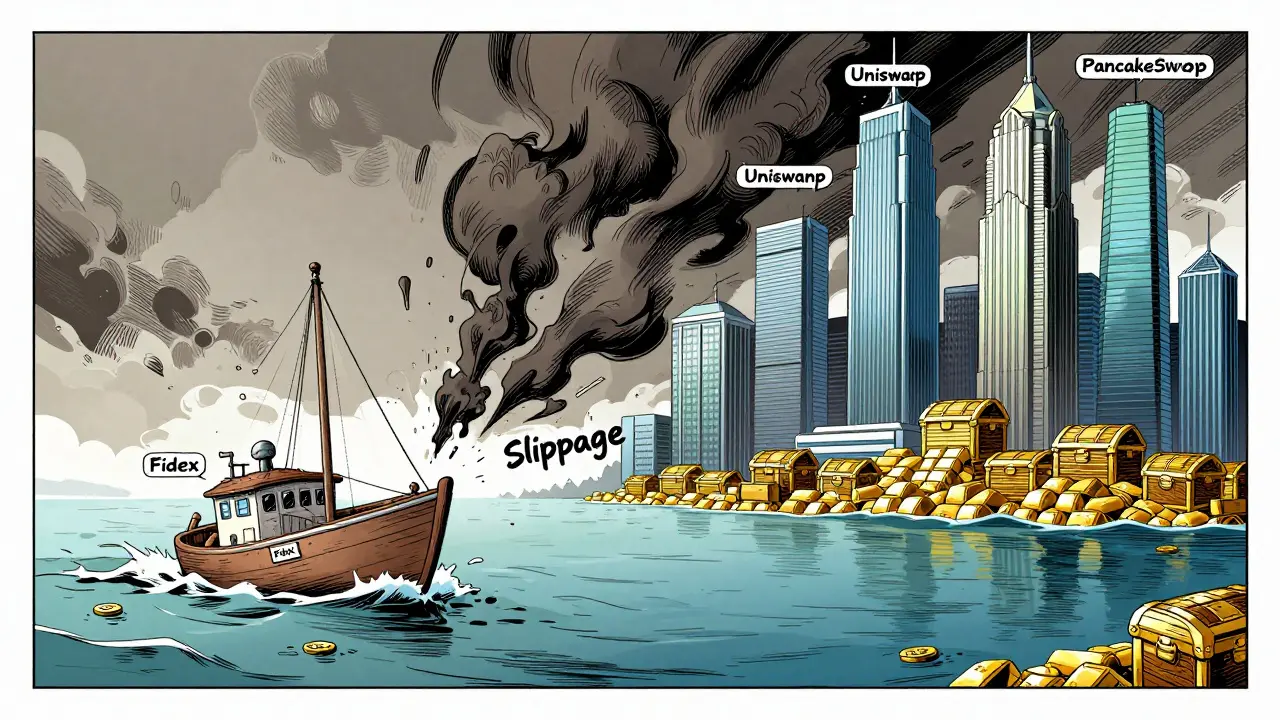
Liquidity is the lifeblood of any exchange. Without it, you cannot buy or sell without drastically moving the price. Here, Fidex struggles significantly. In Q3 2025, Uniswap processed $320 billion in trading volume. PancakeSwap handled $2.1 billion. Meanwhile, Fidex averaged a daily trading volume of just $8,200. To put that in perspective, a single large whale selling $10,000 worth of tokens could crash the entire day's volume on Fidex.
This lack of depth makes trading risky. Slippage-the difference between the expected price of a trade and the price at which the trade is executed-can be severe. If you try to sell a newly listed token, you might find there are no buyers, or the bid prices are so low that you lose most of your investment instantly. The platform’s market capitalization hovers around $1.87 million, ranking it outside the top 1,500 cryptocurrencies globally. This indicates a very small pool of active capital and limited interest from institutional investors.
Security Concerns and Lack of Audits
When you deposit funds into an exchange, you are trusting their security infrastructure. Fidex claims to use data encryption, AI-based transaction tracking, and IP profiling systems certified by PCI and KYC/AML bodies. They also mention "Espays security experts." However, independent verification of these claims is virtually non-existent. The Crypto Research Institute rated Fidex’s security infrastructure a dismal 2.1 out of 10 in their Q2 2025 report, citing a "complete absence of third-party security audits."
In the crypto world, un-audited smart contracts are a red flag. Dr. Elena Rodriguez, a blockchain security researcher at Stanford University, warned in October 2024 that platforms promising instant listings without rigorous vetting create dangerous environments. She noted a 78% scam token rate on similar low-barrier exchanges. Since Fidex lacks the stringent screening of Binance or Coinbase, users are largely on their own. If you connect your wallet to a malicious contract listed via the voting system, there is no customer support team to reverse the transaction.
User Experience and Community Sentiment
The user experience on Fidex is defined by frustration rather than convenience. On Trustpilot, the platform holds a 1.7 out of 5 rating based on 47 verified reviews as of late 2025. Common complaints include withdrawal delays averaging nearly two weeks. One user reported having funds locked for over three weeks during a withdrawal attempt. Another frequent issue involves smart contract errors, with analytics suggesting that 22% of transactions fail during token swaps.
Customer support is another weak point. Response times often exceed 72 hours, and the documentation is sparse. The community presence has also dwindled significantly. SocialBlade data shows Fidex’s Telegram community shrank from 12,500 members in early 2024 to just 3,200 by late 2025. Daily engagement dropped from 150 messages to fewer than 20. An inactive Discord server and sporadic moderator activity suggest the development team may be disengaged. This decline in community trust is a critical warning sign for any potential user.
| Feature | Fidex | Uniswap | PancakeSwap |
|---|---|---|---|
| Daily Volume (Avg) | $8,200 | $3.5 Billion | $2.1 Billion |
| Listings Process | Community Vote + Fee | Permissionless (AMM) | Permissionless (AMM) |
| Security Audits | None Publicly Verified | Multiple Independent Audits | Multiple Independent Audits |
| Network | Ethereum Only | Multi-chain (L2s included) | BSC / Multi-chain |
| Risk Level | Very High | Low-Medium | Low-Medium |
Regulatory Risks and Future Viability
The regulatory landscape for cryptocurrency exchanges has tightened considerably since 2024. In February 2025, the SEC issued guidance classifying instant-listing platforms as "unregistered securities exchanges." This directly targets Fidex’s core business model. Operating in such a gray area exposes the platform to potential legal action, which could lead to shutdowns or frozen assets.
Adoption metrics reflect this uncertainty. Fidex serves approximately 8,500 active monthly users, a sharp decline from 15,200 in early 2024. Most of these users are concentrated in regions with minimal crypto regulation, such as Nigeria, Vietnam, and Pakistan. In contrast, 97% of new token projects now prefer established exchanges with proper vetting, recognizing that "liquidity follows trust." Industry analysts project a 92% probability that Fidex will cease operations within 18 months due to insufficient reserves and declining relevance.
Who Should Use Fidex? (And Who Should Avoid It)
Fidex is not a one-size-fits-all solution. It serves a very specific, high-risk demographic. You might consider using Fidex if:
- You are a developer of a micro-cap ERC20 token that has been rejected by all major exchanges.
- You are an experienced degenerate trader willing to risk small amounts of capital on unvetted projects.
- You understand how to audit smart contracts yourself and do not rely on exchange security.
You should absolutely avoid Fidex if:
- You are looking for a safe place to store long-term investments.
- You require fast withdrawals or responsive customer support.
- You are new to cryptocurrency and unfamiliar with wallet security.
- You expect deep liquidity and stable pricing.
For the vast majority of users, sticking to regulated, audited platforms like Coinbase, Kraken, or even decentralized giants like Uniswap is the only prudent choice. The potential gains on Fidex are outweighed by the extreme risk of losing everything to scams, rug pulls, or platform failure.
Is Fidex a legitimate exchange?
Fidex is a real platform, but its legitimacy is questionable due to a lack of third-party security audits, poor user reviews, and regulatory scrutiny. It operates in a high-risk segment of the crypto market, primarily serving unverified token projects. Users have reported significant issues with withdrawals and scam tokens, making it unsuitable for casual investors.
How much does it cost to list a token on Fidex?
The listing fee is 50,000 FEX tokens. Depending on the current market price of FEX, this translates to approximately $10.75. While this is significantly cheaper than major exchanges, the low fee contributes to a high volume of low-quality or fraudulent listings.
Why is Fidex’s trading volume so low?
Fidex lacks the trust and security features that attract large traders and institutions. With no major security audits and a history of scam tokens, liquidity providers avoid the platform. Consequently, daily volume averages around $8,200, compared to billions on competitors like Uniswap.
Can I withdraw my funds quickly from Fidex?
No, users frequently report withdrawal delays. Data from 2025 indicates an average delay of 14.7 days for withdrawals. Some users have had funds locked for over three weeks. This suggests operational inefficiencies or potential solvency issues.
Is Fidex safe for beginners?
Absolutely not. Fidex is highly risky due to the prevalence of scam tokens, lack of customer support, and absence of security guarantees. Beginners should stick to well-known, regulated exchanges that offer buyer protection and robust security measures.
 Cryptocurrency Guides