
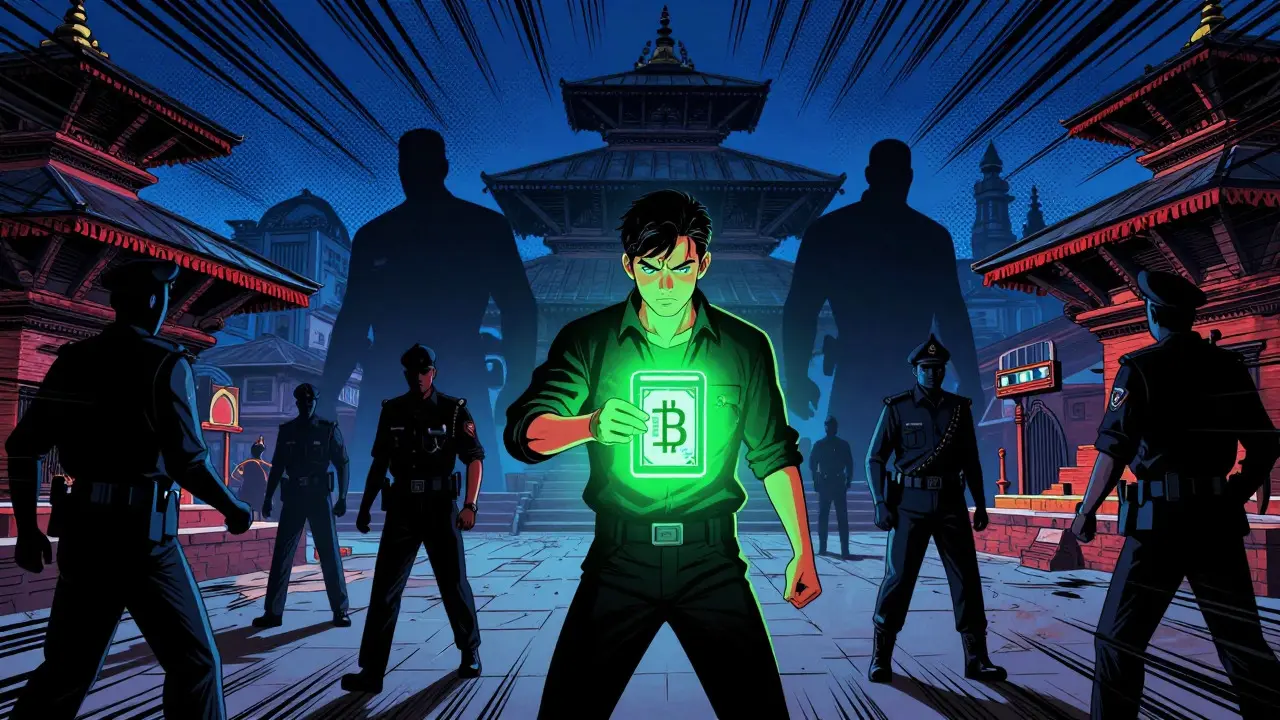
Imagine holding a wallet full of Bitcoin or Ethereum while standing on Nepali soil. To many global investors, that’s just digital wealth. But in Nepal, it might be evidence of a crime. As of August 2026, Nepal remains one of the few countries where cryptocurrency activities are not just regulated but outright illegal. If you’ve been trading, mining, or even storing crypto in Nepal, you face more than just a fine. You risk having your assets seized and potentially facing prison time under strict criminal laws.
This isn’t speculation. The legal framework is clear, enforced by the central bank, and backed by criminal statutes. Understanding how asset forfeiture for crypto violations in Nepal works involves understanding the intersection of criminal law, financial regulation, and anti-money laundering enforcement. Let’s break down what this means for you, whether you’re an individual holder, a trader, or someone considering moving to the region.
The Legal Foundation: Why Crypto Is Illegal in Nepal
To understand the risk of losing your assets, you first need to know why they’re considered illegal in the first place. The primary legal instrument here is the Muluki Criminal Code Act 2017, specifically Section 262(A). This section defines cryptocurrency broadly as any information, code, token, or virtual asset created electronically through cryptography that has commercial significance or can store value.
Under this definition, almost every major digital asset falls into the prohibited category. The Nepal Rastra Bank (NRB), the country’s central bank, reinforces this stance. They warn that engaging in crypto activities undermines monetary control because these assets operate outside traditional banking oversight. The government’s concerns are twofold: protecting the stability of the Nepalese Rupee (NPR) and preventing illicit financial flows like money laundering and tax evasion.
It’s worth noting that this isn’t just a regulatory gray area. It’s a criminal prohibition. Unlike some jurisdictions where crypto is unregulated (meaning you can do what you want, but no one protects you), Nepal treats crypto possession and trade as offenses. This distinction is crucial because it shifts the burden from civil disputes to criminal prosecution, where the state has significantly more power over your property.
How Asset Forfeiture Works in Practice
So, what happens when the authorities decide you’ve violated these laws? While specific, high-profile case studies regarding crypto-only asset seizures are rare in public records, the mechanism follows standard criminal procedure for financial crimes.
- Detection and Investigation: Enforcement often begins with monitoring foreign exchange transactions or reporting by banks. Since crypto usually requires fiat currency entry points, the Nepal Telecommunication Authority (NTA) and NRB watch for unusual patterns.
- Criminal Charge: Violations are typically prosecuted under the Muluki Criminal Code or the Anti-Money Laundering (AML) Law. If prosecutors believe crypto was used to hide proceeds of crime, AML charges become likely.
- Provisional Attachment: Before a final verdict, courts can order the provisional attachment of assets. This means your bank accounts, real estate, and potentially the crypto itself (if recoverable) are frozen.
- Final Forfeiture: Upon conviction, the court may order the permanent forfeiture of assets deemed to be proceeds of crime or instruments used in the offense.
A critical nuance here is the definition of "instrument of crime." In many legal systems, if you bought a car using money from an illegal activity, the car can be forfeited. Similarly, if your crypto holdings are linked to unreported income or black-market trades, the entire portfolio could be viewed as tainted. Even if the crypto itself is hard to trace on-chain, the fiat currency used to buy it is not.
Enforcement Mechanisms: Beyond Just Fines
Nepal’s enforcement strategy has evolved since the initial crackdowns. In 2021, the NTA blocked websites related to cryptocurrency trading and mining. This was a significant move, signaling that the government wanted to cut off access at the source. By blocking these platforms, they aimed to reduce the ease with which citizens could enter the market.
However, technology moves faster than regulation. Many Nepalis still use Virtual Private Networks (VPNs) and offshore exchanges to trade. This creates a compliance gap that authorities are increasingly trying to close. The NRB has issued multiple directives reminding banks to monitor customers for suspicious transactions involving crypto-related entities.
| Country | Status (2026) | Primary Risk for Holders | Asset Forfeiture Likelihood |
|---|---|---|---|
| Nepal | Outright Ban | Criminal Prosecution | High (under AML/Criminal Code) |
| India | Regulated (Taxed) | Tax Evasion Penalties | Low (unless linked to fraud) |
| Bangladesh | Restricted/Ban | Fines/Imprisonment | Medium-High |
Notice the contrast with India. While India initially had a hostile stance, it moved toward a regulatory model with heavy taxation rather than criminalization. Nepal has stuck with the prohibition route. This makes the legal risk profile much steeper for anyone operating within its borders.

Risks for Individuals and Businesses
If you’re an individual living in Nepal, the risks are personal and financial. Holding crypto in a self-custody wallet doesn’t make you invisible. The moment you convert to NPR, deposit into a local bank, or use a local merchant who accepts crypto (which is also illegal), you leave a trail.
For businesses, the stakes are higher. Companies found facilitating crypto payments or holding corporate treasury in digital assets face not just asset forfeiture but potential dissolution of their business licenses. The lack of a clear regulatory framework means there is no safe harbor. You cannot argue that you were following "industry standards" because, legally, no industry exists in Nepal.
One common misconception is that because crypto is decentralized, it’s uncatchable. In practice, forensic firms hired by law enforcement can trace funds through mixing services and cross-chain bridges. Once the chain ends at a local bank account, the case becomes straightforward for prosecutors.
What Happens to Your Crypto?
This is the question everyone asks: "Will they actually take my coins?" Technically, seizing private keys is difficult unless you use a custodial service based in Nepal (which is rare due to the ban). However, the practical approach is often to seize the equivalent value in fiat currency or other assets.
If you hold $50,000 worth of Bitcoin, the court may order the seizure of $50,000 worth of your liquid assets, real estate, or vehicles. This is known as substitute asset forfeiture. It achieves the same punitive effect without requiring the state to manage volatile digital assets directly.
Furthermore, if you are charged with money laundering, the burden of proof can sometimes shift. You may need to prove the legitimate source of funds for your crypto purchases. If you can’t document exactly where the NPR came from, the assets are presumed illegal.

Strategies for Mitigation and Compliance
Given the severity of the situation, what should you do? If you already hold crypto in Nepal, consider these steps:
- Document Everything: Keep clear records of how you acquired your crypto. Bank statements, exchange history, and purchase receipts are vital.
- Consult Local Counsel: Don’t rely on international advice. Hire a lawyer specializing in Nepali criminal and financial law. They understand the nuances of the Muluki Criminal Code.
- Avoid Local Banks for Conversion: Converting large amounts of crypto to NPR via local P2P markets increases scrutiny. Offshore conversion followed by careful repatriation might lower detection risk, though it’s not risk-free.
- Consider Relocation: If you plan to stay active in crypto, moving to a jurisdiction with clearer rules (like Singapore, UAE, or parts of Europe) removes the criminal risk entirely.
There is no "gray zone" strategy that guarantees safety. The government’s consistent enforcement since 2021 shows they are serious. The cost of a legal battle in Nepal, combined with the potential loss of assets, often outweighs the benefits of holding crypto locally.
Future Outlook: Will the Ban Lift?
As of mid-2026, signs suggest the ban will remain. Global trends show fewer countries banning crypto (down to 12% of emerging markets), but Nepal has resisted pressure to follow suit. The NRB continues to emphasize the importance of monetary sovereignty and financial stability.
However, the landscape is changing globally. With the rise of Central Bank Digital Currencies (CBDCs), Nepal might eventually introduce its own digital rupee. This would replace the need for private cryptocurrencies while maintaining government control. Until then, the current prohibition stands.
Keep an eye on official announcements from the NRB and the Ministry of Finance. Any change in policy would likely start with a pilot program or a specific licensing framework, rather than an immediate full legalization. Until such a framework exists, assume the status quo: total illegality.
Is it illegal to just hold crypto in Nepal?
Yes. Under Section 262(A) of the Muluki Criminal Code, possessing a virtual asset with commercial significance is considered a violation. There is no distinction between 'active' traders and passive holders in the current legal text.
Can the Nepalese government seize my private keys?
Directly seizing hardware wallets is rare, but courts can order the seizure of equivalent fiat assets. If you use a custodial service, they can freeze those accounts easily. Forensic tracing is also possible if you interact with local exchanges or banks.
What is the maximum penalty for crypto violations?
Penalties vary based on the charge. Under the Muluki Criminal Code, fines can be substantial relative to local income. If charged with money laundering, imprisonment terms can range from several years to life, depending on the amount involved and intent.
Does using a VPN protect me from enforcement?
A VPN helps hide your IP address but does not hide your financial footprint. If you convert crypto to NPR, the transaction appears in local bank records. Enforcement focuses on fiat entry/exit points, not just internet traffic.
Are there any exceptions for small amounts?
No. The law does not specify a de minimis threshold. Theoretically, holding even a small amount of crypto is a violation, although enforcement priorities usually target larger transactions that impact financial stability or involve suspected money laundering.
 Cryptocurrency Guides