
Imagine you’re running a massive industrial operation. Your machines are humming, consuming electricity at a frantic pace, and generating profit around the clock. Then, one Tuesday morning, the lights go out. Not just for your facility, but for entire cities. The grid is overloaded. The government steps in, cuts your power, and tells you to pack up or face severe penalties. This isn’t a scene from a dystopian movie; it’s the reality that has defined Bitcoin mining is the process of validating transactions on the Bitcoin network using computational power. in Kazakhstan over the last few years.
If you’ve been following the crypto space, you know that Kazakhstan is a Central Asian country that became a major hub for Bitcoin mining due to cheap coal energy. used to be the second-largest player in the game. But as we move through 2026, the narrative has shifted dramatically. We are witnessing a significant hash rate migration is the movement of mining computational power from one geographic region to another. away from this Central Asian nation. Major players like Canaan have officially exited, and the reasons why are rooted in infrastructure strain, regulatory crackdowns, and a changing global landscape.
The Rise and Fall of the Kazakh Mining Boom
To understand why miners are leaving, we first need to look at why they came. It started back in 2018. After the collapse of the Soviet Union, Kazakhstan was left with surplus power capacity and abundant, incredibly cheap coal reserves. For Bitcoin miners, who are always hunting for the lowest energy costs, this was paradise. The mining boom centered in Ekibastuz, a city known for its coal mines. By 2021, Kazakhstan had surged to second place globally in Bitcoin hashrate is a measure of the total computational power being used by the Bitcoin network. distribution. It was a golden era, often referred to as the 'hashrate goldrush.'
But there was a catch. The growth was unsustainable. Mining operations began consuming roughly 7% of the country's total power supply. That might not sound like much until you realize what happens when millions of households try to use their heaters during winter while thousands of ASIC miners draw constant power. The national grid couldn't handle the load. Mass protests erupted as blackouts affected civilian populations. Within weeks, the government made a hard choice: they cut miners off from the national grid. The industry ground to a halt almost overnight.
Why Miners Are Leaving Now (The 2025-2026 Shift)
You might wonder, if the issues started in 2021, why is everyone talking about migration now? The answer lies in the cumulative effect of instability and recent corporate exits. While Kazakhstan still holds about 14.8% of the global hashrate, the trend line is pointing downward. The migration accelerated significantly in 2025.
A concrete example is Canaan, a major manufacturer of mining hardware based in China. In July 2025, Canaan officially withdrew from Kazakhstan as part of a strategic fleet reshuffle. Their hashrate dropped from 6.67 EH/s in May to 5.56 EH/s in July. This wasn't an accident; it was a planned exit. They reported mining 89 BTC in July 2025, but the decline in realized hashrate was directly attributed to pulling out of Kazakhstan and an underperforming site in South Texas. When a company of Canaan's size leaves, it sends a clear signal to the rest of the market: the risks here outweigh the rewards.
Miners are scaling back operations amid rising regulatory and operational uncertainty. They aren't just moving because they can; they're moving because they have to. The era of unplugging rigs into residential sockets without consequence is over. The government is cracking down, and the infrastructure simply isn't built to support industrial-scale mining indefinitely.

Where Is the Hash Rate Going?
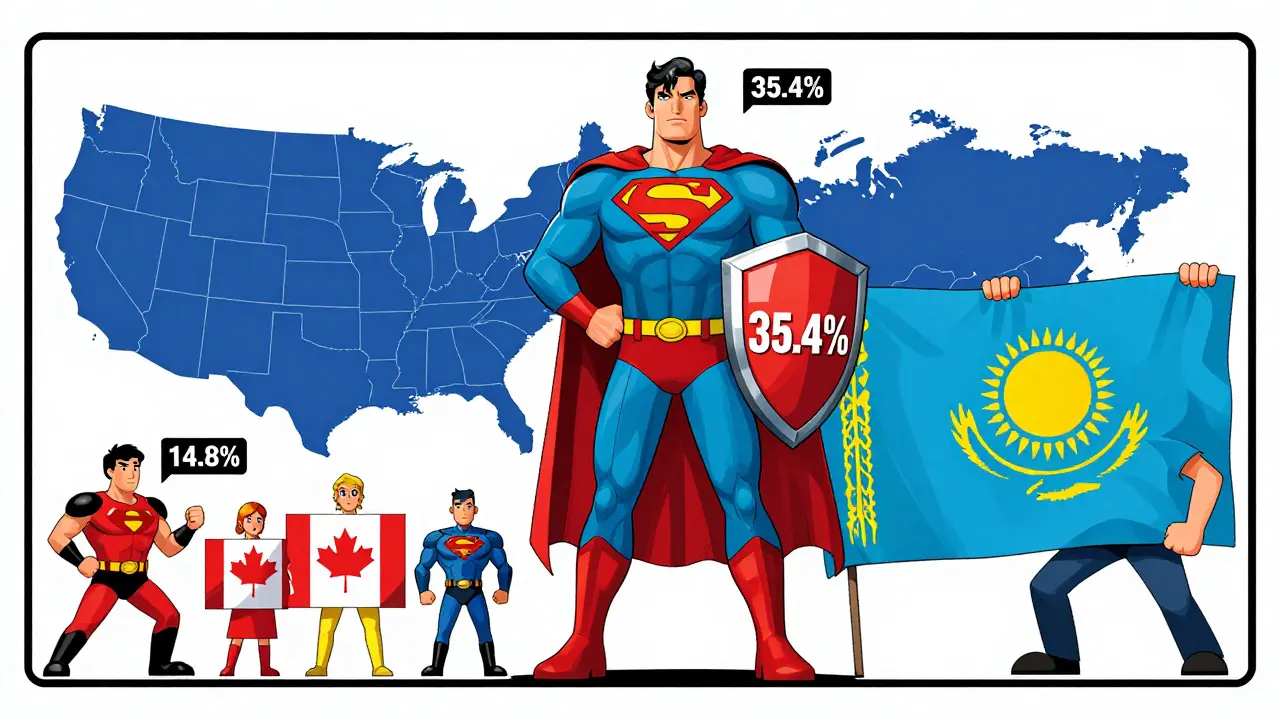
So, where do these miners go when they leave Kazakhstan? The answer is largely the United States, along with other jurisdictions offering more stability. Let’s look at the numbers. As of 2024 data, which sets the stage for 2026 trends, the US leads with 35.4% of global hashrate. Kazakhstan sits at 14.8%, followed by China at 12%, Canada at 9.6%, and Russia at 4.7%.
| Country | Global Share (%) | Key Advantage | Primary Risk |
|---|---|---|---|
| United States | 35.4% | Regulatory clarity, abundant renewable energy | Higher operational costs |
| Kazakhstan | 14.8% | Cheap coal energy, historical infrastructure | Grid instability, political risk |
| China | 12.0% | Large scale manufacturing base | Strict government bans |
| Canada | 9.6% | Hydroelectric power, stable laws | Cold climate challenges |
| Russia | 4.7% | Low energy costs | Geopolitical sanctions |
The gap between the US and Kazakhstan has widened considerably since Kazakhstan's peak in 2021. Miners are prioritizing reliability over raw cost savings. A slightly higher electricity bill in Texas or New York is worth it if you don't have to worry about the government cutting your power because a nearby town lost heat.

Government Response: The 70/30 Rule
Kazakhstan isn't sitting idle. The government knows that completely banning mining would destroy a lucrative revenue stream. Instead, they are trying to balance the books. A new strategy involves a 70/30 energy allocation rule. Under this plan, 70% of new thermal power plant capacity will be allocated to the national grid to ensure civilians have power, while only 30% is reserved for crypto mining.
This sounds fair on paper, but it limits growth. For a miner looking to expand, being capped at 30% of new capacity is a bottleneck. Furthermore, regulatory oversight is tightening. In the first quarter of 2025 alone, Kazakh banks blocked 15,800 unauthorized crypto transactions valued at $3.07 million. This indicates active monitoring and a desire to formalize the sector, which adds compliance costs for operators.
Is Kazakhstan Still Worth It?
Despite the exodus, Kazakhstan remains a significant player. With nearly 15% of the global hashrate, it’s not dead yet. Some miners argue that the advantages-historically cheap energy and a government that wants to see profits from digital assets formalized-are still compelling. Ministers have even suggested that with prudent development, the country could become Central Asia's definitive crypto hub.
However, the sentiment among institutional investors has shifted. According to analysis from AInvest published in September 2025, geopolitical competition in mining hubs mirrors China's past dominance, creating volatility risks. Institutional capital prefers predictability. The correlation between hash rate growth and network security means that when large pools move, it affects the entire ecosystem. Investors view this migration as part of broader portfolio diversification rather than a crisis-driven evacuation, but the direction is clear: stability wins.
What This Means for You
If you are an individual miner, the lesson is simple: diversify your location risk. Don't put all your rigs in one jurisdiction with a fragile grid. If you are an investor, watch the hashrate distribution maps. A drop in Kazakhstan's share usually correlates with a rise in US or Canadian shares, which often signals a maturing, more regulated market. The Bitcoin network itself remains resilient. Its total hashrate reached 1.041 billion terahashes per second in September 2025, a 48.2% increase year-over-year. The network grows stronger even as specific regions struggle.
Why did Bitcoin miners leave Kazakhstan?
Miners left primarily due to grid instability caused by excessive power consumption, leading to blackouts for civilians. The government responded by cutting power to mines and implementing stricter regulations, making operations unpredictable and risky compared to more stable jurisdictions like the US.
Does Kazakhstan still allow Bitcoin mining?
Yes, mining is still allowed but heavily regulated. The government implemented a 70/30 rule where only 30% of new thermal power capacity is reserved for mining, ensuring priority for civilian needs. Banks also actively block unauthorized crypto transactions to enforce compliance.
Which country replaced Kazakhstan as the top mining hub?
The United States has solidified its position as the top mining hub, holding approximately 35.4% of the global hashrate. Its combination of regulatory clarity, access to renewable energy, and stable infrastructure makes it the preferred destination for migrating miners.
How does hash rate migration affect Bitcoin price?
Hash rate migration itself doesn't directly dictate price, but it reflects institutional confidence. A shift towards stable jurisdictions often signals long-term commitment to the network. Historically, sustained hashrate growth precedes price rallies by months, as it indicates enhanced network security and miner profitability.
Will Kazakhstan ever be a viable mining hub again?
It is possible, but unlikely to return to its 2021 peak dominance. Kazakhstan aims to become Central Asia's crypto hub through formalization and improved infrastructure. However, the loss of trust and the established advantage of Western hubs mean it will likely remain a secondary, niche player focused on low-cost, high-risk operations.
 Cryptocurrency Guides