
For those not in the loop, Stablecoins are digital assets pegged to the value of a reserve asset, like the US Dollar or Euro, to minimize price volatility. Unlike Bitcoin, which can swing wildly in value, stablecoins provide the stability needed for actual commerce. By 2025, the global market for these assets hit $210 billion, moving them from a niche crypto tool to a legitimate financial rail for businesses and individuals alike.
The "Stablecoin Sandwich": How it Actually Works
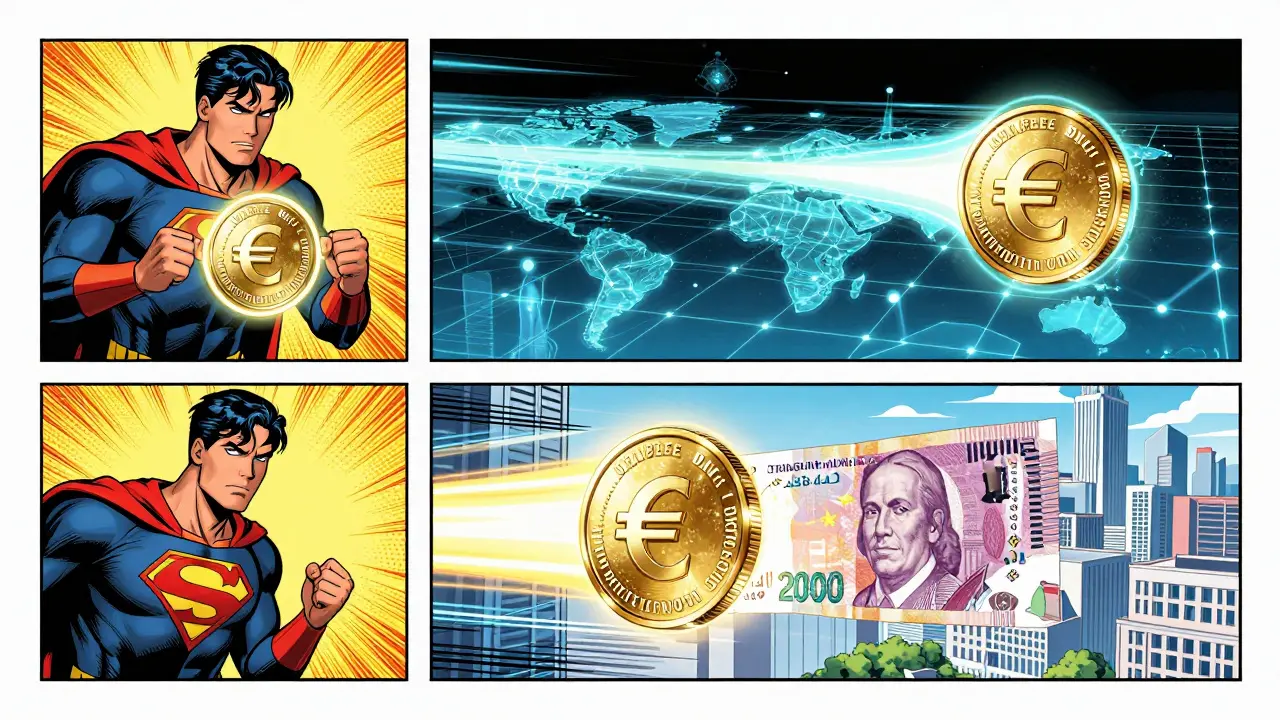
The secret to avoiding traditional banking delays is a process known as the "stablecoin sandwich." Instead of relying on a chain of correspondent banks (where each bank takes a cut and adds a delay), you use a digital bridge. Here is the step-by-step flow:
- The On-Ramp: You convert your local fiat currency (e.g., Euros) into a stablecoin like USDT or USDC via a liquidity provider.
- The Transfer: You send that stablecoin across a blockchain network. Because blockchains don't care about borders, this happens almost instantly.
- The Off-Ramp: The recipient receives the stablecoin and immediately converts it back into their local fiat currency (e.g., Mexican Pesos) through a local partner.
This methodology is a game-changer. While a standard SWIFT transfer might take days, a stablecoin transfer settles in 5 to 10 minutes. In Mexico, this is already mainstream; USDT-based transfers now make up about 22% of all inbound remittances. You're effectively replacing a slow, manual banking process with a programmable, automated one.
Comparing the Rails: Blockchain vs. Traditional Banks
If you're deciding whether to stick with your bank or switch to a crypto-based alternative, the numbers tell the story. Traditional banks offer universal acceptance, but they charge a premium for the privilege. Blockchain networks offer speed and transparency but require a bit more technical setup.
| Metric | Traditional Banking (SWIFT) | Stablecoin Infrastructure |
|---|---|---|
| Average Settlement Time | 3.7 Days | ~8.2 Minutes |
| Average Transaction Fee | 4% - 8% | 0.5% - 1.2% |
| FX Spread (Average) | 2.8% | 0.35% |
| Success Rate (Same-Day) | 63.2% | 98.7% |
| Global Acceptance | High (195 countries) | Moderate (127 countries) |
The Technical Backbone: Networks and Liquidity
Not all blockchains are created equal. To get those sub-10-minute settlement times, you need to be on the right network. Solana is often the top choice for speed, with transaction finality in about 2.5 seconds. Ethereum is the gold standard for security, but for payments, most users stick to Layer 2 solutions like Polygon to keep fees low and speeds high (around 15 seconds).
However, the tech is only half the battle. The real bottleneck is "last-mile liquidity." This is the ability to actually get the money out of the crypto system and into a local bank account. In high-liquidity corridors, like USD to MXN, success rates are nearly 99.1%. In tougher markets, like USD to NGN (Nigerian Naira), success rates can drop to around 68.4% because there aren't enough reliable off-ramp providers. If you're a business, you need to ensure your destination country has a robust liquidity pool-typically at least $5 million for a professional corridor-to avoid funds getting stuck.
The Regulatory Landscape: Rules of the Road
You can't talk about moving money without talking about the law. For a long time, crypto payments were a "Wild West," but 2024 and 2025 brought much-needed clarity. In the EU, the MiCA (Markets in Crypto-Assets) regulation is now fully in effect, giving a clear legal framework for stablecoins. In the US, the GENIUS Act of December 2024 set strict reserve and disclosure requirements, making stablecoins feel more like regulated financial products and less like speculative bets.
That said, the world is still fragmented. There are currently 37 different regulatory frameworks for stablecoins globally. This means a setup that works perfectly for a company in Germany using the EURAU (a BaFin-approved euro stablecoin) might not translate directly to a business operating in Asia. You have to map your regulatory risk based on both where the money starts and where it ends.
Getting Started: Integration and Pitfalls
If you're a business owner looking to move away from legacy banking, don't expect to switch overnight. If you already use API-based payments, you can likely integrate a crypto rail in 2 to 3 weeks. If you're coming from an old-school manual system, expect a 6 to 8 week migration period. You'll need to establish relationships with regulated issuers and find trusted on-ramp/off-ramp partners.
Avoid these common traps:
- Ignoring Volatility Windows: Even stablecoins can be affected by network congestion. During the March 2024 crash, some settlement times spiked by 300% because everyone tried to move funds at once.
- Underestimating Capital Reserves: Small businesses typically need at least $250,000 in capital reserves per corridor to maintain smooth liquidity.
- Overlooking Tax Compliance: Moving money via stablecoins isn't "invisible." Tax authorities in most developed countries now require detailed reporting on digital asset transfers to prevent money laundering.
For most, the trade-off is worth it. Using tools like BVNK or PayPal's crypto integration can slash processing costs by over 30%. You're essentially trading a bit of technical complexity for a massive increase in speed and a significant drop in fees.
Are stablecoin payments safer than bank transfers?
In terms of speed and transparency, yes. However, they lack the same level of consumer protection and insurance (like FDIC) that traditional bank accounts provide. The safety depends heavily on the stability of the issuer and the reliability of the off-ramp provider.
Which stablecoin is best for international payments?
USDT (Tether) has the highest liquidity and is widely used in emerging markets. USDC (USD Coin) is often preferred by US-based corporations due to its transparency and regulatory compliance. For those in Europe, the EURAU is a strong, BaFin-approved option for euro-pegged transfers.
How long does a typical crypto cross-border payment take?
While the blockchain transfer takes seconds, the full "sandwich" process (fiat to stablecoin to fiat) usually takes between 5 and 10 minutes, depending on the liquidity providers used.
What is the biggest risk when using crypto for payments?
The biggest risk is "last-mile liquidity"-the possibility that an off-ramp provider becomes insolvent or unavailable, making it difficult to convert the stablecoin back into local currency.
Do I need to be a crypto expert to use these systems?
No. While the underlying tech is complex, many payment providers now offer API-driven dashboards that make the process look and feel like a traditional digital bank account.
 Cryptocurrency Guides
Robert Smith
May 1, 2026 AT 13:43Total game changer 🚀
Felix Eduardo Velasquez
May 3, 2026 AT 08:16The concept of last-mile liquidity is the real hurdle here. Most people focus on the blockchain speed, but if the local off-ramp in a country like Nigeria is unstable, the whole process collapses. It is essentially a trust problem shifted from a central bank to a liquidity provider. This shift doesn't eliminate risk; it just redefines it. To truly scale, we need decentralized liquidity pools that aren't dependent on a few large market makers. Without that, we are just replacing one set of intermediaries with another. The regulatory frameworks like MiCA are a start, but global harmonization is the only way to avoid the fragmented risk landscape mentioned. Most users don't realize that a "stable" coin is only as stable as its reserve audit. If the audit is fraudulent, the settlement speed is irrelevant because the value is gone. We need more transparent, real-time proof of reserves to make this viable for the average person. The technical bridge is built, but the institutional trust is still under construction. It's a fascinating transition in how we perceive value and movement. The efficiency gains are undeniable, but the systemic fragility remains a concern. We should be looking at hybrid models that combine the safety of traditional insurance with the speed of the ledger. Only then will the mass market truly migrate. Until then, it remains a powerful tool for the tech-savvy and the desperate.
Rain Richardsson
May 5, 2026 AT 07:34Makes a lot of sense. Banks are too slow.
Emily A
May 7, 2026 AT 04:47It is quite amusing that some believe a "stablecoin sandwich" solves everything. You completely ignore the slippage that occurs during the on-ramp and off-ramp phases, which can often eat into those supposed savings. Furthermore, the reliance on USDT is particularly concerning given the historical lack of transparency regarding Tether's reserves. One should not confuse speed with security. Proper financial planning requires an understanding of counterparty risk, which is significantly higher in the crypto ecosystem than in the SWIFT network, despite the latter's antiquity.
its me
May 8, 2026 AT 09:00Funny how we call it "innovation" when we're just moving our money into the hands of unregulated tech bros who think they're philosophers because they read a whitepaper. It's all just a game of musical chairs until the next liquidity crisis hits and everyone realizes their "digital dollar" is actually just a promise from a company in the British Virgin Islands. We're just trading old-school greed for new-school greed and pretending it's progress for the sake of a few minutes of time.
Carli Bates
May 8, 2026 AT 20:18imagine still using a bank in 2025 lmao. just send the usdc and stop complaining about the 3 day wait... if you can even figure out how to use a wallet without losing your keys obviously
Abhishek Verma
May 10, 2026 AT 10:27Oh wow, look at this "revolutionary" guide. I'm sure the author thinks they've discovered fire. Maybe if you actually lived in a place where the off-ramps are a joke, you'd realize that a 68% success rate is basically gambling with your rent money. Truly an inspiring piece of optimism for the delusional.
Aaron Zeiler
May 11, 2026 AT 05:26use solana for the transfers man. fees are practically zero and it's way faster than polygon for simple payments
Jan Conrad
May 11, 2026 AT 16:05I wonder if the integration time for API-based payments includes the KYC hurdles. Usually, the tech is the easy part; it's the compliance checks that take the longest when you're dealing with cross-border flows.
Brendan Thraxton
May 12, 2026 AT 11:02really great breakdown here! for anyone worried about the tech just start with a managed provider and it's way easier than doing it manually
Janis Naglis
May 14, 2026 AT 00:37This is such a paradigm-shifting approach!!! The synergistic potential of Layer 2 scalability combined with MiCA-compliant frameworks is just incredible!!!! Definitely a bullish signal for global liquidity aggregation!!!
Ipsita Seal
May 15, 2026 AT 21:06Too much reading for a basic concept.
Rushell Perry
May 17, 2026 AT 21:04just be careful with the off-ramps folks. some of those local partners can be sketchy and take a bigger cut than they admit in the fine print
Amanda Macy
May 18, 2026 AT 04:20The speed is an obvious benefit, but one must wonder if the loss of a centralized safety net is a price worth paying for efficiency. We are trading stability for velocity.
Lloyd I
May 19, 2026 AT 01:19I'm with you on this! It's all about making things easier for everyone involved. Let's keep pushing for better tools!
Gabby Puche
May 19, 2026 AT 11:38This is so helpful! I've been wanting to try this for my freelance work 🌟✨
Barbara Jones
May 20, 2026 AT 04:48I tried this last month and it was way faster than my bank but i almost sent it to the wrong adress... be laaaaawy slow with the copy paste
Gabrielle Danis
May 20, 2026 AT 13:17The mention of the GENIUS Act is an important detail. Regulatory clarity is the primary catalyst for institutional adoption, as it mitigates the risk of sudden asset freezes by government agencies.
Kathleen Warren
May 21, 2026 AT 22:32If anyone is confused about how to start, just take it one step at a time. You don't need to be a pro to move some money.
Hannah Rubia
May 23, 2026 AT 13:00Glad to see people are embracing the efficiency. It's a steep learning curve but totally worth the effort in the long run.