

Sakai Vault (SAKAI) isn't just another crypto coin. It's a decentralized exchange platform built around a native token designed to fix what’s broken in today’s DeFi trading systems. But here’s the catch: while the idea sounds promising, the reality is far more complicated - and risky - than the marketing suggests.
What Exactly Is Sakai Vault?
Sakai Vault is a Sakai Vault is a decentralized finance (DeFi) platform that offers both spot trading and perpetual futures contracts. Its goal? To let traders execute large orders without price slippage - something most decentralized exchanges (DEXs) struggle with. The platform’s native token, SAKAI is the utility token powering the Sakai Vault ecosystem, is used for paying trading fees, staking, and accessing AI-driven trading tools.
Unlike Uniswap or PancakeSwap, which use a simple constant product formula (x*y=k), Sakai Vault claims to use a multi-asset pool architecture that enables zero price impact trades. This means if you want to swap $10,000 worth of ETH for USDC, you won’t see your price shift because of your own trade. That’s the dream. But does it work in practice? Not really - not yet.
How Does the SAKAI Token Work?
There are 8 million SAKAI tokens total. No more can be created. That’s fixed. But here’s where things get messy:
- Circulating supply: CoinMarketCap says 2.08 million are in circulation. CoinGecko says 3.6 million. That’s a 72% difference. Which one’s right? No one knows for sure.
- Price: As of late 2025, it hovered around $0.028-$0.029. But because of the supply mismatch, market cap numbers vary wildly - from $66,000 to $145,000.
- Deflationary mechanism: Every time someone trades on Sakai Vault, 0.5% of the fee is burned. Sounds good, right? But with daily trading volume under $9,000, you’re burning pennies. That’s not scarcity - that’s noise.
SAKAI runs on Ethereum (ERC-20), Binance Smart Chain (BEP-20), and Polygon. That means you need to switch networks in your wallet depending on where you’re trading. If you’re new to crypto, this alone can be a nightmare.
The AI Trading Feature - Hype or Real?
Sakai Vault advertises AI-powered trading strategies as a key feature. The website says it uses machine learning to predict price movements and auto-execute trades. Sounds like magic? It’s not.
Reviewers from CryptoSlate tested the AI module in October 2025. What they found? It’s just a collection of basic indicators - RSI, MACD, moving averages - wrapped in flashy graphics. No neural networks. No real learning. No backtested edge. It’s like buying a Tesla with a gas engine labeled "electric."
Users on Reddit and Trustpilot report the same thing: "The AI dashboard doesn’t do anything." One trader wrote: "I left it running for 48 hours. It made three trades. Two lost money. The third broke even."
Liquidity: The Silent Killer
This is where Sakai Vault falls apart.
On paper, it’s a DeFi 2.0 platform. In reality, it’s a ghost town.
- Trading volume: Around $8,800 per day. Compare that to Uniswap’s $4.5 billion daily volume. Sakai Vault does 0.00018% of what Uniswap does.
- Maximum trade size: Experts recommend not trading more than $500 at once. Anything bigger? Slippage so bad you lose 15-20% of your value before the trade even finishes.
- Exchange listings: Only three DEXs list SAKAI. No major centralized exchanges (like Binance or Coinbase) touch it. That means no institutional money. No liquidity providers. Just retail traders trying to pump a token with no real demand.
Blockchain analytics from Nansen show 82% of the 126,330 wallet addresses holding SAKAI contain less than $10 worth. These aren’t investors - they’re dust accounts from airdrops or failed presales.

Why the Discrepancies in Data?
Why does CoinMarketCap say 2.08 million SAKAI are circulating while CoinGecko says 3.6 million?
The answer is simple: no one knows. The project doesn’t publish clear token unlock schedules. Some tokens are locked in team wallets. Others are in liquidity pools. Some might be burned. But there’s no transparency. That’s a red flag.
Even the fully diluted valuation (FDV) is inconsistent. CoinMarketCap calculates it at $256,910. CoinGecko lists it as $145,716. Which one’s accurate? Neither. They’re both guesses.
Real User Experiences - Not What You’d Expect
Let’s look at what real people are saying.
- On Reddit: "I tried to buy $1,000 of SAKAI. The price jumped 12% during my order. I lost $120 just because I wanted to trade." - u/CryptoNovice42
- On Trustpilot: Average rating: 2.1/5. Top complaint: "Impossible to execute trades without massive slippage."
- On Telegram: 12,450 members. But only 387 active daily. Discord has 8,920 members - but only 42 active in the last week. That’s not a community. That’s a graveyard.
Early adopters who bought during the presale at $0.00012 claim 2,300% returns. That’s great for them. But those tokens were sold to insiders before public launch. If you’re buying now, you’re the last one in.
Is Sakai Vault Safe?
There’s no regulatory filing. No KYC. No AML compliance. The project hasn’t contacted any financial authority in the U.S., EU, or Asia. That means:
- If the team vanishes, you have zero recourse.
- If a smart contract bug wipes out liquidity, you lose everything.
- If regulators crack down on DeFi, Sakai Vault won’t be prepared.
Deloitte’s October 2025 report flagged Sakai Vault as a high-risk project due to its lack of legal grounding. That’s not paranoia - that’s due diligence.
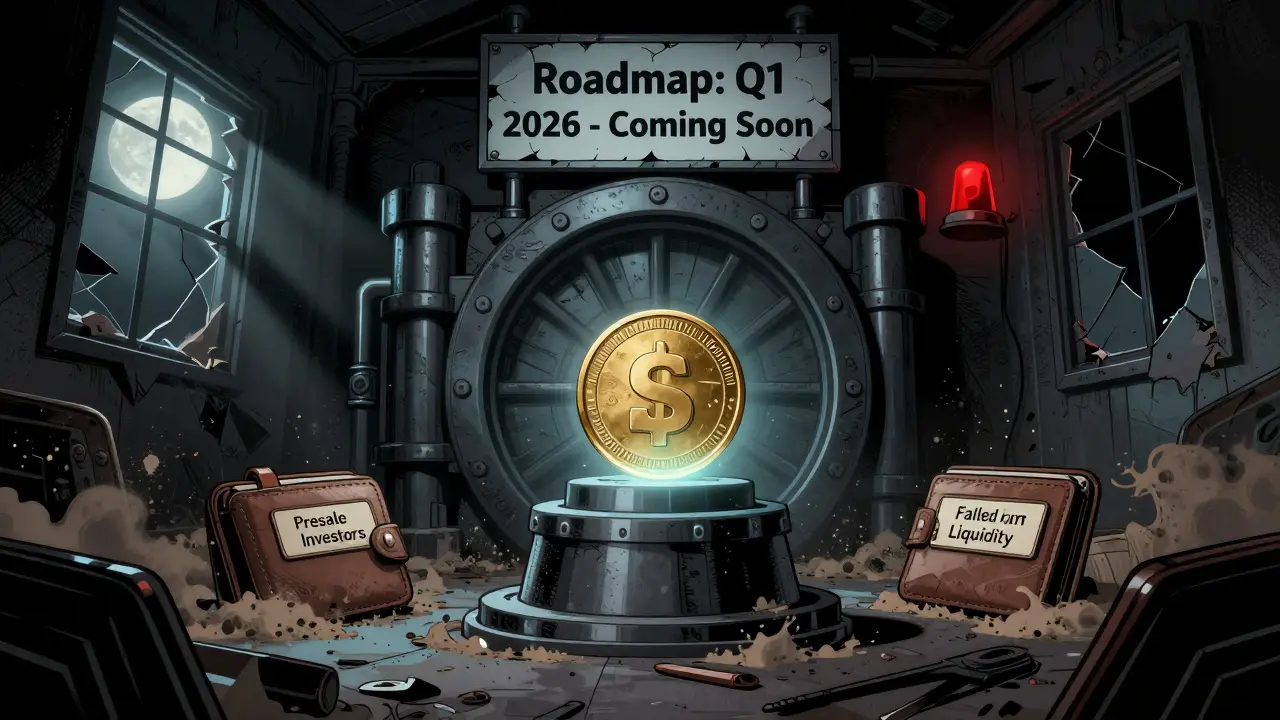
What’s Next? The Roadmap (And Why It’s Skeptical)
The Sakai Vault team published a roadmap:
- Launch v2.0 with improved AI engine - Q1 2026
- List on two Tier-2 centralized exchanges - Q2 2026
- Implement DAO governance - Q3 2026
Here’s the problem: as of November 2025, only 2 of 7 promised v1.0 features were fully implemented. The AI strategy module? Still says "Documentation coming soon." The user interface? Unusable for beginners. Customer support? Takes 72 hours to reply.
Their new partnership with Ondo Finance - meant to bring institutional liquidity - sounds promising. But Ondo is known for working with regulated, institutional-grade assets. Why would they partner with a platform that can’t even get its core features working?
Final Verdict: Should You Buy SAKAI?
Here’s the truth:
- If you’re looking for a long-term DeFi investment: Skip it. The tokenomics are broken, liquidity is non-existent, and the tech doesn’t deliver.
- If you’re chasing quick gains: Maybe. A few people made money during the presale. But that’s not investing - that’s gambling.
- If you’re curious about DeFi innovation: Watch it. The multi-asset pool idea is interesting. But until someone proves it works at scale, it’s just theory.
Professional analysts at The Block gave SAKAI a 30% chance of surviving two years. The broader DeFi sector is projected to grow 150% by end of 2026. Sakai Vault? It’s not even on the map.
Buy SAKAI if you want to fund a high-risk experiment. Don’t buy it if you want to grow your portfolio.
Is Sakai Vault (SAKAI) a scam?
No, it’s not technically a scam - the code exists, the platform runs, and trades can be executed. But it’s a high-risk project with misleading marketing, poor liquidity, and unfulfilled promises. Many users feel scammed because the platform doesn’t deliver what it claims. If you’re buying based on AI promises or zero-slippage claims, you’re being misled.
Can I buy SAKAI on Coinbase or Binance?
No. As of early 2026, SAKAI is not listed on any major centralized exchange. You can only trade it on three small decentralized exchanges, like SushiSwap, QuickSwap, and a lesser-known platform called SakaiSwap. This severely limits access and liquidity.
Why is the price so low?
The price is low because demand is extremely weak. With daily trading volume under $9,000, there’s almost no buying pressure. The token’s total supply is fixed, but most of it isn’t actively traded. The low price reflects zero real-world adoption beyond speculative trading.
Is the AI trading tool useful?
No. Independent reviews found the AI feature uses basic technical indicators like RSI and moving averages - nothing advanced. It doesn’t learn from data or adapt to market conditions. It’s essentially a glorified bot that gives false confidence to users who don’t understand trading.
What’s the best way to store SAKAI?
Store SAKAI in a non-custodial wallet like MetaMask, Trust Wallet, or Phantom. Make sure you’re connected to the correct network - Ethereum, BSC, or Polygon - depending on where you bought it. Never leave large amounts on a DEX. Always use a hardware wallet for long-term holding.
Can I stake SAKAI to earn rewards?
As of now, there is no official staking program for SAKAI. Some third-party platforms claim to offer staking, but these are unverified and carry high risk. Avoid them. The official Sakai Vault platform does not currently support staking or yield farming.
What to Do Next
If you’re still interested in SAKAI:
- Start with under $100. Treat it like a lottery ticket, not an investment.
- Never invest more than you can afford to lose completely.
- Watch for the Ondo Finance partnership update in Q1 2026. If liquidity doesn’t improve, walk away.
- Compare it to proven DeFi platforms like Uniswap, Curve, or Balancer. They’re safer, more liquid, and have real track records.
Sakai Vault might one day become something real. But right now? It’s a gamble with more holes than promise.
 Cryptocurrency Guides
John Fuller
February 21, 2026 AT 17:05Andrew Hadder
February 22, 2026 AT 08:39Daisy Boliaan
February 23, 2026 AT 10:48Jessica Carvajal montiel
February 24, 2026 AT 13:27Molley Spencer
February 25, 2026 AT 20:30Carl Gaard
February 27, 2026 AT 18:30Samantha Stultz
February 28, 2026 AT 16:11bella gonzales
March 1, 2026 AT 03:55Cameron Pearce Macfarlane
March 1, 2026 AT 15:59maya keta
March 2, 2026 AT 09:49Paul Reinhart
March 2, 2026 AT 15:58Sean Logue
March 2, 2026 AT 19:13Robert Conmy
March 4, 2026 AT 03:25Nicki Casey
March 4, 2026 AT 06:13