
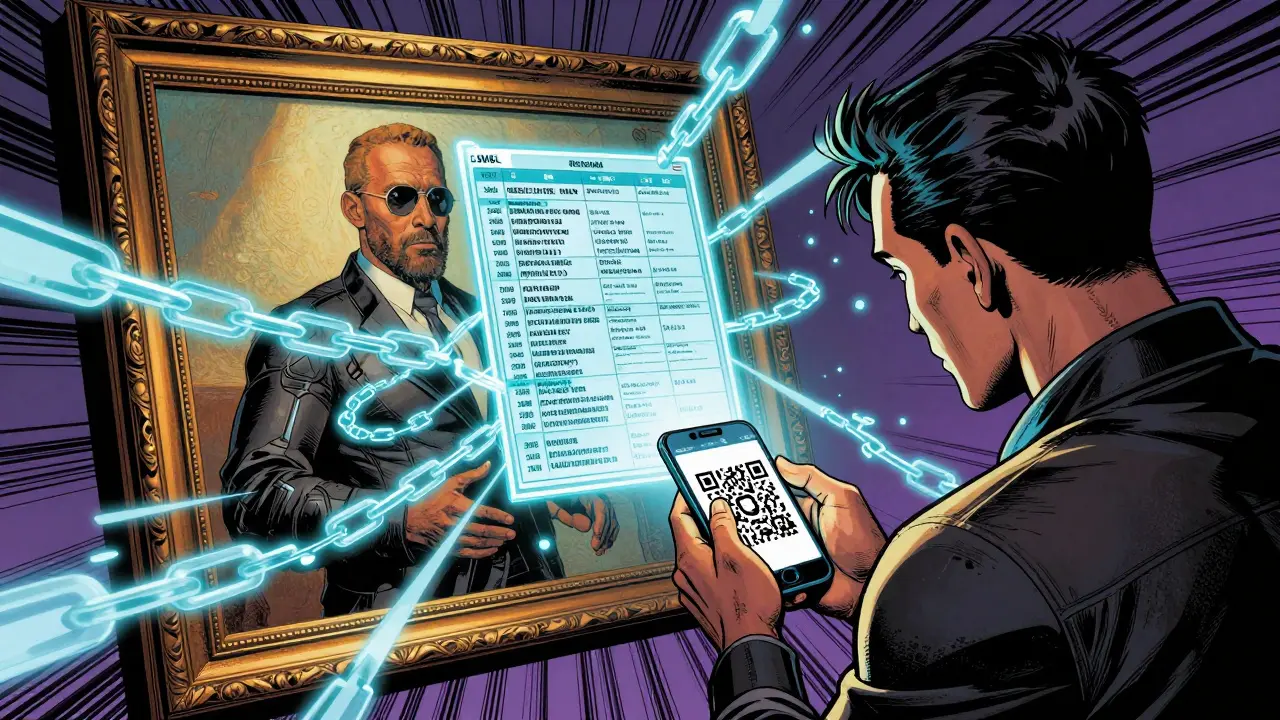
Imagine buying a painting for $50,000-only to find out later it’s a fake. This isn’t science fiction. In the traditional art world, forgeries cost collectors and galleries over $6 billion every year. Now, imagine scanning your phone against the frame of that same painting and seeing a live, unchangeable record showing every owner since the artist created it. That’s what NFTs do for digital and physical art today.
What NFTs Actually Do for Art
NFTs aren’t just JPEGs you buy and show off on your desktop. They’re digital certificates stored on a blockchain-like a public, tamper-proof ledger. Each NFT is unique. Unlike Bitcoin, where every coin is the same, an NFT holds specific data: who made the art, when it was created, who owned it before, and how it’s been verified. This isn’t theory. Since 2020, galleries, artists, and collectors have been using NFTs to replace paper certificates that could be forged, lost, or altered.
The system works because blockchains don’t let you delete or change records. Once an NFT is created and linked to an artwork, that link is permanent. If someone tries to claim they own a piece they don’t, the blockchain shows the truth. No middleman. No guesswork. Just facts.
How Verification Works in Practice
There are three main ways artists and galleries connect physical art to its NFT certificate:
- QR codes-hidden on the back of a frame or canvas. Scan with your phone, and you see the full ownership history, artist info, and even past sale prices.
- NFC chips-tiny embedded chips, like the ones in contactless credit cards. Tap your phone to them, and they unlock encrypted data tied to the NFT. These are tamper-evident: if someone tries to remove or replace the chip, the system flags it.
- Digital watermarks-invisible patterns embedded in the digital file itself. Only special apps can detect them, and they point directly to the NFT on the blockchain. These are especially useful for digital-only art.
These methods aren’t gimmicks. In a 2024 survey by Verifyed.io, 92% of collectors who used QR or NFC verification said they felt more confident about their purchases. One collector on Reddit, u/ArtCollector87, described scanning an NFC chip at a gallery and watching the ownership chain load from the artist to him in under five seconds. “It felt like magic,” he wrote.
Why This Beats Paper Certificates
Before NFTs, authenticity came with a signed piece of paper. Easy to copy. Easy to fake. Easy to lose. NFTs fix all of that.
Here’s the difference:
- Paper certificate: Can be printed by anyone. No way to prove it’s real unless you know the artist’s signature by heart.
- NFT certificate: Stored on a public ledger. Anyone can check it. No one can alter it. Even if you steal the physical artwork, the NFT stays with the rightful owner.
And it’s not just about ownership. NFTs store metadata-details like the creation date, software used, and even the artist’s digital signature. If someone tries to claim a piece is from 2018 but the NFT shows it was minted in 2023, the mismatch is obvious.
Which Blockchains Are Used?
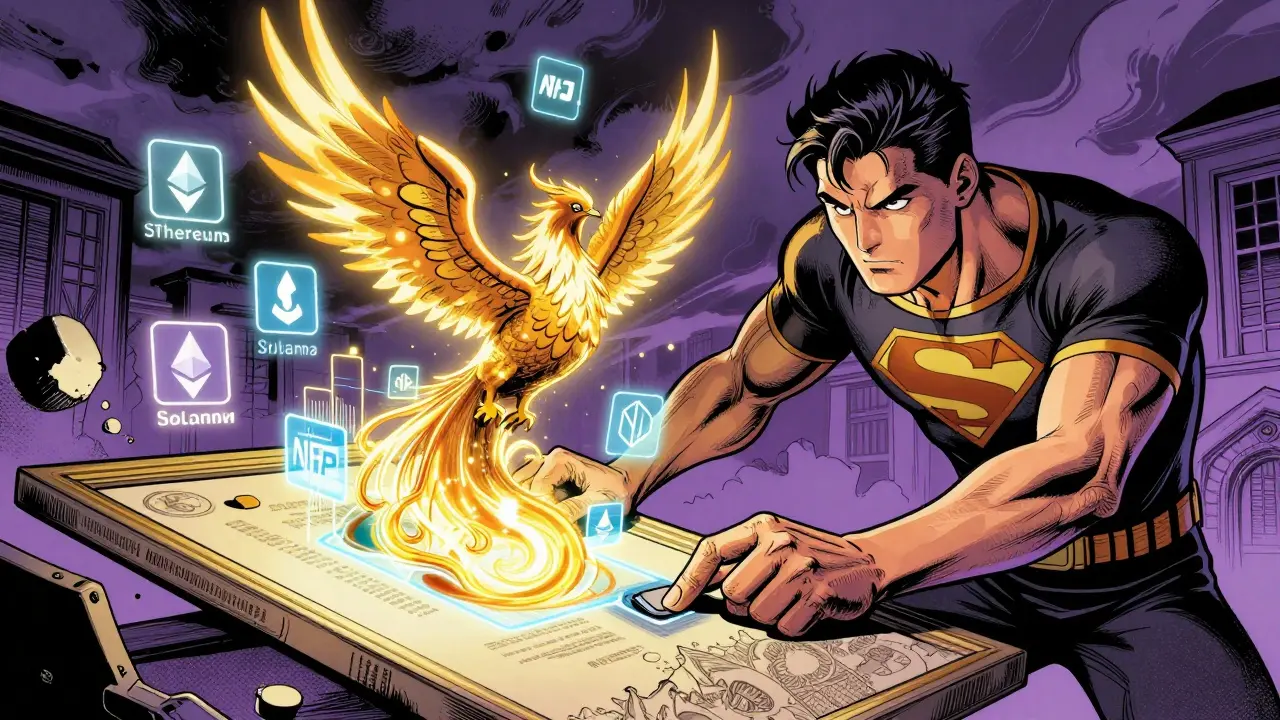
Not all blockchains are equal when it comes to art. As of 2025, Ethereum handles 72% of art-related NFTs. Why? It’s the most trusted, has the longest track record, and supports the ERC-721 standard-the technical blueprint that made NFTs possible.
But Ethereum has a downside: high fees. Gas prices can spike during busy times, making it expensive to mint or transfer an NFT. That’s why alternatives are growing:
- Solana (15% market share): Faster and cheaper. Popular with emerging artists.
- Polygon (8% market share): Built on Ethereum but with lower costs. Used by galleries wanting to reduce barriers for collectors.
Most high-value pieces still live on Ethereum. Christie’s and Sotheby’s still use it for their NFT-backed auctions. But for new collectors or artists just starting out, Solana and Polygon are smart choices.
How Artists Get Started
If you’re an artist, here’s what you actually need to do:
- Create a digital wallet (like MetaMask or Phantom).
- Upload your artwork to a platform like OpenSea, Foundation, or SuperRare.
- Mint the NFT-this means recording it on the blockchain. You pay a one-time fee (gas).
- Link the NFT to your physical piece using a QR code, NFC chip, or watermark.
- Document everything. Keep copies of the NFT ID, wallet address, and verification method.
For someone already comfortable with computers, this takes 10-15 hours. For traditional artists with no tech background, it can take 25-40 hours. That’s a big hurdle. But once it’s done, the system works for you forever. Every resale, every transfer, every verification is automatic.
The Hidden Risks
NFTs aren’t magic. They have real problems.
Wallet security is the biggest. In 2024, Chainalysis found that 43% of stolen NFTs were lost because collectors clicked phishing links or downloaded fake apps. If someone gets your private key, they own your art-no way to get it back.
Gas fees can still surprise you. Minting a single NFT on Ethereum might cost $50 one day and $200 the next. Artists need to plan for that.
Compatibility issues matter too. Not all phones read NFC chips. Older Android models or budget iPhones might not support them. Always test your verification method before selling.
And here’s the big one: blockchain verifies ownership, not physical authenticity. A forger could still paint a perfect copy of a Picasso and attach a real NFT to it. The NFT says “this is the owner’s copy,” but it doesn’t say “this is the original Picasso.” That’s where human experts still matter.
Where Human Expertise Still Matters
Some blockchain fans say “let the code decide.” But art isn’t just data. It’s technique, history, brushwork, materials, aging patterns.
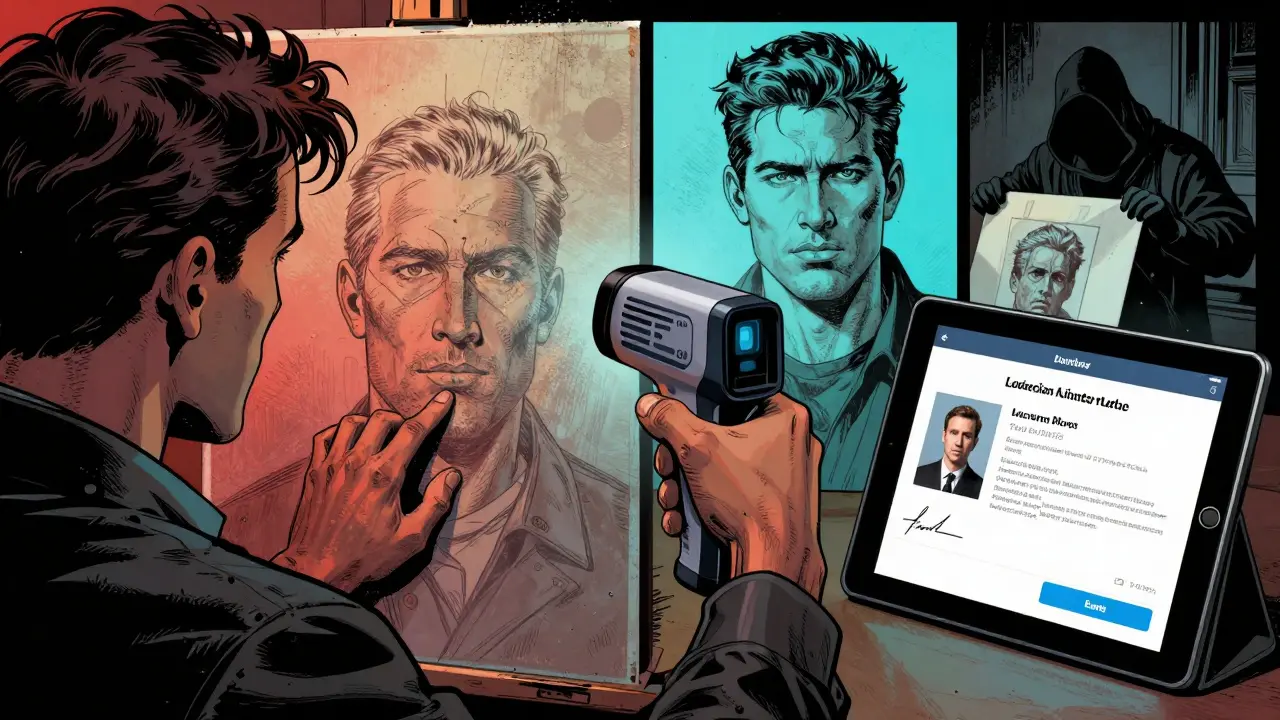
Experts use infrared imaging to see hidden sketches under paint. X-rays reveal overpainting or structural changes. These tools don’t live on the blockchain. They live in labs, museums, and private studios.
That’s why the most reliable systems today combine both. An NFT proves who owns the piece. A human expert proves it’s the real thing. In 2025, Christie’s, Sotheby’s, and 41 of the top 100 galleries use both. They don’t replace experts-they empower them.
Dr. Emily Watson, an art authentication specialist quoted in ArtForum, put it simply: “Blockchain tells you who owns it. We tell you if it’s real.”
What’s Next?
The industry is moving fast. In January 2025, Christie’s, Sotheby’s, and major blockchain platforms launched the Universal Art Authentication Protocol (UAAP). This is a set of shared standards so that an NFT from one platform works the same way on another. No more confusion between systems.
New tech is coming too. VeriArt released NFC chips in March 2025 that include biometric verification-like a fingerprint tied to the artist’s digital signature. AI-powered watermarks are now adapting to different mediums, so they work on canvas, metal, or even ceramic.
Regulations are catching up. The EU’s MiCA law, effective December 2024, now requires NFT marketplaces to verify the identity of sellers and buyers. This stops money laundering and protects collectors.
By 2027, Gartner predicts 75% of high-value art sales will include blockchain verification. But it won’t replace traditional methods. It will layer on top of them.
Is This for You?
If you’re a digital artist, NFT authentication is a no-brainer. It protects your work and builds trust with buyers.
If you’re a traditional artist, consider it if you’re selling high-value pieces. The cost of embedding an NFC chip or QR code is small compared to the risk of forgery.
If you’re a collector, ask: “Can I verify this piece in 10 seconds with my phone?” If the answer is no, dig deeper. Don’t trust a signature on paper. Demand proof on the blockchain.
The art world is changing. The tools are here. The question isn’t whether NFTs work-it’s whether you’re ready to use them.
Can NFTs prove that a physical artwork is real, not a copy?
No, NFTs only prove who owns the digital certificate linked to the artwork. They don’t verify the physical object’s authenticity. That still requires human experts using tools like infrared imaging or X-ray analysis to detect underdrawings, materials, or alterations. The NFT tells you the ownership history. An expert tells you if the piece is genuine.
What happens if I lose my private key to my NFT wallet?
You lose access to your NFT permanently. There’s no password reset, no customer service line, no way to recover it. That’s why security is critical: use a hardware wallet, never share your seed phrase, and avoid clicking suspicious links. Most NFT thefts happen because people give away their keys without realizing it.
Do I need to be tech-savvy to use NFT art authentication?
Not to verify an artwork. Scanning a QR code or tapping an NFC chip takes seconds and needs no technical skill. But to create or buy an NFT, you need to set up a digital wallet and understand basic concepts like gas fees and private keys. For collectors, the verification part is simple. For artists, the setup has a learning curve-expect 10-40 hours of training depending on your experience.
Are NFTs only for digital art?
No. NFTs are used for both digital and physical art. Many galleries now embed QR codes or NFC chips into the frames or backs of physical paintings. The NFT links to the physical object, creating a digital twin that tracks ownership, provenance, and even exhibition history. Luxury brands like Louis Vuitton already do this for handbags and accessories.
Why do some NFTs cost so much to mint?
Minting fees-called gas fees-depend on network demand. Ethereum, the most popular blockchain for art, charges more during busy times because it can only process about 15 transactions per second. When many people are minting at once, fees rise. Platforms like Solana and Polygon offer much lower fees, which is why many artists are switching to them for cost efficiency.
Can I sell an NFT-linked artwork without the physical piece?
Yes, but only if the NFT is designed that way. Some NFTs represent ownership of the digital file only. Others are tied to the physical object. If the NFT includes a clause like “ownership of the physical artwork is transferred with the NFT,” then selling the NFT means selling the painting too. Always check the terms before buying or selling.
Is NFT art authentication legal?
Yes, and it’s becoming regulated. The EU’s MiCA law, effective in December 2024, requires NFT marketplaces to verify user identities and prevent money laundering. In the U.S., NFTs are still treated as property, not securities, but this could change. As long as the system doesn’t deceive buyers, NFT authentication is fully legal and increasingly required by major auction houses.
 Cryptocurrency Guides
Tom Sheppard
February 2, 2026 AT 17:31Aaron Poole
February 3, 2026 AT 17:06Jerry Ogah
February 4, 2026 AT 00:39Will Pimblett
February 5, 2026 AT 18:43Rico Romano
February 7, 2026 AT 13:00Meenal Sharma
February 7, 2026 AT 19:55mary irons
February 9, 2026 AT 05:47Wayne mutunga
February 10, 2026 AT 00:48Katie Teresi
February 11, 2026 AT 00:35Moray Wallace
February 12, 2026 AT 07:06Dahlia Nurcahya
February 12, 2026 AT 20:51William Hanson
February 13, 2026 AT 16:51Lori Quarles
February 15, 2026 AT 05:20Jeremy Dayde
February 15, 2026 AT 19:41Steven Dilla
February 17, 2026 AT 17:17Akhil Mathew
February 17, 2026 AT 20:46Ramona Langthaler
February 18, 2026 AT 23:43Kevin Thomas
February 19, 2026 AT 00:54Robert Mills
February 20, 2026 AT 08:10Andrea Demontis
February 21, 2026 AT 15:07Joseph Pietrasik
February 23, 2026 AT 07:18