
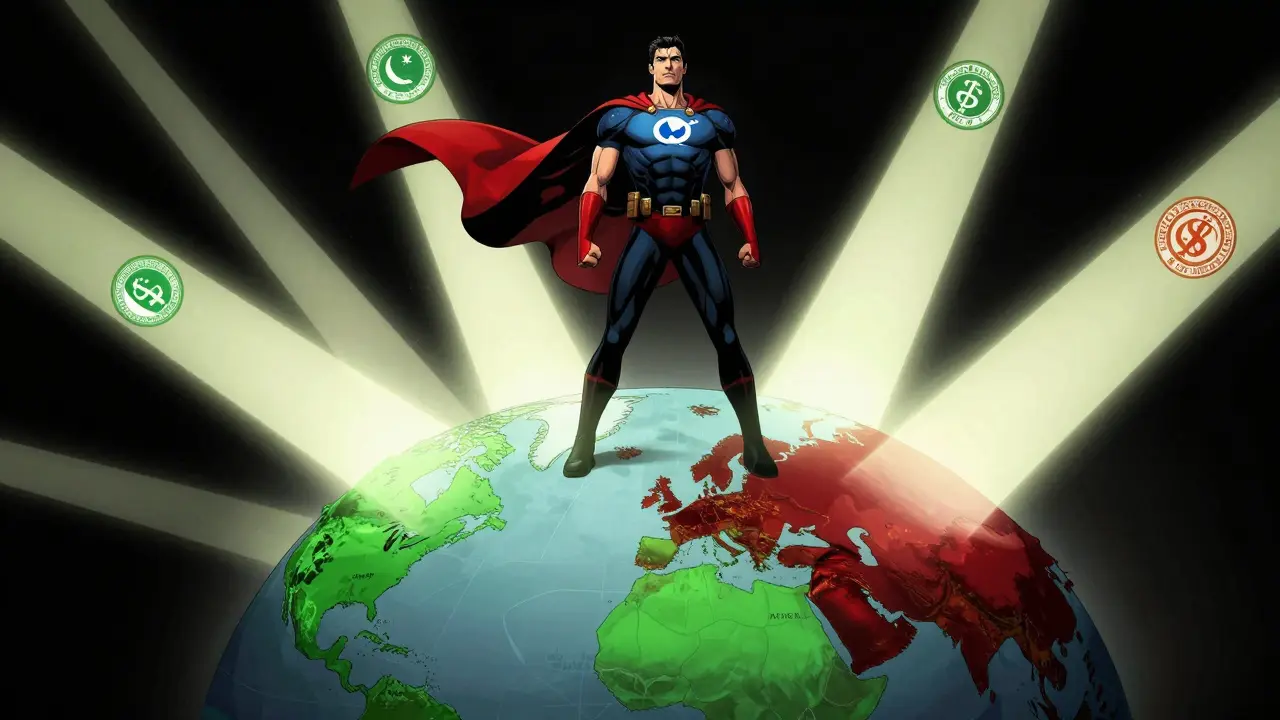
If you’re trying to buy crypto with real money on Coinbase and got blocked, you’re not alone. Thousands of users in countries like Pakistan, Nigeria, and the Philippines face the same wall: Coinbase says "not available"-even if they have a valid ID, a bank account, and a clear conscience. This isn’t a glitch. It’s policy. And understanding why-and where-you can or can’t use Coinbase’s fiat services could save you time, money, and frustration.
What Coinbase Actually Blocks-And Why
Coinbase doesn’t block countries randomly. It follows a strict, legal map drawn by U.S. regulators and global compliance rules. The main reason? The U.S. Treasury’s Office of Foreign Assets Control (OFAC). If a country is on OFAC’s sanctions list, Coinbase shuts down its fiat services there. That includes Russia, Iran, North Korea, Syria, Cuba, and Crimea. No exceptions. Even if you’re a tourist in Russia with a U.S. bank account, you can’t deposit dollars to buy Bitcoin on Coinbase. But it’s not just about sanctions. Some countries aren’t sanctioned, but Coinbase still blocks them because local laws make it too risky. India, for example, has no outright ban on crypto-but the Reserve Bank of India (RBI) doesn’t allow banks to work with crypto exchanges. So Coinbase pulled its fiat services in 2023. Same in Egypt and Nigeria, where central banks issued warnings or outright bans on crypto-related banking. Coinbase doesn’t want to risk fines, lawsuits, or losing its U.S. banking partners.Where You Can Use Coinbase’s Full Services
Coinbase lets you buy, sell, and withdraw crypto using real money in 48 countries. Most are in North America, Western Europe, and parts of Asia-Pacific. Here’s the shortlist of major ones:- United States
- United Kingdom
- Germany, France, Spain, Italy
- Canada, Australia, New Zealand
- Singapore, Japan, South Korea
- Switzerland, Netherlands, Sweden
What’s the Difference Between Coinbase App and Coinbase Wallet?
This is where people get confused. There are two apps:- Coinbase App: This is the full-service exchange. You buy crypto with fiat, trade between coins, and cash out. Only available in 48 countries.
- Coinbase Wallet: This is a self-custody wallet. No fiat. No bank links. Just crypto. You can store, send, and interact with decentralized apps (dApps). It works in almost every country-except the 10-15 on OFAC’s sanctions list.
Where You’re Partially Blocked-And What You Can Do
Some countries sit in a gray zone. You can’t use bank transfers, but you can still use Apple Pay or Google Pay. The UAE is one example. Coinbase allows Apple Pay deposits for crypto purchases but blocks direct bank transfers. Why? Because UAE banks are cautious about crypto, even though the government has a crypto licensing framework. Another example is Colombia. The Coinbase App is blocked for new users, but if you were already on the platform before 2024, you can still trade. New users? No fiat access. You can still use Coinbase Wallet, but again-you’ll need to find another way to get crypto in. In the Philippines, 83% of crypto users want to buy with pesos, according to the Bangko Sentral. But Coinbase doesn’t offer peso deposits. Instead, locals use local exchanges like PDAX or Coins.ph-where fees are 3.5%, compared to Coinbase’s 0.5%. So you’re paying more just because Coinbase won’t play ball.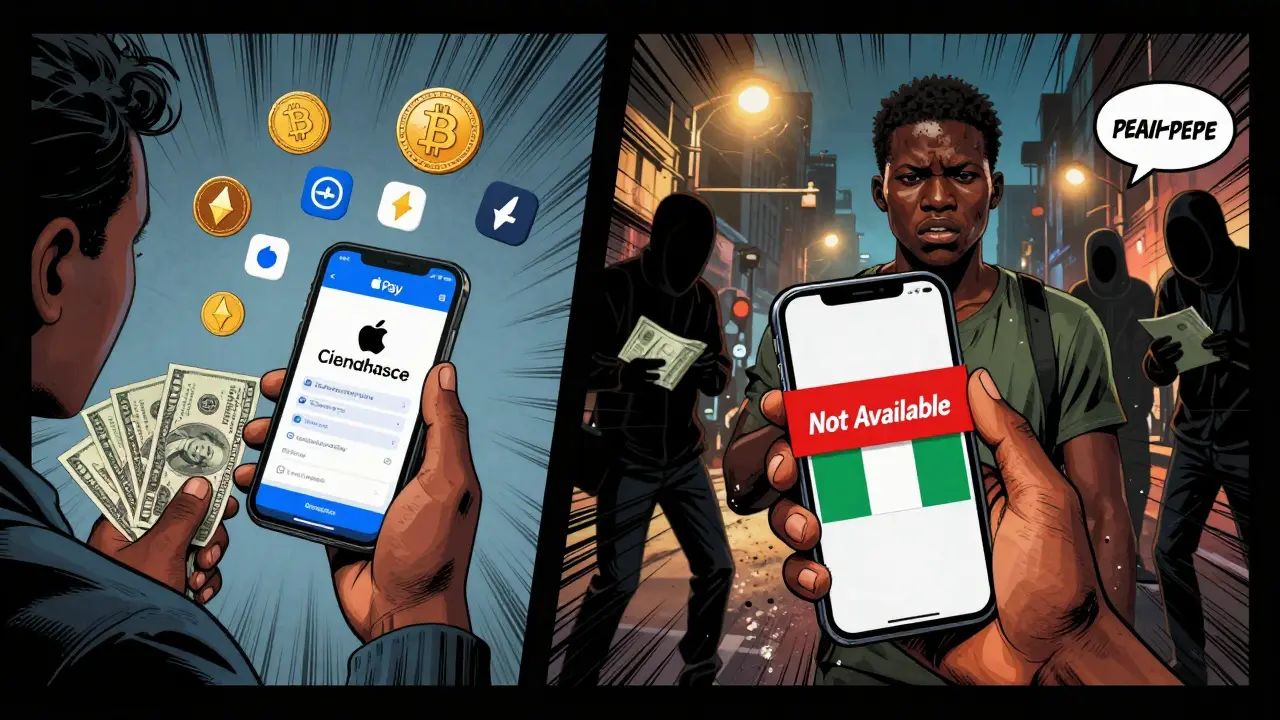
Why Binance and Kraken Are Different
If you’re frustrated with Coinbase’s limits, it’s worth comparing. Binance operates in more than 100 countries with fiat access in over 70. In Pakistan, Binance P2P handles 200,000 daily trades in rupees. In Nigeria, you can buy Bitcoin with naira via bank transfer. Kraken is even wider-it supports fiat in 55 countries, including places like Brazil and Turkey where Coinbase doesn’t go. But here’s the trade-off: Coinbase is regulated. It’s registered with the SEC. It follows strict anti-money laundering rules. Binance and Kraken have faced legal trouble in the U.S. and EU. Kraken settled with the SEC in 2024. Binance paid $4.3 billion in fines in 2023. So if you want safety and legal compliance, Coinbase wins. If you want access, Binance often wins.What Happens If You Use a VPN?
Some users try to bypass restrictions with a VPN. They change their IP address to make it look like they’re in the U.S. or Germany. But Coinbase’s system catches this. It checks your IP, your device ID, your bank details, and your KYC documents. If they don’t match, your account gets flagged. One user in the UAE reported losing $2,300 after using a VPN to access Coinbase. His account was frozen, then permanently closed. He couldn’t get his funds back. Coinbase’s terms say they can terminate accounts if you violate location rules. No appeal. No refund.What About New Regulations Like MiCA?
Europe’s Markets in Crypto-Assets (MiCA) law took full effect in June 2024. It forced Coinbase to restructure its European operations. Instead of one entity serving all EU countries, it now uses Coinbase Luxembourg S.A. for Malta, Iceland, Liechtenstein, and Hungary. This change didn’t expand access-it just made compliance cleaner. MiCA also created new rules for staking. Cardano (ADA) staking, for example, is blocked in 12 EU countries because it’s classified as a financial product. You can still hold ADA, but you can’t earn rewards on Coinbase in those places.
What’s Next? Will Coinbase Expand?
Right now, Coinbase is focused on staying legal in the U.S. and EU. It’s not pushing into emerging markets. Why? Because the cost of compliance there is too high. Hiring local lawyers, setting up bank partnerships, navigating unclear regulations-it’s expensive. And the revenue potential is low compared to the U.S. and Europe, which make up 78% of Coinbase’s income. India is the big wildcard. The RBI is still reviewing crypto regulations. If India legalizes crypto banking in 2025, Coinbase might return. But for now, it’s on pause.What Should You Do If You’re Blocked?
If you’re in a restricted country:- Use Coinbase Wallet to store crypto you already own.
- Use peer-to-peer platforms like Binance P2P, LocalBitcoins, or Paxful to buy crypto with cash or bank transfers.
- Never use a VPN to access fiat services-it’s a direct violation and risks your funds.
- Check Coinbase’s official country list by logging into your account. The app shows real-time availability.
- Consider local exchanges if they’re reliable and regulated in your country.
Why This Matters Beyond Just Access
Coinbase’s restrictions aren’t just about business-they’re about power. The U.S. government controls global finance through the dollar and its sanctions system. By following OFAC rules, Coinbase acts as an extension of that system. That means people in countries under sanctions or economic pressure lose access to a key financial tool. MIT researchers found that Coinbase’s geo-blocks reduce illicit activity by 78% in sanctioned regions. That’s good for compliance. But it also blocks 12.7 million unbanked people who just want to save money or send remittances. That’s the real cost of regulation. In the long run, decentralized wallets like MetaMask or Trust Wallet don’t care where you live. They work everywhere. But they don’t let you buy crypto with your bank account. So you’re stuck choosing between safety and access.Can I use Coinbase in Pakistan?
You can use Coinbase Wallet in Pakistan to store and send crypto, but you cannot buy or sell crypto with Pakistani rupees. The fiat services (bank transfers, cards, Apple Pay) are blocked. Most users in Pakistan use Binance P2P or LocalBitcoins to buy crypto directly from other people, though fees are higher-often 5-10% above market price.
Why is Coinbase not available in India?
Coinbase stopped offering fiat services in India in 2023 because the Reserve Bank of India (RBI) doesn’t allow banks to process crypto-related payments. While crypto isn’t illegal in India, banks refuse to work with exchanges. Coinbase chose to exit rather than risk losing its U.S. banking relationships. As of early 2025, RBI is reviewing its stance, but Coinbase has not announced plans to return.
Can I use Coinbase in the UAE?
Yes, but only partially. You can deposit funds using Apple Pay or Google Pay to buy crypto, but bank transfers (like wire or AED transfers) are blocked. This is because UAE banks are still cautious about crypto, even though the government has licensed crypto businesses. You can’t cash out to a local bank account, but you can trade between crypto assets and withdraw to a wallet.
Does Coinbase work in Nigeria?
No. Coinbase blocks all fiat services in Nigeria. The Central Bank of Nigeria banned crypto transactions through banks in 2021, and while that ban was lifted in 2023, banks still avoid crypto exchanges. Coinbase has not re-entered the market. Nigerians use Binance P2P, Luno, or Yellow Card to buy crypto with naira.
Is Coinbase Wallet safe to use in restricted countries?
Yes. Coinbase Wallet is a non-custodial wallet, meaning you control your private keys. It works in nearly every country except those under U.S. sanctions (like Russia or Iran). Since it doesn’t involve fiat or bank accounts, it’s not subject to the same geographic restrictions as the Coinbase App. Just remember: you still need to get crypto into the wallet from another source.
What happens if I use a VPN to access Coinbase?
Using a VPN to access Coinbase’s fiat services violates their terms of service. Coinbase checks your IP address, device fingerprint, and KYC documents. If they detect a mismatch, your account will be frozen or permanently closed. In multiple cases, users lost access to their funds with no recourse. It’s not worth the risk.
Why can I use Coinbase in Germany but not in Brazil?
Germany has clear crypto regulations and fully licensed exchanges. Coinbase holds a BaFin license there, making it legal to offer fiat services. Brazil has no national ban on crypto, but banks are reluctant to work with exchanges. Coinbase hasn’t built the local banking partnerships needed to operate there. It’s not about legality-it’s about infrastructure and risk.
Can I still use Coinbase if I move to a restricted country?
If you move to a country where Coinbase doesn’t offer fiat services, you’ll lose the ability to deposit or withdraw money. Your existing holdings stay in your account, but you can’t buy more with local currency. You can still trade between crypto assets and use Coinbase Wallet. To get new crypto, you’ll need to use a local P2P platform or transfer from another exchange.
 Cryptocurrency Guides
Shane Budge
December 4, 2025 AT 21:06So Coinbase just picks winners and losers based on US politics? Wild.
Joe West
December 6, 2025 AT 11:26Biggest thing people miss: Coinbase Wallet isn't a workaround-it's the future. Self-custody means no gatekeepers. Stop begging for fiat access and learn to move crypto peer-to-peer. You'll be freer in 3 days.
Stanley Wong
December 7, 2025 AT 17:01I get why Coinbase does this but it's kind of heartbreaking. I have friends in Nigeria who use crypto to send money home instead of Western Union. Now they're stuck paying 15% fees on P2P because a US bank's compliance team decided it's too risky. We're building a decentralized financial system but still letting Wall Street dictate who gets to play. It's like having a revolution but keeping the king's guards in charge.
Sandra Lee Beagan
December 9, 2025 AT 00:15As a Canadian, I'm lucky but also kind of ashamed. We're on the "allowed" list but barely. Coinbase Canada has worse rates than local exchanges. And don't get me started on how they treat small investors. It's not about compliance-it's about profit margins. They'll serve the 1% with $50k/day limits but make the rest jump through hoops for $500.
Nicole Parker
December 10, 2025 AT 13:32It's not just about access-it's about dignity. When you're from a country that's been exploited for decades, being told you can't use a tool because your government is "too risky" feels like being told your life doesn't matter. I get the legal stuff, but the human cost? That's the real story. And no one talks about it.
Brooke Schmalbach
December 10, 2025 AT 15:41Let me be the annoying one who says this: If you're in Nigeria and using Binance P2P, you're already part of the problem. Those traders are scalping people who need food money. And you think Coinbase is the villain? Look at the people buying crypto with naira at 10% premium-they're the ones enabling the scam ecosystem. Stop romanticizing P2P. It's not liberation-it's a pyramid with you at the bottom.
Scott Sơn
December 10, 2025 AT 18:16COINBASE IS A CORPORATE GATEKEEPER IN A WORLD THAT DEMANDS OPENNESS. THEY'RE NOT A BANK. THEY'RE A FEDERAL AGENT WITH A LOGO. AND WE'RE ALL JUST PLEASANTLY TAKING OUR LICKS WHILE THEY COLLECT THEIR REGULATORY BOUNTY. 🤡
Barb Pooley
December 10, 2025 AT 20:56Anyone else think this is all a setup? What if Coinbase is deliberately blocking countries so they can sell "crypto education" later? Like, "Hey, you were blocked? Now pay $99/month to learn how to use a VPN safely!" I'm not saying it's true... but why do they never fix it? Why not just get a local partner? It's too convenient. Too... corporate.
Kenneth Ljungström
December 11, 2025 AT 13:39For anyone in India: I used to rage about this too. Then I got Coinbase Wallet, bought ETH via Binance P2P, and now I hold it like a vault. No bank? No problem. You don't need Coinbase to be your bank-you need it to be your wallet. And trust me, once you learn to self-custody, you never go back. 🙌
Lore Vanvliet
December 12, 2025 AT 03:30Oh please. The US has a right to protect its financial system. If your country is too chaotic, too corrupt, too unstable-then you don't get to play. It's not discrimination, it's common sense. You want crypto? Build a real economy first. Stop blaming Coinbase for your government's failures.
jonathan dunlow
December 12, 2025 AT 16:23Look, I've been in crypto since 2017. I've seen exchanges come and go. But Coinbase? They're the only one that actually follows the rules-and that's why they survive. Yes, it sucks if you're in Pakistan. But if they didn't follow OFAC, they'd be shut down tomorrow. The real villain here isn't Coinbase-it's the global financial system that lets one country's rules control the world. We need better regulation, not more loopholes.
michael cuevas
December 14, 2025 AT 03:02Just use a VPN and move on. They won't catch you. I did it for 2 years in Colombia. Bought $15k in BTC. Got flagged once. Sent them a screenshot of my passport and said "I'm on vacation." They unblocked me. People are too scared to take risks. Crypto is about freedom. Not following rules written by accountants in DC.
sonia sifflet
December 15, 2025 AT 10:20India banned banks from crypto in 2018. Lifted in 2020. Then banks still refused. So Coinbase left. Now you're mad? Who do you think pressured the banks? The same US regulators who force global banks to cut ties. You're angry at the wrong target. The real enemy is the dollar system. Coinbase is just the messenger.
Ben VanDyk
December 17, 2025 AT 03:52Typo in the post: "Coinbase Wallet" is listed as "non-custodial"-correct. But then it says "over 5,500 tokens"-that's wrong. It supports ~200. The rest are via integrations. Minor, but I'm the guy who notices these things. Also, "SEPA clears in under two hours"? Only if you're lucky. Mine took 18 hours last week. Stop overselling.
Cristal Consulting
December 17, 2025 AT 20:37For those stuck: Start small. Buy $20 worth of BTC on Binance P2P. Send it to Coinbase Wallet. Then trade it for other coins. Learn how to send and receive. Don't wait for permission. You don't need a bank to be part of crypto. You just need a phone and courage. You got this.
Frank Cronin
December 19, 2025 AT 06:23Oh look, another crybaby who thinks the world owes them access to a US-based financial platform. If you live in a country where the central bank hates crypto, maybe the problem isn't Coinbase-it's your government. Or worse, your own lack of financial literacy. Go learn how to use a hardware wallet instead of whining.
Nina Meretoile
December 20, 2025 AT 02:54It’s not about the money. It’s about belonging. When I moved from the US to the Philippines, I felt like a ghost. I could hold crypto but couldn’t buy it. I cried. Not because I lost access to Bitcoin-but because I lost access to the conversation. Crypto was supposed to be for everyone. Turns out, it’s only for the countries the West says are "safe."
nicholas forbes
December 21, 2025 AT 10:13Anyone who says "just use a VPN" is either naive or dangerous. I know someone who lost $8k because Coinbase flagged their account. They had a US passport, lived in Mexico, used a US bank-but their phone’s location was off. They spent 6 months fighting it. No one helped. No one cared. This isn't a hack-it's a minefield.
miriam gionfriddo
December 22, 2025 AT 02:40COINBASE IS A CORPORATE SLAVE TO THE DOLLAR EMPIRE AND WE'RE ALL JUST FIGHTING FOR CRUMBS WHILE THEY LAUGH IN THEIR SILICON VALLEY LOUNGE CHAIRS. 🤡💸 #OFACISFASCISM
Richard T
December 23, 2025 AT 00:10What's the real difference between Coinbase and Binance? One is regulated and slow. The other is chaotic and risky. But both are still centralized. The real solution? Decentralized on-ramps. Like MoonPay alternatives built on local P2P networks. That's the future. Not waiting for Coinbase to change their mind.
Tom Van bergen
December 23, 2025 AT 22:54Why do we keep pretending this is about compliance? It's about control. The same banks that funded the war in Iraq now decide who can buy Bitcoin. The same system that froze Russian assets now blocks Nigerian mothers. We call it regulation. It's just empire wearing a suit.