
Imagine finding a digital currency designed specifically to buy and sell platinum. Sounds like a solid idea for hedging against market volatility, right? That was the promise of PlatinumBAR, also known as XPTX, a cryptocurrency that launched with ambitions to bridge the gap between blockchain technology and physical precious metals. But if you are looking at it today in 2026, you might be scratching your head. Where are the buyers? Where are the exchanges? Why does the price look so erratic?
The short answer is that PlatinumBAR is widely considered a "dead" or abandoned project. It serves as a cautionary tale in the crypto world about what happens when a niche concept fails to gain traction. In this guide, we will break down what XPTX actually is, how its unique technology worked, why it failed to catch on, and what you should know if you still hold some coins in an old wallet.
Key Takeaways
- Status: PlatinumBAR (XPTX) is effectively defunct with near-zero liquidity and no active development since roughly 2021.
- Tech Stack: It uses the Quark hashing algorithm and a hybrid Proof-of-Work/Proof-of-Stake consensus model.
- Market Reality: With a market cap under $15,000 and listings on zero major exchanges, selling XPTX is extremely difficult.
- Risk Level: Extremely High. The coin has lost over 99% of its all-time high value.
- Alternative: If you want crypto exposure to precious metals, established tokens like PAX Gold (PAXG) are far more viable.
What Exactly Is PlatinumBAR (XPTX)?
To understand why XPTX exists, we have to look back at its origins. Launched in April 2017 (though some sources cite 2018), PlatinumBAR was created to facilitate transactions in the precious metals market. The creators envisioned a decentralized platform where people could trade platinum-backed assets without relying on traditional banks or brokers.
Unlike Bitcoin, which aims to be digital gold, or Ethereum, which aims to be a global computer, XPTX had a very specific job: handle metal trades. It operates on its own independent blockchain, separate from major networks like Binance Smart Chain or Solana. This independence meant it needed its own miners and validators to keep running, which turned out to be a significant hurdle.
Here is the core problem: while the idea of tokenizing platinum is great, XPTX never successfully linked its digital tokens to actual physical platinum reserves in a way that attracted institutional trust or retail users. It remained a standalone coin with a thematic name rather than a functional financial instrument backed by audited metal.
How the Technology Works: Quark and Hybrid Consensus
One reason developers chose XPTX initially was its technical setup. It doesn't use the standard SHA-256 algorithm found in Bitcoin. Instead, it relies on the Quark algorithm.
Quark is interesting because it chains together nine different hash functions in sequence. This was designed to make mining resistant to specialized hardware like ASICs, allowing regular CPUs and GPUs to participate fairly. For a small community project, this sounded democratic and secure.
XPTX also employs a hybrid consensus mechanism:
- Proof of Work (PoW): Miners solve complex mathematical problems using the Quark algorithm to create new blocks.
- Proof of Stake (PoS): Holders can "stake" their coins to help validate transactions and earn rewards, similar to how Ethereum works now but based on the older Novacoin protocol.
On paper, this dual approach offers security and accessibility. However, in practice, the low number of participants means the network is fragile. Block times are set to two minutes, and difficulty adjusts every five blocks. Without enough miners keeping the lights on, transaction confirmations can become slow or unreliable.
| Feature | Detail |
|---|---|
| Hashing Algorithm | Quark (9-hash chain) |
| Consensus Model | Hybrid PoW / PoS |
| Block Time | 2 minutes |
| Total Supply | 2,160,126 XPTX |
| Mining Software | sgminer (CPU/GPU) |
The Market Reality: Why XPTX Struggles
If you check the current status of PlatinumBAR, the numbers are stark. As of mid-2026, XPTX ranks outside the top 6,000 cryptocurrencies by market capitalization. Its total market cap hovers around a mere $14,800. To put that in perspective, that is less than the value of a single luxury car.
There are several reasons for this decline:
Lack of Liquidity: You cannot easily buy or sell XPTX on major exchanges like Coinbase, Binance, or Kraken. While data aggregators might show a price, there are often no actual orders waiting to match yours. This is known as "zero liquidity." If you try to sell, you might find yourself holding a coin with no buyer.
Data Discrepancies: Different tracking platforms show wildly different prices. One site might list it at $0.04, while another shows $0.006. This inconsistency usually indicates that the price is being calculated from stale or manipulated data rather than real trading activity.
Abandonment: Development updates stopped years ago. The GitHub repositories associated with the project show minimal activity. There is no active community on Telegram or Discord, and Reddit discussions are virtually nonexistent. When a project claims "Long Term Support" but stops posting code updates, it’s a red flag.
Comparing XPTX to Viable Alternatives
If your goal is to invest in precious metals via cryptocurrency, XPTX is likely not the right tool. Let's compare it to a leading competitor in this space: PAX Gold (PAXG).
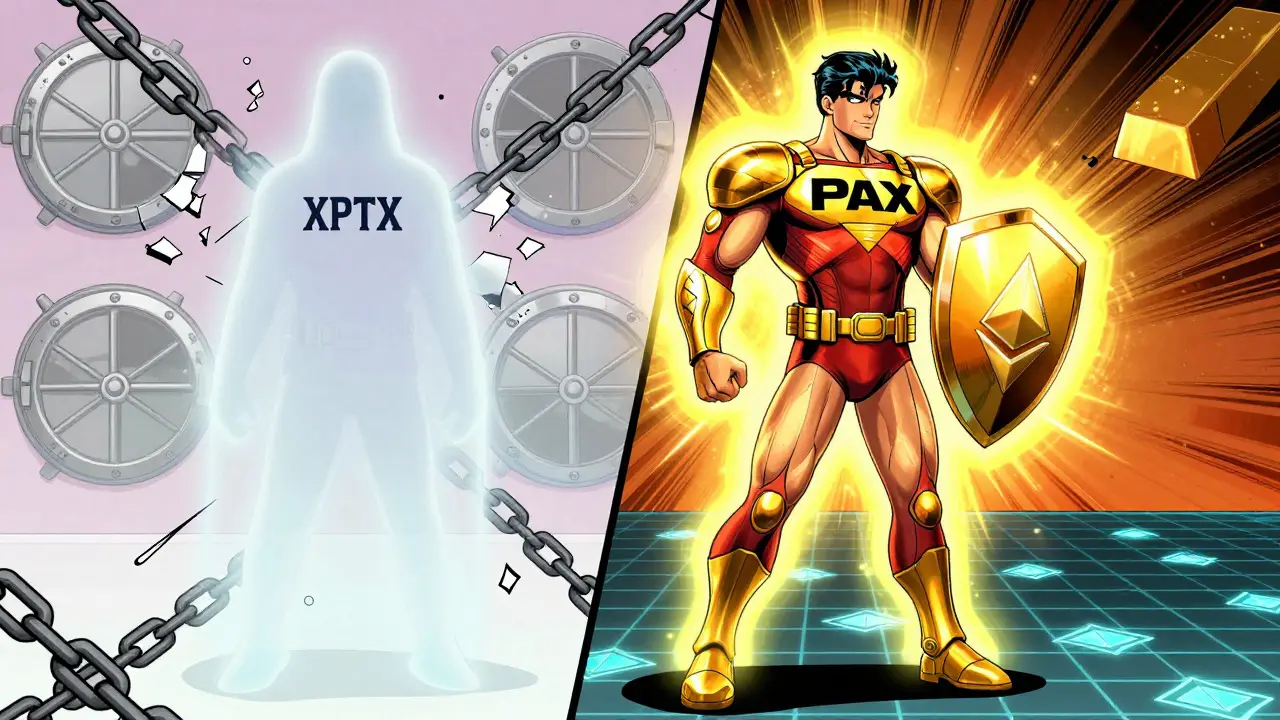
PAXG is an ERC-20 token on the Ethereum network. Each PAXG token is backed by one troy ounce of a London Good Delivery gold bar, stored in vaults in London. This creates a direct link between the digital token and physical reality.
| Feature | PlatinumBAR (XPTX) | PAX Gold (PAXG) |
|---|---|---|
| Backing | None (Thematic only) | Physical Gold (Audited) |
| Network | Independent Blockchain | Ethereum (ERC-20) |
| Liquidity | Near Zero | High (Major Exchanges) |
| Market Cap | ~$15,000 | ~$350 Million+ |
| Development Status | Abandoned | Active & Supported |
The contrast is clear. PAXG benefits from the massive ecosystem of Ethereum, ensuring easy transfers, widespread exchange support, and transparent audits. XPTX lacks all these advantages. For investors seeking stability and real-world asset backing, XPTX offers neither.
Should You Still Hold XPTX?
Maybe you mined some XPTX back in 2018 and forgot about it. Or perhaps you bought it during a brief hype cycle. What should you do now?
First, check if you can actually access your funds. Since the network has few nodes, syncing your wallet might take a long time. The official website suggests downloading blockchain .dat files to bootstrap your wallet, which is a manual process indicating weak network health.
If you can access your coins, consider whether the effort to sell them is worth it. Given the lack of exchanges, you might need to find a peer-to-peer buyer on obscure forums, accepting a heavy discount. For most holders, the value is negligible, and the coin may eventually become worthless as the last few nodes go offline.
It is important to treat any remaining XPTX as a sunk cost. Do not invest more money hoping for a revival. In the crypto world, projects that lose their community and developer base rarely come back from the dead.
Conclusion
PlatinumBAR (XPTX) started with an interesting premise: combining blockchain with precious metals trading. However, due to poor execution, lack of liquidity, and eventual abandonment, it has faded into obscurity. It serves as a reminder that in cryptocurrency, technology alone isn't enough. You need active development, a strong community, and real utility to survive.
If you are interested in precious metals crypto, look toward established, audited projects on major blockchains. For everything else, XPTX remains a historical footnote-a ghost town in the vast landscape of digital assets.
Is PlatinumBAR (XPTX) a scam?
While not necessarily a malicious scam in the legal sense, XPTX is widely regarded as an abandoned project. It failed to deliver on its promises of facilitating precious metals transactions and has seen its value drop by over 99%. Investors who bought in early lost most of their money due to lack of liquidity and development.
Where can I buy PlatinumBAR (XPTX)?
Currently, XPTX is listed on zero major exchanges. You might find traces of it on obscure peer-to-peer platforms or defunct exchange archives, but buying it carries extreme risk due to the inability to sell it later. Most data trackers show no active markets.
What is the Quark algorithm used by XPTX?
The Quark algorithm is a cryptographic hash function that combines nine different hashing algorithms in sequence. It was designed to prevent ASIC dominance, making mining accessible to CPUs and GPUs. However, its complexity and niche adoption limited its popularity compared to simpler algorithms like SHA-256.
Does XPTX have any real-world use cases?
No. Despite its name, PlatinumBAR does not appear to be backed by physical platinum nor is it accepted by merchants for metal purchases. Its primary "use case" now is merely existing on a dormant blockchain, with no significant commercial or industrial application.
Why did PlatinumBAR fail?
XPTX failed due to a combination of factors: lack of liquidity, absence of major exchange listings, cessation of development updates, and failure to establish a tangible connection to physical precious metals. Competitors like PAX Gold offered better security, transparency, and ease of use, drawing users away from niche projects like XPTX.
 Cryptocurrency Guides