
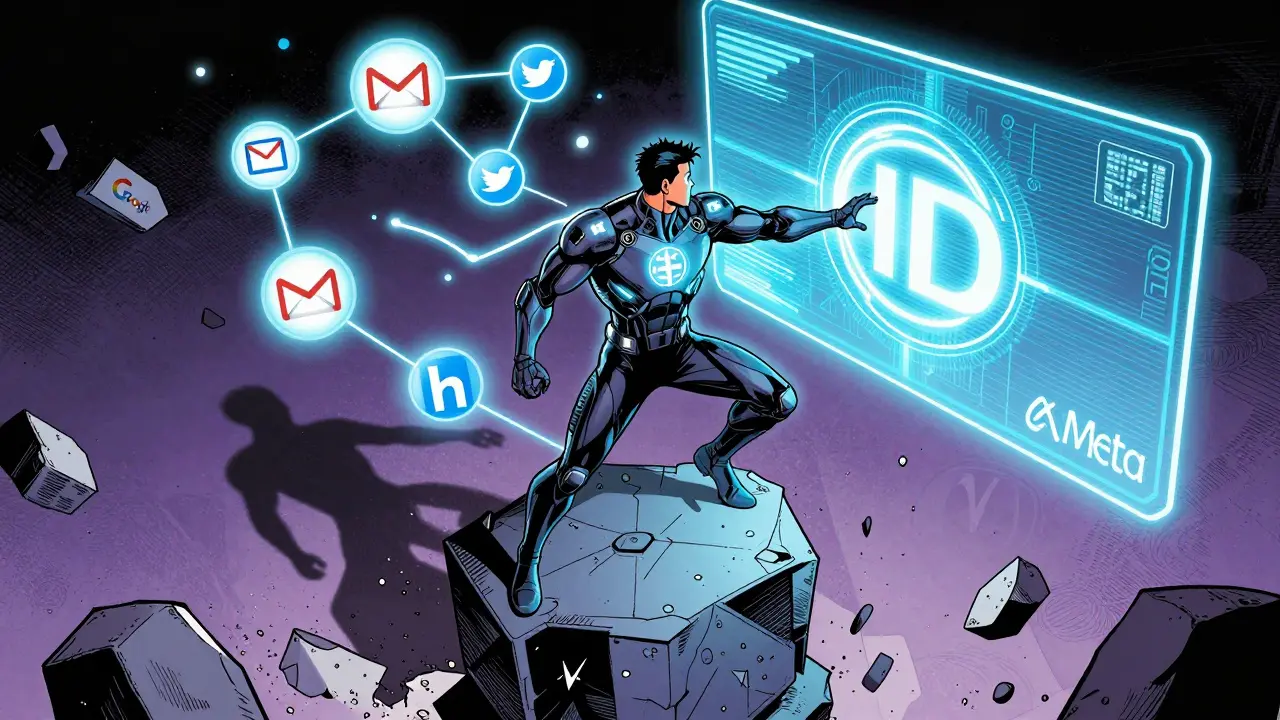
Most people hear "crypto coin" and think of Bitcoin or Ethereum. But there’s a whole layer of blockchain projects that aren’t about trading or speculation-they’re about identity. Karat (KAT) is one of them. It’s not designed to be the next big price pump. Instead, it’s trying to solve a real problem: how do you prove who you are online without handing over your email, Twitter, or phone number to every app that asks?
What Karat Actually Does
Karat isn’t just a token. It’s a protocol that links your Web2 accounts-like your Gmail, X (Twitter), or LinkedIn-to your crypto wallet. Think of it like a digital ID card that lives on the blockchain. When you sign up for a new DeFi app or social platform, instead of logging in with Google or Facebook, you can prove you’re real using your Karat ID. And here’s the kicker: you still own your data. No company stores it. No middleman controls it.
This works through two advanced technologies: Multi-Party Computation (MPC) and Zero-Knowledge proofs. MPC lets your private keys be split across multiple computers so no single point can be hacked. Zero-Knowledge proofs let you prove something is true-like "I’m over 18" or "I own this Twitter account"-without showing the actual data. All of this is stored on IPFS, a decentralized file system, not on a central server.
How Karat ID Works
To get a Karat ID, you need to stake 500 KAT tokens for seven days. That’s not a purchase-it’s a lock-up. You’re not paying to join; you’re proving you’re serious. Once you stake, you gain access to a private chat room with a content creator (like a creator on YouTube or Twitch), and your Web2 identity gets verified and linked to your wallet. The creator gets 50 KAT staked in their validator for 30 days per new user. It’s a simple incentive system that rewards participation.
Once you have a Karat ID, you can use it across any app that supports it. Need to prove you’re a verified user on a gaming platform? Show your Karat ID. Want to log into a DAO without a password? Use your verified identity. Over 100 protocols have already asked to use Karat’s data during their alpha phase, including DeFi apps, social networks, and advertising platforms. That’s not hype-it’s adoption.
Why It’s Built on ZKSync
Karat runs on ZKSync, a Layer-2 blockchain built on Ethereum. Why does that matter? Because ZKSync is fast and cheap. Transactions cost pennies and confirm in seconds. That’s critical when you’re dealing with identity verification-imagine having to pay $5 every time you want to prove your email is real. On Ethereum mainnet, that would kill adoption. On ZKSync, it’s doable.
And Karat isn’t just another project on ZKSync-it’s the largest protocol there. As of late 2024, over 300,000 wallets are actively using Karat’s services. More than 250,000 of those wallets are KYC-verified, meaning they’ve linked real-world identities to their crypto wallets. That’s more verified users than most identity projects have in total.

The Token: KAT Supply and Tokenomics
The KAT token has a total supply of 1.96 billion, with a maximum cap of 2 billion. As of September 2024, only about 255 million are in circulation-just 13% of the total. That means most of the supply is still locked up in staking, vesting, or reserves.
At its peak in August 2023, KAT hit $0.058. Today, it trades around $0.0005. That’s a 99% drop. But here’s the twist: price doesn’t tell the whole story. The protocol has grown massively since then. The number of users has tripled, while the token’s value has collapsed. That’s not normal. Usually, when a project gets popular, the token goes up. Karat is the opposite.
Why? Low liquidity. The 24-hour trading volume is around $11,600-less than 10% of its market cap. That’s a red flag for traders. It means even small buys or sells can swing the price wildly. But for users? It doesn’t matter. They’re not buying KAT to flip it. They’re staking it to access the network. The token is a utility, not a speculation tool.
Validator Nodes and Staking Requirements
If you want to run a validator node on Karat’s network, you need to stake 350,000 KAT tokens. That’s about $178 at current prices. Not cheap, but it’s designed to keep the network secure and honest. Only serious operators with skin in the game can validate data. These validators are backed by big names like Bitmart, OKX, and NEO-established players in crypto infrastructure.
There are also 300 top-tier Key Opinion Leaders (KOLs) running validator nodes. These aren’t random influencers-they’re trusted figures in the crypto space who help onboard users and verify identities. Their role is critical: they’re the bridge between the technical protocol and real people.
How Karat Compares to Other Identity Projects
There are other identity projects out there-Civic, Polygon ID, Microsoft’s Entra Verified ID. But Karat is different. Civic and Polygon ID focus on KYC and document verification. Karat goes further: it connects your social media, your wallet, your reputation, and your real-world identity-all in one decentralized layer.
And unlike Microsoft’s centralized system, Karat doesn’t rely on a single company. It’s open-source, community-run, and built on a public blockchain. You don’t need permission to use it. You just need to stake KAT.
Most identity projects are still in pilot mode. Karat already has hundreds of thousands of active users. That’s a huge lead.

Is Karat a Good Investment?
Let’s be clear: if you’re looking for a coin to double in value next month, KAT isn’t it. The trading volume is too low. The price is too volatile. Analysts at CoinCodex predict it could drop another 20% by the end of 2025.
But if you care about the future of digital identity-where your data belongs to you, not Meta or Google-then Karat is one of the most important projects in crypto right now. It’s not a store of value. It’s infrastructure. Think of it like Ethernet cables in the 1990s. No one bought them to get rich. But without them, the internet wouldn’t exist.
Right now, Karat is in the "build it and they will come" phase. The users are here. The tech works. The only thing missing is demand for the token. If big apps start integrating Karat IDs for login, advertising, or rewards, the token value could catch up. But that’s not guaranteed.
Who Should Care About Karat?
Three groups:
- Developers building Web3 apps who need verified users without relying on centralized logins.
- Content creators who want to monetize their audience with exclusive access and verified followers.
- Privacy-focused users who are tired of handing out their email and phone number to every app.
If you’re one of those people, Karat isn’t just another crypto project. It’s a tool that gives you back control over your digital life.
Where to Go Next
To get started, visit docs.karatdao.com. You’ll find step-by-step guides on how to mint your Karat ID, stake KAT, and connect your social accounts. You’ll need a wallet like MetaMask or Rabby, and some KAT tokens-which you can get on exchanges like Bitmart or ZKSync’s native DEX.
Don’t expect to get rich. But if you care about a future where your online identity isn’t owned by corporations, Karat might be one of the quietest revolutions happening in crypto today.
 Cryptocurrency Guides
Khaitlynn Ashworth
December 31, 2025 AT 22:06So let me get this straight - you’re telling me I have to lock up 500 of a coin that’s down 99% just to prove I’m not a bot? And this is supposed to be the future of identity? Bro, I’d rather just type ‘I’m real’ into a Discord bot and call it a day.
NIKHIL CHHOKAR
January 2, 2026 AT 04:07It’s fascinating how people confuse utility with speculation. Karat isn’t meant to be a pump-and-dump token - it’s infrastructure. Like TCP/IP, but for identity. The fact that you’re focused on price instead of adoption is why Web3 still feels like a carnival.
Mike Pontillo
January 2, 2026 AT 16:16Stake 500 KAT to prove you’re real? That’s like paying $500 to get a library card. If I wanted to pay to prove I exist, I’d just buy a domain and put my name on it. At least then I’d own something real.
rachael deal
January 4, 2026 AT 03:52I love this. Finally, someone’s building something that doesn’t ask for my email and then sell it to 12 ad networks. I’ve been waiting for this. The token price doesn’t matter - what matters is that real people are using it. Keep going, Karat team. You’re doing the work.
Elisabeth Rigo Andrews
January 4, 2026 AT 12:45Zero-knowledge proofs + MPC + IPFS? Sounds like a buzzword bingo card written by a VC who’s never written a line of code. And yet somehow, this is the only identity protocol with 300k active users? Coincidence? I think not. This is the only one that didn’t try to be everything to everyone. It’s focused. That’s rare.
Bruce Morrison
January 5, 2026 AT 14:58Most people don’t realize that identity isn’t about proving you’re real - it’s about proving you’re consistent. Karat does that by tying your behavior across platforms to your wallet. That’s the real innovation. Not the token. Not the price. The pattern.
nayan keshari
January 6, 2026 AT 17:58Everyone’s acting like this is the first time someone tried to decentralize identity. What about Sovrin? Or uPort? Or even Civic? Karat just got lucky with ZKSync and a bunch of KOLs pushing it. Don’t worship the hype.
alvin mislang
January 6, 2026 AT 20:35Imagine if you had to pay $100 to log into Facebook. That’s what this is. And you’re calling it liberation? 😒
Alexandra Wright
January 8, 2026 AT 00:13You think you’re being clever by mocking the staking requirement? Try building a system that doesn’t rely on centralized authorities. Try making it scalable. Try getting 250k users to verify their real identities without a single data breach. Karat did it. You’re just mad because your crypto portfolio didn’t explode.
Jack and Christine Smith
January 9, 2026 AT 00:48so like… you pay 500 kat to get access to a private chat with a creator? thats kinda cool? like a fan club but on blockchain? idk im confused but also kinda into it? lol
Raja Oleholeh
January 10, 2026 AT 12:00India has 500M internet users. Karat has 300k. That’s 0.06%. This isn’t a revolution. It’s a footnote. Until it’s in Hindi, it’s just a toy for rich Americans.
Michelle Slayden
January 11, 2026 AT 19:18The philosophical underpinning of Karat is not technological, but ontological: it posits that identity is not a commodity to be owned, but a property to be asserted. The token serves as a cryptographic mechanism for non-repudiation, not speculation. One must distinguish between the instrument and the intention.
christopher charles
January 13, 2026 AT 06:16Okay, I just staked my 500 KAT. Took 12 minutes. Got my ID. Linked my Twitter. Got into the creator chat. No drama. No KYC form. No “please verify your phone.” Just… worked. I’m not rich. I’m not a whale. But I feel like I finally own my online self. That’s worth more than any price chart.
Vernon Hughes
January 14, 2026 AT 02:26Token price down 99%? Good. That means the real users are still here. The speculators left. That’s how you build something lasting. Let the market sort itself out.
Alison Hall
January 15, 2026 AT 11:02I’ve tried 3 other identity tools. This is the only one that didn’t make me feel like a lab rat. Just staked. Got in. Done. No forms. No ads. Just… clean. Thank you.
Amy Garrett
January 15, 2026 AT 22:48so wait… if i stake 500 kat i get to talk to my fav youtuber? that sounds like the best fan club ever. i’m in. also i spelled karat wrong but u get it lol
Haritha Kusal
January 16, 2026 AT 03:06i know its cheap but this feels like the real thing. not hype. not pump. just… people building something useful. i believe in this. keep going :)