
How Blockchain Transparency Prevents Fraud

How Blockchain Transparency Prevents Fraud

Fraud Prevention Calculator

Calculate potential savings from implementing blockchain technology to reduce fraud losses. Based on real-world data from the article showing how blockchain prevents fraud in finance, supply chains, and real estate.

Potential Fraud Savings

Total Fraud Loss Without Blockchain:

Total Fraud Loss With Blockchain:

Annual Savings:

Investigation Savings:

Based on real-world data from the article: Blockchain can reduce fraud rates by up to 80% in finance (HSBC/JPMorgan) and 70% in real estate (Georgia/Illinois pilots).

Every year, businesses lose billions to fraud. Fake invoices, forged documents, stolen identities, counterfeit goods - it’s not just a problem for banks or governments. It’s everywhere. And the worst part? Most of it happens because systems are built on trust, not proof. Blockchain transparency changes that. It doesn’t just make fraud harder - it makes it nearly impossible to get away with.

Why Traditional Systems Fail Against Fraud

Think about how most records are kept today. A bank updates its internal ledger. A title office stores paper files. A supplier logs a shipment in a spreadsheet. Who checks it? No one, until something goes wrong. And when it does, you’re stuck digging through layers of outdated systems, missing signatures, and conflicting databases.

Fraud thrives in these gaps. Someone alters a document. A middleman fakes a delivery. A hacker tampers with a payment record. Because there’s no shared, real-time truth, it takes months - sometimes years - to catch it. And even then, proof is weak. You’re relying on someone’s word, a backup copy, or a timestamp that could’ve been faked.

Blockchain fixes this by removing the middleman and replacing trust with verification.

How Blockchain Creates an Unbreakable Record

At its core, blockchain is a digital ledger. But it’s not stored in one place. It’s copied across hundreds or thousands of computers - called nodes - all over the world. Every new transaction is grouped into a block, linked to the one before it with a unique cryptographic code. Change one block? You break the chain. And to fix it, you’d need to change every block after it - on every single node at the same time.

That’s not just hard. It’s practically impossible.

Here’s how it works step by step:

  1. A transaction happens - say, a property sale or a shipment of pharmaceuticals.
  2. The details are verified by multiple participants on the network.
  3. The verified data is added to a new block.
  4. The block is cryptographically sealed and linked to the previous one.
  5. Every node updates its copy of the ledger.
No one controls the ledger. No single point of failure. No hidden edits. Once it’s on the blockchain, it’s permanent.

Real Estate: Ending Title Fraud

Title fraud is one of the fastest-growing crimes in real estate. Criminals forge documents, impersonate owners, and sell homes they don’t own. In 2023, the U.S. recorded over 1,200 cases of title fraud - with losses exceeding $100 million.

Traditional title systems rely on scattered county records, handwritten deeds, and outdated databases. A single error or forgery can cascade into a legal nightmare.

Blockchain changes that. Property titles are digitized and recorded on a shared ledger. Every transfer - from original purchase to resale - is timestamped and verified. Buyers, sellers, lenders, and title insurers all see the same history. No more hidden liens. No more fake signatures. No more lost paperwork.

In places like Georgia and Illinois, pilot programs using blockchain for land registries have cut title disputes by 70%. And because the system is public (but encrypted), anyone with permission can verify ownership in seconds - not weeks.
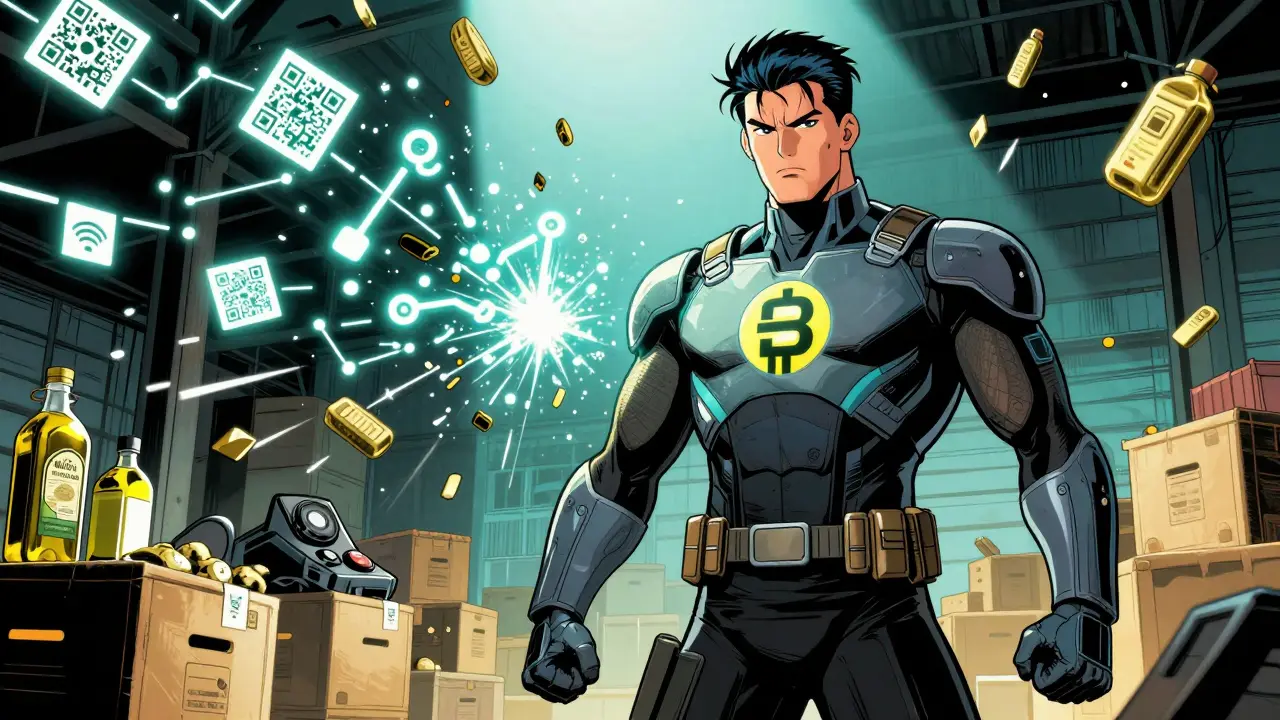
A blockchain superhero stands in a warehouse as counterfeit goods disintegrate into digital code.

Supply Chains: Stopping Counterfeits at the Source

How do you know that bottle of premium olive oil is real? Or that your iPhone parts weren’t stolen from a warehouse in Shenzhen?

Counterfeit goods cost the global economy over $500 billion a year. Most of it happens because supply chains are opaque. A product passes through ten different handlers. Each one uses their own system. No one knows what’s real.

Blockchain tracks every step. From the farm where the olives were picked, to the shipping container that left the port, to the store shelf where it was sold - each movement is recorded as a block. QR codes or RFID tags link physical items to their digital trail.

If someone tries to slip in a fake batch, the system flags it immediately. The blockchain shows the last verified location. The temperature logs. The customs clearance. The signature of the inspector. All of it. No gaps. No blind spots.

Companies like Walmart and Maersk now use blockchain to track food and shipping. Results? 90% faster dispute resolution. 40% fewer counterfeit incidents.

Finance: Catching Fraud in Real Time

Banks lose billions to internal fraud - employees manipulating payments, falsifying loan applications, or covering up losses. Traditional audits happen quarterly. By then, it’s too late.

Blockchain enables real-time monitoring. Every transaction is visible to authorized parties. Smart contracts - self-executing code on the blockchain - can be programmed to block payments that don’t meet rules. For example: if a vendor hasn’t been verified, or if a payment exceeds a pre-set limit, the system automatically refuses it.

In 2024, HSBC and JPMorgan rolled out blockchain-based trade finance platforms. Fraud detection rates jumped 65%. False positives - legitimate transactions flagged as fraud - dropped by 50%. Why? Because the system doesn’t guess. It verifies.

And when it comes to cryptocurrency, blockchain transparency is the only defense. The EU’s 5AMLD and FATF rules now require exchanges to track wallet owners. Every crypto transfer leaves a permanent, traceable footprint. Money laundering? It’s still possible - but far harder, and far riskier.
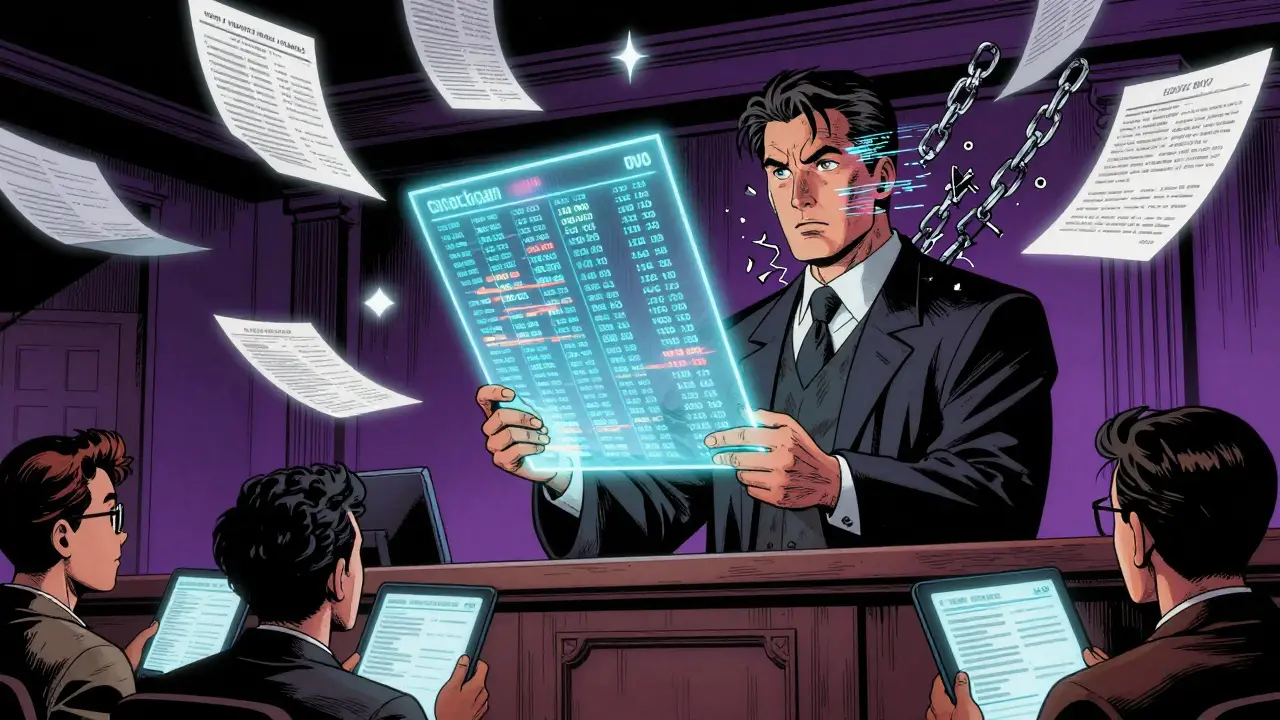
A judge projects a blockchain ledger in court as a corrupt official’s identity glitches and fails.

Anti-Corruption: Making Bribes Visible

Corruption thrives in secrecy. A government contract awarded behind closed doors. A donation that disappears into a shell company. A public fund diverted through fake invoices.

Blockchain makes these actions public by design. Countries like Ukraine and Sweden have launched blockchain-based public procurement systems. Every bid, every contract award, every payment is recorded on a transparent ledger. Citizens can track where tax money goes - down to the cent.

In 2023, Ukraine’s system reduced bid rigging by 80% in pilot regions. Why? Because anyone could see who bid, who won, and why. No more anonymous winners. No more hidden kickbacks.

But here’s the catch: blockchain doesn’t verify the truth of the data - only its integrity. If someone enters a fake invoice, the blockchain will record it faithfully. That’s why trusted data entry matters. The system doesn’t replace people - it holds them accountable.

What Blockchain Can’t Do

It’s not magic. Blockchain won’t stop fraud if the data going in is wrong. If a corrupt official falsifies a land deed before it’s uploaded, the blockchain will record the lie as truth.

It also doesn’t fix broken processes. If your team still uses paper forms to collect data, blockchain won’t help. You need digital capture at the source - scanners, IoT sensors, verified digital IDs.

And adoption matters. One company using blockchain alone won’t stop fraud. You need networks - suppliers, banks, regulators, customers - all on the same system. That’s why early adopters are partnering with industry groups and governments.

The Future Is Transparent

Blockchain isn’t about replacing old systems. It’s about replacing guesswork with proof.

In five years, we won’t ask, “Can we trust this record?” We’ll ask, “Where’s the blockchain verification?”

Real estate, healthcare, logistics, voting - every industry that relies on documents, ownership, or trust will shift to blockchain-backed systems. The cost of fraud will drop. The cost of verification will drop even faster.

The technology is here. The tools exist. The question isn’t whether blockchain can prevent fraud.

It’s whether you’re ready to stop trusting - and start verifying.

13 Comments

  • Image placeholder

    Kenneth Ljungström

    December 8, 2025 AT 09:55
    This is actually kind of beautiful 🤩 I never thought about how blockchain could fix title fraud until now. My cousin got scammed last year selling her grandma’s house - took 14 months to clear it up. If this had been in place? She’d’ve been fine. Love that it’s not just tech for tech’s sake.
  • Image placeholder

    Sandra Lee Beagan

    December 9, 2025 AT 12:20
    The cryptographic immutability layer combined with distributed consensus mechanisms effectively eliminates single-point-of-failure vulnerabilities inherent in centralized ledgers. When paired with zero-knowledge proofs for privacy-preserving verification, you get a robust audit trail that’s both transparent and compliant with GDPR and CCPA frameworks. This isn’t just innovation-it’s systemic re-architecture.
  • Image placeholder

    michael cuevas

    December 10, 2025 AT 15:11
    So you're telling me if I lie before I put it on the blockchain, it's still a lie but now it's permanent? Cool. Thanks for making fraud more reliable.
  • Image placeholder

    Nina Meretoile

    December 11, 2025 AT 23:47
    I love this so much. It’s like the internet finally grew a spine 💖 We’ve been trusting people with paper and passwords for too long. Blockchain doesn’t make us perfect, but it makes lying expensive. And honestly? That’s all we need. The real magic is in the accountability, not the code.
  • Image placeholder

    Barb Pooley

    December 13, 2025 AT 14:26
    This is all just a government crypto scam. They’re tracking everything. You think your property title is safe? Nah. Soon they’ll know what color socks you wore when you bought your house. And who you voted for. And what you ate for breakfast. This isn’t transparency. It’s control.
  • Image placeholder

    Isha Kaur

    December 14, 2025 AT 06:37
    I think this is really promising especially in developing economies where corruption is rampant and documentation is often lost or manipulated by local officials, and I've seen firsthand in rural India how fake land records cause entire families to lose their homes because there's no verifiable trail, and if you can digitize every transaction from the moment a plot is registered through every sale and inheritance, it could prevent generations of injustice, and even if the initial data entry is flawed, at least future audits will have a clear lineage of changes, and over time with digital ID integration and IoT sensors for physical assets, the system becomes self-correcting and more trustworthy, and I believe this is the future of equitable governance and economic inclusion, not just for real estate but for everything from crop subsidies to medical supply chains, because when people can see where money goes, they stop being afraid and start demanding better, and that’s the real win here.
  • Image placeholder

    Glenn Jones

    December 15, 2025 AT 19:26
    BRO. BLOCKCHAIN ISNT MAGIC. YOU THINK SOMEONE IN UKRAINE ISNT JUST UPLOADING FAKE BIDS? THEY’RE STILL HUMAN. THEY’RE STILL CORRUPT. THIS JUST MAKES THE LIE PERMANENT. AND NOW YOU’RE LOCKED INTO A SYSTEM WHERE EVERYTHING IS PUBLIC BUT NO ONE IS RESPONSIBLE FOR THE INPUT. I’M SICK OF TECH BRO’S THINKING CODE = ETHICS. IT’S NOT. IT’S JUST A BETTER WAY TO LIE FOREVER.
  • Image placeholder

    Regina Jestrow

    December 16, 2025 AT 04:26
    I’m curious-how do you handle edge cases? Like, what if a sensor fails and logs wrong temperature data for a shipment? Or someone with bad intent uploads a forged invoice before the system goes live? Does the blockchain just accept it as truth because it’s ‘verified’? I get the structure, but the human layer still feels fragile.
  • Image placeholder

    Martin Hansen

    December 16, 2025 AT 18:51
    This whole thing is just crypto bros repackaging 90s database theory and calling it revolutionary. You think your grandma’s property title is safer now? Nah. She still has to trust some tech guy to digitize her deed. Meanwhile, real solutions like notarized paper with biometric verification have been around for decades. You’re not solving fraud-you’re just making it more expensive to audit.
  • Image placeholder

    Lore Vanvliet

    December 17, 2025 AT 09:28
    USA is the only country that actually gets this. Europe’s too busy debating privacy laws while their supply chains rot with fake meds. China’s using it to spy. India? Still printing receipts on napkins. If you’re not on the blockchain, you’re not in the game. And if you’re not in the game, you’re just a footnote in history. Wake up.
  • Image placeholder

    Scott Sơn

    December 18, 2025 AT 07:47
    Imagine if your entire life was a blockchain-every text, every lie, every time you said 'I'm fine' when you weren’t. Every breakup, every bad decision, every midnight snack logged forever. That’s what this is. We’re not building a ledger. We’re building a digital ghost that haunts us forever. And honestly? I’m kinda into it.
  • Image placeholder

    Stanley Wong

    December 18, 2025 AT 12:43
    I think the real issue isn't the tech it's the people who control the gateways to input data like if only certified professionals can add entries then maybe it works but if anyone can submit a document then it's just a fancy spreadsheet with more steps and honestly I've seen too many systems where the shiny new thing just adds complexity without solving the actual problem like why not fix the training of clerks or automate the scanning process before you go full blockchain
  • Image placeholder

    Nicole Parker

    December 20, 2025 AT 10:50
    I’ve been thinking about this all day. It’s not just about fraud prevention-it’s about healing. When people know their records can’t be erased or altered without everyone knowing, it changes how they behave. It makes them pause. It makes them honest. I work in social services and I’ve seen families lose everything because of a typo in a file. What if we could give them peace of mind instead of panic? That’s what this is. Not tech. Humanity, upgraded.

Write a comment

*

*

*