
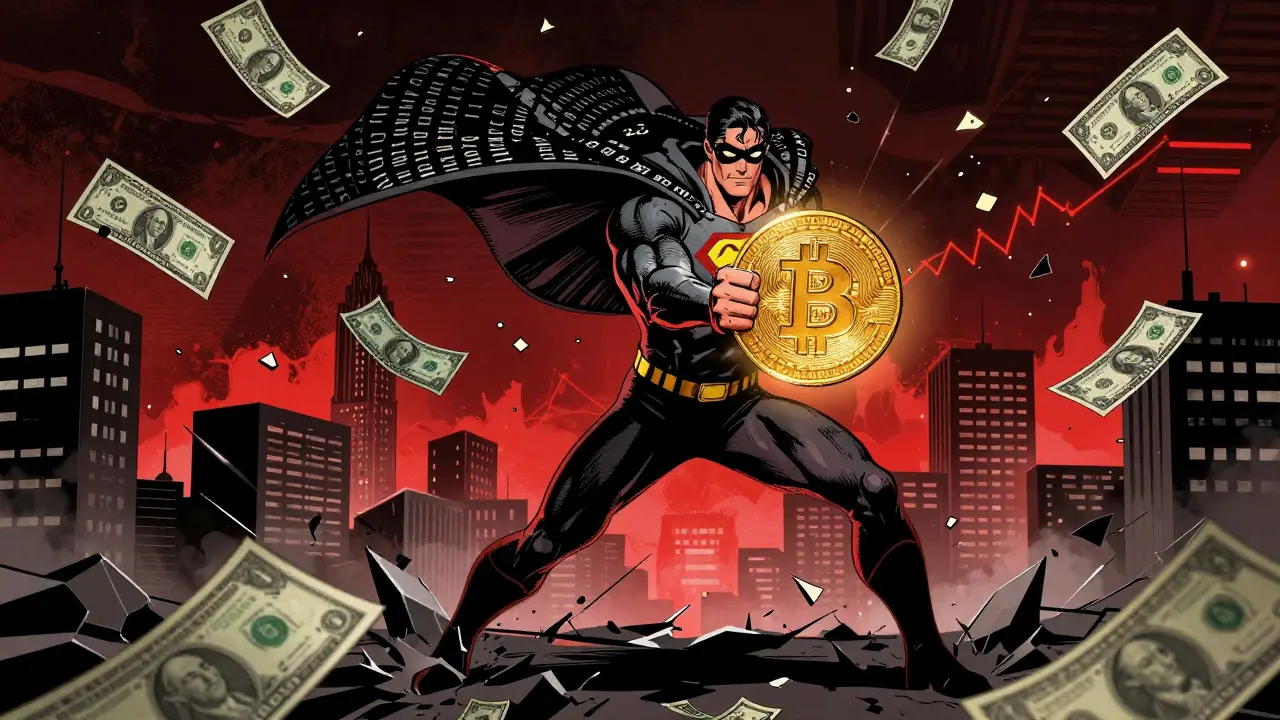
Bitcoin doesn’t just go up and down randomly. It follows a pattern-repeating, almost like clockwork. Since 2009, the crypto market has gone through clear phases: long periods of quiet consolidation, explosive rallies,疯狂 euphoria, and brutal crashes. These aren’t accidents. They’re crypto market cycles, shaped by code, psychology, and money flow. If you’ve ever bought at the top, sold at the bottom, or wondered when to get back in, understanding these cycles isn’t just helpful-it’s essential.
The Four Phases of a Crypto Cycle
Every crypto cycle, no matter how wild or unpredictable it feels, moves through four distinct stages. Think of them like seasons-each has its own vibe, behavior, and signals.Phase 1: Accumulation-This is when the market is quiet. Prices hover in a narrow range, often down 70-80% from their last peak. Trading volume drops. Most people have given up. The Fear & Greed Index sits at 20-30-pure fear. This phase lasts 6 to 12 months. Bitcoin might trade between $3,800 and $5,200 after a crash, like it did in early 2020. This is where smart money buys. Not because they’re lucky, but because they know what comes next.
Phase 2: Markup (Uptrend)-The quiet ends. Prices start climbing. Slowly at first, then faster. Bitcoin goes from $5,000 to $69,000 in 18 months. Volume surges by 300-500%. The Fear & Greed Index climbs into the 70s and 80s. People who ignored crypto last year are now asking their friends how to buy. This is when narratives explode-DeFi, NFTs, memecoins. The market isn’t just rising-it’s accelerating.
Phase 3: Distribution (Bubble)-This is the peak. Prices break all records. Bitcoin hits $118,000 in June 2024, 180% above its pre-halving price. Daily swings hit 8-12%. News outlets run headlines like “Bitcoin Is the New Gold.” Retail investors pour in, often using leverage. But here’s the trap: the people who bought early are now selling. Whales, institutions, and early adopters are taking profits. Volume spikes, but the price doesn’t follow. This is the warning sign.
Phase 4: Markdown (Crash)-The bubble pops. Prices drop 75-85% in 12-18 months. Bitcoin falls from $118,000 to $75,000 by November 2025. Trading volume spikes again-but this time, it’s panic selling. The Fear & Greed Index crashes to 10-15. Social media turns dark. “Crypto is dead” headlines return. But here’s the truth: this is when the next cycle begins. The same people who sold in fear are now watching from the sidelines. And the cycle repeats.
The Bitcoin Halving: The Engine Behind the Cycle
The reason crypto cycles have a rough 4-year rhythm comes down to one thing: the Bitcoin halving. Every 210,000 blocks-about every four years-the reward miners get for securing the network is cut in half. It’s built into Bitcoin’s code by Satoshi Nakamoto.Here’s what happened in past halvings:
- 2012: Halving from 50 to 25 BTC. Price went from $12 to $1,063 in 13 months.
- 2016: Halving from 25 to 12.5 BTC. Price rose from $650 to $7,000 in 14 months.
- 2020: Halving from 12.5 to 6.25 BTC. Price jumped from $9,000 to $69,000.
Each time, the halving acted like a spark. Less new Bitcoin entering supply, while demand kept growing. That imbalance pushed prices up.
But the 2024 halving changed everything. Bitcoin rose only 180% to $118,000-far below the 450%+ gains of 2020. And it peaked just two months after the halving, not 16 like before. Why? Because the market isn’t the same. Institutions now control 35% of daily trading volume, up from 5% in 2017. Spot Bitcoin ETFs, approved in January 2024, let Wall Street buy Bitcoin directly. That’s not just more money-it’s different money. Less speculative. More steady. And that’s changing the rhythm.

Why the Old Rules Don’t Work Anymore
The four-year cycle used to be a reliable map. Now? It’s more like a rough sketch.Algorithmic trading accounts for 65% of crypto volume today. That means prices move in milliseconds based on code, not human emotion. ETF inflows now drive 28% of Bitcoin’s price swings-up from just 8% before. When BlackRock or Fidelity buys billions in Bitcoin through ETFs, it doesn’t follow the halving schedule. It follows Fed policy, inflation data, and risk appetite.
Volatility is down. The 2022-2025 crash saw a 77.6% drop. The 2018 crash? 84%. The 2014 crash? 89%. The market is maturing. Bigger players smooth out the edges. That’s good for stability-but bad for cycle predictability.
Analysts like Willy Woo and Dr. Carol Alexander now say the old model is broken. The cycle isn’t dead-it’s evolving. The phases still exist. But they’re shorter. The accumulation phase might last 4 months instead of 12. The bull run might peak in 8 months, not 18.
What Actually Works Today
So what should you do if the old cycle model is unreliable?First, stop trying to time the top or bottom. Nobody gets it right every time-not even the pros. Instead, focus on what you can control.
- Use dollar-cost averaging (DCA). Buy a fixed amount of Bitcoin every week, no matter the price. Swan Bitcoin’s 2025 report shows DCA outperformed lump-sum buying by 22% during accumulation phases.
- Track on-chain metrics. Tools like Glassnode and CoinMetrics give you real data: MVRV Z-Score tells you if Bitcoin is overvalued. NUPL shows net unrealized profit/loss. SOPR reveals whether holders are selling or holding. These aren’t guesses-they’re signals.
- Watch the Fear & Greed Index. It’s still reliable. If it hits 15, you’re likely near a bottom. If it hits 85, you’re likely near a top. Don’t ignore it.
- Limit your exposure. Never put more than 5-10% of your total portfolio into crypto during early bull phases. You’re not trying to get rich overnight. You’re trying to survive the next crash.
- Combine signals. Don’t rely on just one indicator. Use price, volume, sentiment, and on-chain data together. If three out of four say accumulation, you’re probably in the right phase.
Also, don’t fall for the “crypto is dead” narrative during crashes. Every single bear market has ended. Every single one. The 2022 crash felt like the end. But by November 2025, Bitcoin was trading at $75,000. The cycle didn’t disappear-it just got faster.

Real People, Real Mistakes
Look at what traders actually do. A 2024 analysis of 12,500 Reddit comments found:- 68% of retail investors regretted selling too early in 2021.
- 82% admitted to panic selling in 2022.
- 73% of negative reviews on exchanges blamed emotional decisions.
That’s the real enemy-not the market. It’s you. The fear when prices drop. The FOMO when they rise. The belief that “this time is different.”
People who succeed don’t predict the future. They manage their emotions. They stick to a plan. They buy when others are scared. They hold when others are greedy.
The Future of Crypto Cycles
What’s next? Analysts at Grayscale predict cycles will shrink to 24-30 months. The EU’s MiCA regulations, fully active in January 2026, could add more stability-or more chaos, depending on how they’re enforced. Bitcoin’s dominance has dropped from 85% in 2017 to 52% today. Altcoins are playing a bigger role. That means cycles might not just be about Bitcoin anymore.But one thing stays the same: human behavior. Greed and fear haven’t changed. People still buy when everyone else is buying. They sell when everyone else is selling. That’s the core of every cycle.
The crypto market isn’t a casino. It’s a reflection of how money, technology, and psychology collide. The cycles won’t disappear. They’ll just get more complex. Your job isn’t to predict them perfectly. It’s to understand them well enough to not get crushed by them.
Learn the phases. Respect the signals. Stay disciplined. And remember-every crash is just the quiet before the next rally.
Are crypto market cycles still reliable after the 2024 Bitcoin halving?
The traditional four-year cycle based solely on Bitcoin halvings is less reliable now. While the phases of accumulation, markup, distribution, and markdown still occur, the timing and amplitude have changed. Institutional involvement, spot Bitcoin ETFs, and algorithmic trading have accelerated cycles and reduced volatility. The 2024 cycle peaked just two months after the halving-far faster than past cycles. Use cycles as a framework, not a crystal ball.
What’s the best way to profit from crypto market cycles?
The most consistent strategy is dollar-cost averaging (DCA). Instead of trying to time the bottom, buy a fixed amount of Bitcoin weekly or monthly. This smooths out price volatility. Combine it with on-chain metrics like MVRV Z-Score and the Crypto Fear & Greed Index to confirm phase transitions. Never risk more than 5-10% of your total portfolio on crypto at any time.
How do Bitcoin ETFs affect market cycles?
Bitcoin ETFs have fundamentally changed the market. Since their approval in January 2024, institutional ownership of Bitcoin has jumped to 22% of circulating supply. ETF inflows now drive 28% of Bitcoin’s price movements, compared to just 8% before. This reduces wild swings and shortens cycle phases. It also makes cycles less dependent on retail FOMO and more tied to macroeconomic trends like interest rates and inflation.
Is now a good time to buy crypto based on the current cycle?
As of November 2025, Bitcoin is trading around $75,000 after a 35% drop from its June 2024 peak. The Fear & Greed Index is around 40 (neutral), and on-chain metrics like NUPL show moderate unrealized gains. This suggests we’re likely in the early accumulation or early markup phase. If you’re new, start with DCA. If you’re experienced, look for confirmation from multiple indicators before increasing exposure.
What tools should I use to track crypto market cycles?
Use Glassnode and CoinMetrics for on-chain data like MVRV Z-Score and SOPR. Track the Crypto Fear & Greed Index from Alternative.me for sentiment. TradingView has community-built cycle indicators like CryptoCred’s script. For institutional flow, monitor ETF inflows via Bloomberg and CoinGecko. Don’t rely on one tool-combine at least three signals to confirm what phase you’re in.
 Cryptocurrency Guides
Daniel Verreault
December 29, 2025 AT 07:33Alison Hall
December 30, 2025 AT 07:44Amy Garrett
December 31, 2025 AT 11:11Haritha Kusal
January 1, 2026 AT 05:30Michelle Slayden
January 2, 2026 AT 07:48Jacky Baltes
January 3, 2026 AT 15:05Andy Reynolds
January 3, 2026 AT 22:41Mike Reynolds
January 5, 2026 AT 02:48Antonio Snoddy
January 5, 2026 AT 03:00dayna prest
January 6, 2026 AT 06:39Brandon Woodard
January 6, 2026 AT 18:09Rick Hengehold
January 8, 2026 AT 16:32Jackson Storm
January 10, 2026 AT 15:21Brooklyn Servin
January 12, 2026 AT 11:06Phil McGinnis
January 12, 2026 AT 11:06Ian Koerich Maciel
January 14, 2026 AT 01:01Prateek Chitransh
January 15, 2026 AT 17:00Raja Oleholeh
January 16, 2026 AT 21:41Ryan Husain
January 16, 2026 AT 23:48Vernon Hughes
January 18, 2026 AT 19:00christopher charles
January 20, 2026 AT 15:05