
Most people think trading crypto means buying Bitcoin or Ethereum and waiting for the price to go up. But if you look at the numbers, that’s not where the real action is. In fact, over 79% of all crypto trading volume in 2025 happened on derivatives markets-not spot exchanges. That’s not a small side note. It’s the main stage.
What Exactly Are Crypto Derivatives?
Crypto derivatives are contracts whose value comes from the price of an underlying cryptocurrency-like Bitcoin or Ethereum. You don’t need to own the coin to trade it. Instead, you’re betting on whether the price will go up or down. Think of it like betting on the weather without having to step outside.
The big three types are:
- Futures: Agreements to buy or sell crypto at a set price on a future date. CME Group started offering Bitcoin futures in 2017, and that opened the door for banks and hedge funds.
- Perpetual futures (perps): These are the most popular. They work like futures but never expire. Traders pay a small funding rate every 8 hours to keep the position open. This keeps the price in line with the spot market.
- Options: The right-but not the obligation-to buy or sell crypto at a certain price by a certain date. Used mostly by institutions to hedge risk.
Perpetual futures make up about 65% of all crypto derivatives volume. Why? Because they’re simple, always available, and let traders use high leverage without worrying about contract expiration.
Who’s Trading These Things-and Why?
The market isn’t just retail traders with a phone app. It’s a mix of hedge funds, asset managers, miners, and everyday people looking to make a quick buck.
Institutions use derivatives for one main reason: hedging. If you own a lot of Bitcoin and you’re worried about a crash, you can short Bitcoin futures to protect your portfolio. You don’t sell your coins-you just offset the risk. According to Acuiti’s 2025 survey, 68% of institutional users trade derivatives for hedging, not speculation.
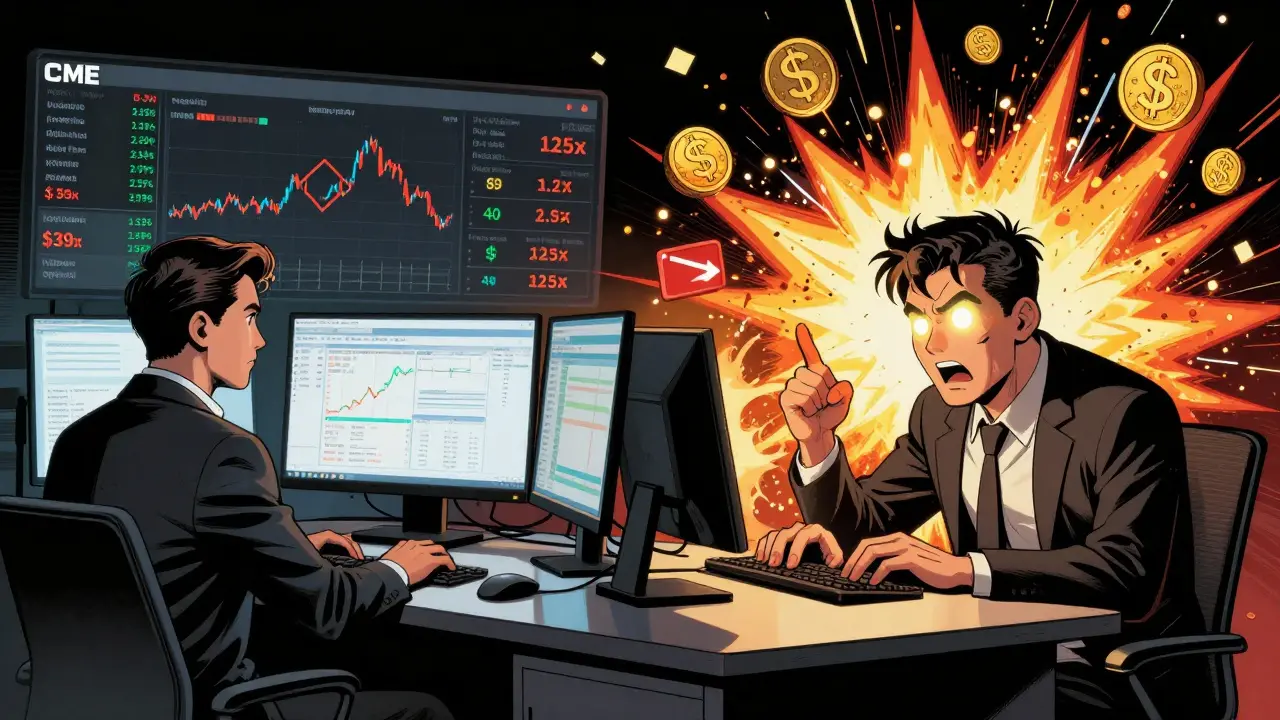
On the retail side, it’s mostly about leverage. Platforms like Binance and Bybit let you trade with up to 125x leverage. That means with $1,000, you can control $125,000 worth of crypto. It sounds amazing-until the market moves against you. In Q3 2025, over $2 billion in retail positions got liquidated in a single week because of over-leveraged trades.
Meanwhile, regulated platforms like CME Group limit leverage to just 2.5x. It’s boring, but it’s safe. And for big players like Goldman Sachs and BlackRock, safety matters more than speed.
Centralized vs. Decentralized Derivatives
The market is split into two worlds: centralized exchanges (CEXs) and decentralized protocols (DeFi).
Centralized exchanges like Binance, Bybit, Deribit, and Coinbase Derivatives handle 95% of all volume. They’re fast, easy to use, and offer tons of trading pairs. But they’re also vulnerable. If the exchange gets hacked or shuts down, your money could vanish. In 2024, the CFTC fined Binance $4.3 billion for operating illegally in the U.S., forcing them to block American users until April 2025.
Decentralized derivatives like dYdX and GMX are built on blockchain networks. You trade directly from your wallet-no KYC, no middleman. That’s great for privacy, but it’s slow and expensive. DeFi platforms only make up about 5% of the total market, but they grew 217% in 2025. Why? Because they’re the only option for people who don’t trust centralized platforms.
Here’s the catch: DeFi platforms don’t have insurance funds or customer support. If you get liquidated, you’re out. No appeals. No refunds.
Who’s Winning: U.S. Regulated vs. Offshore Exchanges
There’s a clear divide between platforms that follow U.S. rules and those that don’t.
U.S.-regulated exchanges (CME, Coinbase Derivatives, Bitnomial) are slow to launch products but rock-solid in execution. They only offer futures for BTC, ETH, SOL, and XRP. Max leverage? 2.5x. Clearing is handled by CME Clearing, which has been around since the 1970s. In Q3 2025, CME reported $39 billion in peak open interest-the highest ever. And when the market crashed, they didn’t crash. Their systems stayed up. No outages. No delays.
Offshore exchanges (Binance, Bybit, Deribit) are the wild west. They offer over 15 crypto pairs, 125x leverage, and 24/7 trading. They processed 68% of all global volume in 2025. But they’re under fire. The EU’s MiCA regulations are forcing them to change. The U.S. keeps pushing for compliance. And when volatility hits, their systems buckle. In September 2025, $2.1 billion in positions were wiped out on offshore platforms. On CME? Just $187 million.
The Deribit-Coinbase merger announced in October 2025 is a sign of where things are headed. It’s an attempt to merge the liquidity of offshore with the compliance of U.S. regulation.
Why This Market Matters
Crypto derivatives aren’t just gambling tools. They’re infrastructure.
They help set prices. When futures traders push Bitcoin down, spot traders follow. Derivatives give the market a way to express fear or confidence before it shows up on the spot market.
They’ve brought real institutions into crypto. In 2024, only 18% of CME’s large open interest holders were traditional asset managers. By Q3 2025, that number jumped to 38%. That’s not just hedge funds anymore. That’s pension funds, endowments, and family offices.
And they’re evolving. New products like Luxor Technology’s Hashprice NDF let miners hedge their electricity costs. Staking yield swaps let people earn income from locked-up crypto without selling it. Even XRP futures, launched in May 2025, hit $1.4 billion in open interest by September.

What You Need to Know Before You Trade
If you’re thinking about jumping in, here’s what you need to understand:
- Funding rates: Every 8 hours, longs pay shorts (or vice versa) to keep the perp price close to spot. If funding is positive, longs pay. If it’s negative, shorts pay. It’s not a fee-it’s a market mechanism.
- Liquidation: If your margin drops too low, your position gets automatically closed. High leverage = higher risk. A 10% move against you with 10x leverage wipes you out.
- Regulation matters: If you’re in the U.S., stick to Coinbase or CME. Offshore platforms might offer more, but you’re trading without legal protection.
- Start small: Even if you’re experienced in stocks, crypto derivatives are different. 67% of retail traders take 3+ months to learn how to use them properly.
Most people lose money in derivatives-not because they’re bad traders, but because they don’t understand the mechanics. Read the documentation. Watch tutorials. Paper trade first.
The Future: More Regulation, More Growth
The crypto derivatives market is growing fast. It hit $28 trillion in notional value by the end of 2024-nearly 25 times the size of the spot market. Analysts at Bernstein predict a 45% annual growth rate for regulated platforms through 2027.
By 2027, experts expect U.S.-regulated platforms to control up to 30% of global volume, up from just 12% today. Why? Because institutions won’t touch crypto until they can trade it under clear, trusted rules.
Meanwhile, the unregulated side-where most of the volume still lives-is a ticking time bomb. MIT’s Elaine Zhang warns that the $28 trillion unregulated market creates systemic risk. If one big offshore exchange fails during a crash, it could trigger a chain reaction.
The fix? Global coordination. SWIFT is testing blockchain-based settlement for derivatives in Q1 2026. The EU’s MiCA rules are forcing offshore platforms to adapt. The U.S. is slowly catching up.
This market isn’t going away. It’s becoming part of finance. The question isn’t whether you should trade it. It’s whether you’ll trade it safely-or get swept away by it.
 Cryptocurrency Guides
kris serafin
January 6, 2026 AT 10:11Perps are wild, man 😅 One minute you’re up 5x, next minute your margin call hits and you’re wondering where your rent money went. I’ve seen people turn $500 into $25k in a week… and back to $50 in 3 hours. The funding rate is basically a tax on hope.
Jordan Leon
January 6, 2026 AT 19:13The real story here isn’t leverage or liquidity-it’s trust. Derivatives markets function as a mirror for collective belief. When institutions move into regulated platforms, they’re not just trading crypto-they’re signaling that they believe the system can be stable. That’s a quiet revolution.
Rahul Sharma
January 6, 2026 AT 23:38Very clear explanation. In India, many people think crypto = buy and hold. But derivatives are where the real money moves. Even small traders use Binance perps. But they don’t understand funding rates. That’s dangerous.
Jessie X
January 8, 2026 AT 03:08Why do people think 125x leverage is a feature and not a suicide button
Kip Metcalf
January 8, 2026 AT 08:20Bro I started with $200 on Bybit last year. Made $18k. Then lost it all in one night. But I’m back. This market don’t care if you cry. It just moves. Stay sharp.
Frank Heili
January 8, 2026 AT 20:57Most retail traders don’t realize that funding rates are designed to keep perps aligned with spot. It’s not a fee-it’s a feedback loop. If longs are over-leveraged, they pay shorts. That’s market self-correction. Understand that and you’re already ahead of 90% of traders.
Also, CME’s $39B open interest isn’t just a number-it’s institutional confidence. When pension funds start using BTC futures as a hedge, crypto stops being a meme and becomes an asset class.
And yes, DeFi derivatives are slow and expensive. But they’re the only way to trade without trusting a CEO who might get arrested next week.
Dave Lite
January 8, 2026 AT 22:20OMG YES. The funding rate is the secret sauce of perps 🤯 I used to think it was just a fee. Then I started tracking it daily. When it spikes positive? That’s the market screaming 'longs are too greedy.' Negative? Shorts are overextended. I use it as a contrarian indicator now. Also-CME is the only place I trust with my capital. No drama. No hacks. Just clean, boring finance. 🙌
jim carry
January 9, 2026 AT 06:52Let me be the one to say it: You’re all naive. The entire crypto derivatives market is a Ponzi built on leverage, regulatory arbitrage, and the delusion that 'this time is different.' The $28 trillion notional value? That’s not wealth-it’s phantom debt. When the next crash hits, and it will, the offshore platforms will vanish like vapor. And the retail traders? They’ll be left with nothing but a Discord server and a credit card bill. This isn’t finance. It’s gambling with a blockchain veneer.
Don Grissett
January 9, 2026 AT 18:40Ugh. Everyone acts like CME is some holy grail. Binance does 20x the volume. Who cares if they got fined? They still pay out. CME’s 2.5x leverage is for grandmas with 401ks. If you want to make real money, you go where the liquidity is. Plain and simple. Also, why are you all scared of leverage? It’s just math.
Mollie Williams
January 10, 2026 AT 04:01I keep thinking about how derivatives turn emotion into price. Fear doesn’t just live in your chest-it gets coded into funding rates, liquidations, and open interest. When miners hedge with Hashprice NDFs, they’re not just managing risk-they’re saying, 'I believe in this network enough to bet on its future.' That’s poetry, really. Quiet, technical, but deeply human.
Surendra Chopde
January 11, 2026 AT 09:49Very good breakdown. In India, many don’t know about perps. They think crypto = buy BTC on WazirX and wait. But derivatives are the real game. I use dYdX sometimes. Slow, but I sleep better knowing no one can freeze my wallet. Still, I wish gas fees were lower.
Tiffani Frey
January 11, 2026 AT 22:48There’s something profoundly ironic about the fact that the most decentralized financial innovation in history-blockchain-based derivatives-is dominated by centralized platforms with CEO’s, compliance officers, and corporate logos. The dream was autonomy. The reality? A hybrid beast: part Wall Street, part crypto anarchist, all profit.
And yet… I still check my funding rates every 8 hours like a nervous parent checking on a sleeping child.
Tre Smith
January 13, 2026 AT 12:46You’re all missing the point. The Deribit-Coinbase merger isn’t innovation-it’s capitulation. The unregulated market is being absorbed, not improved. And when institutions take over, they’ll kill the volatility that made crypto profitable in the first place. You think 2.5x leverage is safe? It’s just a leash. And soon, you’ll be on it. Welcome to regulated finance. It’s beige. It’s slow. And it’s the end of the crypto revolution.