
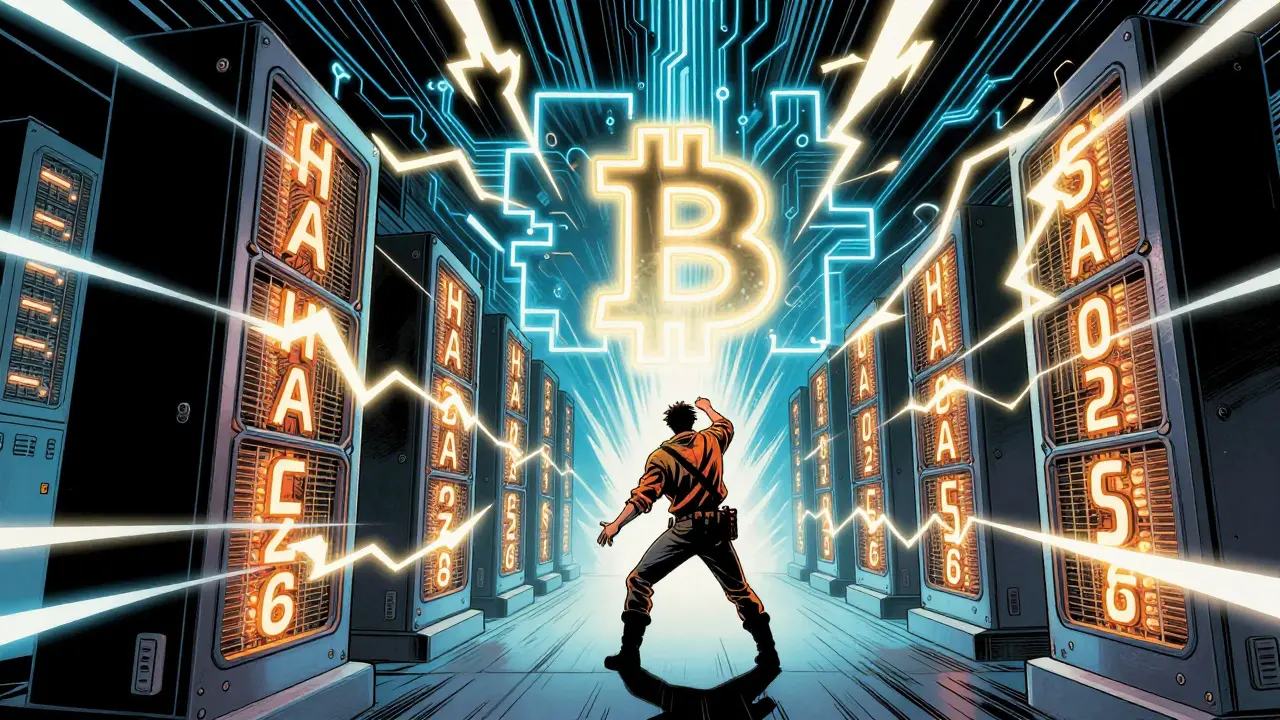
Bitcoin doesn’t need banks. It doesn’t need governments. It doesn’t even need you to trust the person you’re sending money to. All it needs is Proof of Work-a system that turns electricity and hardware into trust.
How Proof of Work Stops Fraud
Imagine trying to spend the same Bitcoin twice. That’s called a double-spend. In the digital world, copying files is easy. So how does Bitcoin stop you from copying money? Proof of Work (PoW) makes it physically and economically impossible. Every time someone sends Bitcoin, it gets bundled into a block. Miners compete to solve a math puzzle using the SHA-256 algorithm. This isn’t a simple calculation. It’s a brute-force race: billions of guesses per second, trying to find a hash that starts with a certain number of zeros. The first miner to solve it gets to add the block to the chain-and earns new Bitcoin and transaction fees. The puzzle is hard to solve but easy to verify. That’s the magic. If you try to alter an old transaction, you’d have to redo every block after it. And since each block links to the one before it, changing one means changing hundreds of thousands. At current network difficulty, that would take more computing power than the entire planet’s mining rigs combined.The Cost of Attack Is Higher Than the Reward
Bitcoin’s security isn’t about math alone. It’s about money. As of late 2023, the Bitcoin network was hashing at 600 exahashes per second. That’s 600 quintillion calculations every second. To put that in perspective: if you tried to brute-force one block on your laptop, it would take over 100 million years. The network’s total energy use? Around 121 terawatt-hours a year-more than most countries. That’s not waste. It’s the price of security. An attacker wanting to take over Bitcoin would need to control more than half of that hashpower-a 51% attack. Experts estimate that would cost over $15 billion per month just in electricity and hardware. And even if you pulled it off, you’d destroy Bitcoin’s value. Your stolen coins would be worthless. Your hardware would be scrap. The attack pays nothing. This is called economic asymmetry: the cost to break the system is far higher than what you could gain. That’s why no 51% attack has ever succeeded on Bitcoin. Even when GHash.io briefly controlled 55% of the network in 2014, they voluntarily stepped back. The community called them out. The market reacted. The incentive to be honest was stronger than the temptation to cheat.Why SHA-256 and Not Something Else?
Bitcoin uses SHA-256 because it’s fast, reliable, and has been battle-tested for decades. Developed by the NSA in the early 2000s, it’s used everywhere from military communications to SSL certificates. It turns any input-whether a single letter or a full block of transactions-into a fixed 256-bit string. Change one bit, and the output becomes completely different. Each Bitcoin block header is 80 bytes. Miners tweak a 32-bit nonce (a random number) and rehash until they find a result below the network’s target. The difficulty adjusts every 2,016 blocks (about every two weeks) to keep block time at 10 minutes. If miners get faster, the puzzle gets harder. If miners leave, it gets easier. This self-adjusting mechanism ensures stability. No matter how many ASICs flood the market, or how many countries ban mining, the network always finds equilibrium. It’s not controlled by any person or company. It’s controlled by math and economics.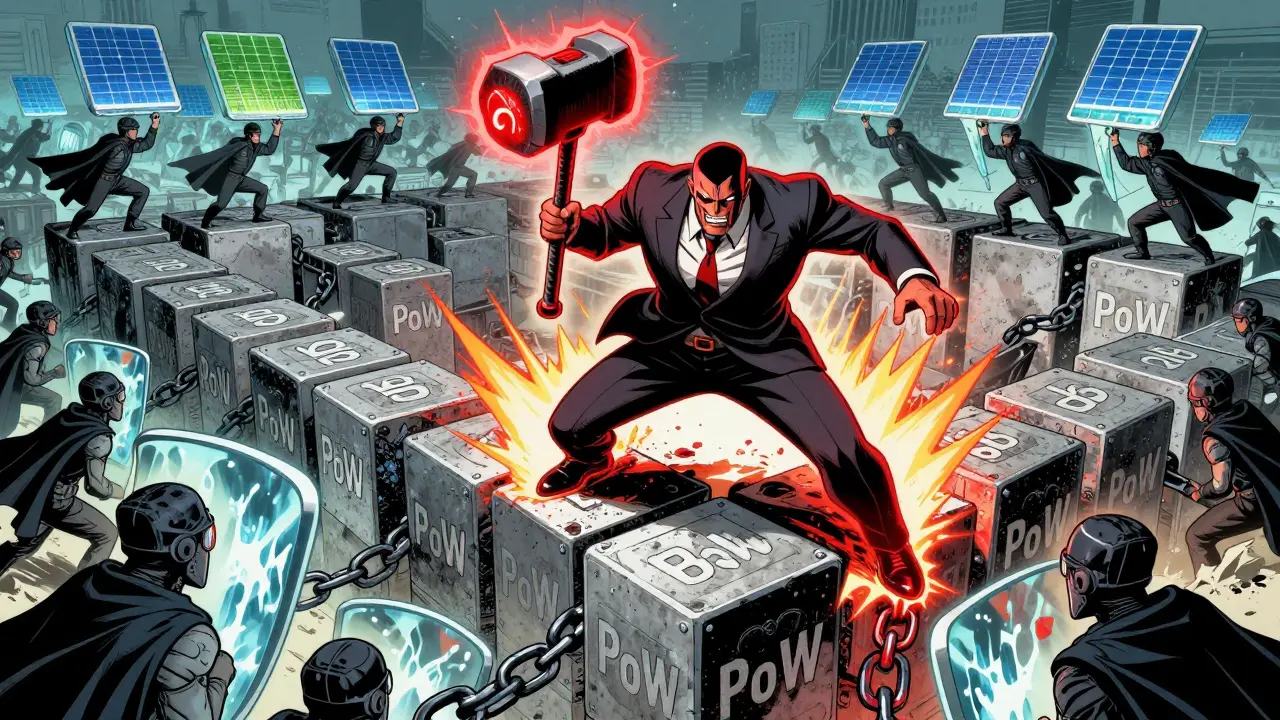
Proof of Work vs. Proof of Stake
Ethereum switched to Proof of Stake in 2022, claiming it was greener and cheaper. And it was-energy use dropped by 99.99%. But security isn’t just about power bills. In Proof of Stake, you lock up ETH to validate blocks. The more ETH you own, the more power you have. That sounds fair, but it creates a new risk: centralization. A single entity controlling 31% of staked ETH (like Lido) can sway consensus. In PoW, you can’t just buy hashpower-you have to buy hardware, rent space, pay for electricity, and maintain cooling systems. You can’t do it from a laptop. PoW’s security comes from real-world resources: electricity, silicon, copper, labor. These can’t be created out of thin air. PoS relies on token ownership, which can be bought, borrowed, or manipulated. Bitcoin’s PoW is like a fortress built with concrete and steel. PoS is like a gate guarded by people who already own the keys. Bitcoin’s Nakamoto coefficient-the minimum number of entities needed to control 51% of the network-is 3. That’s AntPool, F2Pool, and Foundry USA. Ethereum’s is 19. Fewer entities means less decentralization. Bitcoin’s PoW makes it harder for any single group to dominate.Energy Use? It’s Not What You Think
Critics call Bitcoin mining a climate disaster. The truth is more nuanced. According to the Bitcoin Mining Council, 48.1% of Bitcoin’s energy comes from renewable sources. That’s higher than the global grid average. Many miners use stranded power-wind farms in North Dakota that shut down when the grid is full, hydro surplus in Quebec, flare gas from oil fields in Texas. They turn waste into value. Miners don’t care if the electricity is green or dirty. They care if it’s cheap. So they go where power is abundant and underpriced. That’s why Texas, Kazakhstan, and Georgia became mining hubs. They’re not polluting-they’re absorbing excess supply. The National Bureau of Economic Research found that Bitcoin mining helps stabilize renewable grids by acting as a flexible load. When solar panels produce too much at noon, miners turn on. When wind drops at night, they shut off. That’s not a bug. It’s a feature.
What Keeps Miners Honest?
Miners aren’t altruistic. They’re profit-driven. And their profit depends on the network staying secure. If Bitcoin’s price crashes, miners lose money. If the difficulty spikes too fast, their machines become unprofitable. So they have every reason to protect the network. A broken Bitcoin means broken revenue. Professional miners run 24/7 operations with industrial cooling, backup generators, and multi-location redundancy. They invest millions. They don’t risk it all for a short-term hack. The system is designed so that honesty is the only profitable strategy. On Reddit’s r/BitcoinMining, users report 85-92% uptime for well-run farms. The biggest complaints? Hardware obsolescence (ASICs last 18 months on average) and heat management. Not security breaches. Not fraud. Just maintenance.Why This Matters for You
You don’t need to mine Bitcoin to benefit from Proof of Work. You just need to know that your transactions are final. When you send $10,000 in Bitcoin, you’re not waiting for a bank to approve it. You’re waiting for six blocks to be added. Each block takes about 10 minutes. After six, the chance of reversal is less than one in a trillion. That’s not because someone said so. It’s because the math says so. No other digital currency has proven this level of security for over 14 years. Not Ethereum. Not Solana. Not Cardano. Bitcoin’s PoW has survived price crashes, government bans, hardware shortages, and global pandemics. It’s the only system that’s never been hacked at the protocol level. If you hold Bitcoin as a store of value, PoW is your silent guardian. It doesn’t sleep. It doesn’t take bribes. It doesn’t change rules. It just keeps working.What’s Next for Proof of Work?
Bitcoin’s block reward halves every four years. The next one is in April 2024, cutting rewards from 6.25 BTC to 3.125 BTC. After that, miners will rely almost entirely on transaction fees. Will that break Bitcoin? Probably not. Fees have been rising as usage grows. Taproot, activated in 2021, made transactions smaller and cheaper, helping fee sustainability. And as Bitcoin becomes more valuable, even small fees add up. The Bitcoin community has no interest in replacing PoW. It’s not a flaw-it’s the foundation. Any change risks breaking the security model that made Bitcoin valuable in the first place. Fidelity Digital Assets forecasts Bitcoin’s annual security budget will hit $25 billion by 2025. That’s not a cost. That’s an investment. And it’s the reason Bitcoin remains the most secure digital asset ever created.Can Bitcoin be hacked through Proof of Work?
No, Bitcoin’s protocol has never been hacked. All major breaches-like exchange thefts totaling over $3.8 billion since 2011-happened because users or exchanges failed to secure their own keys, not because the blockchain was compromised. The Proof of Work consensus mechanism has resisted every known attack attempt, including the largest hashrate concentration (GHash.io at 55%) in 2014, which voluntarily reduced its share after community pressure.
Why does Bitcoin use so much electricity?
Bitcoin’s electricity use is the cost of security. Every watt consumed by miners is a barrier to attack. The network consumes about 121 terawatt-hours per year, which sounds high-but it’s what keeps the $538 billion market safe. Unlike traditional finance, which relies on physical vaults, lawyers, and auditors, Bitcoin uses energy as its audit trail. About 48.1% of that energy comes from renewable sources, and miners often use stranded or otherwise wasted power that would otherwise go unused.
Is Proof of Work better than Proof of Stake for security?
For a decentralized, permissionless system like Bitcoin, yes. Proof of Work requires real-world resources-electricity and hardware-that can’t be faked or inflated. Proof of Stake relies on token ownership, which can be bought, borrowed, or concentrated. Bitcoin’s Nakamoto coefficient is 3, meaning only three mining pools control 51% of the network. Ethereum’s PoS has a coefficient of 19, making it more vulnerable to centralization. PoW’s security is verifiable, physical, and irreversible.
What happens if Bitcoin mining becomes unprofitable?
If mining becomes unprofitable, some miners shut down. That reduces the network’s hash rate, which triggers the difficulty adjustment to lower the puzzle’s complexity. This makes mining profitable again for remaining participants. The system self-corrects. In November 2022, Bitcoin’s hash rate dropped 47% after a price crash, but within weeks, difficulty adjusted and mining stabilized. The network has survived multiple cycles like this since 2009.
Can governments shut down Bitcoin mining?
Governments can ban mining in their countries, but they can’t shut down the global network. Bitcoin mining operates in over 127 countries. Even when China banned mining in 2021, the network’s hash rate didn’t collapse-it just relocated to the U.S., Kazakhstan, and other regions. The decentralized nature of PoW makes it resilient to censorship. No single government controls the majority of hashrate, and the protocol doesn’t rely on any central authority to function.
 Cryptocurrency Guides
christopher charles
December 28, 2025 AT 21:00Man, this post hit different. PoW isn't just tech-it's a physical barrier to chaos. I love that it's not about trust, it's about cost. You can't fake electricity.
Alison Hall
December 30, 2025 AT 18:24Bitcoin’s security is the quiet hero no one notices until it’s gone. And it’s been holding strong for 14 years. 🙌
Vernon Hughes
January 1, 2026 AT 16:01The energy argument misses the point. Miners use waste power. That’s not pollution. That’s efficiency.
dayna prest
January 1, 2026 AT 20:57Proof of Work is the last true anarchist institution left. The state can ban you, jail you, tax you-but it can’t stop a thousand miners in basements running on stolen grid power. And that’s beautiful.
Mike Reynolds
January 2, 2026 AT 17:43I used to think PoW was a waste. Then I learned how much energy the banking system uses just to process wire transfers. PoW is actually more efficient when you account for the whole system.
Brandon Woodard
January 3, 2026 AT 09:32Let’s be honest: Proof of Stake is just permissioned capitalism dressed up as decentralization. You don’t earn security-you buy it. And that’s not freedom. That’s a membership club.
Amy Garrett
January 4, 2026 AT 08:45imagine if u could just buy ur way into securing the network… thats not security thats a paywall
Ryan Husain
January 6, 2026 AT 06:27Bitcoin’s Nakamoto coefficient of 3 is terrifying to some, but it’s actually a sign of robustness. It means the system doesn’t rely on thousands of tiny players-it relies on a few professional, economically rational actors who have too much to lose. That’s not centralization. That’s maturity.
Michelle Slayden
January 6, 2026 AT 12:07The philosophical underpinning of Proof of Work is profound: trust is not a social contract, but an economic one. It transforms abstract faith into measurable, verifiable labor. In a world where identity is performative and truth is negotiable, Bitcoin offers something radical-objective reality enforced by physics.
SHA-256 is not merely an algorithm; it is a covenant written in entropy. The nonce is not a random number-it is the last vestige of human agency in a deterministic universe. Each hash attempt is a prayer whispered into the void, and only those who expend sufficient energy are heard.
This is not computing. This is ritual. And like all sacred rites, it demands sacrifice. The miner does not seek reward alone; they become the guardian of an immutable truth. The electricity consumed is not waste-it is consecration.
When we dismiss Bitcoin’s energy use as wasteful, we reveal our own moral bankruptcy. We accept the invisible labor of bankers, lawyers, and auditors as natural, yet recoil at the visible labor of miners. We worship convenience, then mourn its cost.
Proof of Work does not merely secure Bitcoin. It redefines value. It says: something is only worth what you are willing to burn to prove it exists. And in that, it is the purest expression of scarcity ever devised by human hands.
Rick Hengehold
January 6, 2026 AT 23:58People who say PoW is bad for the planet don’t know what they’re talking about. Miners are the only industry that actively helps renewable grids stabilize. They’re not the problem-they’re the solution.
Haritha Kusal
January 7, 2026 AT 01:11bitcoin is like a temple made of electricity and steel and no one can destroy it even if they try 😊
Phil McGinnis
January 7, 2026 AT 20:56Let’s not pretend this isn’t a massive subsidy to energy producers and tech monopolies. The U.S. government benefits from Bitcoin mining just as much as the miners do-through tax revenue, job creation, and geopolitical leverage. Calling it ‘decentralized’ is a fantasy.
And let’s not ignore the fact that ASIC manufacturers are owned by a handful of Chinese and American firms. This isn’t freedom-it’s corporate capture wrapped in libertarian rhetoric.
nayan keshari
January 8, 2026 AT 16:20Proof of Work is just a fancy way of saying ‘we’re burning money to prove we have money.’ PoS is simpler, cheaper, and just as secure if you trust the validators. Stop romanticizing waste.
Brandon Woodard
January 9, 2026 AT 01:52Interesting. So you’re saying we should trust a few wealthy stakeholders with voting power over a global financial system… while dismissing the physical, verifiable, distributed cost of PoW? That’s not trust. That’s feudalism with a blockchain logo.