
You’ve heard the name TronTrade. Maybe you saw an ad promising zero withdrawal fees and low trading costs on the TRON blockchain. On paper, it looks like a dream for anyone holding TRX. But here is the hard truth that most promotional articles won’t tell you: there are serious, credible allegations that TronTrade is not just risky-it might be a scam.
As of late 2025 and into 2026, the consensus among independent watchdogs and user communities has shifted dramatically. While some older sources still list it as a functional decentralized exchange (DEX), newer investigations paint a disturbing picture. This review cuts through the noise to answer the real question: Should you risk your funds on TronTrade?
The Allure: Why TronTrade Looks Attractive at First Glance
Let’s be fair. If you ignore the red flags for a moment, the features TronTrade advertises are compelling. The platform launched in 2018, positioning itself as a specialized DEX for the TRON ecosystem. For users who already hold TRX, the idea of a dedicated spot to trade without dealing with complex multi-chain bridges sounds convenient.
The fee structure is their main selling point. They advertise a flat 0.20% trading fee for both makers and takers. In a market where many centralized exchanges charge between 0.10% and 0.50%, this seems competitive. More importantly, they claim zero withdrawal fees. According to industry data from 2025, fewer than 30 major exchanges offer completely free withdrawals across all assets. For high-volume traders, saving on withdrawal costs can add up quickly.
However, convenience often masks complexity. TronTrade operates exclusively with TRX as the base pair. This means you cannot buy Bitcoin with US Dollars directly on the platform. You must already own cryptocurrency, specifically TRX, to participate. There are no fiat on-ramps. No credit card support. No bank transfers. This limitation immediately excludes beginners and forces experienced users to move funds from safer, regulated environments into this unverified space.
The Red Flags: What Watchdogs Are Saying
Here is where the story changes. The promise of "zero fees" often comes with hidden costs-in this case, security and solvency. In July 2025, Traders Union, a prominent financial watchdog, published a scathing analysis. They flagged "Tron Trade Options"-an entity widely believed to be linked to or identical to TronTrade-for severe operational issues.
Their investigation highlighted three critical failures:
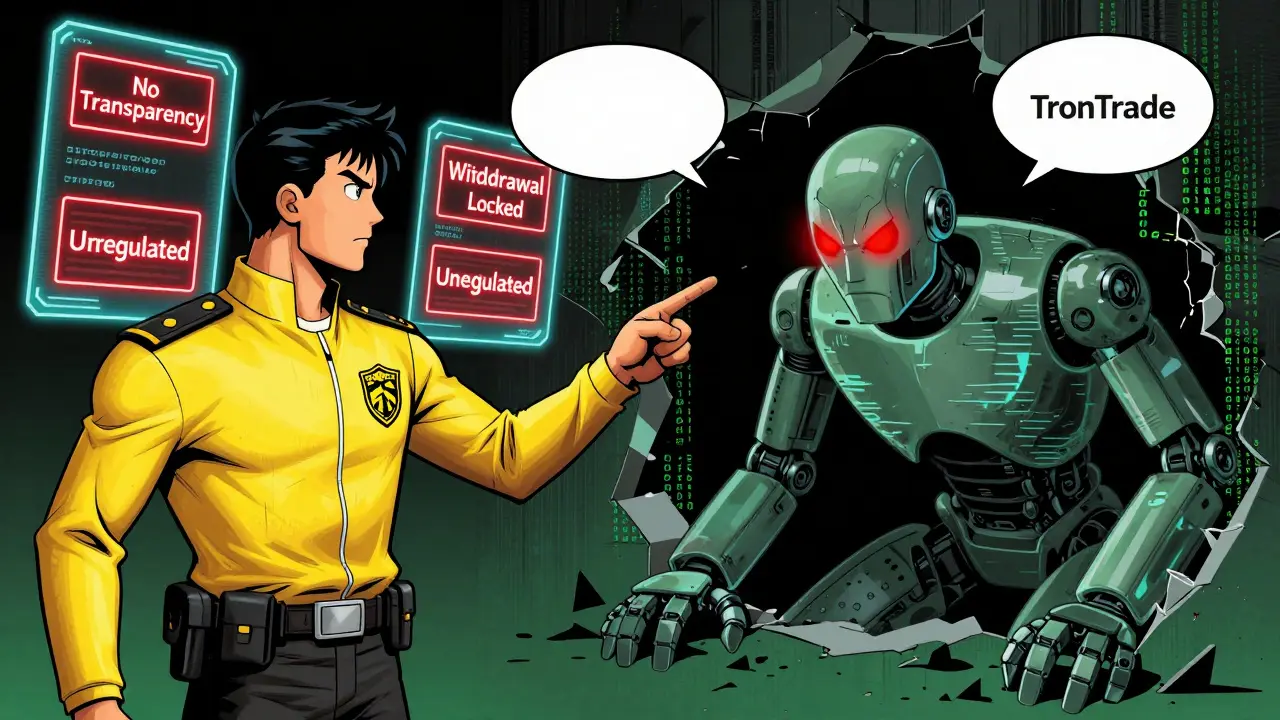
- Lack of Transparency: The platform provides minimal information about its ownership, licensing, or regulatory compliance. Legitimate exchanges, even decentralized ones, usually have clear governance structures or public team identities. TronTrade offers neither.
- Withdrawal Difficulties: Users reported being unable to withdraw funds after depositing them. This is a classic hallmark of fraudulent schemes. Once money enters the wallet, the exit doors lock shut.
- Questionable Trading Activities: Reports suggest manipulated interfaces and unresponsive customer support channels.
Traders Union’s methodology involves cross-referencing regulator registries and analyzing user complaints. Their conclusion was blunt: "Don't be too quick to trust everything you read... Try to be skeptical." When an organization dedicated to exposing fraud raises these alarms, you should listen.
User Experiences: The Real Cost of "Zero Fees"
Marketing materials don’t lie, but they omit context. User reviews tell the full story. As of September 2025, aggregated data from platforms like Trustpilot showed an average rating of just 1.8 out of 5 stars based on verified reviews. The pattern of complaints is consistent and alarming.
One user on Reddit, posting in August 2025, described losing $2,300. They had met all stated requirements for withdrawal, yet their funds remained locked indefinitely. Another common theme on Crypto Twitter (X) involved users connecting wallets like TronLink only to have their balances drained instantly. These weren’t failed trades; they were unauthorized transactions triggered by malicious smart contracts or phishing links disguised as the official exchange.
Notice the discrepancy? The positive reviews tend to come from new accounts with little history, likely incentivized bots. The negative reviews come from real people who tried to access their money and couldn’t. In the crypto world, if you can’t withdraw, you don’t own the asset. It’s that simple.
| Feature | TronTrade | Uniswap (DEX) | Coinbase (CEX) |
|---|---|---|---|
| Type | Decentralized (Alleged) | Decentralized | Centralized |
| Fiat Support | No | No | Yes (USD, EUR, etc.) |
| Trading Fee | 0.20% | ~0.30% + Gas | 0.4% - 3.99% |
| Withdrawal Fee | Claimed Zero | Network Gas Only | Variable |
| Regulatory Status | Unregulated/Unknown | Protocol-Based | SEC Registered (US) |
| Safety Rating | High Risk | Medium (User Error Risk) | Low (Institutional Grade) |
How TronTrade Compares to Safe Alternatives
If you want to trade TRX or other cryptocurrencies safely, you have better options. The comparison above highlights why TronTrade stands out-not for its quality, but for its danger.
Uniswap and PancakeSwap are established decentralized exchanges. They operate on Ethereum and BNB Chain respectively. While they charge network gas fees, their code is open-source, audited, and governed by community tokens. You know exactly how the protocol works. With TronTrade, the backend is a black box.
Coinbase and Kraken are centralized giants. Yes, their fees are higher. Yes, they require identity verification (KYC). But they are insured, regulated, and accountable. If Coinbase freezes your account, you can appeal to regulators. If TronTrade disappears, you have no recourse. The $11.27 billion global exchange market in 2025 is dominated by players with proven track records. TronTrade is an outlier with no such proof.
For TRON-specific trading, consider using SunSwap or JustLend. These are legitimate DeFi protocols built on the TRON network. They have transparent liquidity pools and verifiable transaction histories. They do not promise "zero fees" because that is economically unsustainable and usually a trap.
Technical Risks: Wallet Draining and Smart Contract Vulnerabilities
Understanding the technical side helps you see why this platform is dangerous. Decentralized exchanges work by interacting with smart contracts. When you connect your wallet, you grant permission for the contract to move specific tokens. A legitimate DEX requests permission to swap. A malicious one requests unlimited approval.
Reports from early 2025 indicate that TronTrade’s interface may have included malicious code. Users connecting via TronLink found their entire TRX balance transferred to unknown addresses within seconds. This isn’t a bug; it’s a feature of a scam. The "zero withdrawal fee" is irrelevant if you never get the chance to initiate a withdrawal because your wallet has been emptied.
Furthermore, the lack of audit reports is concerning. Reputable DeFi projects undergo audits by firms like CertiK or SlowMist. TronTrade has no public audit history. Without an audit, there is no guarantee that the smart contracts don’t contain backdoors allowing developers to freeze funds or steal assets.
Is TronTrade Still Operating in 2026?
The status of TronTrade remains ambiguous. Unlike legitimate businesses that publish quarterly reports or security updates, TronTrade has gone silent since late 2024. Industry analysts at Delphi Digital noted in September 2025 that unverified DEXs claiming TRON integration became a primary vector for scams, resulting in over $47 million in losses in Q3 alone.
The domain may still load, and the website may still look professional. But activity metrics suggest a hollow shell. Liquidity is likely fake, created by bots to simulate volume. When you try to trade, you might see prices move, but executing a large order could fail entirely, or worse, trigger the draining mechanism described earlier.
Given the escalating regulatory scrutiny on crypto exchanges globally, any platform operating in the gray area without transparency is at high risk of being shut down or blacklisted by wallet providers. TronLink, for instance, has increasingly blocked connections to known malicious domains. If your wallet provider warns you against connecting to TronTrade, take that as a definitive stop sign.
Final Verdict: Avoid TronTrade
So, is TronTrade safe? No. The evidence points to a high probability of fraud. The combination of anonymous ownership, widespread user complaints about frozen funds, allegations of wallet draining, and warnings from financial watchdogs creates a perfect storm of risk.
The promise of zero fees is too good to be true. In finance, if something sounds too good to be true, it almost always is. Your capital is better protected on regulated centralized exchanges like Coinbase or Kraken, or on reputable, audited decentralized protocols like Uniswap or SunSwap. Don’t let the allure of low costs blind you to the threat of total loss.
Is TronTrade a scam?
While not officially declared illegal by every jurisdiction, TronTrade exhibits multiple characteristics of a scam. Independent watchdogs like Traders Union have flagged it for withdrawal issues and lack of transparency. User reports confirm instances of wallet draining and locked funds. Most experts advise treating it as a high-risk or fraudulent platform.
Why does TronTrade offer zero withdrawal fees?
Legitimate exchanges charge withdrawal fees to cover blockchain network costs (gas fees). Offering zero fees is economically unsustainable for a real business. In the case of TronTrade, this promise is likely a marketing hook to attract victims. The "cost" is paid in the form of stolen principal when users cannot withdraw or have wallets drained.
Can I recover my funds if TronTrade locks my account?
Recovery is extremely difficult. Because TronTrade operates as a decentralized or semi-decentralized platform without clear corporate ownership, there is no customer support team to contact. Blockchain transactions are irreversible. Unless law enforcement intervenes and identifies the operators, lost funds are typically gone forever.
What are safe alternatives for trading TRX?
For centralized trading, use Coinbase, Kraken, or Binance, which are regulated and insured. For decentralized TRON-based trading, use audited protocols like SunSwap or JustLend. Always verify the URL and ensure you are connecting to the official, audited smart contracts.
Did TronTrade hack my wallet?
If your funds disappeared after connecting to TronTrade, you likely interacted with a malicious smart contract or approved a transaction that granted unlimited spending access to a hacker. This is a common tactic used by fraudulent DEXs. Check your transaction history on a block explorer like Tronscan to see where the funds were sent.
 Cryptocurrency Guides
Melissa L
June 28, 2026 AT 19:30honestly this whole thing looks sus to me
ELNORA JEFFERSON
June 30, 2026 AT 07:44I don't have the energy to read all this but it sounds like another crypto rug pull waiting to happen. People are so gullible these days chasing zero fees when common sense should tell you something is wrong. The article is basically screaming scam but everyone ignores it until they lose their shirts. I just stay away from anything that isn't a major exchange because the headache isn't worth the tiny savings on fees.
Carol @minaszilda
June 30, 2026 AT 08:28We should always look out for one another in this space.
It is easy to feel overwhelmed by the technical details, but staying informed is our best defense.
Please take care of your assets and verify every link before connecting your wallet.
Let us support each other with accurate information rather than fear.
Trent Erman1
July 1, 2026 AT 07:56Hey folks! Just wanted to jump in and say that the comparison table here is super helpful for visual learners. It really breaks down why sticking to audited protocols like Uniswap or SunSwap makes way more sense than gambling on unknown DEXs. The gas fees might sting a bit, but losing your entire principal to a drainer hurts way more. Always double-check those contract addresses!
Fiona Ellis
July 3, 2026 AT 00:13One must consider the broader implications of such opaque financial instruments. 🧐
The lack of regulatory oversight is not merely an inconvenience; it is a fundamental breach of trust between service provider and consumer. When entities operate in the shadows, they invite predation upon the unsuspecting public. We cannot allow these digital wild west scenarios to persist without demanding rigorous accountability from platform operators. 🚫💸
Jon Milton
July 3, 2026 AT 18:19Look, I get the appeal of low fees, but operating outside any regulatory framework is a huge red flag for anyone who values their capital. In my experience, if a platform doesn't have clear ownership or audit reports, it's essentially a casino where the house always wins. You're better off paying a premium for security on established platforms like Coinbase or Kraken. Don't let greed blind you to basic risk management principles.
Abby Martin
July 4, 2026 AT 11:01Can we stop pretending there's any mystery here? This is a textbook scam. Anonymous team, zero withdrawals, bad reviews. It’s not rocket science. If you’re still using TronTrade, you’re either stupid or lying. The rest of us know better. Move your funds to a reputable exchange and stop feeding these parasites.
Mélanie Boulay
July 4, 2026 AT 13:32It is truly fascinating how the narrative around decentralized exchanges has evolved over the past few years, particularly within the TRON ecosystem, which was once heralded as a beacon of efficiency and speed for high-throughput transactions. However, as we delve deeper into the specifics of TronTrade, one cannot help but notice a disturbing pattern of behavior that aligns more closely with fraudulent operations than legitimate financial innovation. The absence of transparent governance structures, combined with the alarming reports of frozen withdrawals and potential smart contract vulnerabilities, suggests a systemic failure that goes beyond mere operational inefficiencies. Furthermore, the reliance on unverified liquidity pools and the lack of third-party audits raise significant concerns about the solvency and integrity of the platform, prompting users to exercise extreme caution and perhaps reconsider their engagement with such high-risk entities entirely.
Maurice Flynn
July 4, 2026 AT 16:40Just observing the chaos here. Seems like people are quick to panic but slow to learn. Stick to the basics and you'll be fine.
nancy jarecki
July 6, 2026 AT 11:39The semantic dissonance between the advertised utility and the actual operational reality of TronTrade is quite palpable to those versed in DeFi mechanics. It is evident that the platform leverages the allure of frictionless transactions to obscure its underlying insolvency and malicious intent. Such obfuscation tactics are characteristic of predatory schemes designed to exploit the cognitive biases of retail investors who prioritize fee structures over security audits. One must possess a sophisticated understanding of smart contract interactions to recognize the subtle indicators of compromise, which most casual users simply overlook in their pursuit of marginal gains.
Robert Hundley
July 7, 2026 AT 15:44Yo, this is wild! 😲 I remember seeing ads for this everywhere last year. Good thing I didn't bite. The fact that they promise zero withdrawal fees is literally impossible unless they're stealing your money somewhere else. Stay safe out there everyone! 👋
Rob Morton
July 8, 2026 AT 13:49It is important to reflect on why these scams continue to thrive despite widespread warnings. Perhaps we need to focus more on education regarding how smart contracts actually work. Understanding the difference between a legitimate swap and a malicious approval can save someone thousands. Let's keep sharing these insights so others can avoid making the same mistakes.
Routh Middaugh
July 10, 2026 AT 13:11Well, it seems obvious that the lack of transparency is the core issue here; however, one might also consider the role of user error in some of these incidents. Still, the consensus is clear: avoid it. The risks far outweigh any perceived benefits, especially when safer alternatives exist. It is crucial to remain vigilant and skeptical of any platform that does not adhere to standard industry practices regarding audits and regulatory compliance.
Ryan Peters
July 11, 2026 AT 07:15Typical American stupidity falling for 'zero fees' scams. You guys make it too easy for foreign hackers to drain your wallets. If you can't afford the 0.5% fee on Binance, maybe you shouldn't be trading crypto at all. It's not a charity, it's a market. Wake up and use regulated exchanges like Coinbase instead of playing roulette with shady offshore DEXs. Pathetic.
ross harris
July 13, 2026 AT 00:52The digital leviathan known as TronTrade devours the innocent with a smile painted in pixels. It is a carnival of mirrors where every reflection promises wealth but delivers only void. The code is a labyrinth designed by spiders, weaving traps for the unwary who seek shortcuts through the forest of finance. Do not step onto this stage, for the curtain falls quickly and the actors vanish into the night, leaving you holding nothing but empty promises and drained wallets.
Carl Belgrave
July 14, 2026 AT 14:00This is exactly what happens when you let unregulated tech bro startups run wild. They think they're above the law because it's 'decentralized.' Newsflash: if you can't withdraw your money, you don't own it. Period. Use real exchanges that follow the rules and pay taxes. Stop enabling these criminals by giving them attention and capital. It's disgraceful.
Carl Hanzel
July 14, 2026 AT 21:33You all are missing the point. Of course it's a scam. Everything in crypto is a scam eventually. The real question is whether you were smart enough to exit before the rug pull. Blaming the platform is weak. Take responsibility for your own ignorance. If you connected your wallet to an unaudited contract, you deserved to lose. No sympathy for the lazy.
John Curry
July 15, 2026 AT 20:22There is a profound sadness in watching people chase ghosts in the machine. The allure of free money is a siren song that has lured many sailors onto rocky shores throughout history. TronTrade is just the latest iteration of an ancient tale. We must cultivate wisdom and patience in our financial journeys, recognizing that true value is rarely offered without cost. Let us learn from these tragedies and build a future based on trust and transparency rather than deception and haste.