
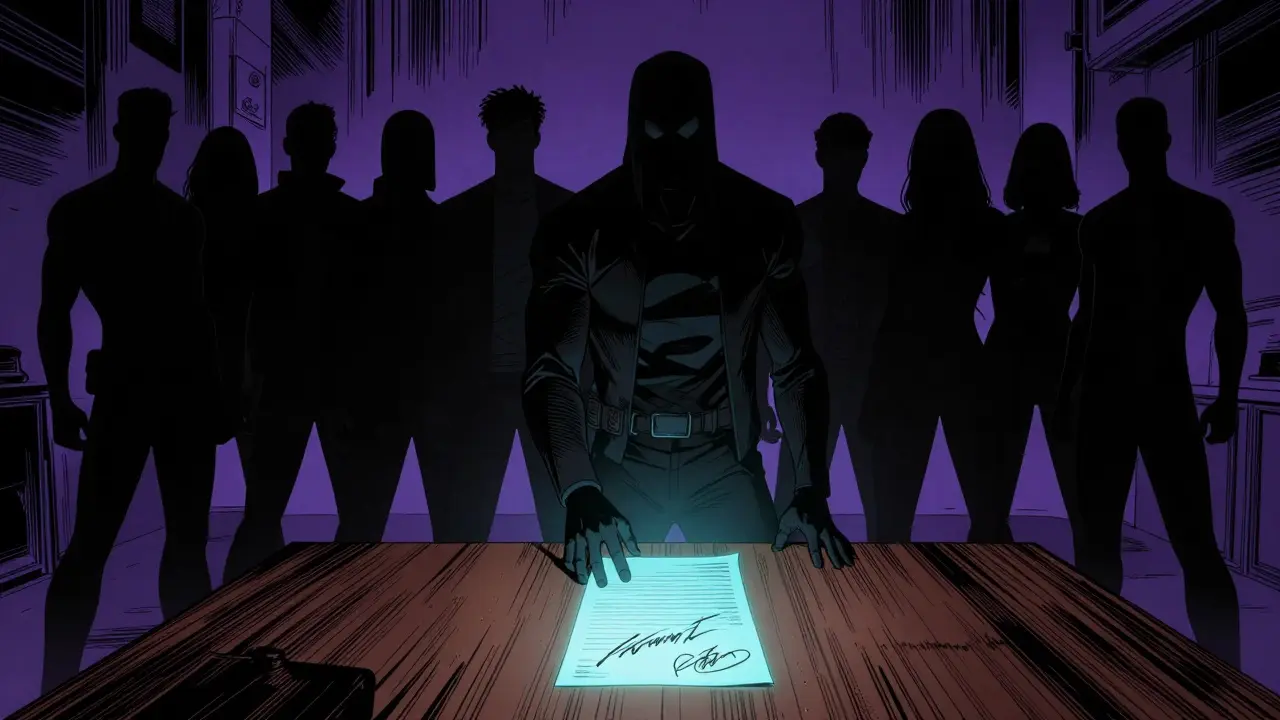
Imagine you're in a room with ten people, and one of you leaves a signed note on the table. You know the note came from someone in that room, but there's no way to tell exactly who wrote it. That's the core idea behind ring signatures. In the world of digital currency, where most blockchains are like open books for anyone to read, this technology creates a vital layer of "plausible deniability." Instead of a transparent trail showing exactly where your money came from and where it went, ring signatures mask your identity by blending your transaction with others.
What Exactly Are Ring Signatures?
Ring signatures is a cryptographic technique that allows a member of a group to digitally sign a transaction without revealing which specific member produced the signature. First proposed in 2001 by Ron Rivest, Adi Shamir, and Yael Tauman Kalai in the paper "How to Leak a Secret," this method ensures that an observer can see that someone from a specific group authorized a payment, but they can't pin it on a single person.
In a standard blockchain like Bitcoin, the ledger is transparent. If you send someone 1 BTC, the whole world knows which address sent it and which address received it. Ring signatures flip this script. They take the actual sender's public key and mix it with a set of "decoys"-other public keys pulled from the blockchain. To anyone watching, the transaction looks like it could have been signed by any one of the members of that "ring." This makes it computationally nearly impossible to distinguish the real spender from the decoys.
The Monero Implementation: Privacy by Default
While many coins offer privacy as an optional "extra," Monero is a privacy-centric cryptocurrency that integrates ring signatures as a core, mandatory feature to ensure all users remain anonymous. Monero doesn't just use ring signatures in isolation; it uses a "three-prong approach" to make transactions truly invisible.
- Ring Signatures: Hides the sender.
- Stealth Addresses: Hides the recipient's identity.
- RingCT: Hides the transaction amount.
The way Monero picks these decoys is quite clever. It uses a gamma distribution method to select previous outputs from the blockchain, ensuring that the decoys look natural and aren't easily filtered out by analysts. Over time, the network has increased the default ring size to improve privacy. In the early days, a ring might only have 3 members, but by 2020, the default increased to 11. More decoys generally mean better privacy, although it comes with a cost in data size.
RingCT: Hiding the Numbers
A ring signature hides who sent the money, but it doesn't hide how much was sent. That's where RingCT (Ring Confidential Transactions) comes in. Launched on January 10, 2017, this protocol uses Pedersen commitments to mask the amounts.
Think of a Pedersen commitment as a sealed envelope. The network can verify that the sum of the inputs equals the sum of the outputs-meaning no one is creating money out of thin air-without ever actually seeing the numbers inside the envelope. This is a huge leap forward because, without RingCT, an observer could potentially guess the sender's identity just by looking for a transaction that matches a specific, unique amount.
| Feature | Ring Signatures (Monero) | zk-SNARKs (Zcash) | PrivateSend (Dash) |
|---|---|---|---|
| Privacy Level | High (Default) | Very High (Optional) | Moderate (Optional) |
| Setup | No trusted setup | Requires trusted setup | No setup |
| Tx Size | Large (13-15 KB) | Small (~1.4 KB) | Standard |
| Anonymity Set | Decoy-based | Global (Shielded pool) | Mixing-based |
The Trade-offs: Bloat and Performance
Nothing in cryptography comes for free. The biggest downside to ring signatures is "blockchain bloat." Because every transaction has to carry a list of decoys and complex cryptographic proofs, Monero transactions are significantly larger than Bitcoin's. While a Bitcoin transaction might average around 250 bytes, a Monero transaction can reach 13-15 KB. This puts more pressure on the nodes that store the ledger.
There's also a hit to processing speed. Research from the University of Edinburgh suggests that private transactions increase computational load by about 30%. In practical terms, users on forums like MoneroTalk have noted that during high network congestion, transactions can feel slower to confirm compared to non-private chains. However, for most people using wallets like Cake Wallet or the Monero GUI, this happens in the background and doesn't affect the daily experience.
Can Ring Signatures Be Broken?
You might hear experts talk about "heuristic analysis" or "chain analysis." This is the process of looking for patterns to unmask users. For example, if a user always uses a ring size of 11 but consistently sends money at the same time every Tuesday, an analyst might be able to narrow down who the real signer is. Some critics, including teams at LocalMonero, have called ring signatures the "weakest link" in the privacy chain because they are more susceptible to these pattern-based attacks than the zero-knowledge proofs used by Zcash.
Governments are definitely interested. In 2020, the IRS reportedly spent over $600,000 on a contract with Chainalysis to find ways to decrypt Monero transactions. Despite this, many experts, including Chainalysis's own CEO, have admitted that breaking these signatures at scale is still computationally prohibitive. As long as the decoys are chosen effectively and the ring size remains robust, the "plausible deniability" holds up.

The Future: Triptych and Arcturus
The developers aren't just sitting still. They're working on ways to get the privacy of large rings without the massive file sizes. One major breakthrough is the Triptych protocol, which enables logarithmic scaling. Instead of the transaction size growing linearly with every decoy added, Triptych allows for a much larger number of decoys (up to 100) while only taking up a fraction of the space-potentially reducing transaction sizes by 80%.
Then there's the Arcturus protocol, which optimizes how signatures are verified, speeding up the process by roughly 400%. Looking further ahead, the Lelantus protocol aims to move away from fixed ring sizes entirely, creating a dynamic anonymity set that makes it even harder for analysts to use heuristics.
Practical Tips for Maximum Privacy
If you're using a system based on ring signatures, remember that the technology is only half the battle. Your behavior matters. To stay truly anonymous:
- Avoid "Tainted" Patterns: Don't link your private wallet to a KYC-verified exchange account in a way that creates a clear timing correlation.
- Use Modern Wallets: Stick to updated wallets that implement the latest ring size and distribution settings.
- Be Mindful of Metadata: While the ring signature hides the sender on-chain, your IP address can still leak. Use a VPN or Tor when broadcasting transactions.
Do ring signatures make a cryptocurrency completely untraceable?
Not 100% in every single scenario, but they provide "plausible deniability." While they hide the specific sender among a group of decoys, sophisticated chain analysis can sometimes use timing patterns or metadata to make educated guesses. However, for the vast majority of users, it is computationally infeasible for an outsider to prove who sent a transaction.
What is the difference between a ring signature and a group signature?
The main difference is the "setup." A group signature usually requires a group manager who knows the identity of all members. Ring signatures are improvisational-the signer can pick any public keys from the blockchain to form a ring on the fly, without the other "members" even knowing they are part of the ring.
Why are Monero transactions so much larger than Bitcoin's?
Bitcoin transactions only need to prove that the sender has the private key for a specific output. Monero transactions must include the actual signature and a list of multiple decoy public keys to create the anonymity ring. This extra cryptographic data significantly increases the size of each transaction from a few hundred bytes to several kilobytes.
Can the IRS or FBI break ring signatures?
While agencies like the IRS have funded research into breaking these signatures, the underlying math (based on elliptic curve cryptography) remains extremely strong. Most experts agree that breaking ring signatures at scale is currently impossible with existing computing power, though they may use "side-channel attacks" (like tracking IP addresses) to identify users.
What happens if the ring size is too small?
A small ring size (e.g., 3 members) means there are fewer decoys to hide behind. This makes it easier for an analyst to use a process of elimination. If they can prove that two of the decoys couldn't have sent the money, the third person (the actual sender) is exposed. This is why Monero has steadily increased its default ring size over the years.
 Cryptocurrency Guides
Jan Conrad
April 27, 2026 AT 23:01The comparison between ring signatures and zk-SNARKs is a great touch. Most people don't realize that while Zcash has a more 'complete' anonymity set, the trusted setup is a huge psychological barrier for a lot of users. Monero's approach of using decoys is much more intuitive from a trustless perspective, even if the transaction sizes are a bit beefy. It's always a trade-off between proof size and the nature of the privacy guarantee.
Aaron Zeiler
April 28, 2026 AT 22:55Triptych is the real game changer here because linear scaling was always the Achilles heel of XMR. if we can actually get those sizes down while bumping the ring size to 100 that basically kills most heuristic analysis attempts by the IRS
its me
April 29, 2026 AT 17:51It is quite amusing how we celebrate this 'privacy' while ignoring the moral vacuum it creates. If you have nothing to hide, why do you need a ring of decoys to mask your footsteps? One might argue that true transparency is the only path to a virtuous society, yet here we are, obsessing over digital curtains.
Carli Bates
April 30, 2026 AT 12:29oh wow a digital curtain... how poetic. i bet you feel so morally superior hiding behind a keyboard while discussing the virtues of transparency lol
Ipsita Seal
May 1, 2026 AT 16:23Too long. Didn't read.
Jimmy vasquez
May 3, 2026 AT 15:13For anyone starting out, I'd just add that using a VPN or Tor as mentioned is non-negotiable. You can have the best cryptographic ring in the world, but if your ISP is logging your connection to a Monero node, the on-chain privacy is only half the battle. Stay safe out there!
Janis Naglis
May 5, 2026 AT 02:53The implementation of Pedersen commitments within RingCT is absolutely fascinating!!! It's such a brilliant way to maintain the additive property of the ledger without leaking the actual scalars!!! The synergy between these protocols is just breathtaking!!!
Arti Jain
May 5, 2026 AT 17:23Typical Western obsession with privacy. My country handles finance with far more dignity than these chaotic anonymous coins.
Noel Mandotah
May 6, 2026 AT 13:58Imagine thinking 11 decoys is "robust" in 2024. Hilarious.
Ryan Nakielny
May 7, 2026 AT 17:28Sure, let's just pretend that a ring of 11 is a fortress. It's a nice warm blanket for the paranoid, I suppose.
Rachel S
May 9, 2026 AT 15:28Actually, the gamma distribution makes the decoys look much more natural than a simple random pick! 🌟 It's an elegant solution to prevent analysts from spotting the 'fresh' outputs too easily. It is simply marvelous how the math supports the privacy goal! ✨
Rushell Perry
May 11, 2026 AT 10:43just keep learning and experimenting with these tools and the patterns become clearer
Gabrielle Danis
May 12, 2026 AT 18:38The distinction between ring signatures and group signatures is an important point. In a group signature, the group manager possesses a 'trapdoor' that can revoke anonymity. Ring signatures, by contrast, provide a decentralized form of anonymity because the signer selects the decoys unilaterally.
Abhishek Verma
May 13, 2026 AT 16:04Imagine actually caring about your IP address when the IRS already has your tax returns. Pure comedy.
Brendan Thraxton
May 15, 2026 AT 12:47dont sweat the complexity guys just focus on the basics first and the rest will click eventually
Andrew Todd
May 15, 2026 AT 13:58This is all just nonsense for people who want to hide their money. Real power comes from the state, not some fake digital ring.
Sri Astuti
May 16, 2026 AT 01:12The author fails to emphasize that heuristic analysis isn't just a 'risk' but a constant reality for anyone moving large sums of XMR over long periods 🙄. If you think you're invisible just because the ring size is 11, you are delusional, as timing attacks and EAE (External Account Exposure) can easily peel back these layers of so-called 'plausible deniability' for any determined agency with enough compute power and metadata access. 🙄
Elle Kharitou
May 18, 2026 AT 00:43It is so wonderful to see the evolution of these privacy tools as a way to protect individual autonomy in an increasingly digital age 🌿. When we think about the philosophy of the 'secret,' we realize that privacy is not about hiding a crime, but about preserving the sacred space of the self from the gaze of the collective 🌸. I truly believe that the Triptych and Arcturus protocols represent a beautiful bridge between the need for efficiency and the inherent right to be unseen ✨.
Nitin Gupta
May 18, 2026 AT 23:44I agree that the trade-off in transaction size is a necessary evil for the level of privacy provided.
Wayne Gillis
May 19, 2026 AT 14:24Wait, so I can actually hide from the government? 😂 That's wild! 🚀
Livvy Cooper
May 21, 2026 AT 12:49Who cares? It's just more jargon to make people feel smart while they lose money on coins.
Gabby Puche
May 21, 2026 AT 18:57Love how this was explained! 💖 Super helpful for us newbies! 🌈✨
Lynne Teperman
May 22, 2026 AT 19:24a colorful dance of numbers to keep the prying eyes away
Kathleen Warren
May 24, 2026 AT 19:16If you're feeling overwhelmed by the math, just remember that it's basically like a digital crowd. You're just one face in a group of people who all look similar enough that no one can point you out. It's okay to take it slow while learning!
Barbara Jones
May 26, 2026 AT 08:25I tried useing a wallet and it was a bit confusing at first but the community is realy great at helping out