
Most people think airdrops are free money. They aren't. They're marketing costs paid in tokens, and if you don't know where the tokens actually come from, you'll end up with an empty wallet or, worse, a drained one. The DONK (Donkey) project is a prime example of this confusion. It markets itself as a "100% decentralized community experiment," but the reality of how you get these tokens is far more specific than just waiting for a magic drop.
If you've been hunting for the DONK airdrop, you've probably hit a wall. Why? Because there isn't one single, massive "claim your tokens" button on a generic website. Instead, the distribution is tied to exchange ecosystems and presale mechanics that operate differently depending on which "Donkey" token you're actually tracking. This guide breaks down exactly how to acquire DONK, what the technical data says about its value, and how to spot the difference between the main DONK token and similar-sounding projects like DONKM.
The Reality of DONK Distribution
Let's clear up the biggest misconception first. Unlike major Layer-1 blockchains that distribute billions of tokens via retroactive snapshots, DONK operates on a smaller scale with a maximum supply of 10 million tokens. As of recent data, the circulating supply has often been reported as near zero on certain trackers, which signals either a very new listing or limited trading activity. This scarcity is part of the hype, but it also means liquidity can be thin.
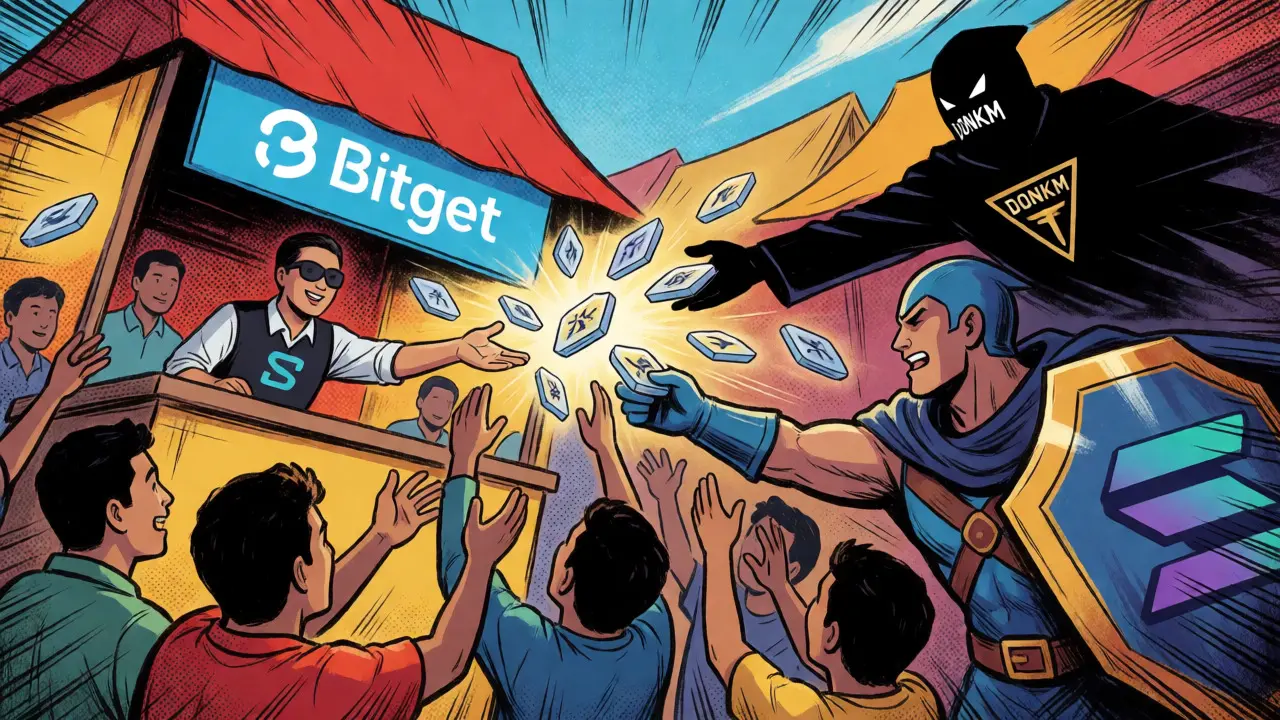
The primary way users have acquired DONK recently hasn't been through a direct claim page on the Donkey website. Instead, it has flowed through Bitget's promotional programs. If you saw friends posting about getting free DONK, they likely participated in one of two mechanisms:
- Learn2Earn: You complete educational modules on Bitget about blockchain basics or specific coins, and they reward you with DONK.
- Assist2Earn: You invite friends to join Bitget. When they trade, you earn rewards, which can sometimes be converted to or issued as DONK.
This isn't a traditional "airdrop" where you connect a wallet and sign a transaction. It's a platform-based incentive program. If you're looking for a simple wallet-to-wallet transfer, you might be looking at the wrong project entirely.
DONK vs. DONKM: Don't Mix Them Up
Crypto naming conventions are terrible. There is DONK (the main Donkey token), and then there is $DONKM. These are not the same thing. Confusing them is the easiest way to lose money or miss out on rewards.
$DONKM ran a presale phase that included an automatic airdrop feature. If you sent SOL (Solana) to their presale contract during the specific window, you were automatically airdropped $DONKM tokens to your wallet. No claiming required, provided your wallet was configured correctly. DONK, however, does not follow this Solana-presale model. It is positioned more similarly to other meme tokens like SHIBA INU or AKITA INU, relying on community sentiment and exchange listings rather than a complex multi-chain presale structure.
| Feature | DONK (Donkey) | $DONKM |
|---|---|---|
| Primary Acquisition Method | Exchange Promotions (Bitget), Spot Trading | Solana Presale (Automatic Airdrop) |
| Blockchain Focus | Multi-exchange support (Bitget focus) | Solana Ecosystem |
| Supply Model | Max 10 Million (Low Supply) | Presale-based allocation |
| Claim Process | Earn via tasks or buy on market | Auto-distributed to sender wallet |
Technical Analysis: Is the Drop Worth Holding?
Getting the tokens is step one. Keeping them profitable is step two. Here, the data gets messy. Major analysis platforms like CoinCodex and BeInCrypto have struggled to provide reliable predictions for DONK due to insufficient historical trading data. When a token doesn't have enough price history, algorithms fail. But we do have some indicators from mid-2025 that paint a picture of high volatility and low momentum.
Technical analysis from June 2025 showed a heavily bearish outlook. Out of 33 signals, 31 were bearish and only 2 were bullish. The Relative Strength Index (RSI) sat at 20.15. In traditional trading, an RSI below 30 indicates an "oversold" condition, which some traders interpret as a buy signal because the price has dropped too fast. However, in meme coins, oversold can quickly become "zero."
The 200-day Simple Moving Average (SMA) was projected to hover around $0.002029, while the short-term 50-day SMA was expected to be much lower at $0.000722. This gap suggests that long-term holders are underwater compared to recent buyers. Price forecasts for 2025 ranged widely, from a minimum of $0.000554 to a maximum of $0.001272. That's a narrow band in absolute terms, but in percentage terms, it represents massive risk.
Utility: What Can You Actually Do With DONK?
Meme tokens often lack utility, but DONK tries to push back against that narrative by integrating with financial products on exchanges. If you manage to acquire DONK, here is how you can use it beyond just staring at the chart:
- Arbitrage Trading: Because DONK is frequently traded across different pairs on Bitget, its price fluctuates constantly. Savvy traders use this to buy low on one pair and sell high on another, though fees must be calculated carefully.
- Staking and Lending: Through Bitget Earn, you can lend your DONK holdings to generate income. This turns idle tokens into yield-bearing assets, although the APY (Annual Percentage Yield) on small-cap meme coins can be volatile.
- Payments: The project encourages using DONK as a payment method for friends, charities, or fundraisers. While adoption is still niche, sending tokens directly to a recipient's address bypasses traditional banking delays.
The project claims to have sent 1/4 of its tokens to Vitalik Buterin. This is a common tactic among meme coins (Shiba Inu did it, Dogecoin didn't). It creates a story-"Vitalik holds our coin"-that drives social media engagement. But remember, Vitalik holding tokens doesn't mean he's building tech for them. It's a marketing move, not a development roadmap.
Step-by-Step: How to Secure Your DONK Allocation
If you missed the early waves, don't panic. You can still position yourself for future distributions or simply acquire tokens on the open market. Here is the practical workflow for someone starting today in Auckland or anywhere else globally:
- Create a Bitget Account: Since most DONK activity is centered here, verify your KYC status immediately. Unverified accounts often miss out on promotional airdrops.
- Check the "Rewards Hub": Navigate to the Bitget Rewards section. Look for active "Learn2Earn" campaigns featuring DONK. Complete the quizzes. It takes minutes, and the payout is usually instant upon completion.
- Monitor Spot Markets: If no promotions are active, check the DONK/USDT spot pair. Use limit orders rather than market orders to avoid slippage, especially given the low liquidity.
- Set Alerts: Given the low circulating supply, sudden spikes in volume can lead to rapid price changes. Set price alerts on your exchange app to catch potential exit opportunities.
Risks and Red Flags
Be honest with yourself: this is a high-risk asset. The "decentralized community experiment" label is great for branding but vague for governance. Who decides when to burn tokens? Who approves new partnerships? Without clear documentation, you're trusting the core team implicitly.
Furthermore, the lack of data is a double-edged sword. Platforms saying "insufficient data for prediction" means you cannot rely on automated bots to tell you when to sell. You need to watch the community sentiment manually. Twitter and Telegram groups will move the price before any chart indicator catches up. If the chat goes quiet, the price usually follows.
Finally, beware of phishing sites. Because "Donkey" is a popular animal theme, several copycat tokens exist. Always verify the contract address. For DONK, ensure you are interacting with the official contract listed on reputable aggregators like CoinMarketCap or CoinGecko, not a random link from a Discord DM.
Frequently Asked Questions
Is there a direct DONK airdrop claim website?
Generally, no. Most DONK distribution occurs through exchange-specific promotions like Bitget's Learn2Earn or Assist2Earn programs. There is rarely a standalone "claim" portal for the general public outside of these platform integrations. Always check the official social media channels for temporary campaign links.
What is the difference between DONK and DONKM?
DONK is the main Donkey token, often associated with meme coin communities and exchange promotions. $DONKM is a separate token that ran a presale on the Solana network with an automatic airdrop mechanism for investors who sent SOL. They are distinct entities with different blockchains and acquisition methods.
Why is the circulating supply of DONK reported as zero?
This usually indicates that the token is newly listed, has very low trading volume, or that data aggregators haven't fully indexed the smart contract balances yet. It does not necessarily mean the tokens don't exist, but it does highlight a lack of liquidity and market depth.
Can I stake DONK for passive income?
Yes, primarily through Bitget Earn products. You can lend your DONK to earn interest. However, rates for micro-cap tokens can change rapidly, and locking up funds carries the risk that you might not be able to sell quickly if the market crashes.
Did Vitalik Buterin really receive DONK tokens?
The project claims to have sent 1/4 of its total supply to Vitalik Buterin. This is a verifiable on-chain event, but it is important to note that receiving tokens does not imply endorsement or active involvement in the project's development. It is largely a marketing strategy common in the meme coin sector.
Next Steps for Investors
If you're already holding DONK, monitor the RSI. If it climbs above 70, consider taking profits, as overbought conditions in low-cap coins often lead to sharp corrections. If you're looking to enter, wait for confirmed volume increases rather than buying based on social media hype alone. And always keep a portion of your portfolio in stablecoins so you can react to dips without being forced to sell your DOGE or ETH holdings.
 Cryptocurrency Guides