

You bought Bitcoin when it was cheap. You watched it go up. Then you saw Ethereum surge past it. So you sold half your BTC to buy ETH. A month later, both dropped 20% because the Federal Reserve raised interest rates. Sound familiar? This is the trap of fake diversification. In the world of blockchain knowledge and digital assets, many investors think holding five different cryptocurrencies means they are safe. They are not.
Diversification as risk management is not about owning more tokens; it is about owning assets that do not move in lockstep. If your entire portfolio crashes whenever tech stocks sneeze, you haven't diversified. You've just spread your exposure across multiple ways to lose money. Real risk management requires understanding correlation, liquidity, and the structural differences between traditional finance and decentralized protocols.
The Myth of "More Coins" Equals Safety
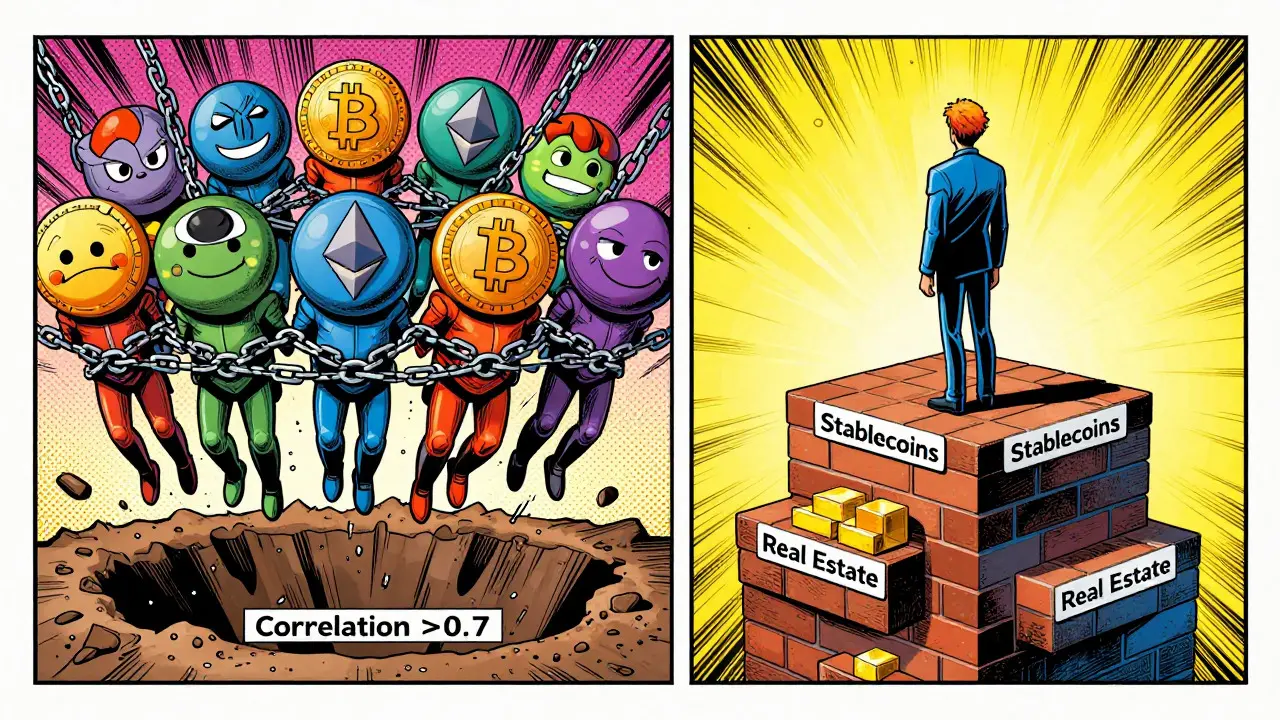
Let's look at the data. For most of the last decade, the correlation coefficient between Bitcoin (BTC), Ethereum (ETH), and major altcoins has hovered above 0.7. In financial terms, a correlation of 1.0 means two assets move perfectly together. A correlation of 0 means they have no relationship. When BTC drops, 90% of the top 100 cryptocurrencies usually drop too. Why? Because most crypto trading pairs are against USDT or BTC. If confidence in the system shakes, capital flees to stablecoins or fiat, dragging everything down with it.
This phenomenon creates an illusion of safety. You might hold Solana, Cardano, Polkadot, and Avalanche. On paper, these are four distinct ecosystems with different technologies. In practice, during a market downturn, they all suffer from the same macroeconomic pressures: regulatory fear, liquidity crunches, and retail panic selling. True portfolio diversification requires looking beyond the ticker symbol and into the underlying mechanics of value creation.
Understanding Correlation in Digital Assets
To manage risk effectively, you need to understand what drives price action. Traditional diversification mixes stocks, bonds, gold, and real estate. These assets react differently to inflation, interest rates, and economic growth. Bonds often rise when stocks fall. Gold shines during geopolitical turmoil. Real estate provides tangible utility.
In the blockchain space, we don't have this natural hedge yet. Most crypto assets are speculative growth plays. However, there are emerging categories that behave differently:
- Store of Value Assets: Bitcoin acts as digital gold. It tends to lead market cycles but also retains value better during long-term bear markets compared to high-risk altcoins.
- Infrastructure Protocols: Layer-1 blockchains like Ethereum derive value from network usage fees. Their performance is tied to developer activity and transaction volume, not just hype.
- Stablecoins and Yield Bearing Assets: Holding a portion of your portfolio in USD-backed stablecoins allows you to earn yield without exposure to volatility. This is the closest equivalent to short-term government bonds in crypto.
- Real World Assets (RWA): Tokenized treasury bills or real estate introduce cash flows from the traditional economy, which may decouple from pure crypto sentiment.
By mixing these categories, you reduce the chance that a single event-like a hack on one exchange or a bug in one smart contract-wipes out your net worth.
Structural Risks Beyond Price Volatility
Price fluctuation is only one type of risk. In blockchain investing, structural risks can be far more devastating. Diversification must address these non-price factors:
- Smart Contract Risk: Every decentralized application runs on code. Code has bugs. If you keep all your funds in one DeFi protocol, a single exploit could drain your account. Spreading funds across audited, established protocols reduces this exposure.
- Custodial Risk: Leaving assets on centralized exchanges exposes you to bankruptcy risk (remember FTX?). Using self-custody hardware wallets for long-term holdings and keeping only active trading capital on exchanges mitigates this.
- Regulatory Risk: Different jurisdictions treat tokens differently. Some classify them as securities, others as commodities. Holding assets with clear regulatory status in multiple regions can protect against sudden bans or restrictions.
- Liquidity Risk: Small-cap tokens can plummet 50% in minutes if a large holder sells. Large-cap assets like BTC and ETH maintain deep order books, ensuring you can exit positions without massive slippage.
A robust strategy acknowledges that technology fails. By not putting all eggs in one basket-whether that basket is one coin, one wallet, or one jurisdiction-you build resilience.
Practical Steps to Build a Resilient Portfolio
So how do you actually implement this? Start by defining your risk tolerance and time horizon. Are you saving for retirement in 20 years, or trying to flip gains next month? The approach differs significantly.
For long-term holders, consider the core-satellite approach. Allocate 60-80% of your portfolio to "core" assets with proven track records and wide adoption, primarily Bitcoin and Ethereum. These form the foundation. Use the remaining 20-40% for "satellite" investments in higher-risk areas like new Layer-1s, DeFi governance tokens, or NFT projects. This structure ensures that even if your satellite bets fail, your core wealth remains intact.
Next, rebalance regularly. Markets change. An asset that was a small cap six months ago might now be a mid-cap. If your satellite positions grow too large due to price surges, sell some profits and move them back into your core holdings or stablecoins. This forces you to buy low and sell high systematically, removing emotion from the equation.
| Strategy Type | Risk Level | Potential Return | Key Benefit | Main Drawback |
|---|---|---|---|---|
| Concentrated (1-3 coins) | Very High | High | Simplicity | Total loss possible |
| Broad Altcoin Basket | High | Medium-High | Exposure to trends | High correlation risk |
| Core-Satellite Mix | Medium | Medium | Balanced growth/safety | Requires active rebalancing |
| Multi-Asset (Crypto + TradFi) | Low-Medium | Low-Medium | True uncorrelated returns | Complex tax reporting |
The Role of Stablecoins and Cash Equivalents
Many crypto natives view holding cash as a sin. They believe you should always be invested to catch the next bull run. But in risk management, cash is a strategic asset. Stablecoins like USDC or DAI allow you to stay within the ecosystem while avoiding volatility. During bear markets, having dry powder lets you buy dips at significant discounts.
Furthermore, stablecoins provide yield opportunities through lending protocols. While yields vary, earning 3-5% APY on stablecoins offers a buffer against inflation without the downside risk of equity-like tokens. This transforms idle cash into a productive component of your diversified portfolio.

Common Pitfalls to Avoid
Diversification can go wrong if implemented poorly. Here are three common mistakes:
- Over-diversification: Holding 50 tiny positions makes tracking difficult and dilutes potential gains. Transaction fees and gas costs can eat into profits. Focus on quality over quantity.
- Igoring Fees: Complex strategies involving frequent swapping across chains incur high costs. Ensure your expected returns justify the friction.
- Chasing Hype: Buying into every new meme coin or AI token under the guise of "exploration" is gambling, not diversification. Stick to assets with fundamental utility or strong community backing.
Remember, the goal isn't to maximize returns in a vacuum. It's to achieve consistent growth while surviving inevitable downturns. As Warren Buffett famously said, "Rule No. 1: Never lose money. Rule No. 2: Never forget rule No. 1." In crypto, this means preserving capital during winters so you can thrive in summers.
Looking Ahead: Emerging Diversification Tools
The landscape is evolving. New instruments are appearing that offer better hedging capabilities. Options markets on derivatives platforms allow you to buy puts to protect against downside moves. Perpetual futures enable shorting overvalued assets. While these tools carry their own risks, they provide sophisticated investors with granular control over their exposure.
Additionally, cross-chain bridges and interoperability protocols are making it easier to access diverse ecosystems without fragmenting your holdings across dozens of wallets. Security remains paramount here, as bridge hacks have been a major source of losses. Always use well-audited, established bridges.
Is Bitcoin enough for a diversified crypto portfolio?
For conservative investors focused solely on store-of-value properties, yes. However, Bitcoin alone exposes you to single-asset risk. Adding Ethereum provides exposure to the smart contract ecosystem, which behaves differently during certain market phases. True diversification often includes stablecoins and potentially other asset classes outside crypto.
How often should I rebalance my crypto portfolio?
Quarterly rebalancing is a good standard for most investors. Monthly may be too frequent given transaction costs, while annually might let allocations drift too far from your target. Rebalance when any asset class deviates by more than 5-10% from its target weight.
What is the difference between correlation and covariance in crypto?
Correlation measures the direction of movement between two assets (-1 to +1). Covariance measures how much two variables change together. In practice, correlation is more useful for diversification decisions because it normalizes for volatility. You want assets with low or negative correlation to smooth out portfolio swings.
Can NFTs help with diversification?
NFTs are highly illiquid and speculative, making them poor diversifiers for most portfolios. They lack standardized valuation metrics and deep markets. Only allocate a very small percentage (1-2%) if you have specific expertise and high risk tolerance. They should not be relied upon for risk reduction.
Does staking affect diversification benefits?
Staking locks up assets, reducing liquidity flexibility but adding yield. It doesn't inherently improve diversification unless you stake across multiple uncorrelated networks. Be aware that slashing penalties in Proof-of-Stake systems add another layer of technical risk to consider.
 Cryptocurrency Guides