
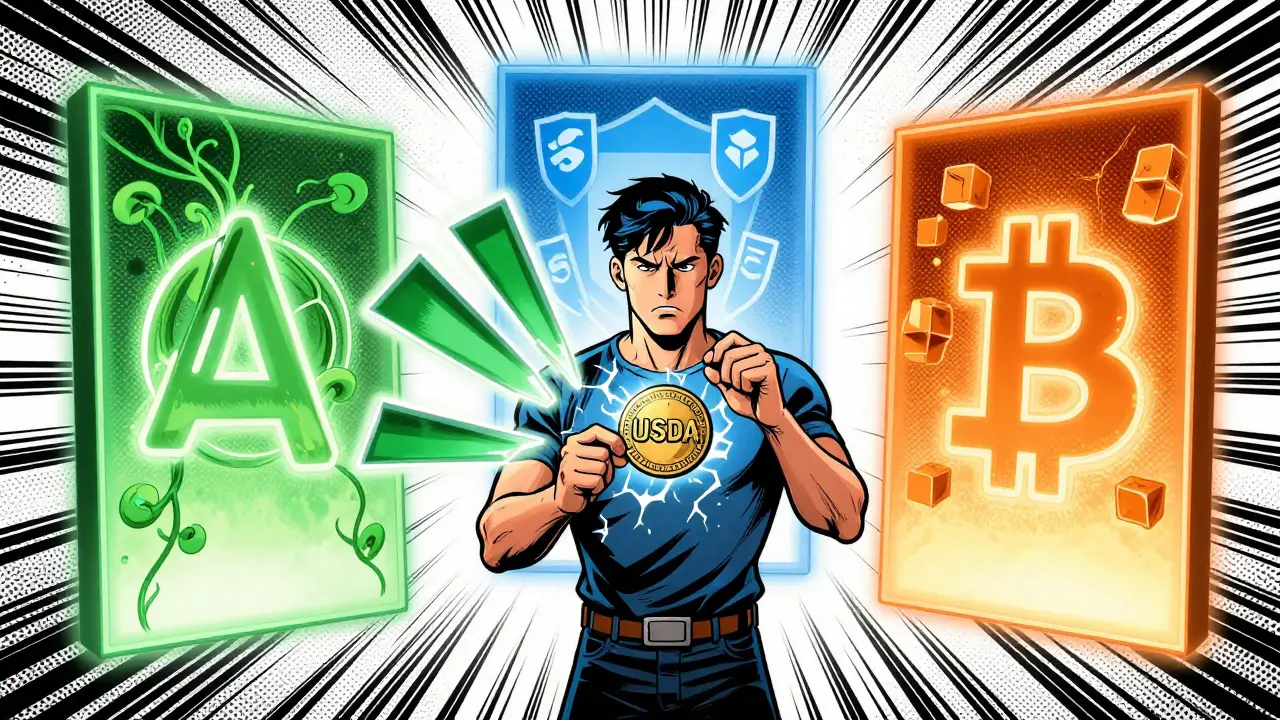
You see the ticker USDA on a chart or in your wallet, but what exactly are you holding? It isn't just one coin. In fact, "USDA" currently refers to three completely different projects trying to do the same thing: peg their value to the U.S. dollar. If you buy the wrong one, you might end up with an asset that doesn't fit your strategy-or worse, one that carries risks you didn't expect.
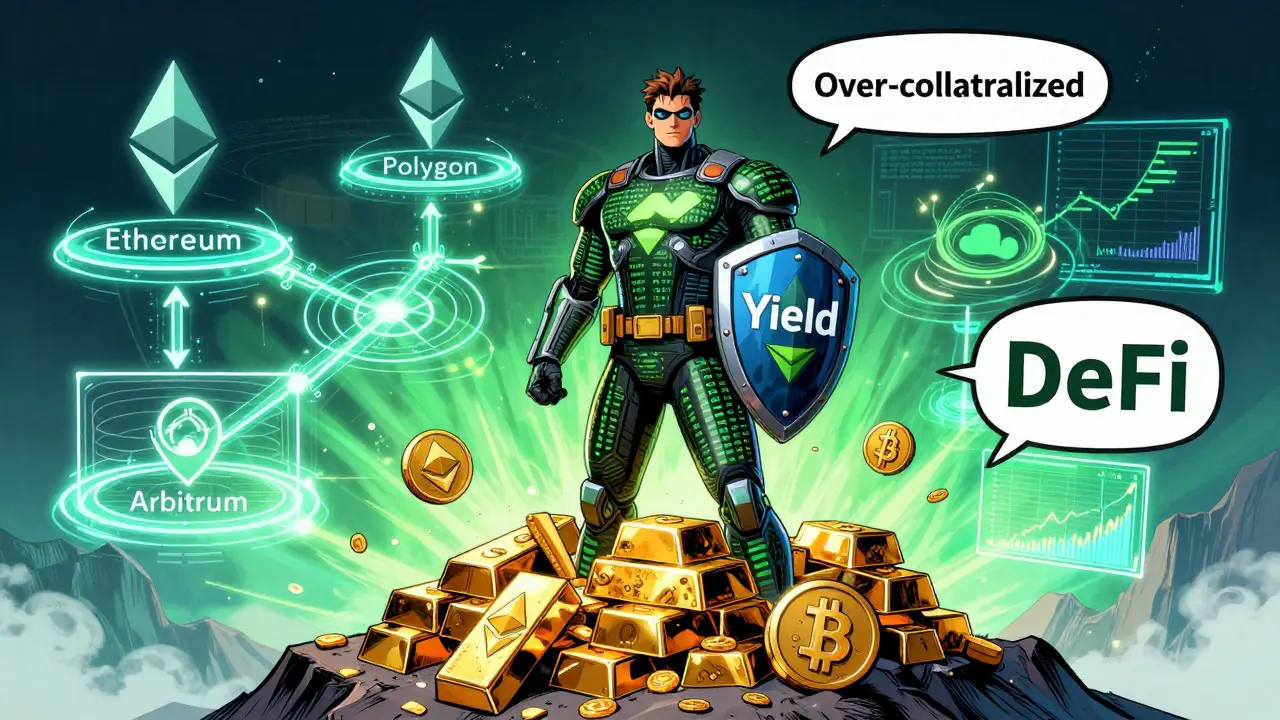
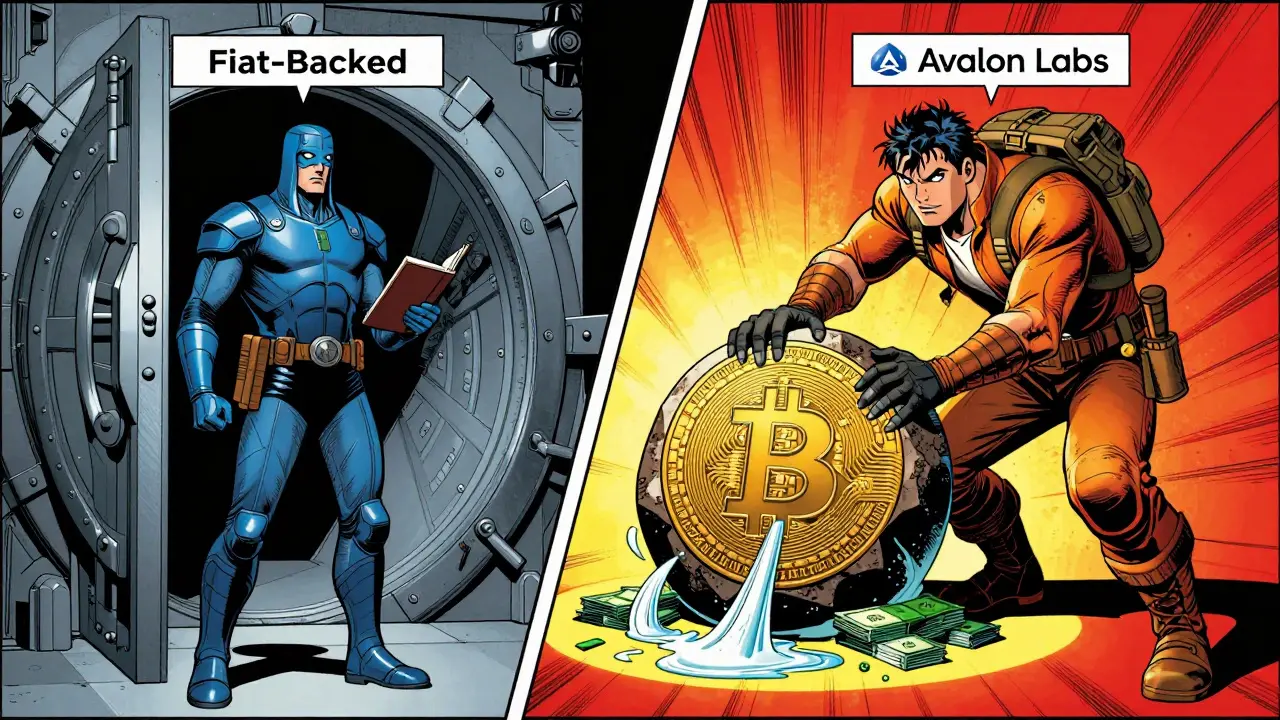
The confusion happens because multiple issuers use the same four-letter code. There is Angle Protocol’s USDA, which is a decentralized, over-collateralized stablecoin built for DeFi yield. Then there is the Cardano/Anzens USDA, a fiat-backed stablecoin designed for payments and regulatory compliance. Finally, there is Avalon Labs’ USDa, a Bitcoin-collateralized stablecoin operating within a CeDeFi lending platform.
To figure out which one matters to you, we need to break down how each works, who backs them, and where they live on the blockchain. Let's clear up the fog.
1. Angle Protocol’s USDA: The Yield-Bearing DeFi Play
If you are deep into decentralized finance (DeFi), this is likely the USDA you have heard about. Issued by Angle Protocol, a decentralized organization focused on building resilient stablecoin infrastructure, this version of USDA is designed to be more than just a store of value. It aims to generate income for holders.
How It Stays Pegged
Angle’s USDA maintains its $1.00 peg through a mix of real-world assets (RWAs) and crypto collateral. Unlike traditional stablecoins that hold cash in a bank vault, Angle backs its tokens with:
- Tokenized U.S. Treasury Bills and Government Bonds
- Ethereum (ETH)
- Bitcoin (BTC)
- Other liquid USD-denominated stablecoins
This structure makes it over-collateralized. That means the total value of the reserves sitting behind the token is greater than the total number of USDA coins in circulation. This buffer protects users if the price of ETH or BTC drops suddenly. The protocol uses a "Price Stability Module" (PSM)-smart contracts that have been audited multiple times-to manage swaps between USDA and these underlying assets, keeping the price close to parity.
Why Hold It?
The main draw here is yield. Because the backing assets include things like Treasuries and lending positions, the protocol earns interest. Angle passes some of this earnings back to USDA holders. You aren't just parking your money; you are earning a return derived from low-risk TradFi yields and DeFi strategies. Ledger notes that Angle is ranked among the safest DeFi protocols by DeFiSafety, which adds a layer of trust regarding smart contract security.
Where Can You Use It?
Angle USDA is highly interoperable. It lives on ten major blockchains, including Ethereum, Arbitrum, Optimism, Base, Polygon, BNB Chain, Avalanche, Linea, and Celo. You can swap for it on decentralized exchanges (DEXs) like Uniswap and 1inch. You can also borrow it directly from lending protocols like Morpho Blue. Major wallets like Ledger and Trust Wallet support it, with Trust Wallet even offering a "Stablecoin Earn" feature specifically for USDA.
2. Cardano / Anzens USDA: The Regulatory-Compliant Option
If you are in the Cardano ecosystem, you are looking at a different beast entirely. This USDA is issued by Anzens Inc. in partnership with EMURGO, a founding entity of the Cardano project. Its goal is not complex DeFi yield, but reliable, compliant payments.
Fully Backed by Fiat
This USDA follows the traditional stablecoin model. For every 1 USDA token in existence, there is $1.00 held in reserve by a regulated U.S. banking partner. These reserves consist of U.S. dollars and dollar-equivalents like short-term government treasuries. When you want USDA, you deposit USD, and the system mints the token. When you want cash back, you burn the token, and the system sends you the USD.
EMURGO explicitly contrasts this with algorithmic stablecoins (like the failed TerraUSD). Their argument is simple: if a fully backed stablecoin loses its peg temporarily due to market panic, it has a much higher chance of recovering because the hard cash is actually there waiting for redemption.
Use Cases and Availability
Anzens positions this USDA as a tool for cross-border payments and settlements. Businesses and individuals can move money internationally with near-instant finality, avoiding expensive foreign exchange fees. Initially launched on the Cardano blockchain, it is designed to integrate with Cardano dApps for lending and borrowing. Users access it through the Anzens portal (which requires KYC verification), Cardano DEXs, or centralized exchanges.
3. Avalon Labs’ USDa: The Bitcoin-Centric Choice
The third player is Avalon Labs, a platform creating an on-chain financial center for Bitcoin. Their token, often listed as USDa but trading under the USDA ticker, is a Collateralized Debt Position (CDP) product.
Bitcoin-Backed Liquidity
Here, you don't deposit fiat or a mix of crypto. You deposit Bitcoin. Avalon Labs allows BTC holders to unlock liquidity without selling their coins. By locking BTC into their CeDeFi (Centralized-Decentralized Finance) lending platform, users mint USDA against their collateral. This appeals to Bitcoin maximalists who want to keep exposure to BTC while accessing a stable currency for spending or trading.
Market Reality Check
Data from CoinGecko shows this version has a circulating supply of around 210 million USDA. However, trading volume is extremely thin-sometimes less than $60 in a 24-hour period. The price often hovers slightly below $1.00 (e.g., $0.9837), indicating limited liquidity depth. This suggests that most usage happens internally within the Avalon ecosystem rather than on public exchanges.
Comparing the Three USAs
Since the ticker is identical, you must look past the name to the mechanics. Here is how they stack up against each other:
| Feature | Angle Protocol USDA | Cardano / Anzens USDA | Avalon Labs USDa |
|---|---|---|---|
| Issuer | Angle Protocol (Decentralized) | Anzens Inc. & EMURGO | Avalon Labs |
| Backing Assets | Treasuries, ETH, BTC, other stablecoins (Over-collateralized) | 100% USD Cash & Treasuries (Fully Reserved) | Bitcoin (Collateralized Debt Position) |
| Primary Blockchain(s) | Ethereum, Arbitrum, Base, Polygon, BNB, etc. (Multi-chain) | Cardano (with interoperability plans) | Bitcoin-centric / Associated EVM sidechains |
| Main Goal | DeFi Yield & Cross-chain Composability | Regulatory Compliance & Payments | BTC Liquidity Unlocking |
| Redemption | Swap via DEXs or Burn via Protocol | Direct 1:1 Redemption via Anzens Portal | Repay Debt to Release BTC |
Risks You Need to Know
No stablecoin is risk-free, and USDA is no exception. The type of risk depends entirely on which version you choose.
Smart Contract Risk (Angle): While Angle is audited and rated highly by DeFiSafety, it relies on complex code to manage over-collateralization. If there is a bug in the Price Stability Module, funds could be lost. Additionally, because it holds volatile assets like ETH and BTC, a massive, simultaneous crash in those markets could theoretically stress the peg if the collateral ratio isn't managed aggressively.
Custodial & Regulatory Risk (Cardano/Anzens): This model trusts a central entity (Anzens) and a bank. If regulators crack down on Anzens' operations or freeze their banking partners, redemptions could halt. You are relying on their transparency reports and audits to prove the dollars are actually there.
Liquidity & Centralization Risk (Avalon): With very low trading volume, selling large amounts of Avalon's USDa could cause significant slippage (price drop). Furthermore, the "CeDeFi" nature means parts of the system may be centralized, introducing counterparty risk regarding how your Bitcoin collateral is stored and managed.
Which One Should You Pick?
Your choice depends on your end game.
If you want to earn passive income on your stablecoin holdings and are comfortable interacting with DeFi protocols across multiple chains, Angle’s USDA is the strongest candidate. It offers yield and broad utility.
If you are a business or individual needing to send money globally with legal certainty and prefer the simplicity of a fiat-backed model, look toward Cardano’s USDA. Just ensure you are using the official Anzens portal for minting and redeeming.
If you are a Bitcoin holder who refuses to sell your BTC but needs spendable cash for daily expenses, Avalon’s USDa provides that bridge, though you should be wary of its low liquidity outside the Avalon platform.
Always double-check the contract address before swapping. In crypto, tickers lie, but addresses don't.
Is USDA a scam?
No, USDA is not inherently a scam. However, because three different legitimate projects use the same ticker, confusion can lead to buying the wrong asset. Angle Protocol and Anzens (Cardano) are well-known entities with transparent operations. Always verify the specific issuer and contract address before transacting.
Does USDA pay interest?
Angle Protocol’s USDA is designed to be yield-bearing, meaning holders can earn returns generated from the protocol's reserve assets (like Treasuries and DeFi lending). Cardano’s USDA does not natively pay interest simply by holding it, though you can stake it in other DeFi apps. Avalon’s USDa is a debt position, so it doesn't pay interest; instead, you avoid selling your Bitcoin.
Can I buy USDA on Binance or Coinbase?
Which blockchain is USDA on?
It depends on the version. Angle USDA is on Ethereum, Arbitrum, Base, Polygon, BNB Chain, and others. Cardano USDA is native to the Cardano blockchain. Avalon USDa operates on Bitcoin-centric or associated EVM-compatible networks. You must select the correct network when adding the token to your wallet.
Is USDA safer than USDT or USDC?
Safety is subjective. USDT and USDC are centralized and fiat-backed, similar to Cardano's USDA, but with much higher liquidity. Angle USDA is decentralized and over-collateralized, which removes counterparty risk of a single issuer but introduces smart contract risk. Generally, larger market cap stablecoins like USDC offer deeper liquidity, making them easier to trade quickly without affecting the price.
What happens if USDA de-pegs?
If Angle USDA de-pegs, arbitrageurs typically buy the discounted token and redeem it for collateral, pushing the price back up. If Cardano USDA de-pegs, users can redeem it 1:1 for USD via the Anzens portal, provided the reserves are intact. For Avalon USDa, a de-peg usually signals liquidity issues or collateral stress, potentially leading to liquidation of user positions.
 Cryptocurrency Guides