
Have you ever scrolled through a list of cryptocurrencies and seen a name that sounds like it was generated by an algorithm trying to be funny? Doge Floki Coin, or DOFI, is exactly that kind of asset. It’s a meme cryptocurrency built on Binance Smart Chain that combines branding from Dogecoin and Floki with deflationary mechanics. But before you rush in thinking you’ve found the next big thing because the price is practically zero, you need to understand what this token actually is, how it works, and why it carries significant risk.
In the world of crypto, names matter. DOFI isn’t just a random string of letters; it’s a deliberate mashup designed to catch the eye of investors who loved Dogecoin (DOGE) and Floki Inu (FLOKI). The project claims to offer "advantages" over its predecessors, primarily through a tokenomics model that rewards holders and burns supply. However, the reality on the ground-looking at liquidity, team transparency, and market presence-tells a much more cautious story.
The Basics: What Exactly Is DOFI?
At its core, Doge Floki Coin is a BEP-20 token operating on the Binance Smart Chain (BSC). This means it doesn’t have its own blockchain. Instead, it relies on the BSC infrastructure for security and transaction processing. If you’re familiar with Ethereum, think of BSC as a faster, cheaper cousin. Transactions on BSC typically confirm in about five seconds, and gas fees are significantly lower than on Ethereum mainnet.
Why does this matter for DOFI? Because being a BEP-20 token makes it easy to trade on decentralized exchanges (DEXs) like PancakeSwap. You don’t need a centralized exchange to buy or sell it; you just need a wallet like Trust Wallet or MetaMask connected to BSC. This accessibility is part of its appeal, but it also lowers the barrier to entry for speculative trading.
The project positions itself as "fully decentralized." In theory, this means no single entity controls your funds once they are in your wallet. However, "decentralized" in the context of meme coins often refers to the lack of a central authority managing user accounts, not necessarily the governance of the project itself. As we’ll see later, the distinction between true decentralization and anonymous development teams is crucial here.
Tokenomics: The Deflationary Promise
Let’s talk numbers, because that’s where DOFI tries to differentiate itself. The token has a maximum supply of 420 quadrillion (420,000,000,000,000,000) tokens. Yes, that’s a lot of zeros. This massive supply is common in meme coins to keep the per-token price extremely low, which psychologically appeals to buyers who want to feel like they’re getting "cheap" assets.
Here is how the money moves when you trade DOFI:
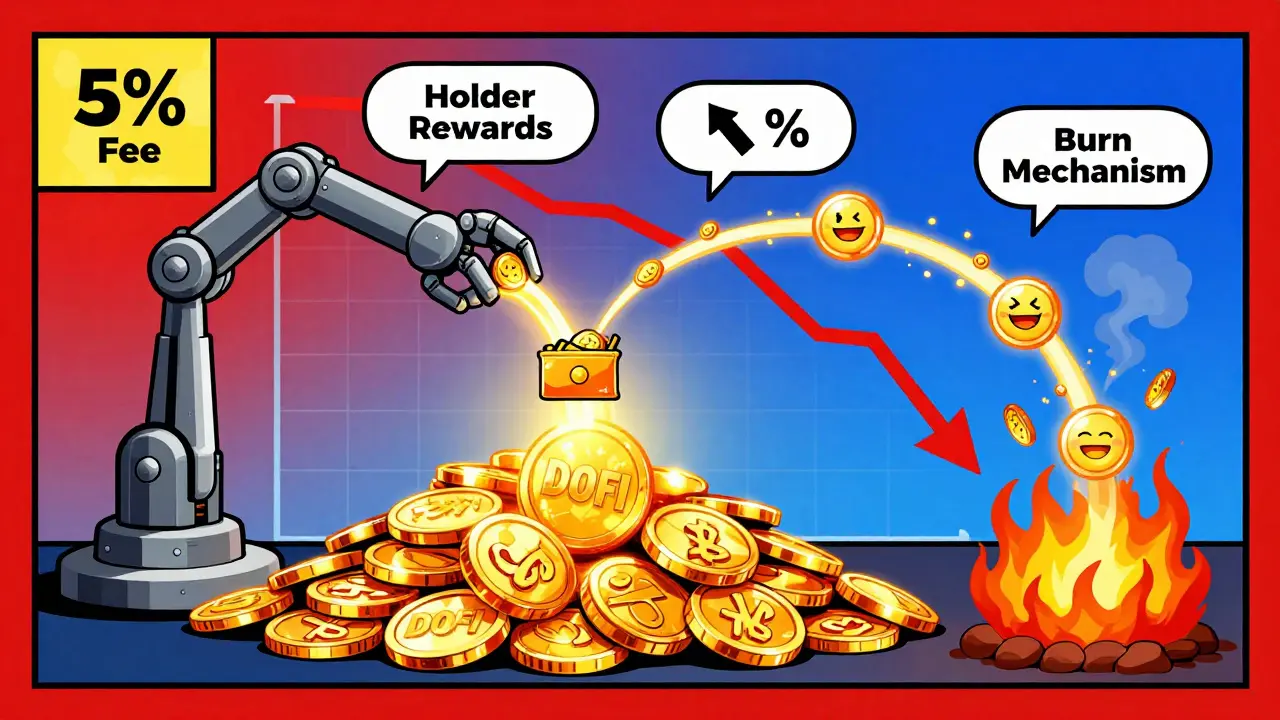
- Transaction Fee: Every time you buy or sell DOFI, a 5% fee is applied.
- Holder Rewards: A portion of that 5% is redistributed to existing holders. If you hold DOFI in your wallet, you passively earn more DOFI whenever someone else trades. This is known as a "reflection" mechanism.
- Burn Mechanism: Another portion of the fee is burned, meaning those tokens are sent to a dead address and removed from circulation forever. The goal is to create deflationary pressure, making the remaining tokens scarcer over time.
On paper, this looks attractive. You hold the token, people trade, you get paid, and the supply shrinks. But there’s a catch: this only works if there is consistent trading volume. If no one is buying or selling, no fees are generated, and no rewards are distributed. Currently, DOFI suffers from extremely low liquidity, which we’ll explore next.
Market Reality: Liquidity and Price Data
If you check major trackers like CoinMarketCap or CoinGecko, you might find conflicting or sparse data for DOFI. Here’s what the latest snapshots tell us:
| Metric | Value / Status |
|---|---|
| Price | ~0.0000000000001 USD (fractions of a trillionth) |
| 24-Hour Volume | Often less than $20 USD on some platforms |
| Market Cap | ~$54,000 - $57,000 (Fully Diluted Valuation) |
| Circulating Supply | Data inconsistent; ranges from 0 to 420 Quadrillion depending on source |
| Ranking | #5800 - #7300 (Micro-cap tier) |
Look closely at that trading volume. On days when the entire global market moves billions of dollars, DOFI might see only $6 to $17 in total trading activity. This indicates extremely thin liquidity. What does that mean for you? It means if you try to sell a large amount of DOFI, you could crash the price instantly because there aren’t enough buyers on the other side. Conversely, a small buy order can spike the price artificially.
Furthermore, many major exchanges do not support DOFI. While it appears on niche platforms or older listings on Bybit, it is not widely traded on top-tier exchanges like Coinbase or Binance. Crypto.com, for instance, tracks the price but notes it is "not tradable yet" on their platform. This lack of broad exchange support limits accessibility and increases risk.
The Team and Transparency Issue
This is perhaps the most critical section for any investor. Who is behind Doge Floki Coin?
The short answer is: We don’t know.
Unlike established projects like Bitcoin or even newer altcoins with public founders, DOFI operates anonymously. There are no named team members, no corporate entity listed on major profiles, and no verifiable biography of the creators. The marketing narrative ties the coin to Elon Musk, claiming it was created with his help or inspired by his Shiba Inu, Floki. However, there is no evidence that Elon Musk has any involvement in DOFI. This is a common tactic in the meme coin space: leveraging celebrity association without permission or verification.
The absence of a transparent team raises red flags. In crypto, "anonymous" often correlates with higher risk of rug pulls (where developers abandon the project and take the liquidity) or pump-and-dump schemes. Without a team to hold accountable, investors have little recourse if things go wrong.
Future Roadmap: Staking and NFTs?
The whitepaper summaries suggest ambitions beyond simple trading. The project mentions plans for:
- A Staking Platform: Allowing users to lock up DOFI to earn additional rewards.
- NFT Marketplace Integration: Enabling the use of DOFI to purchase non-fungible tokens.
- Payment Utility: Positioning DOFI as a medium of exchange for goods and services.
However, these features remain largely theoretical. There are no confirmed launch dates, no audited smart contracts for staking pools, and no visible integrations with major NFT platforms. Until these utilities are live and verified, DOFI remains primarily a speculative asset driven by community sentiment rather than functional utility.

How to Buy DOFI (If You Choose To)
If you’ve read all the warnings and still want to proceed, here is the general process. Note that this involves using decentralized exchanges, which requires technical comfort.
- Set Up a Wallet: Download a BSC-compatible wallet like Trust Wallet or MetaMask.
- Buy BNB: Purchase Binance Coin (BNB) on a centralized exchange (like Binance or Kraken) and withdraw it to your wallet. You need BNB to pay for gas fees on BSC.
- Connect to a DEX: Go to a decentralized exchange like PancakeSwap and connect your wallet.
- Find the Contract Address: Search for DOFI. Crucial Step: Verify the contract address against official sources. Scammers often create fake tokens with similar names. Never trust a link from a random social media post.
- Swap: Swap your BNB for DOFI. Be aware of the 5% fee and potential slippage due to low liquidity.
Alternatively, if DOFI is listed on a specific centralized exchange like Bybit (check current availability), you can deposit fiat or crypto there and trade directly. However, always verify the listing status, as micro-caps can be delisted quickly.
Risks You Cannot Ignore
Before investing even a dollar, consider these risks:
- Liquidity Risk: With daily volumes under $20, exiting your position may be difficult or costly.
- Anonymity Risk: No team accountability means higher chance of malicious behavior.
- Brand Confusion: DOFI is often confused with FLOKI or DOGE. Do not mix them up. They are entirely different projects.
- Volatility: Micro-cap meme coins can swing 50-90% in hours based on rumors or whale movements.
- No Fundamental Value: Unlike stocks or utility tokens, DOFI’s value is purely speculative, driven by hype and scarcity mechanics.
Conclusion: Is DOFI Worth Your Attention?
Doge Floki Coin (DOFI) is a classic example of a high-risk, high-reward meme token. It offers an interesting deflationary model and leverages the popularity of dog-themed cryptos. However, it lacks the transparency, liquidity, and institutional support of more established assets. For experienced traders who understand how to navigate decentralized exchanges and manage extreme volatility, it might be a small speculative play. For beginners, it is generally safer to stick with larger, more liquid assets.
Remember, in crypto, if something sounds too good to be true-or if the team refuses to show their face-proceed with caution. Always do your own research (DYOR) and never invest more than you can afford to lose.
Is Doge Floki Coin (DOFI) the same as Floki Inu (FLOKI)?
No, they are completely different. Floki Inu (FLOKI) is a well-known meme coin with a large market cap and active development team. Doge Floki Coin (DOFI) is a separate, much smaller token on Binance Smart Chain that uses similar branding but has no affiliation with the FLOKI project.
Who is behind Doge Floki Coin?
The team behind DOFI is anonymous. There are no publicly identified founders or corporate entities associated with the project. Marketing materials reference Elon Musk, but there is no evidence of his involvement.
Can I buy DOFI on Coinbase or Binance?
Currently, DOFI is not widely listed on major centralized exchanges like Coinbase or Binance. It is primarily traded on decentralized exchanges (DEXs) like PancakeSwap or niche platforms. Always verify the current listing status before attempting to buy.
What happens to the 5% transaction fee?
The 5% fee is split into two parts: one portion is redistributed to existing holders as passive income, and the other portion is burned to reduce the total supply, aiming to create deflationary pressure.
Is DOFI a safe investment?
No, DOFI is considered a high-risk, speculative asset. It has extremely low liquidity, an anonymous team, and no fundamental utility. Investors should only allocate funds they can afford to lose entirely.
 Cryptocurrency Guides