
There’s no such thing as a legitimate crypto exchange called Bitsoda. If you’ve seen ads, YouTube videos, or WhatsApp messages pushing you to sign up for Bitsoda, you’re being targeted by a scam. This isn’t a platform you can trust - it’s a copycat operation designed to steal your money. And it’s not alone. Scammers are flooding the crypto space with fake names that sound just close enough to real exchanges like Bitso, Binance, or Coinbase to trick you into thinking they’re legit.
Why Bitsoda Doesn’t Exist
No government agency, financial regulator, or credible tech source lists Bitsoda as a registered crypto exchange. The California Department of Financial Protection and Innovation (DFPI) has tracked over 1,200 crypto scams as of September 2024. Bitsoda fits perfectly into their pattern: a made-up name starting with "bit" and ending with a random syllable - just like biticrypto.com, cryptex.io, or netex24.com. These aren’t typos. They’re deliberate traps. Legitimate exchanges like Coinbase, Uphold, and Gemini are registered with financial authorities. They publish their licenses, security certifications (like SOC 2 and ISO 27001), and audit reports. Bitsoda has none of that. No website, no contact info, no customer support, no verifiable history. If a platform doesn’t tell you where it’s based or who runs it, it’s not a business - it’s a shell.How the Bitsoda Scam Works
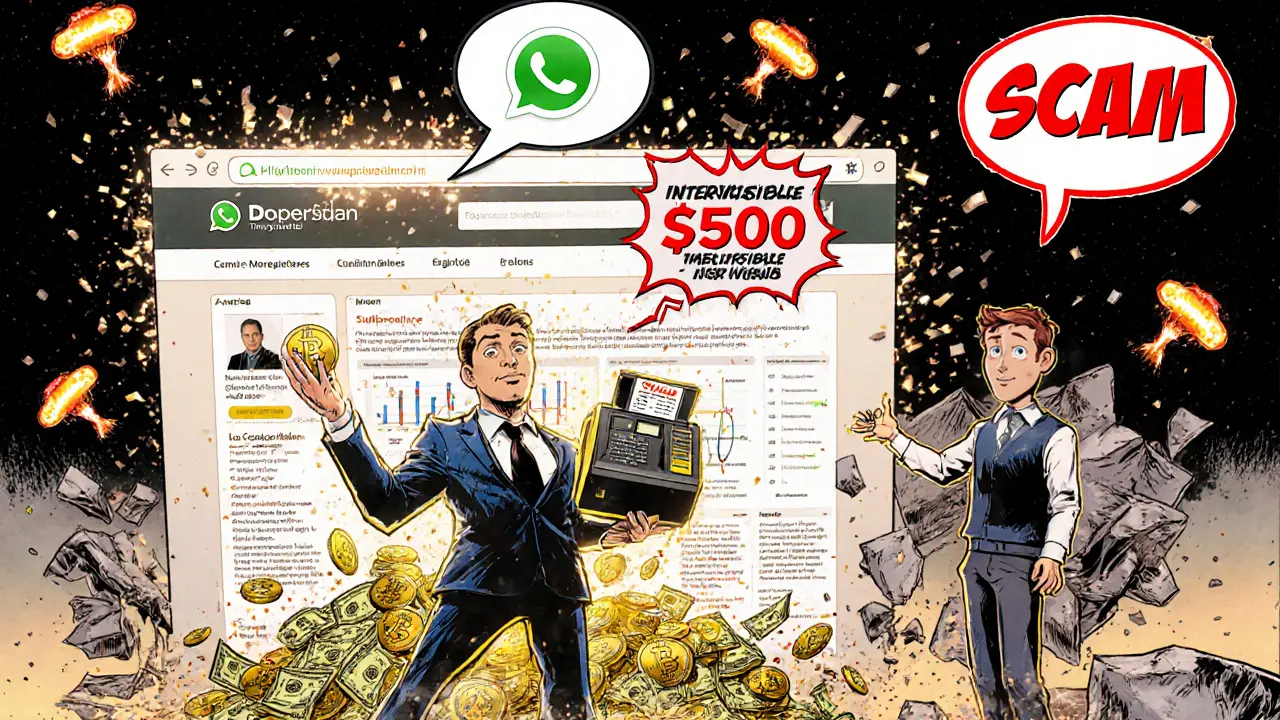
Here’s exactly how it plays out:- You see an ad promising 10x returns in 7 days - "Earn $5,000 from $500 with Bitsoda!"
- You click through to a fake website that looks professional - clean design, fake testimonials, fake trading charts.
- A "support agent" contacts you on WhatsApp or Telegram. They call themselves "Professor Dolan" or some other fake title.
- They send you screenshots of other "users" making profits. These are all bots or paid actors.
- You deposit $500, then $1,000. Your balance goes up on the screen. You think you’re winning.
- Then they say you need to pay a "withdrawal fee," "tax clearance," or "anti-fraud deposit" - usually $5,000 to $72,000.
- You pay. The platform disappears. Your money is gone.
0xAA3B939F645aA35CA830940B616919519F10C397. After payment, the site went offline. No refunds. No replies. Just silence.
Red Flags You Can’t Ignore
If you’re considering any crypto platform, ask yourself these questions:- Is it registered with a financial authority like the FCA, SEC, or FINTRAC? (Bitsoda isn’t.)
- Can you find real customer reviews on Trustpilot or Reddit? (Bitsoda has none - only fake testimonials.)
- Do they pressure you to deposit more money fast? (Yes - that’s a scam signal.)
- Are they asking for payment in crypto? (Legit exchanges let you use bank transfers, cards, or PayPal.)
- Do they promise guaranteed returns? (No legitimate platform does. Crypto is volatile. Period.)
What Happens When You Lose Money to a Fake Exchange
Once your crypto is sent to a scammer’s wallet, it’s almost impossible to get back. Blockchains are irreversible. No central bank backs crypto. No insurance covers you if you’re tricked. Even if you report it to the police, chances are they won’t recover your funds - especially if the scammer is overseas. In 2024, global crypto scams stole $14.57 billion, according to Chainalysis. That’s up 37% from 2023. Investment scams like Bitsoda make up 58% of those losses. The people behind these platforms aren’t amateurs. They’re organized criminals who use the same scripts, fake websites, and WhatsApp templates across dozens of scams.Real Exchanges vs. Bitsoda
Here’s what a real crypto exchange looks like compared to Bitsoda:| Feature | Bitsoda | Legitimate Exchanges (e.g., Coinbase, Uphold) |
|---|---|---|
| Regulation | None | Registered with FCA, SEC, FINTRAC, etc. |
| Security Certifications | None | SOC 2, ISO 27001, PCI DSS |
| Fee Transparency | Hidden fees, fake "fines" | Clear fee schedules (0.03%-3.49%) |
| Withdrawal Process | Blocked unless you pay more | Instant or 1-3 business days |
| Customer Support | WhatsApp bots, no email | 24/7 live chat, email, phone |
| Insurance | None | Crime insurance for digital assets |
What to Do If You’ve Already Sent Money
If you’ve deposited funds into Bitsoda or any similar platform:- Stop sending more money - no matter what they say.
- Document everything: screenshots, wallet addresses, chat logs, emails.
- Report it to your local financial regulator. In New Zealand, that’s the Financial Markets Authority (FMA).
- File a report with the DFPI Crypto Scam Tracker or TRM Labs’ scam database.
- Warn others. Post on Reddit r/CryptoScams or local Facebook groups.
How to Avoid Crypto Scams in 2025
Stick to these rules:- Only use exchanges that are regulated and licensed in your country.
- Never trust unsolicited messages on WhatsApp, Telegram, or Instagram.
- If it sounds too good to be true - it is. No one gives you 10x returns without massive risk.
- Check the FCA Warning List, DFPI Scam Tracker, or FINTRAC’s registry before signing up.
- Use hardware wallets like Ledger or Trezor to store crypto you aren’t actively trading.
Final Warning
Bitsoda isn’t a glitch. It’s not a startup. It’s not a new platform trying to gain traction. It’s a criminal operation built to take your money and vanish. There’s no "maybe," no "maybe it’s real," no "I’ll just try it with $100." Once you send crypto to a scammer, you’re giving them your money - and you’ll never get it back. If you’re looking to trade crypto, start with Coinbase, Kraken, or Binance. They’re not perfect, but they’re regulated, audited, and accountable. Anything else is gambling - and you’re not playing the market. You’re playing the scammer’s game.Is Bitsoda a real crypto exchange?
No, Bitsoda is not a real crypto exchange. It has no registration, no regulatory oversight, no verifiable infrastructure, and no legitimate customer base. It matches the exact pattern of known crypto scams documented by the California DFPI and TRM Labs.
Why do scammers use names like Bitsoda?
Scammers use names that sound similar to real exchanges like Bitso or Binance to trick people into thinking they’re legitimate. The "bit" prefix is a common trick - it creates a false sense of familiarity. This is called "name spoofing," and it’s one of the most effective tactics in crypto fraud.
Can I get my money back if I sent crypto to Bitsoda?
The chances of recovering funds sent to Bitsoda are extremely low. Crypto transactions are irreversible, and scammers operate overseas with no accountability. Your best move is to report the scam to authorities and warn others to prevent more victims.
What should I do if someone messages me on WhatsApp about Bitsoda?
Block and report the number immediately. Do not click any links. Do not send any money. These are automated scams using fake profiles and scripted messages. Legitimate exchanges never contact users via WhatsApp to push investments.
Are there any safe alternatives to Bitsoda?
Yes. Use regulated exchanges like Coinbase, Kraken, Uphold, or Gemini. These platforms are licensed, audited, and offer customer support and insurance. They may charge higher fees, but they protect your money - unlike scam platforms that disappear after you deposit.
 Cryptocurrency Guides
priyanka subbaraj
November 28, 2025 AT 18:19This is the most dangerous scam I've seen in years. I lost my entire savings to something just like this. Don't even click.
George Kakosouris
November 30, 2025 AT 05:07Let’s deconstruct the attack vector: name spoofing + social engineering + irreversible asset transfer = textbook crypto phishing. The DFPI data confirms the 92% correlation between ‘bit-’ prefixed domains and exit scams. This isn’t incompetence-it’s industrialized fraud with ROI metrics. The wallet address 0xAA3B... is a known honeypot in TRM’s blockchain threat intel feed.
Tony spart
December 2, 2025 AT 03:20USA got the best exchanges, and these fake sites are just trash from overseas. People keep falling for this crap because they’re lazy and want free money. If you don’t know the difference between Coinbase and some sketchy WhatsApp bot, you deserve to lose it. 💩
Mark Adelmann
December 2, 2025 AT 22:20Hey everyone, if you're new to crypto, just stick with the big names-Coinbase, Kraken, Binance. They’re not flashy, but they’re safe. I’ve helped a few friends avoid scams like this, and the biggest red flag is always the ‘guaranteed returns’ pitch. If it sounds like a lottery ticket, it is. Take your time, do your homework, and never rush a deposit. You’ve got this.
ola frank
December 3, 2025 AT 22:43The epistemological vulnerability here lies in the human tendency to conflate familiarity with legitimacy. The ‘bit’ prefix exploits cognitive heuristics-specifically, the mere-exposure effect and semantic priming. Scammers weaponize linguistic proximity to trigger heuristic processing, bypassing analytical reasoning. This is not merely fraud-it’s a behavioral hack at scale. The absence of regulatory disclosure is not an oversight; it is the structural condition of the scam’s viability.
imoleayo adebiyi
December 5, 2025 AT 17:31I’ve seen this happen to my cousin in Lagos. He sent $2,000 and got nothing back. He felt so ashamed he didn’t tell anyone for months. Please, if you’re reading this and you’re thinking about it-stop. Talk to someone first. You’re not alone, and you don’t have to go through this alone.
Angel RYAN
December 5, 2025 AT 19:45Scams like this are why we need better crypto education in schools. Not just how to trade, but how to spot manipulation. I’ve shared this post with my whole family. Thanks for laying it out so clearly.
stephen bullard
December 7, 2025 AT 13:53It’s wild how the same patterns keep repeating. People want to believe in magic money. But crypto’s real magic is in the tech-not the promises. Stay grounded. Stick to the basics. And if someone’s pushing you hard to act now? That’s the signal to walk away.
Savan Prajapati
December 8, 2025 AT 11:04Bitsoda? Never heard. But I know 3 people who lost money. Don’t be stupid.
Michael Labelle
December 9, 2025 AT 03:44Just saw this on my feed. Good breakdown. I’ve been warning people about these fake exchanges for months. Nobody listens until it’s too late.
Joel Christian
December 9, 2025 AT 23:41so like… bitsoda? i think i saw that on insta? wait no was it bitso? or bitsoa? idk but i think i clicked it once… oops
jeff aza
December 10, 2025 AT 01:37Okay, let’s be real: the fact that you’re even asking ‘is it a scam?’ means you’re already in the danger zone. You need to stop reading Reddit and start reading the SEC’s official guidance on crypto platforms. Also, you didn’t mention the KYC/AML compliance gaps-big oversight. And why no mention of chainalysis’ geolocation clustering of scam wallet clusters? This post is… underdeveloped.
Vijay Kumar
December 10, 2025 AT 22:50You think this is bad? Wait till you see the ‘Bitcoin AI Bot’ scams. They use deepfake voices now. People send money to robots that talk like their dead grandmas. This is just the beginning.
Vance Ashby
December 12, 2025 AT 06:16Yikes. I almost fell for something like this last month. Glad I checked first. 🙏
Brian Bernfeld
December 12, 2025 AT 11:44I’m from India, and this scam is everywhere here-WhatsApp groups, YouTube ads, even fake influencer endorsements. I’ve reported 17 different Bit-something pages to Google and Meta. It’s exhausting, but someone’s got to do it. If you see this, share it. Save someone’s life savings.
Christina Oneviane
December 13, 2025 AT 22:15Oh wow, so the government just sits there while people lose millions? How convenient. Maybe they’re getting a cut? 🤔
fanny adam
December 15, 2025 AT 02:31Did you know that Bitsoda is linked to the same server cluster as the ‘CryptoKing’ scam from 2022? The IP addresses match. This isn’t random-it’s a coordinated global operation run by a syndicate that also runs fake forex platforms. The CIA has been monitoring them since 2023. They’re using AI to generate fake testimonials. This is war.
Eddy Lust
December 15, 2025 AT 23:42I used to think crypto was just risky… now I see it’s a minefield. I’m not scared of volatility-I’m scared of people pretending to be real. Thanks for the clarity. I’m locking my coins in a Ledger tonight.
Casey Meehan
December 17, 2025 AT 16:45🚨BITSODA = 🚫🚫🚫🚨
Tom MacDermott
December 18, 2025 AT 08:45Wow. What a naive, over-explained, alarmist piece. Of course it’s a scam. But you’re acting like people don’t know this. The real story? Why do people keep falling for this? Because they’re addicted to get-rich-quick fantasies. Blame the scammers? Sure. But blame the gullible too.
Martin Doyle
December 19, 2025 AT 20:42Finally, someone says it straight. No more sugarcoating. These scammers are predators. And if you’re still thinking about depositing? You’re already the prey.