
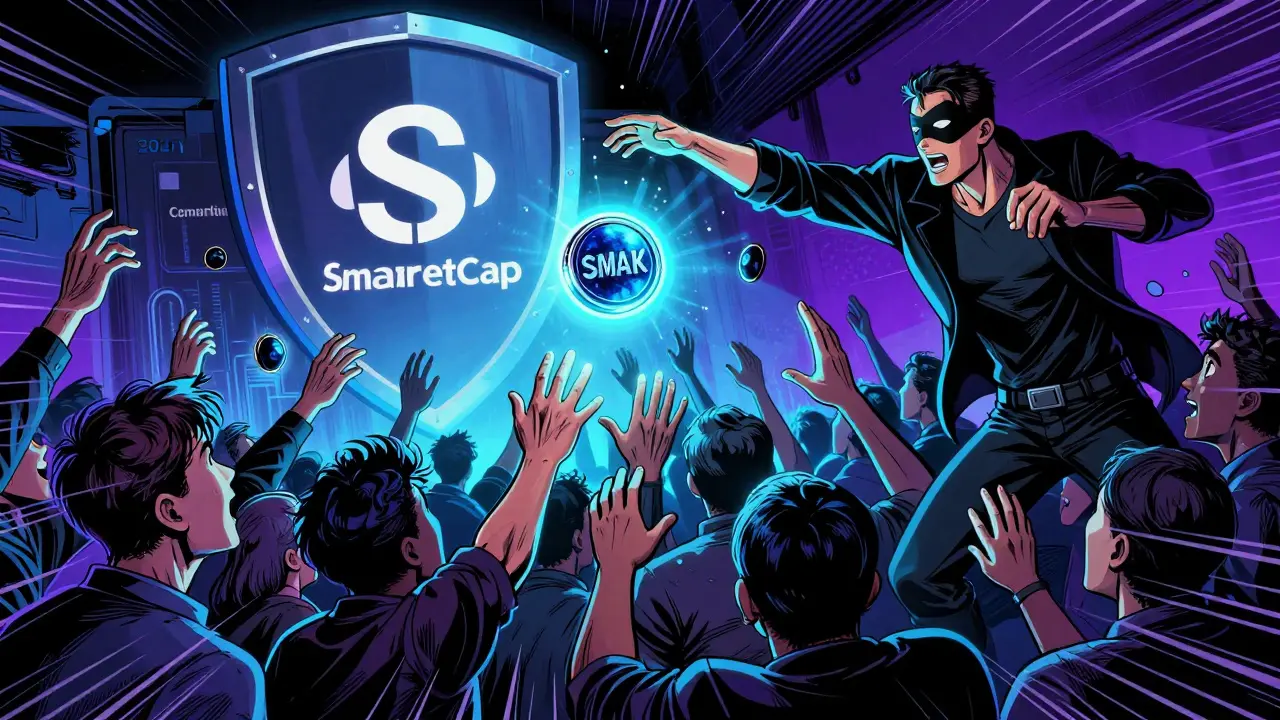
You might be scrolling through old crypto forums or watching a YouTube video from 2021 that promises free tokens. You see the name SMAK paired with CoinMarketCap and Smartlink. The hype looks real. The dates look specific. But here is the hard truth you need to know right now: this event is over. In fact, it has been dead for years.
The SMAK X CoinMarketCap Campaign was not a current opportunity. It was a historical marketing stunt conducted in September 2021. If you are looking to claim tokens today, you will find nothing but empty wallets and broken links. Understanding why this project failed is more valuable than trying to participate in a ghost event. Let’s break down what actually happened, where the money went, and why the SMAK token is essentially worthless today.
The 2021 Hype Machine: What Was the SMAK Airdrop?
To understand the silence around SMAK today, you have to look back at the noise of late 2021. That year was the peak of the decentralized finance (DeFi) boom. Everyone wanted a piece of the action. Smartlink, the team behind the SMAK token, launched a campaign designed to grab attention quickly.
From September 13 to September 23, 2021, Smartlink distributed $20,000 worth of SMAK tokens through the CoinMarketCap platform. This wasn’t just a random giveaway. It was a coordinated push. They posted promotional videos on YouTube as early as September 7, building anticipation before the drop even started. The goal? Exposure. They called it "a token of gratitude towards our community," which is code for "we need users and liquidity fast."
CoinMarketCap is the go-to source for millions of crypto investors. Getting an airdrop listed there gave the project instant legitimacy. Participants had to follow specific steps on the platform to qualify. For many newbies, seeing the CoinMarketCap logo made them trust the project without doing deep due diligence. That trust was the currency Smartlink was trading in, not the SMAK tokens themselves.
What Is Smartlink and Why Did They Choose Tezos?
Smartlink is a decentralized escrow platform built for Web 3.0 applications. In simple terms, they wanted to solve a classic problem in online transactions: trust. When you buy something from a stranger online, who holds the money until both parties agree the job is done? Traditionally, that’s PayPal or Stripe. Smartlink wanted to do that using blockchain technology.
They built their infrastructure on the Tezos blockchain. This was a strategic choice. Ethereum, the dominant smart contract platform at the time, was expensive and slow during peak usage. Tezos offered lower transaction fees and better scalability. For an escrow service dealing with small-to-medium payments, high gas fees would have killed the business model.
The ecosystem included several tools:
- Smartlink Escrow Service: Handling C2C, B2C, and B2B transactions securely.
- Payment Processing: A decentralized portal for instant settlements using various digital currencies.
- Milestone Management: Releasing funds only when specific work milestones were met.
- Decentralized Marketplace: A place for retailers and businesses to list products.
The SMAK token was supposed to be the fuel for this engine. Holding SMAK meant you could get exemptions from escrow fees and earn rewards. It also served as a governance token, allowing holders to vote on platform changes. On paper, it sounded like a solid utility model. In practice, it struggled to gain traction against established competitors.
The Brutal Reality: SMAK Price Collapse
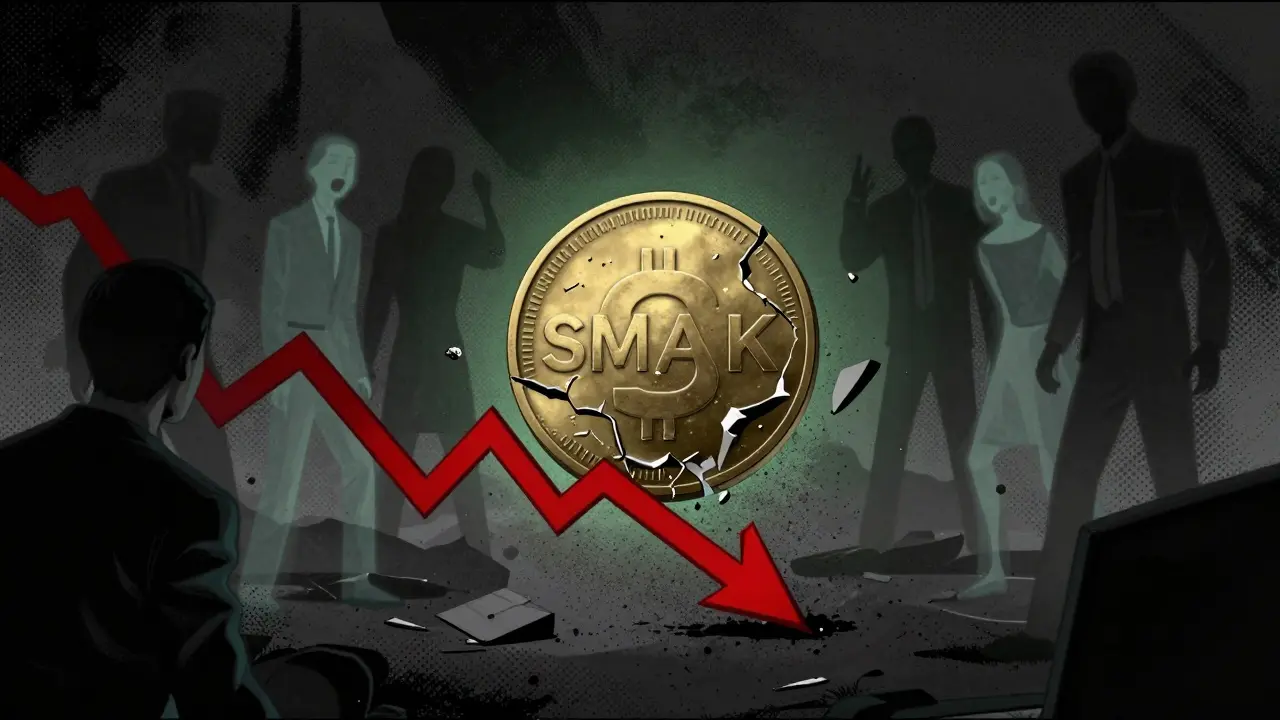
If you missed the 2021 airdrop, you don’t need to worry. If you participated, you likely lost everything. The price performance of SMAK since that campaign tells a story of rapid abandonment.
During its brief period of relevance, SMAK traded around $0.0024 per token. Fast forward to 2025 and 2026, and the price has cratered. Recent data shows SMAK trading between $0.000113 and $0.000137. That is a decline of nearly 95% from its one-year prior value. Even worse, the momentum hasn’t stopped falling. Over a single seven-day period in recent months, the token dropped another 47%. Over a month, it fell by more than 60%.
This isn’t just normal market volatility. This is a death spiral. The 24-hour trading volume for SMAK is effectively zero ($0.00). There is no liquidity. No traders. No interest. When a token has no volume, you can’t sell it even if you want to. The order books are empty.
| Metric | Peak Period (2021-2022) | Current Status (2025/2026) |
|---|---|---|
| Price per Token | ~$0.0024 | ~$0.000113 - $0.000137 |
| Year-over-Year Change | N/A | -94.59% |
| 24-Hour Volume | Active Trading | $0.00 (No Liquidity) |
| Exchange Listings | Multiple Platforms | Limited (e.g., Gate.io only) |
| Market Sentiment | Hype/Speculative | Abandoned/Negligible |
The Supply Mystery and Lack of Transparency
One of the biggest red flags with SMAK is the confusion surrounding its supply. Data from CoinMarketCap showed a self-reported circulating supply of roughly 305.49 million SMAK tokens. However, other sources indicated a current supply of zero. This discrepancy is alarming.
In crypto, transparency is everything. If the numbers don’t match, it usually means one of two things: either the token distribution failed completely, or the reporting is inaccurate due to abandoned contracts. This uncertainty creates massive risk for any remaining holder. You can’t calculate the true market cap or scarcity of a token if you don’t know how many exist. This lack of clarity contributed significantly to the loss of investor confidence.

Why Smartlink Failed to Adopt
So, why did a project with a clear use case, a major partner like CoinMarketCap, and a technically sound blockchain like Tezos fail?
First, timing. While 2021 was great for fundraising, it was terrible for building sustainable user bases. Too many projects promised too much and delivered too little. Users got burned repeatedly.
Second, competition. By the time Smartlink tried to gain traction, giants like Bitrefill, OpenEscrow, and even integrated features on larger exchanges were already handling escrow-like functions. Building a standalone decentralized marketplace is incredibly difficult because it requires network effects on both sides-buyers and sellers. Without critical mass, the platform remains empty.
Third, exchange delistings. As trading volume dried up, major exchanges removed SMAK from their platforms. Currently, Gate.io is one of the few places you can even find a trading pair. Being listed on obscure exchanges doesn’t help liquidity; it often traps users further. If you can’t easily move your tokens to a bank account or a stablecoin, the asset is useless.
Lessons Learned for Modern Crypto Investors
The SMAK saga serves as a cautionary tale for anyone participating in modern airdrops or early-stage DeFi projects. Here is what you should take away from this failure:
- Airdrops Are Marketing, Not Value: Free tokens are given to create buzz, not because the project believes in long-term utility for those specific recipients. Most airdrop participants dump the tokens immediately after claiming them, crashing the price.
- Check the Liquidity: A token might have a high market cap on paper, but if the daily volume is near zero, you cannot exit your position. Always check the 24-hour volume on CoinMarketCap or CoinGecko.
- Verify Supply Data: If different sources show conflicting supply numbers, walk away. Transparency issues are often the first sign of a dying project.
- Platform Matters: Building on Tezos was a smart technical move, but it limited the audience. Most crypto users stick to Ethereum, Solana, or Binance Smart Chain. Niche blockchains make user acquisition harder.
- Exchange Support Is Critical: If a token is only available on one or two minor exchanges, it is a trap. Look for listings on top-tier venues like Binance, Coinbase, or Kraken as a sign of health.
Don’t let nostalgia for the 2021 bull run blind you to the reality of 2026. The SMAK token is a relic of a past cycle. It offers no utility, no liquidity, and no hope of recovery. Save your time and capital for projects that are actively building, transparently reporting, and genuinely solving problems today.
Can I still claim the SMAK CoinMarketCap airdrop?
No. The SMAK X CoinMarketCap campaign ended in September 2021. The distribution period closed on September 23, 2021. Any website or video claiming you can still claim these tokens is likely a scam attempting to steal your wallet credentials.
Is the SMAK token worth investing in now?
Absolutely not. SMAK has lost over 95% of its value, has near-zero trading volume, and is listed on very few exchanges. There is no liquidity to support investment, and the project shows no signs of active development or user adoption.
What happened to the Smartlink project?
Smartlink failed to gain significant market traction despite its initial marketing efforts. The decentralized escrow concept struggled against established competitors, and the lack of exchange support led to a collapse in liquidity and user interest.
Why did Smartlink choose the Tezos blockchain?
Tezos was chosen for its low transaction fees and high scalability, which are essential for an escrow platform handling frequent, smaller transactions. However, this choice also limited the potential user base compared to more popular networks like Ethereum.
Where can I trade SMAK tokens if I hold them?
Trading options are extremely limited. Gate.io is one of the few exchanges that may still list SMAK pairs, but liquidity is negligible. You may find it impossible to sell large amounts without drastically impacting the price.
 Cryptocurrency Guides
Kimberly Herbstritt
May 20, 2026 AT 07:11I actually think people are being too harsh on the Tezos choice here. Look, I know everyone loves their Ethereum nostalgia, but low fees were literally the point for an escrow service. If you charge $50 in gas to hold $100 of goods, nobody uses it. Smartlink got the tech right, they just failed at marketing and community building. It’s not always about the blockchain, sometimes it’s about the team’s ability to sell the dream without selling out.
Jan Gilmore
May 20, 2026 AT 07:31Let me stop you right there because this is exactly the kind of naive thinking that gets retail investors rekt. You think 'low fees' matter when there is zero liquidity? It doesn't matter if the fee is zero if you can't sell the token. The market has spoken. SMAK is dead. The fact that you're defending a dead project shows you don't understand basic market dynamics. Liquidity is king, volume is queen, and everything else is just noise. Wake up.
Gavin Wonnacott
May 21, 2026 AT 04:24You are both missing the forest for the trees. This isn't about fees or liquidity charts. It's about the fundamental failure of the decentralized escrow concept in a world where trustless systems are still too complex for the average user. People want PayPal because it works, not because it's 'decentralized'. Smartlink tried to solve a problem that didn't need solving with technology that was too expensive to explain. They were pretentious in their approach and ignored the human element of commerce. Typical Silicon Valley hubris.
Destiny Kilby
May 22, 2026 AT 07:45i feel like we forget how much hope these projects gave us back then. it was such a different time in crypto. i remember reading about smartlink and thinking finally someone is trying to make online shopping safer. it hurts to see them fail but maybe the lessons learned will help future projects succeed
Sheldon Friesen
May 24, 2026 AT 06:11Oh, bless your heart! Did you really believe that a YouTube video from 2021 was going to change the global economy?!
Look, I get it. We all wanted to believe. We all wanted that 'easy money' narrative. But let's be real for a second, shall we? The reason this failed isn't just 'bad luck.' It's because the utility was weak, the competition was fierce, and the execution was mediocre. Stop romanticizing the failures of 2021. They weren't 'hopeful'; they were speculative bubbles waiting to burst. And they did. Boom. Gone.
Tricia Alach
May 25, 2026 AT 01:35the supply mystery is what really bugs me tho. how can circulating supply be 300 million one day and zero the next? its like the whole thing was a glitch in the matrix. makes u wonder if they even cared about transparency or if they just ghosted everyone once the hype died down. feels like a betrayal of the early believers who actually read the whitepaper
Caique Muniz
May 25, 2026 AT 08:11bro if the supply data is that messed up its probably because the devs ran away with the wallet keys. classic rug pull vibes even if they didnt technically steal the funds. just abandoned ship. lazy dev work usually leads to lazy reporting. dont waste ur time digging into ghosts
Bradley Geldenhuys
May 26, 2026 AT 17:14Listen up folks! The real lesson here is resilience. Sure, SMAK crashed. Sure, the team faded. But what did we learn? We learned that niche blockchains have niche audiences. Tezos is great, sure, but it lacks the mass adoption of ETH or SOL. However, the idea of decentralized escrow is NOT dead. It's just premature. We need better UX. We need simpler interfaces. Don't let this failure discourage you from innovating. Build better! Fight harder! The future is still decentralized, even if this specific train wreck wasn't part of it!
robert Whitehead
May 27, 2026 AT 20:48Your optimism is genuinely nauseating. There is nothing 'resilient' about a token that has lost 95% of its value and has zero trading volume. That is not a 'premature' idea; that is a failed business model. The escrow market is dominated by centralized entities for a reason: legal recourse. Blockchain cannot provide legal recourse. Until you accept that, you are just shouting into the void. The moral failing here is the lack of due diligence by the investors, not the 'potential' of the tech.
Mike S
May 29, 2026 AT 08:46Ah, the classic 'it's not my fault, it's the system' defense. How dramatic.
Let's cut through the philosophical nonsense. The project failed because it was built on a platform with no users (Tezos) to solve a problem that required users (Escrow). It's a chicken-and-egg problem that they never solved. Instead, they relied on a CoinMarketCap listing to fake legitimacy. That is not innovation; that is vanity. And now you're here telling us to 'build better' while ignoring the fact that most of these projects are just cash grabs disguised as tech solutions. Disgusting.
H F
May 31, 2026 AT 01:53I have to agree with the sentiment that the timing was off, but I disagree that the concept is flawed. Look at how many disputes happen on eBay or Amazon daily. A neutral, code-based escrow could revolutionize B2B transactions if the UI was intuitive enough. The tragedy of Smartlink is that they focused too much on the 'crypto' aspect and not enough on the 'user experience' aspect. They alienated the very people they wanted to serve. It’s a shame because the underlying logic was sound, even if the execution was disastrous.
Michael Berggren
May 31, 2026 AT 08:03Great analysis everyone! 🌟 While SMAK is definitely a relic of the past, the core issue highlighted here-liquidity-is the biggest killer of altcoins. Always check the volume! 📉 If you can't sell it, it's not an investment, it's a souvenir. Keep learning and stay safe out there! 💪🚀
Kiran CS
June 1, 2026 AT 10:20How utterly tedious. One must appreciate the sheer audacity of writing a lengthy post about a project that has been clinically dead for three years. It is akin to dissecting a fossil and expecting new biological insights. The author’s attempt to derive 'lessons' from such a mundane failure is intellectually bankrupt. The only valuable takeaway is the importance of recognizing incompetence when it presents itself wrapped in buzzwords like 'Web 3.0' and 'Decentralized Escrow'. Do not waste your cognitive resources on such trivialities.