

Imagine buying a coffee for $5 today and seeing the same cup cost $20 tomorrow. That’s not how most grocery shopping works, but it’s exactly what happens in the Cryptocurrency digital asset market characterized by extreme price fluctuations driven by speculative demand, limited liquidity, and regulatory uncertainty. If you’ve ever checked your portfolio after a long weekend only to see red numbers staring back at you, you’ve experienced Cryptocurrency Volatility the statistical measure of price dispersion over time, significantly higher than traditional assets due to market immaturity and sentiment-driven trading. It’s the defining feature of this asset class-both its biggest danger and its greatest opportunity.
Volatility isn’t just “prices going up and down.” In finance, it’s a specific metric that measures how much an asset’s price deviates from its average value over a set period. For stocks like Apple or Microsoft, these deviations are usually small percentages. For crypto, they can be double-digit swings in hours. Understanding why this happens, how to measure it, and how to protect yourself is the difference between getting wrecked by the market and using its energy to your advantage.
The Core Mechanics: Why Crypto Moves So Much
To understand why crypto prices jump around so violently, you have to look at the structure of the market itself. Traditional markets, like the New York Stock Exchange, have existed for centuries. They have deep pools of money (liquidity), strict regulations, and millions of participants. The crypto market is young, fragmented, and often unregulated. Here are the three main engines driving those wild price swings:
- Liquidity Constraints: Imagine trying to sell a rare painting. If only five people want to buy it, the price depends entirely on who wants it most right now. In crypto, especially with smaller coins, there aren’t enough buyers and sellers to absorb large orders. When a big player (a "whale") sells, there’s no one else to catch the ball, so the price crashes instantly.
- Supply Shocks: Bitcoin the first cryptocurrency with a fixed supply cap of 21 million coins, creating unique scarcity dynamics that amplify price reactions to demand changes has a hard limit. Unlike fiat currency, which central banks can print endlessly, Bitcoin cannot exceed 21 million units. When demand spikes suddenly-say, because of positive news-the price doesn’t adjust gradually; it rockets upward because new supply can’t be created to meet it.
- Sentiment-Driven Trading: Most crypto traders are retail investors, not institutional giants. Retail investors react emotionally to headlines, social media trends, and fear of missing out (FOMO). This creates a feedback loop where prices rise because people think they will rise, leading to exaggerated peaks and subsequent panic selling.
These factors combine to create a market that is highly sensitive to external shocks. A single tweet from a prominent figure or a regulatory announcement from a major government can move the entire market by 10% or more in minutes.
How Volatility Compares to Traditional Markets
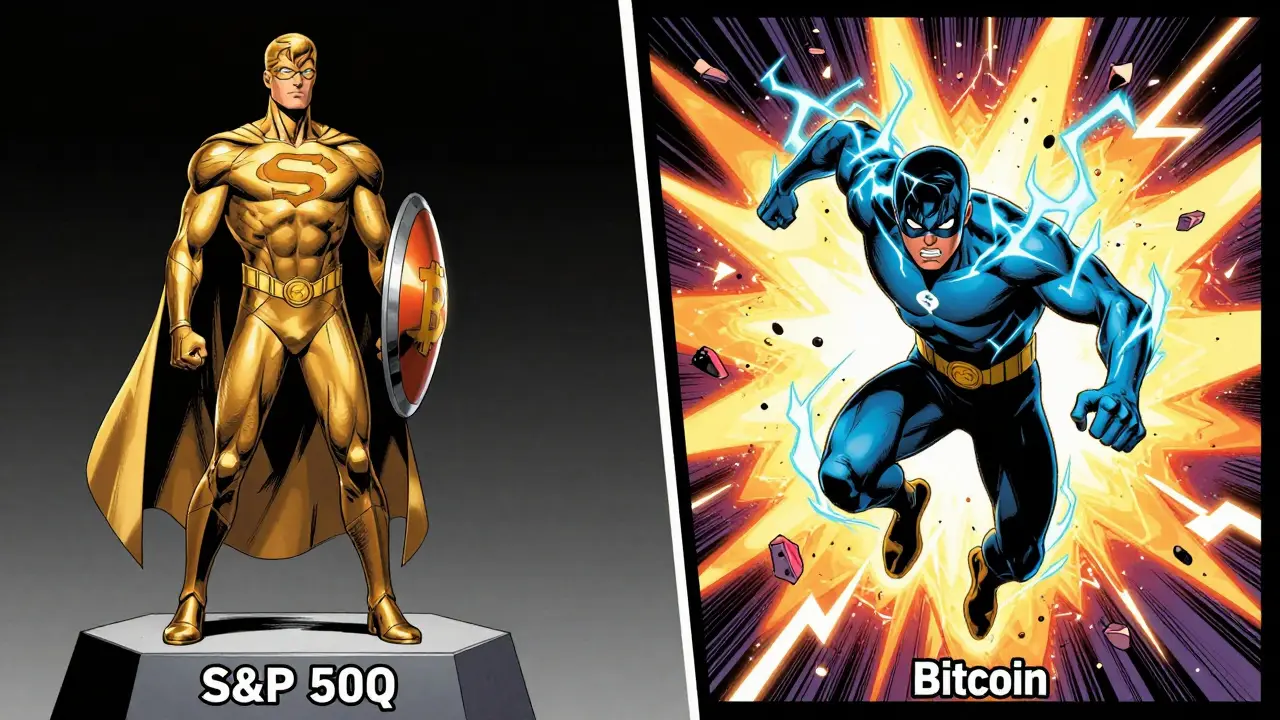
You might hear experts say crypto is "volatile," but what does that actually mean compared to what you’re used to? Let’s put it in perspective. The VIX Index known as the 'fear index,' measures expected volatility in the U.S. stock market based on S&P 500 options pricing tracks stock market volatility. Historically, the VIX hovers between 15 and 20. During crises, it spikes. But even then, it rarely stays above 40 for long.
Crypto volatility indexes, such as the CVX (Crypto Volatility Index), tell a different story. Between 2020 and 2024, Bitcoin demonstrated three to four times higher volatility than major equity indices like the S&P 500. To give you a concrete example: if the S&P 500 drops 10% in a bad month, Bitcoin might drop 30% or gain 30% in the same timeframe. However, recent data shows a shift. With the introduction of Spot ETFs exchange-traded funds that hold actual cryptocurrencies, allowing traditional investors to buy crypto exposure through standard brokerage accounts for Bitcoin and Ethereum, realized volatility has decreased slightly. Institutional money is steadier than retail hype, bringing some stability to the table.
| Asset Class | Average Annual Volatility | Risk Profile |
|---|---|---|
| S&P 500 Stocks | 15-20% | Moderate |
| Gold | 10-15% | Low/Moderate |
| Bitcoin | 60-80% | High |
| Altcoins (e.g., Solana, Cardano) | 100-150%+ | Very High |
Note that while Bitcoin is volatile, it’s actually the "stable" anchor of the crypto world. Smaller coins, known as altcoins, can swing 50% in a day without blinking. This hierarchy matters when you’re building a portfolio.
Historical Lessons: Peaks, Crashes, and Recovery
Looking at history helps us see that volatility isn’t random-it follows patterns. These patterns are driven by human psychology and market cycles.
Consider the 2017 Bull Run. Bitcoin started the year around $1,000. By December, it hit nearly $20,000. This wasn’t gradual growth; it was explosive speculation fueled by mainstream media coverage and retail FOMO. Then came the crash. In early 2018, the price dropped 80%. People who bought at the top lost most of their money quickly. Those who held through the pain eventually recovered as the next cycle began.
Then there was the March 2020 Crash. When the pandemic hit, global markets panicked. Bitcoin fell 50% in a single day. Interestingly, this showed that crypto can correlate with traditional markets during extreme stress. But unlike stocks, which took months to recover, Bitcoin bounced back within weeks, eventually reaching new highs. This resilience highlighted its potential as a hedge against monetary inflation, despite short-term volatility.
The 2021 Cycle saw Bitcoin reach $69,000, driven by corporate adoption (like Tesla buying Bitcoin) and easy money policies from central banks. Again, followed by corrections. The pattern is clear: rapid expansion, peak euphoria, sharp correction, and consolidation. Understanding where you are in this cycle helps manage expectations.
Strategies to Navigate the Storm
If volatility is inevitable, how do you survive it? You don’t try to predict every move-that’s impossible. Instead, you build systems that work regardless of direction. Here are three proven strategies used by experienced investors:
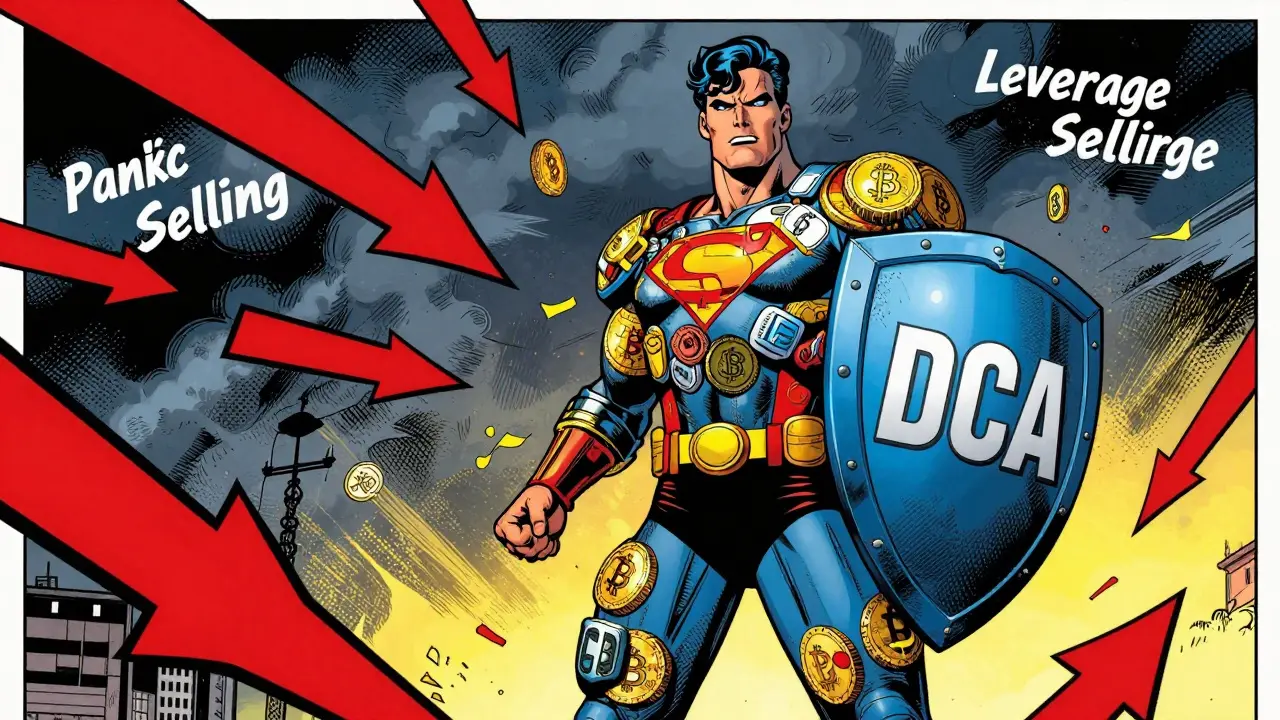
- Dollar-Cost Averaging (DCA): Instead of investing $10,000 all at once, invest $1,000 every week for ten weeks. This smooths out your entry price. If the market crashes next week, you buy cheaper. If it rallies, you still have exposure. DCA removes emotion from the equation.
- Position Sizing: Never bet the farm. Financial advisors typically recommend allocating only 1-5% of your total portfolio to high-volatility assets like crypto. If that 5% drops 50%, your overall portfolio only loses 2.5%. You sleep better knowing the rest of your wealth is safe in stable assets like bonds or index funds.
- Stop-Loss Orders: Use automated tools to sell if a price drops below a certain level. For example, if you buy Bitcoin at $60,000, set a stop-loss at $55,000. This prevents a small loss from becoming a catastrophic one. However, be careful: in extremely volatile markets, stop-losses can trigger prematurely during temporary dips.
Another tool is Bollinger Bands a technical analysis indicator consisting of a moving average upper and lower bands that expand and contract based on volatility, helping identify overbought or oversold conditions. This charting tool shows when an asset is statistically expensive or cheap relative to its recent history. When prices touch the upper band, they’re often overextended. When they hit the lower band, they may be undervalued. It’s not a crystal ball, but it provides context.
The Future: Is Volatility Decreasing?
As the market matures, volatility tends to decrease. This is a fundamental law of finance. As more institutions enter the space, as regulations clarify, and as liquidity deepens, price swings become less extreme. We’re already seeing this trend. The approval of spot ETFs has brought billions of dollars in steady, long-term capital into Bitcoin and Ethereum. Private companies and ETFs now control approximately 6% of Bitcoin’s circulating supply, acting as a stabilizing force.
However, don’t expect crypto to become as boring as a savings account anytime soon. Even with increased institutional adoption, the underlying technology remains experimental, regulatory landscapes are shifting, and retail sentiment still drives significant portions of the market. Over the next 5-10 years, we’ll likely see volatility drop from 80% to perhaps 40-50%, which is still very high compared to stocks. This means risk management will always be essential.
Common Mistakes to Avoid
New investors often make costly errors when facing volatility. Here’s what to avoid:
- Panic Selling: Selling at the bottom because you’re scared locks in your losses. Remember, volatility means prices go down as much as they go up. If you believe in the long-term thesis, dips are opportunities, not emergencies.
- Leverage Trading: Borrowing money to trade crypto amplifies both gains and losses. In a volatile market, leverage is a fast track to losing everything. A 10% drop can liquidate a 10x leveraged position completely.
- Chasing Hype: Buying a coin just because it’s trending on social media is gambling, not investing. These assets often lack fundamentals and can collapse overnight.
Education is your best defense. Spend time understanding blockchain technology, tokenomics, and market cycles before putting real money at risk.
Is cryptocurrency volatility good or bad for investors?
It depends on your timeline. For short-term traders, volatility is necessary to make profits from price differences. For long-term holders, volatility is a nuisance that requires emotional discipline. It presents buying opportunities during dips but also risks of significant drawdowns. There is no universal "good" or "bad"-only appropriate or inappropriate for your specific strategy.
Why is Bitcoin more volatile than gold?
Gold has been a store of value for thousands of years with massive market depth and global acceptance. Bitcoin is less than 20 years old, has a smaller market cap, and faces regulatory uncertainty. Additionally, Bitcoin’s fixed supply makes it more sensitive to sudden demand shifts, whereas gold mining output adjusts slowly to price changes.
Can I predict cryptocurrency price movements?
No one can consistently predict short-term price movements with high accuracy. Technical analysis and fundamental research improve probabilities, but they don’t guarantee outcomes. The market is influenced by unpredictable events like hacks, regulatory bans, or macroeconomic shifts. Focus on managing risk rather than predicting prices.
What is the safest way to invest in volatile crypto markets?
The safest approach involves diversification, dollar-cost averaging, and limiting exposure to a small percentage of your total net worth. Stick to established assets like Bitcoin and Ethereum initially, use hardware wallets for security, and never invest money you cannot afford to lose entirely.
Will cryptocurrency volatility decrease in the future?
Yes, historically, as markets mature and institutional participation grows, volatility decreases. Spot ETF approvals and clearer regulations are contributing factors. However, crypto will likely remain more volatile than traditional stocks for decades due to its smaller size and speculative nature.
 Cryptocurrency Guides
Lex Harley
May 3, 2026 AT 02:20honestly the liquidity part is what gets me every time. like if a whale decides to dump their bags on a low cap altcoin it just vanishes into thin air. the order book depth is so shallow compared to nyse that one big sell order can wipe out 30% of the market cap in seconds. its wild how much leverage people use knowing this risk exists.
Bevon Findley
May 3, 2026 AT 11:07lol typical retail trader panic. :)
Gabby Puche
May 3, 2026 AT 15:18I feel you! It’s really scary when you see those red candles dropping so fast 📉 But honestly, I’ve learned that DCAing helps take the edge off the anxiety. Just keep breathing and stick to the plan! 💪✨
Ralph Espinosa
May 4, 2026 AT 18:25You are absolutely right about the liquidity constraints!!! It is a fundamental issue that many new investors overlook!!!! The lack of deep order books means that price discovery is inefficient at best!!!! This is why position sizing is critical!!!! If you do not manage your exposure you will get wrecked by slippage alone!!!! Always check the volume before entering any trade!!!!
VIVEK SINGH
May 5, 2026 AT 02:14The irony is thick here. We talk about decentralization as freedom, yet we are slaves to the sentiment of a few whales. It is a philosophical paradox. The market is efficient only in its ability to extract wealth from the emotional to the disciplined. Or maybe I am just tired of watching charts all day. Who knows? Probably neither of us.
Emily A
May 5, 2026 AT 07:11Your understanding of market mechanics is superficial at best. You fail to account for the impact of institutional accumulation during periods of high volatility. Retail traders often mistake noise for signal because they lack the technical analysis skills required to identify trend reversals. Furthermore, your dismissal of leverage ignores the strategic utility of hedging with derivatives. One must study candlestick patterns and volume profiles before attempting to comment on such complex financial instruments. Ignorance is not a strategy.
Abhishek Verma
May 6, 2026 AT 22:39Oh look, another 'expert' telling everyone else they are stupid. How original. Maybe if you spent less time typing condescending paragraphs and more time actually trading, you wouldn't be down 50% this year. But sure, tell me about my 'superficial' understanding while you hold onto your bag of shitcoins.
Kristi Swartz
May 8, 2026 AT 03:00People need to stop treating gambling like investing. It is morally wrong to encourage others to put money into something so unstable without proper education. The greed is palpable. You should focus on stable assets and ethical banking practices instead of chasing hype cycles that destroy families. There is no honor in losing everything because you wanted to get rich quick.
Alex Mazonowicz
May 9, 2026 AT 06:45Hey there!!! Don't let the negativity get you down!!! Volatility is just opportunity in disguise!!! Every dip is a chance to buy more!!! Stay positive and keep learning!!! The future is bright for those who believe in technology!!! Keep smiling and holding strong!!! 😊🚀
Robert Smith
May 9, 2026 AT 20:02Yeah vibes are weird rn 🤷♂️ Just watch the charts and chill.
Felix Eduardo Velasquez
May 10, 2026 AT 00:15The comparison to gold is interesting but flawed. Gold has millennia of history as a store of value. Bitcoin has less than two decades. The volatility difference is not just about supply shocks but about trust. Trust takes time to build. Until then, crypto will remain a speculative asset class rather than a monetary standard. This is not a bad thing necessarily, but it requires a different mindset than traditional finance.
Arti Jain
May 10, 2026 AT 04:37Western markets are broken. Our financial systems are superior. Stop listening to American media narratives. India is leading in blockchain adoption. You should respect our regulatory framework. It is cleaner and more logical. Your volatility is a symptom of your economic instability. Learn from us instead of complaining.
Mitali Rajvanshi
May 12, 2026 AT 03:22I think Arti makes a fair point about regional differences. In India, we are seeing a lot of innovation despite the regulatory hurdles. It is important to look beyond the US-centric view of crypto. Many developers here are building real solutions for remittances and micro-payments. The volatility might be higher, but the utility is growing steadily. Let us support each other across borders.
Harvey Alford
May 12, 2026 AT 15:26So you lost money huh? Did you check your wallet security too? Probably left your keys on an exchange. Typical. You guys always blame the market when you are just careless. Tell me, did you use a hardware wallet or just some shady mobile app? I bet it was the latter. Sad.
Kathleen Warren
May 12, 2026 AT 20:24Harvey, please don't be mean. Everyone makes mistakes. What matters is that we learn from them. I know how stressful it can be when the market drops. I have been there too. It is okay to feel scared. Just take a deep breath and remember that this is a long game. We are all in this together. Let us help each other understand the risks better.
Brendan Thraxton
May 14, 2026 AT 07:28great points kathleen. its easy to forget that were all human beings dealing with real stress. the key is community support. i always try to remind folks that volatility is normal. dont let fear drive your decisions. keep talking to each other and sharing experiences. it helps a lot.
Tony Phan
May 14, 2026 AT 13:55Man I just want to make millions overnight. Why is it so hard? I bought Solana last week and now I am down 20%. This is bullshit. I hate this market. It sucks. I wish I could just press a button and get rich. Everyone else seems to win except me. It is unfair. I am so angry right now.
Lloyd I
May 15, 2026 AT 13:37Hey Tony, I hear you. It is tough when things go against us. But remember, every successful investor has had losses. The key is to stay resilient. Focus on what you can control. Your entry points, your exit strategies, your emotions. You got this. Let us bounce back stronger together. Keep pushing forward!
Carli Bates
May 17, 2026 AT 02:20Volatility is just entropy in action. The market seeks equilibrium but never finds it. We are merely observers in a chaotic system pretending to have agency. Buy low sell high sounds simple until you realize time is relative. Anyway the ETFs are coming so maybe the bots will stabilize it. Or maybe they will just make it more efficient at stealing our souls.
Aaron Zeiler
May 17, 2026 AT 05:34the bollinger bands tip is solid. most people ignore technical indicators because they think its voodoo magic. but its just math. standard deviations. if you know stats you can see where the price is stretched. helps me decide when to add to my position. dont overtrade though. patience pays off.
Barbara Jones
May 19, 2026 AT 03:26i totally agree with aaron. i used to ignore charts until i started using simple indicators. it really helped calm my nerves. also typos happen lol. just focus on the big picture. dont sweat the small dips. they are just noise. keep learning and you will get the hang of it. good luck everyone!
Gabrielle Danis
May 20, 2026 AT 21:21It is crucial to distinguish between speculation and investment. The article correctly identifies the role of sentiment-driven trading. However, many readers will overlook the importance of fundamental analysis. Tokenomics matter. Supply schedules matter. Governance structures matter. Without these pillars, any price movement is merely a bubble waiting to burst. Education is the only true hedge against volatility.