
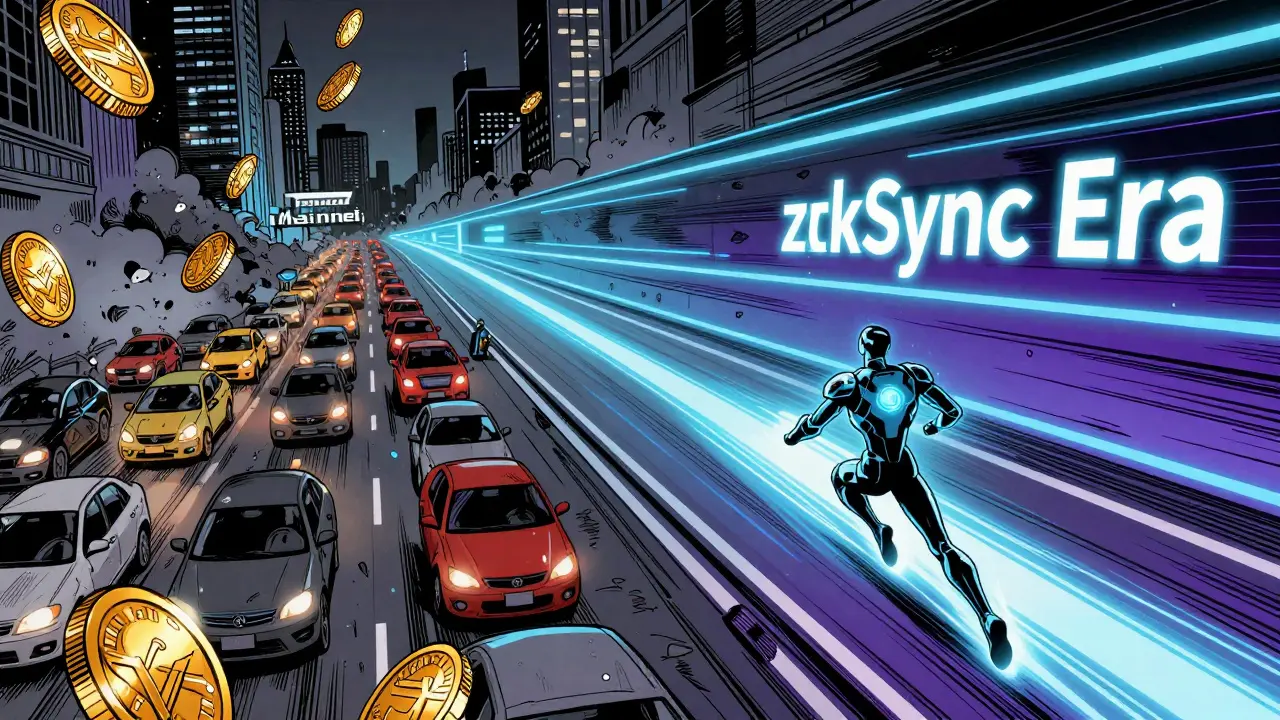
Trading on the Ethereum mainnet often feels like paying a luxury tax just to move your own money. Between the fluctuating gas fees and the slow confirmation times, it's a headache for anyone not moving millions. That's why the move to Layer 2 solutions is a big deal. When PancakeSwap v3 is a decentralized exchange (DEX) that allows users to trade tokens without a central authority landed on zkSync Era is an Ethereum Layer 2 scaling solution using zk-rollup technology to increase speed and lower costs , it promised a middle ground: the security of Ethereum with the speed of a centralized app. But does it actually deliver, or is it just another fork of the same old tech?
The Bottom Line: Fast, Cheap, and Efficient
If you've used PancakeSwap on Binance Smart Chain (BSC), you know the vibe. But the zkSync Era version is a different beast. The main draw here is the cost. While Ethereum mainnet gas fees can spike wildly, zkSync Era keeps things remarkably stable. We're talking about average gas fees around 0.00056 ETH. For a real-world example, some users have reported swapping 10,000 USDT for DAI while paying only about $0.07 in gas. That's a massive jump from the $5 or $50 fees you might see on Layer 1.
The speed is another win. Transaction finality happens in seconds. You aren't staring at a loading spinner for two minutes wondering if your trade went through. However, keep in mind that while the trade is "final" on the L2, the actual settlement back to the Ethereum mainnet can take up to 24 hours. For most daily traders, this doesn't matter, but it's a crucial detail if you're bridging large sums back to L1.
| Feature | Ethereum Mainnet | zkSync Era (L2) |
|---|---|---|
| Average Gas Cost | 0.005 - 0.015 ETH | ~0.00056 ETH |
| Transaction Speed | 12-15 second blocks | Near-instant (Seconds) |
| Fee Reduction | Baseline | 88% - 96% cheaper |
| Security | Native L1 | L1-backed via ZK-Rollups |
Mastering Concentrated Liquidity
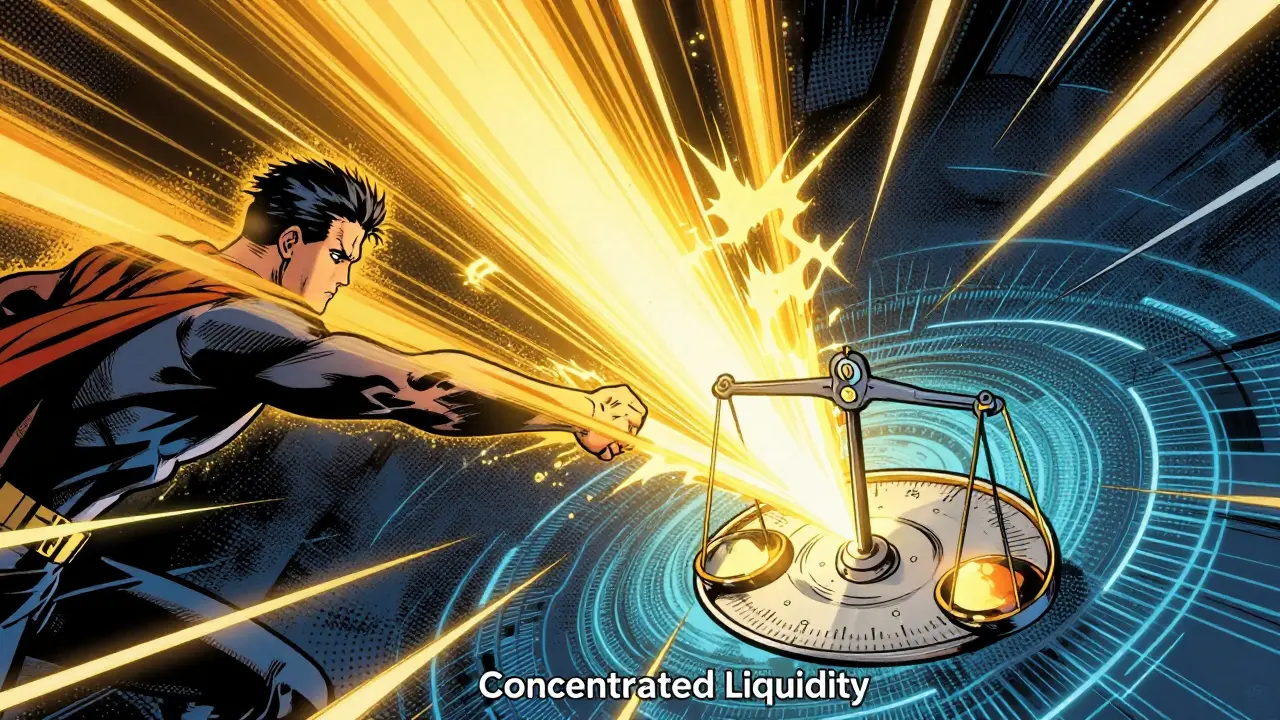
The "v3" in PancakeSwap v3 isn't just a version number; it's a complete shift in how liquidity works. In the old days (v2), you provided liquidity across a price range from zero to infinity. This was lazy and inefficient because most of your money sat idle, far away from where the actual trading was happening.
Now, the platform uses Concentrated Liquidity is a mechanism allowing liquidity providers to allocate their capital within specific, narrow price ranges . This means you can pick a tight window-say, between $1.00 and $1.02 for a stablecoin pair-and your capital works way harder. The result? Capital efficiency multipliers can reach up to 4000x. For the trader, this is great because it reduces slippage, meaning you get a price closer to the actual market rate.
The trade-off is the learning curve. If the price of the asset moves outside your chosen range, you stop earning fees entirely. It requires active management. You can't just "set it and forget it" like you could with v2. If you're a passive investor, this might feel like a chore; if you're a pro, it's a goldmine.
Fees and Rewards: The CAKE Ecosystem
PancakeSwap uses a multi-tier fee structure that's more flexible than its competitors. While some DEXes stick to a flat 0.3%, PancakeSwap ranges from 0.01% to 1%. This is a huge advantage for stablecoin pairs where traders demand razor-thin margins. If you're swapping USDC for USDT, you don't want to pay a premium.
Then there's the CAKE is the native utility token of the PancakeSwap ecosystem used for governance, staking, and rewards token. Stakers can earn trading rebates of up to 10%, which adds a nice layer of incentive to hold the token. However, it's worth noting that the platform is evolving. The "Simple Staking Product" was retired in March 2025 to make room for more sustainable models. If you're looking for a quick, mindless yield, the old ways are gone, and you'll need to dive deeper into the v3 liquidity pools.
Setup Guide: Getting Started on zkSync Era
Getting your wallet ready for zkSync Era takes about 10 to 20 minutes for most people. The most common point of failure is the network configuration. You can't just use your default Ethereum settings.
- Configure Your Wallet: If you use MetaMask, you need to manually add the zkSync Era network. Use Chain ID 324 and the RPC URL
https://mainnet.era.zksync.io. Check your transactions usinghttps://explorer.zksync.io. - Bridge Your Funds: You'll need ETH for gas. You can use the official zkSync Lite bridge or third-party options like Layerswap to move your funds from Ethereum to the L2.
- Execute the Swap: Navigate to the PancakeSwap interface, select the zkSync Era network, choose your tokens, and confirm the prompt in your wallet.
Pro tip: Always keep a small amount of extra ETH in your wallet for gas. A common mistake is bridging exactly the amount you intend to swap, only to find you can't execute the trade because you have zero ETH for the network fee.

The Competition and Potential Risks
PancakeSwap is a giant, but it's not without rivals. On zkSync Era, SyncSwap is a native competitor that has captured a significant chunk of the volume. Some users prefer SyncSwap because it was built specifically for this ecosystem from day one, whereas PancakeSwap is an expansion from BSC.
There are also some functional gaps. Some users have noted that certain charting tools available on the BSC version are missing here. Additionally, there's a limitation regarding limit orders for "taxed tokens"-assets that take a fee on every transfer. If you're trading niche, high-tax meme coins, you might hit a wall.
From a technical standpoint, the security is high because it relies on the Matter Labs recursive proving system. This means the security is mathematically tied to Ethereum. However, as with any L2, you are trusting the operator's implementation of the ZK-rollups. While audits haven't found critical holes, it's a different risk profile than holding assets directly on the mainnet.
Is PancakeSwap v3 on zkSync Era safe?
Yes, it leverages the security of the Ethereum mainnet via zk-rollups. While it's generally considered safe, users should be aware that L2s have different risk profiles than L1s, and it's always wise to only deposit what you can afford to lose in a smart contract.
Why are my gas fees lower on zkSync Era than on Ethereum?
zkSync Era bundles hundreds of transactions into a single batch before sending the proof to Ethereum. This means the high cost of Ethereum's security is split among many users, drastically reducing the individual cost per trade.
What happens if the price leaves my concentrated liquidity range?
If the market price moves outside your set range, your position becomes "inactive." You will stop earning trading fees until the price moves back into your range or you manually adjust your range by removing and re-adding liquidity.
Can I use my BSC wallet for zkSync Era?
Yes, as long as you use a compatible wallet like MetaMask. Since both BSC and zkSync Era are EVM-compatible, you use the same private keys and addresses, but you must switch the network setting in your wallet to zkSync Era.
How do I bridge tokens to PancakeSwap v3 on zkSync?
You can use the official zkSync Lite bridge to move ETH from L1 to L2. Alternatively, third-party bridges like Layerswap allow for more flexible transfers, including moving funds directly from centralized exchanges to the zkSync Era network.
Next Steps and Troubleshooting
If you're just starting, your first move should be to bridge a small amount of ETH to test the waters. Don't move your entire portfolio until you've successfully completed a few swaps. If you run into issues, the most common fix is checking your RPC URL-ensure there are no typos in your network settings.
For the advanced users, look into the zkPorter integration. Once fully rolled out, it's expected to reduce fees by another 20x and boost throughput. If you're providing liquidity, set a calendar reminder to check your price ranges weekly. In a volatile market, a concentrated position can go out of range in hours, leaving your capital unproductive.
 Cryptocurrency Guides
Scott Fenton
April 9, 2026 AT 16:25The transition to zk-rollup technology represents a significant advancement in scalability. It is imperative that users maintain a rigorous understanding of the distinction between L2 finality and L1 settlement to avoid liquidity mismanagement.
Swati Sharma
April 10, 2026 AT 16:58Totally agree with the points on capital efficiency. Utilizing concentrated liquidity is a game-changer for maximizing yield on stablecoin pairs, especially when you optimize the tick range to capture maximum volume and minimize impermanent loss through tight range management.
Rebecca Violette
April 11, 2026 AT 23:00i tried to bridge and it totaly failed and now im just sad and broke lol like why is crypto so hard for me just to move money
Jonathan Chamma
April 12, 2026 AT 14:03It's like a little garden for your coins, you just gotta prune the ranges carefully so they keep growing. A bit of a learning curve for sure, but it's a colorful way to earn!
Carroll Foster
April 12, 2026 AT 17:04Oh wow, a 4000x multiplier! I'm sure the 'pro' traders are just loving the thrill of checking their screens every five minutes to make sure they haven't gone out of range. Truly the pinnacle of passive income, isn't it?
ssjuul z
April 14, 2026 AT 06:05LFG! This is exactly what we need to push adoption 🚀 The fees are basically non-existent compared to mainnet!
Lane Montgomery
April 15, 2026 AT 10:49Too much text. Just use SyncSwap.
Amanda Faust
April 17, 2026 AT 00:04everyone knows the v3 model is just a copy of uniswap and the 24h withdrawal is the real bottleneck here
Kelly Cantrell
April 18, 2026 AT 03:29I don't trust these bridges. Who knows who actually controls the keys in the background? They tell us it's mathematical security but it's probably just a way for the big players to track every single move we make across the chain. Be careful out there.
Prasanna Shembekar
April 19, 2026 AT 10:54my funds are stuck and im crying lol
Will Dixon
April 19, 2026 AT 18:47just make sure you got some eth for gas or u will be stuck like i was man its a pain
Jessie Tayaban
April 20, 2026 AT 15:25Omg i tried setting the range and i totally messed up the numbers and lost like 20 bucks in fees just moving it around!! Why is the UI so confusing??
Rima Dinar
April 21, 2026 AT 08:45If you are feeling overwhelmed by the concentrated liquidity aspect, please remember that it is perfectly fine to start with a wider range and gradually narrow it down as you become more comfortable with how the price action behaves on the zkSync Era network. It is much better to earn a smaller amount of fees consistently than to constantly be out of range and earning nothing at all while your capital sits idle.
Stanly Hayes
April 22, 2026 AT 07:07PancakeSwap is basically the king of DEXs and anyone saying SyncSwap is better is just coping. Get on board or get left behind!
Hope Johnson
April 22, 2026 AT 23:11We must consider that the shift toward Layer 2 isn't just about speed, but about the democratization of finance where the smallest user can interact without being priced out by gas. The philosophical implication of ZK-rollups is that we can maintain a trustless state while achieving the efficiency of centralized systems, which is the true goal of the blockchain revolution since 2009.
aletheia wittman
April 23, 2026 AT 02:26literally just saw my range go out of bounds and i actually screamed out loud i cant deal with this volatility today!!
Artavius Edmond
April 23, 2026 AT 17:22I'm just vibing with the lower fees, man. Doesn't matter if it's a fork or a native app as long as my wallet isn't bleeding out every time I swap some memes.
Jason Davis
April 25, 2026 AT 12:54The RPC settings can be triky for some people so always double check the chain id before you send any funds. Also try using a different browser if the wallet doesnt pop up right away.
Agnessa Dale
April 26, 2026 AT 17:08This looks like a great opportunity for new users to get into DeFi without spending all their money on gas!
7stargee Emmanuel Obani
April 28, 2026 AT 14:31Imagine thinking L2 is a big deal when the tokenomics are still trash 🤡 keep chasing those pennies lol
Surender Kumar
April 29, 2026 AT 20:46fees are realy low now it helps alot for small trades i think its a gud move for everyone
Mikayla Murphy
April 30, 2026 AT 14:43It is quite helpful to have these guides for those who aren't native to the tech. Bridging can be intimidating, so the step-by-step approach is appreciated.
logan bates
April 30, 2026 AT 18:02Just keep the money in US-based projects if you want real stability.
Terrance Hausmann
April 30, 2026 AT 21:43Stay patient guys. Just take it slow. If you get stuck, just reach out to the community, we all started from zero and it takes time to learn the ropes of concentrated liquidity, so don't beat yourself up if you miss a range shift today because tomorrow is always a new day to optimize your positions and get those fees rolling in again.
Emily H
May 1, 2026 AT 03:32The detailed comparison table is exceptionally useful for visualizing the cost benefits. It is my professional opinion that the 88% reduction in fees will significantly increase the velocity of capital within the zkSync ecosystem.