
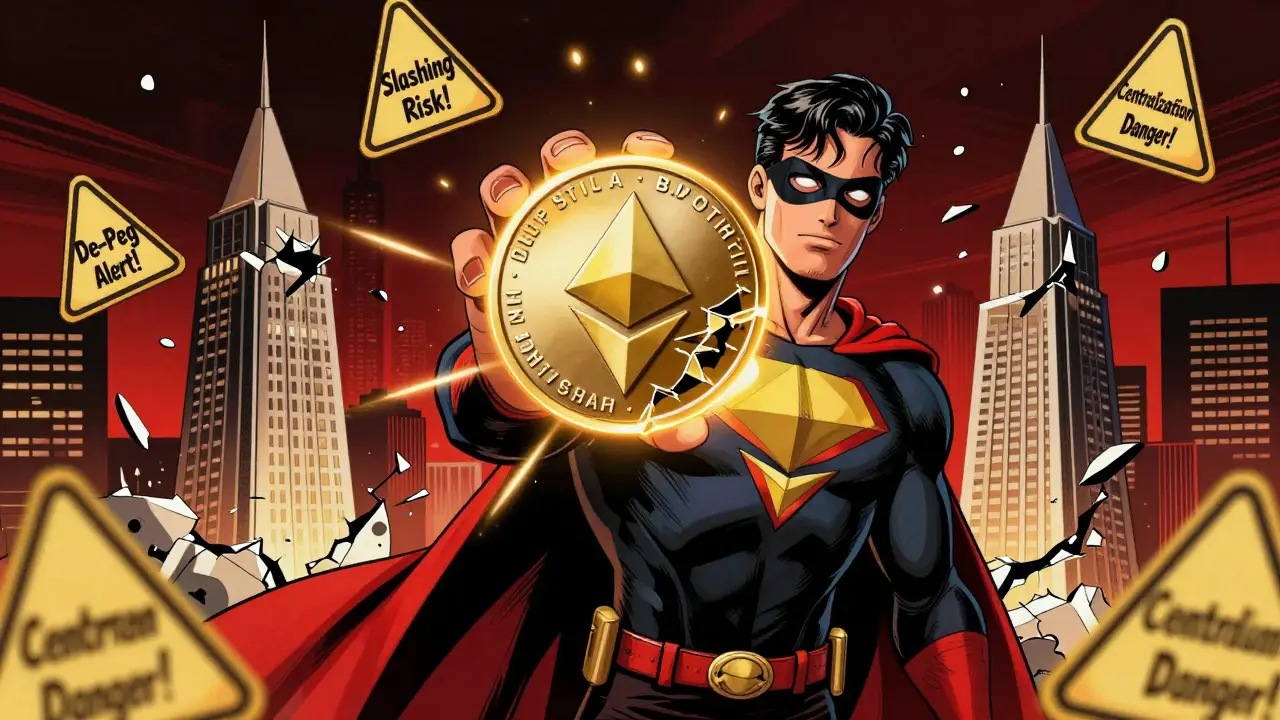
When you stake your ETH or SOL, you lock it up to help secure a blockchain and earn rewards. Simple. But what if you could stake your crypto and still use it-trade it, lend it, or put it in a DeFi protocol? That’s the promise of liquid staking. Protocols like Lido, Rocket Pool, and Origin Ether let you swap your staked ETH for a token-like stETH-that acts like your original ETH but can move around freely. It sounds too good to be true. And in many ways, it is.
Liquid staking isn’t magic. It’s a complex web of smart contracts, validator networks, and market mechanics. And when things go wrong, they go wrong hard. We’ve seen stETH drop to $0.92 against ETH during a market crash. We’ve seen users locked out of their funds because liquidity vanished. And we’ve seen entire protocols become single points of failure for the whole Ethereum network.
What Exactly Is a Liquid Staking Token?
Let’s cut through the jargon. When you stake ETH directly, you’re running or delegating to a validator. Your ETH is locked for months-sometimes over a year-until withdrawals are enabled. Liquid staking changes that. You send your ETH to a protocol. In return, you get a token-say, stETH-that represents your staked ETH plus accumulated rewards.
Here’s the catch: stETH isn’t ETH. It’s a claim. Think of it like a IOU note that earns interest. You can sell it, use it as collateral, or swap it on a DEX. But it’s not the same thing as holding real ETH in your wallet. And that difference is where the risks start.
Slashing: When Validators Mess Up
Every validator on Ethereum is expected to behave correctly. If they sign conflicting blocks, go offline too often, or try to cheat the system, they get slashed. That means a portion of their staked ETH is burned as punishment. For direct stakers, that’s your money gone. But with liquid staking, you didn’t run the validator-you trusted someone else to.
Protocols like Lido and Rocket Pool spread your ETH across dozens of validators. That reduces risk. But if even one validator gets slashed, the protocol takes a hit. And because your stETH is tied to the collective performance of all validators, your token’s value can dip. Galaxy Research found that slashing events can cost up to 1 ETH per incident. Multiply that by thousands of validators, and suddenly your stETH isn’t worth 1:1 anymore.
And here’s the scary part: you don’t get warned. No email. No alert. One day, your stETH trades at 0.98 ETH. The next, it’s 0.95. No explanation. Just market panic.
Smart Contract Bugs: The Silent Killer
Every liquid staking protocol runs on smart contracts. These are self-executing code on the blockchain. They handle deposits, issue tokens, distribute rewards, and manage withdrawals. Sounds simple? It’s not.
Smart contracts are code. And code has bugs. Even if a protocol claims it’s been audited by OpenZeppelin or Trail of Bits, audits don’t catch everything. Ankr’s 2023 analysis warns that “smart contracts that hold the original unstaked assets will have bugs which makes them susceptible to hacking.”
Remember the Celsius collapse in 2022? It wasn’t a hack. It was a liquidity crisis. But the damage spread because stETH was used as collateral in DeFi protocols. When users tried to redeem stETH for ETH on Curve Finance, the pool ran dry. Why? Because the underlying ETH was locked in validators, and withdrawals were still disabled. The market crashed. The peg broke. And people lost money.
That’s not a theoretical risk. That’s what happened. And it can happen again.

De-Pegging: When Your Token Stops Being Worth What It Should
This is the biggest, most misunderstood risk. Liquid staking tokens are supposed to trade at 1:1 with their underlying asset. stETH should equal 1 ETH. rETH should equal 1 ETH. But they don’t. Not always.
Coin Metrics tracked stETH and found it traded below 0.99 ETH on 15 separate occasions in just six months in 2023. During the FTX collapse, users reported stETH hitting 0.94 ETH. Reddit threads from June 2022 show people panicking because they couldn’t convert stETH to ETH-no matter how much they paid in fees.
Why does this happen? Three reasons:
- Liquidity crunches: If everyone tries to sell stETH at once, buyers vanish. Prices drop.
- Withdrawal delays: Even after Ethereum’s Shanghai upgrade, withdrawals are queued. If demand to exit exceeds capacity, stETH trades at a discount.
- Market fear: If users think the protocol might fail, they dump stETH. That creates a death spiral.
There’s no guarantee stETH will ever recover its peg. And if you’re using it as collateral for a loan? You could get liquidated.
Centralization: One Protocol, Too Much Power
Lido controls roughly 32% of all staked ETH. That’s more than any single validator operator, mining pool, or exchange. That’s dangerous.
Ethereum’s security relies on decentralization. If one entity controls a third of the network’s staked ether, it becomes a target. A government could pressure Lido. A hacker could compromise its governance. A bug in its smart contract could freeze billions.
And Lido isn’t alone. Coinbase’s cbETH and Binance’s BETH are even more centralized. They’re custodial. That means Coinbase or Binance holds your ETH. They decide when to stake, how to distribute rewards, and whether to let you withdraw. If they go down, your staking rewards go with them.
Compare that to Rocket Pool. To run a validator, you need 8 ETH plus 2.4 ETH worth of RPL. That’s expensive. But it means more people are running their own nodes. Less centralization. Less risk.
Token Models: Rebasing vs. Reward-Bearing
Not all liquid staking tokens are created equal. There are two main types:
- Rebasing tokens: Your token count increases over time. You start with 1 stETH. After a month, you have 1.015 stETH. The value per token stays at 1 ETH.
- Reward-bearing tokens: Your token count stays the same. But each token becomes more valuable. You still have 1 stETH-but now it’s worth 1.015 ETH.
This matters for taxes, accounting, and how your wallet tracks value. Most users don’t realize this difference. But if you’re using stETH in a DeFi protocol that expects a fixed supply, it can break your position. Some yield aggregators assume rebasing tokens behave like ERC-20s with constant supply. They don’t. And when they fail, users lose money.
Regulatory Time Bomb
In August 2025, the SEC issued a formal statement on “Certain Liquid Staking Activities.” They didn’t say “this is illegal.” But they didn’t say “this is fine” either.
Their message? We’re watching. And if LSTs look like securities-promising returns, controlled by a central entity, traded on exchanges-we might classify them as such.
That could mean:
- Exchanges like Coinbase and Binance stop listing stETH.
- DeFi protocols can’t accept stETH as collateral.
- Users in the U.S. get blocked from using liquid staking entirely.
It’s not a guarantee. But it’s a real threat. And it’s growing.
How to Protect Yourself
You’re not powerless. Here’s what you can actually do:
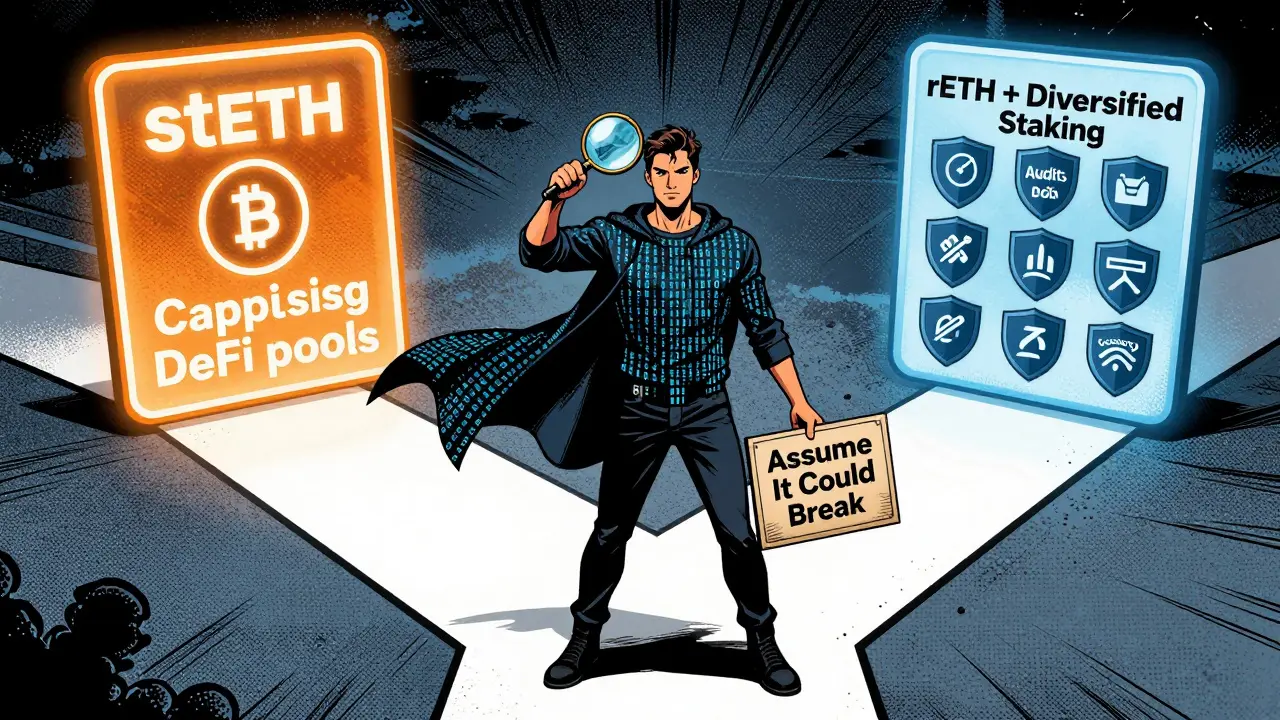
- Diversify your staking: Don’t put all your ETH into stETH. Use Rocket Pool’s rETH. Try Origin Ether’s OETH. Even try stSOL if you’re holding SOL. Spread the risk.
- Check liquidity: Before using a liquid staking token, look at its trading volume on Uniswap, Curve, or Balancer. If the pool is shallow, avoid it. If it’s been down 5% in the last week? Walk away.
- Verify audits: Don’t trust marketing. Go to the protocol’s GitHub or docs. Look for audit reports from OpenZeppelin, CertiK, or Trail of Bits. If they only had one audit? Red flag.
- Know your token type: Is it rebasing or reward-bearing? Check the token contract on Etherscan. If you’re unsure, don’t use it in DeFi.
- Don’t use LSTs as collateral unless you’re ready to lose: If you’re borrowing against stETH, assume it could depeg. Have a 150% collateral ratio. Or better yet, avoid it.
The Bottom Line
Liquid staking isn’t evil. It’s useful. It lets people earn rewards without technical barriers. But it’s not risk-free. It’s not even low-risk. It’s high-risk by design.
The market is growing fast. TVL crossed $14 billion in late 2023. But with growth comes concentration. With concentration comes fragility. And when the next market crash hits-because it will-those who thought stETH was just “ETH with extra benefits” will find out the hard way that it’s not.
Understand the risks. Don’t assume. Don’t trust blindly. Monitor. Diversify. Stay informed.
Is liquid staking safe?
Liquid staking isn’t safe-it’s risky. It introduces new dangers like de-pegging, smart contract exploits, and centralization that don’t exist in direct staking. While it offers liquidity benefits, you’re trading control for convenience. If you can’t afford to lose part of your stake or deal with temporary price drops, avoid it.
Can stETH lose its peg permanently?
Yes. While stETH has always recovered its peg after past dips, there’s no technical guarantee it will always do so. If the underlying staking infrastructure fails, or if confidence in Lido collapses, the peg could remain broken for months-or longer. Markets don’t always correct themselves.
Why is Lido so risky despite being popular?
Lido’s dominance creates systemic risk. With over 30% of all staked ETH under its control, a failure in Lido’s infrastructure could destabilize Ethereum’s entire security model. It’s like one company controlling half the power grid. The more popular it becomes, the more dangerous its failure becomes.
Should I use Coinbase’s cbETH or Binance’s BETH?
Only if you trust Coinbase or Binance to hold your ETH indefinitely. These are custodial services. You don’t own the private keys. If the exchange gets hacked, shuts down, or freezes withdrawals, you lose access. They’re convenient, but they’re centralized-and that’s the opposite of what blockchain is supposed to be.
Are liquid staking tokens considered securities?
The SEC hasn’t officially classified them yet, but their August 2025 statement strongly implies they’re looking at LSTs as potential securities. If they do, exchanges may delist them, DeFi protocols may block them, and U.S. users could be barred from using them entirely. Regulatory risk is now a real part of the equation.
 Cryptocurrency Guides
Jesse VanDerPol
March 7, 2026 AT 19:02jonathan swift
March 8, 2026 AT 06:33Datta Yadav
March 9, 2026 AT 03:28Lydia Meier
March 9, 2026 AT 22:10jay baravkar
March 10, 2026 AT 16:35Ian Thomas
March 12, 2026 AT 12:24Austin King
March 13, 2026 AT 21:32Bryanna Barnett
March 15, 2026 AT 03:45Josh Moorcroft-Jones
March 15, 2026 AT 12:10Rachel Rowland
March 16, 2026 AT 05:18Bonnie Jenkins-Hodges
March 16, 2026 AT 23:41Melissa Ritz
March 17, 2026 AT 14:27Jamie Hoyle
March 18, 2026 AT 17:11Jeffrey Dean
March 20, 2026 AT 09:41Brian T
March 21, 2026 AT 04:30Ken Kemp
March 23, 2026 AT 01:49Leah Dallaire
March 23, 2026 AT 11:29prasanna tripathy
March 23, 2026 AT 12:49James Burke
March 23, 2026 AT 16:19Nick Greening
March 25, 2026 AT 13:42