
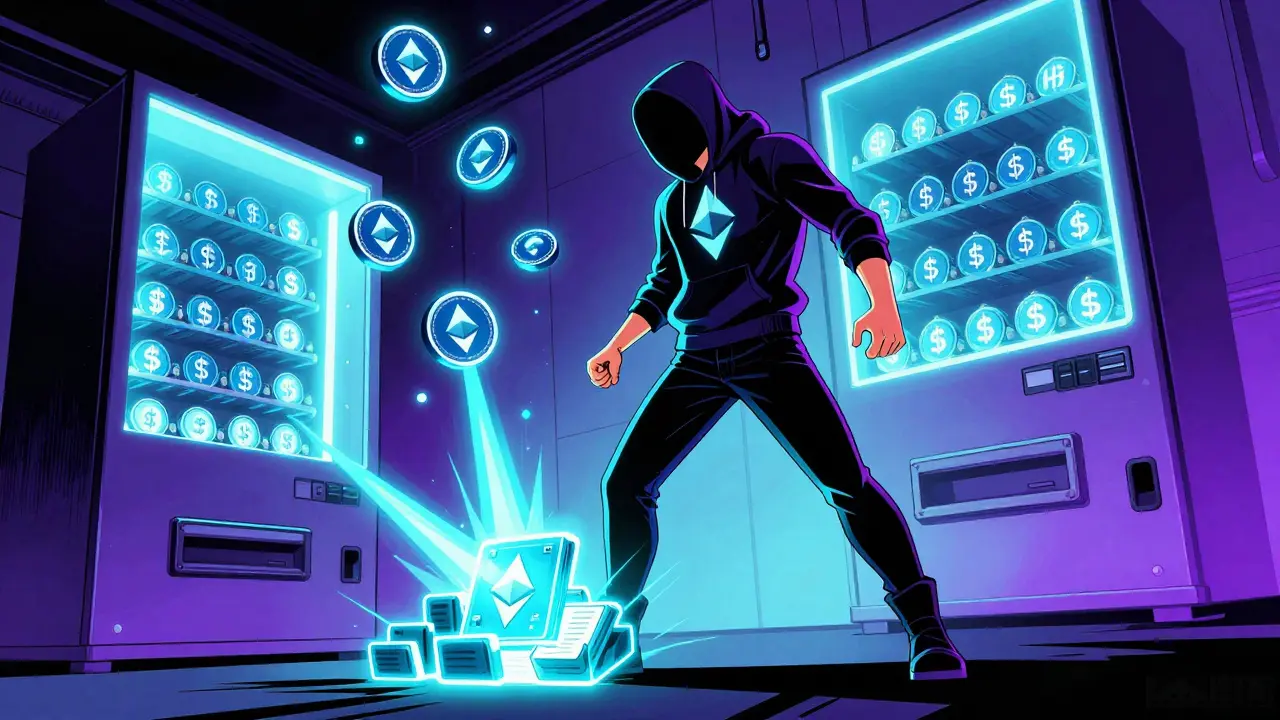
A decentralized exchange (or DEX) is a crypto trading platform that lets you swap one digital asset for another without handing over control of your money to a company. Unlike centralized exchanges like Binance or Coinbase, where the platform holds your funds, a DEX lets you trade directly from your own wallet. Your private keys stay with you. No bank. No broker. No middleman. Just code.
How DEXs Work: No Intermediaries, Just Smart Contracts
Think of a DEX like a vending machine for crypto. You put in one token, and out comes another. But instead of a machine, it’s a smart contract - a self-running program on the blockchain. These contracts follow rules like: "If someone deposits 1 ETH, they get 2,000 USDC in return." No human approves it. No one can change the rules mid-trade.
The first real DEX that gained traction was Uniswap a decentralized exchange built on Ethereum that uses automated market makers to enable token swaps without order books, launched in November 2018. Before Uniswap, early DEXs like EtherDelta relied on order books - matching buyers and sellers manually. But Uniswap changed everything by using something called an Automated Market Maker (AMM).
The AMM Model: How Prices Are Set Without Buyers and Sellers
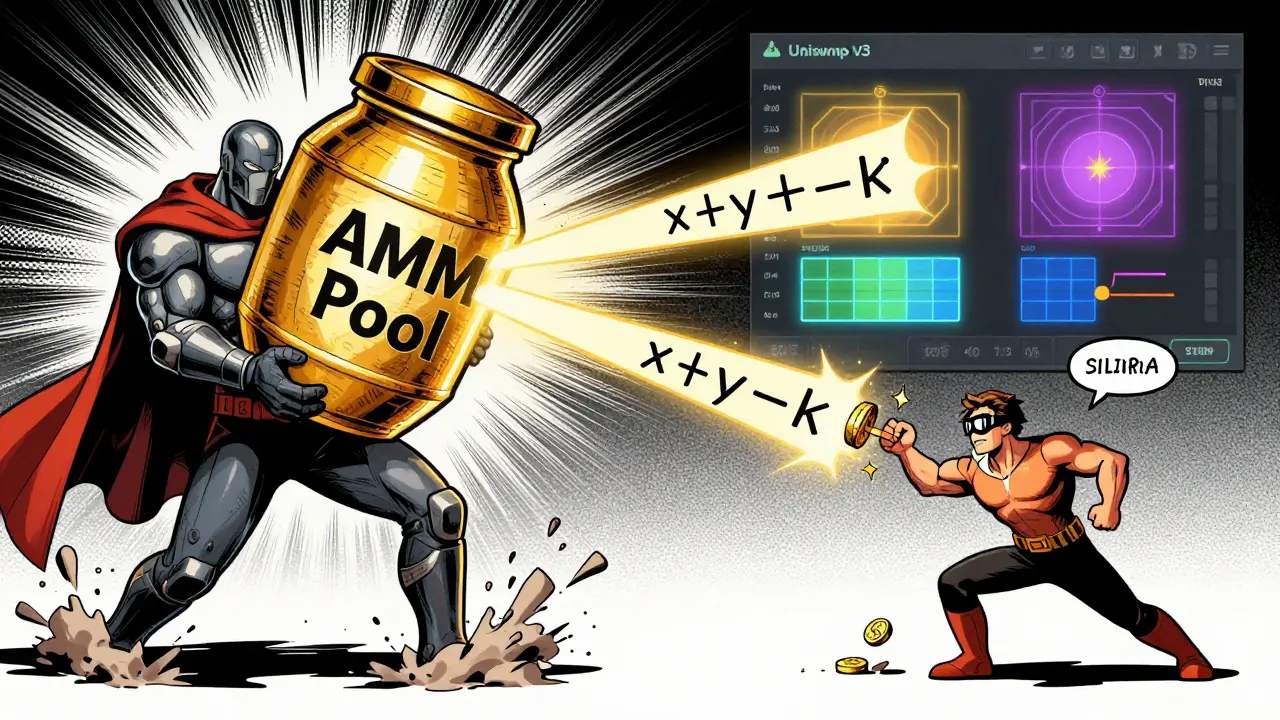
Traditional exchanges need someone to buy and someone to sell. DEXs using AMMs don’t. Instead, they use liquidity pools. These are jars of money, filled by users like you who deposit two tokens in equal value - say, 100 ETH and $200,000 worth of USDC. The pool then lets anyone trade between those two tokens.
The price? It’s calculated by math. Most DEXs use a formula called x * y = k. If you buy 1 ETH from the pool, the amount of ETH in the pool goes down, and the amount of USDC goes up. That shift changes the price automatically. More buyers? Price goes up. More sellers? Price drops.
Uniswap v3 (launched in May 2021) made this even smarter. Instead of spreading your money across the whole price range, you can choose a custom range - like $1,800 to $2,200 for ETH. This lets you earn more fees when prices stay in that zone. Some users report 4,000x better capital efficiency than older versions.
Other DEX Types: Order Books and Aggregators
Not all DEXs use AMMs. Some, like dYdX a decentralized exchange that uses off-chain order books and on-chain settlement for margin trading, use traditional order books. Buyers list prices they’re willing to pay. Sellers list what they want. The system matches them. These are better for large trades and advanced strategies like leverage.
Then there are DEX aggregators services like 1inch that split trades across multiple DEXs to find the best price and lowest slippage. Think of them as Google Shopping for crypto trades. You ask for 1 ETH in USDC, and the aggregator checks Uniswap, SushiSwap, Curve, and 100+ others to find the best deal. It’s like comparing prices across 100 different stores in seconds.
Why Use a DEX? The Real Advantages
- No KYC - You don’t need to send your ID or passport. 98.7% of DEX users trade anonymously, according to Chainalysis.
- More tokens - Uniswap supports over 250,000 token pairs. Binance has around 1,500. If a new coin launches, it’s likely to show up on a DEX first.
- No custodial risk - Your coins never leave your wallet. No exchange gets hacked, and your funds stay safe.
- Global access - If you’re in a country with crypto restrictions, DEXs still work. No bank account needed.
The Downsides: What You Lose Going Decentralized
- Slippage - If you trade a large amount on a shallow pool, the price moves against you. A $1,000 trade might end up giving you 5% less than expected.
- Gas fees - On Ethereum, each trade costs $1-$5 in network fees. During congestion, it can hit $10+. Solana DEXs are cheaper - often under $0.01.
- Smart contract risk - Bugs happen. In 2022, hackers stole $2.8 billion from DeFi protocols, 65% of which came from DEXs.
- Impermanent loss - If you provide liquidity and one token’s price swings wildly, you can lose money compared to just holding the tokens.
- Complex interface - If you’re new, DEXs feel like hacking a spaceship. Approvals, allowances, slippage settings - it’s overwhelming.
DEXs vs. Centralized Exchanges: A Quick Comparison
| Feature | Decentralized Exchange (DEX) | Centralized Exchange (CEX) |
|---|---|---|
| Who holds your funds? | You (non-custodial) | The exchange (custodial) |
| KYC required? | No | Yes (99% of users) |
| Token variety | 250,000+ pairs | ~1,500 curated pairs |
| Fiat on-ramps? | No | Yes (127 currencies on Coinbase) |
| Trade speed (avg) | 15-30 seconds | Under 1 second |
| Best for | Experienced users, privacy, new tokens | Beginners, fiat deposits, large trades |
Who Uses DEXs? Real User Patterns
According to DappRadar, 48% of monthly DEX users come from Asia - Vietnam, Thailand, and the Philippines lead the way. Another 29% are in the Americas. Europe trails at 18%.
Reddit and Twitter show a clear split. Beginners often complain: "I lost $200 in gas fees because I didn’t know what slippage meant." But experienced traders say things like: "I made 31% APR by providing liquidity to Uniswap v3 with concentrated range and automated yield farming."
On Trustpilot, MetaMask - the most popular wallet for DEXs - has a 3.8/5 rating. Half the complaints are about failed transactions during Ethereum congestion. The other half? Users who accidentally approved unlimited token access and got drained by malicious contracts.
How to Start Trading on a DEX (Simple Steps)
- Get a wallet: Install MetaMask a non-custodial cryptocurrency wallet that connects to DEXs and manages Ethereum-based assets or Trust Wallet a mobile cryptocurrency wallet supporting multiple blockchains and DEX integrations.
- Buy ETH or another native token: You need gas to pay for transactions. Buy ETH on a CEX and send it to your wallet.
- Connect your wallet: Go to Uniswap, PancakeSwap, or another DEX. Click "Connect Wallet" and approve the connection.
- Set slippage: For stablecoins like USDC, use 0.5%. For volatile coins like DOGE, use 1-2%.
- Approve token spending: First-time trades require you to approve the DEX to spend your token. Never approve "unlimited" unless you trust the contract.
- Swap: Pick your tokens, enter amount, review price, and confirm.
What’s Next for DEXs?
Uniswap v4 is coming in early 2024. It lets developers build custom trading logic - think automated strategies inside the DEX itself. Ethereum’s Dencun upgrade (targeting Q1 2024) will cut transaction costs by up to 100x using proto-danksharding.
Regulation is the big wild card. The U.S. SEC settled with Uniswap Labs for $50 million in October 2023, arguing it operated as an unregistered exchange. The EU’s MiCA rules (effective 2024) will force DEXs serving Europeans to add KYC for fiat on-ramps.
Meanwhile, big players are adapting. Coinbase integrated DEX aggregation into its app. Binance bought Matcha, a DEX aggregator. The future isn’t DEXs or CEXs - it’s DEXs inside CEXs.
Final Thought: DEXs Are the Real Crypto
Decentralized exchanges aren’t just a better way to trade. They’re proof that blockchain can do finance without banks. No permission. No gatekeepers. No middlemen. That’s the original promise of Bitcoin - and DEXs are making it real.
Yes, they’re clunky. Yes, they’re risky. But for those who want true ownership of their money - and the freedom to trade anything, anywhere - DEXs are the only game in town.
 Cryptocurrency Guides
Shruti Sharma
February 8, 2026 AT 12:54Brittany Novak
February 9, 2026 AT 14:53Joshua Herder
February 10, 2026 AT 05:12Brittany Coleman
February 11, 2026 AT 19:14David Bain
February 12, 2026 AT 09:58Josh Flohre
February 12, 2026 AT 11:29Jesse Pasichnyk
February 13, 2026 AT 01:17Jordan Axtell
February 13, 2026 AT 12:54James Harris
February 14, 2026 AT 09:11Alex Garnett
February 14, 2026 AT 09:28aryan danial
February 14, 2026 AT 13:40Kyle Pearce-O'Brien
February 16, 2026 AT 02:46Matthew Ryan
February 17, 2026 AT 07:15Nathaniel Okubule
February 18, 2026 AT 17:23Jacque Istok
February 19, 2026 AT 14:10