

Quick Takeaways
- Plausible Deniability: Your transaction is mixed with "decoys," so no one knows which signature is yours.
- Privacy by Default: Unlike some coins where you must opt-in, technologies like those in Monero apply this to every transaction.
- The Trade-off: High privacy comes at the cost of larger transaction sizes and slightly higher computational needs.
- Evolving Tech: Newer protocols like Triptych and Arcturus are making these signatures smaller and faster.
How Ring Signatures Actually Work
To understand ring signatures, you first have to realize how a standard blockchain like Bitcoin works. In a transparent system, every transaction is a public record: "Address A sent 1 BTC to Address B." Anyone with a block explorer can trace that money back to its origin. Ring Signatures break this trail by creating a cryptographic group. When you send a transaction, the system doesn't just use your public key. Instead, it picks a handful of other keys from the blockchain-called decoys-and mixes them with yours. To an observer, the signature looks like it could have been produced by any one of the members of that "ring." Because every member of the ring appears equally likely to be the sender, you gain plausible deniability. Monero, the most famous implementation of this tech, has evolved its ring sizes over time to stay ahead of analysis tools. They started with a ring size of 3, moved to 5, then 7, and eventually settled on 11 as the default. The larger the ring, the harder it is for a hacker or a government agency to guess who the real sender is, though it does make the transaction data slightly heavier.The Privacy Trio: Ring Signatures, Stealth Addresses, and RingCT
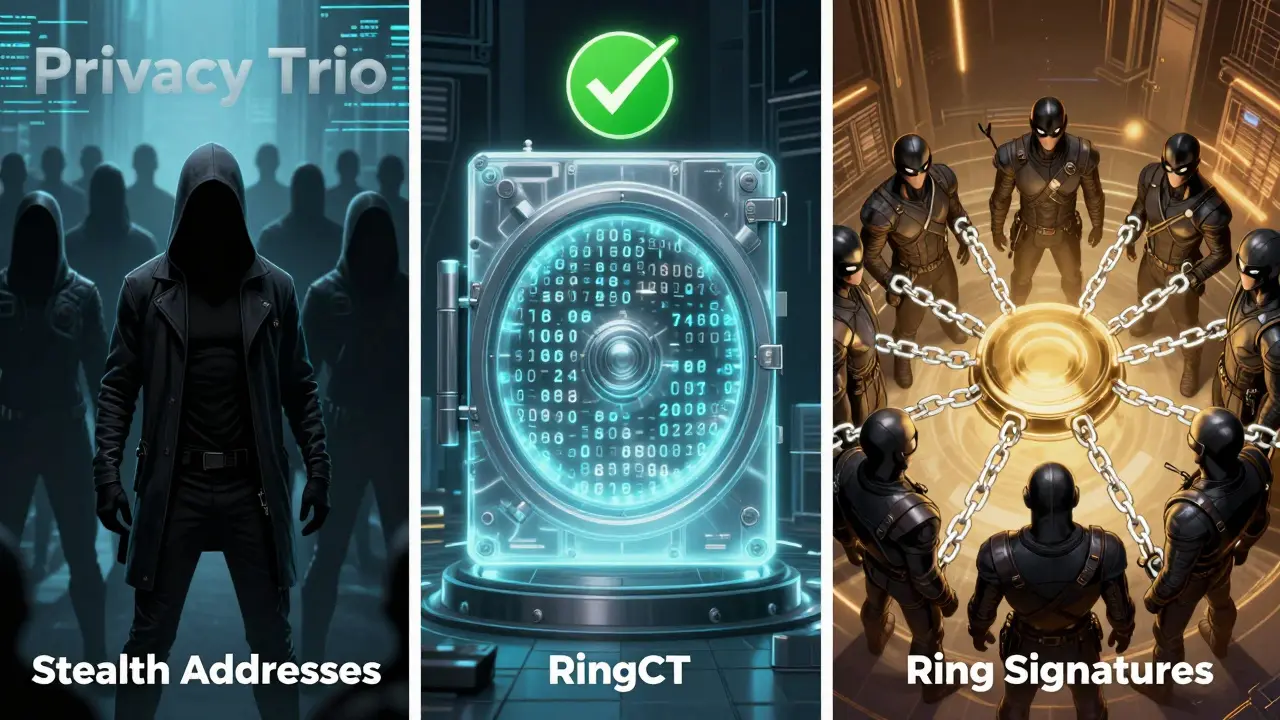
Ring signatures are powerful, but they only solve one piece of the puzzle: the sender's identity. If the amount sent or the receiver's address were still public, a smart analyst could still figure things out. That's why Monero uses a three-pronged approach to ensure total anonymity. First, Stealth Addresses hide the recipient. Instead of sending money to a public address, the sender creates a one-time address for that specific transaction. Only the recipient can "unlock" it, meaning no one looking at the blockchain knows who actually received the money. Second, there is RingCT (Ring Confidential Transactions). This protocol, launched in early 2017, uses Pedersen Commitments to hide the transaction amount. It allows the network to verify that the sum of the inputs equals the sum of the outputs without actually revealing the numbers. Essentially, the network knows the math adds up, but it doesn't know if you sent 0.1 XMR or 1,000 XMR. Together, these three technologies ensure that the sender, the receiver, and the amount are all obscured, making the currency truly fungible-meaning one coin is identical to another, and no "tainted" history can be used to block a transaction.Comparing Privacy Tech: Ring Signatures vs. The Rest
Not all privacy coins use the same blueprint. You'll often hear about Zcash and its use of zk-SNARKs. While both aim for privacy, the approach is fundamentally different. Zcash's zero-knowledge proofs are theoretically stronger than ring signatures. However, they originally required a "trusted setup"-a ceremony where a group of people had to create the initial parameters and then destroy the evidence. If that setup were compromised, the system's integrity would be at risk. Ring signatures, by contrast, require no such setup; they are improvisational and work out of the box. Then there's Dash, which uses a mixing service called PrivateSend. This is more like a digital laundromat where you send your coins to a pool and get different ones back. The problem? It's optional. Only a fraction of Dash users actually use it, whereas in a ring-signature system, the privacy is baked into every single move you make.| Feature | Ring Signatures (Monero) | zk-SNARKs (Zcash) | Mixing (Dash) |
|---|---|---|---|
| Privacy Default | Yes | Optional (Shielded) | Optional |
| Trusted Setup | Not Required | Required (Initially) | Not Required |
| Tx Size | Large (13-15 KB) | Small (~1.4 KB) | Standard |
| Fungibility | Very High | High (if shielded) | Moderate |
The Real-World Trade-offs and Pitfalls
Nothing in cryptography is free. The extreme privacy provided by ring signatures comes with a performance tax. Because each transaction carries a group of decoys, the data is significantly bulkier. While a Bitcoin transaction might average around 250 bytes, a Monero transaction can swell to 15 KB. This leads to "blockchain bloat," requiring more storage for nodes and potentially slower confirmation times during network congestion. There is also the risk of heuristic analysis. Even if the math of a ring signature is perfect, humans are predictable. If you always send 1.0 XMR every Friday at 5 PM, a sophisticated observer (like a government agency using tools from Chainalysis) might start to notice patterns. They can't prove which key in the ring is yours, but they can narrow the possibilities over time. This is why the Monero Research Lab uses a "gamma distribution" to pick decoys, ensuring the selection process looks natural and random rather than programmatic. From a regulatory standpoint, this technology has put a target on the back of privacy coins. Agencies like the IRS have spent hundreds of thousands of dollars trying to find ways to decrypt these transactions. While the CEO of Chainalysis has admitted that breaking these signatures at scale is computationally prohibitive, the pressure has led some exchanges to delist assets that use them.The Future: Making Privacy Faster and Smaller
Developers aren't standing still. The goal for the next few years is to keep the privacy while slashing the transaction size. There are three major protocols currently moving the needle:- Triptych: This protocol allows for "logarithmic scaling." Instead of the transaction size growing linearly with the number of decoys, it grows much slower. This means you could have 100 decoys but only use the space of 10, potentially reducing transaction sizes by 80%.
- Arcturus: This focuses on the speed of verification. It optimizes how the network checks the multi-layered ring structures, potentially speeding up the process by 400%.
- Lelantus: This is the "holy grail" on the roadmap. It aims to move away from fixed ring sizes entirely, using dynamic anonymity sets to make the group size even more unpredictable.

Getting Started with Private Transactions
If you're a regular user, you don't need a PhD in elliptic curve cryptography to use this. Most modern wallets, such as Cake Wallet or the official Monero GUI, handle the ring signatures in the background. You just hit "send," and the wallet automatically selects the decoys and constructs the ring for you. For developers, it's a different story. Implementing ring signature verification from scratch requires a deep understanding of EdDSA and Curve25519. If you're building a custom integration, expect a steep learning curve-often around 80 hours of development just to get the basics right. The biggest mistake beginners make is choosing decoys poorly, which can accidentally signal to analysts who the real sender is. Always stick to the recommended distribution parameters provided by the official documentation.Do ring signatures make my coins untraceable?
They make it computationally infeasible for an observer to identify the specific sender. However, no system is 100% foolproof. If you leave a trail of metadata outside the blockchain-like using a public email to notify a recipient or consistently sending a specific amount at a specific time-a dedicated analyst can use those patterns to make an educated guess.
Why are Monero transactions so much larger than Bitcoin?
Bitcoin transactions only need to include the actual sender's signature. Monero transactions include the sender's signature PLUS a set of decoy public keys to create the "ring." This extra data is what increases the size from a few hundred bytes to several kilobytes.
Can the government "break" ring signatures?
Breaking the actual cryptography would require a massive leap in computing power (or a functioning quantum computer). However, governments often try to "break" the privacy by attacking the endpoints-such as the exchanges where users trade their coins for cash-rather than the cryptography itself.
What is the difference between a ring signature and a group signature?
A group signature usually involves a manager who can reveal the identity of the signer if necessary (escrow). A ring signature has no such manager; once the signature is created, the identity is hidden permanently and cannot be revealed by any central authority.
Will Triptych and Arcturus make my transactions more private?
Primarily, these protocols improve efficiency and scalability. By reducing the size of the transaction, they allow for larger ring sizes (more decoys) without bloating the blockchain, which indirectly improves privacy by making the anonymity set larger.
Next Steps and Troubleshooting
Depending on who you are, your path forward with ring signatures differs:- For the Privacy-Conscious User: Start by using a reputable wallet like Cake Wallet. Ensure you are using a remote node or running your own node to avoid leaking your IP address to a single provider.
- For the Developer: Dive into the Monero GitHub repositories. Focus on understanding the gamma distribution for decoy selection before attempting to implement custom verification logic.
- For the Business Owner: If you're looking at confidential payroll, explore providers like Bitwage who have already integrated these features into their enterprise systems.
 Cryptocurrency Guides
Jan Conrad
April 28, 2026 AT 03:17The point about the gamma distribution for decoy selection is actually the most critical part here. Without a proper distribution, you're basically handing the keys to any chain analyst with a basic script. It is fascinating how the balance between the anonymity set size and the actual statistical probability of a decoy being the real sender creates such a tightrope for developers to walk. Most people just see the 'ring' as a magic shield, but it's really just a game of probabilities and data noise. If the selection isn't random enough, the whole thing collapses under heuristic analysis.
Aaron Zeiler
April 29, 2026 AT 04:03totally agree on the gamma distribution stuff it really is the secret sauce that keeps the whole thing from being a joke
its me
April 29, 2026 AT 13:44It's quite amusing how we cling to these digital masks. We pretend that hiding our financial footprints is a virtuous pursuit of liberty, but in reality, it's often just a way to avoid the moral accountability that comes with transparency. True privacy is an internal state, not something you buy with a specific coin. Perhaps if we spent more time reflecting on why we need to hide, we wouldn't be so obsessed with the mechanics of decoys.
Carli Bates
April 29, 2026 AT 17:37wow someone actually brought philosophy into a crypto thread how original
Gabrielle Danis
May 1, 2026 AT 13:06The comparison between ring signatures and zk-SNARKs is accurate, though it is worth noting that the 'trusted setup' issue in Zcash has been largely addressed in newer versions. However, the advantage of ring signatures remains their inherent lack of reliance on any initial ceremony, which is a far more robust security model for those who distrust central authorities entirely.
Jimmy vasquez
May 2, 2026 AT 14:03If anyone is struggling with the setup, definitely stick to the official GUI. Trying to manually configure a remote node for the first time can be a bit of a headache, but it's totally worth it for the peace of mind regarding your IP address!
Rushell Perry
May 4, 2026 AT 03:13glad to see the focus on fungibility here it is really the only way currency can actually work as money
Ipsita Seal
May 4, 2026 AT 04:51Too much text, I just want to know if my money is safe.
Abhishek Verma
May 6, 2026 AT 01:04Imagine needing 15KB for a single transaction just to feel 'safe.' Absolute peak inefficiency. I'm sure the developers are very proud of their bloated blockchain.
Arti Jain
May 6, 2026 AT 09:38Utterly pathetic. Only a fool thinks a 'ring' saves them from a real state agency. Pure delusion.
Brendan Thraxton
May 7, 2026 AT 02:27Don't let the FUD get to you. The progress with Triptych is actually super exciting. We're seeing a real path toward high privacy and low overhead which is a win for everyone in the space
Janis Naglis
May 8, 2026 AT 16:11The synergy between RingCT and stealth addresses is simply breathtaking!!! It creates such a robust cryptographic primitive that ensures maximum entropy for the user!!! The way the Pedersen Commitments maintain the balance of the ledger without leaking the scalar value is just pure genius!!! Truly a masterpiece of engineering!!!
Kathleen Warren
May 8, 2026 AT 22:34It's okay if this feels a bit overwhelming. Just remember that the wallets do most of the hard work for you. You don't have to be a math expert to value your own privacy.
Gabby Puche
May 9, 2026 AT 19:56Privacy is a human right! 🛡️✨ Love seeing this tech get explained simply. Keep going! 🚀
Lynne Teperman
May 11, 2026 AT 19:02this is some wild digital alchemy right here mixing ghosts and shadows to hide a coin
Barbara Jones
May 13, 2026 AT 00:05i think the part about the rsg sizes is cool, its like a cat and mouse game with the govt. hope the new protocols work out’
Andrew Todd
May 14, 2026 AT 09:41Only people in the US care about this. Real power is knowing how to move money without needing a fancy ring. This is just a toy for nerds.
Ryan Nakielny
May 15, 2026 AT 17:22Oh look, another 'alpha' claiming a basic ring signature is a toy. I'm sure your 'secret' methods are way more sophisticated than actual mathematics. Definitely. 🙄
Rachel S
May 16, 2026 AT 08:28The sheer audacity of suggesting that metadata leaks are negligible is truly alarming! 😱 One must understand that a ring signature is merely one layer of a vast security onion! If you are using a public email or a leaky DNS, you are essentially shouting your identity from the rooftops while wearing a tiny mask! It is absolutely catastrophic to ignore the operational security aspect! We must be meticulous or the technology is utterly useless! 📉