
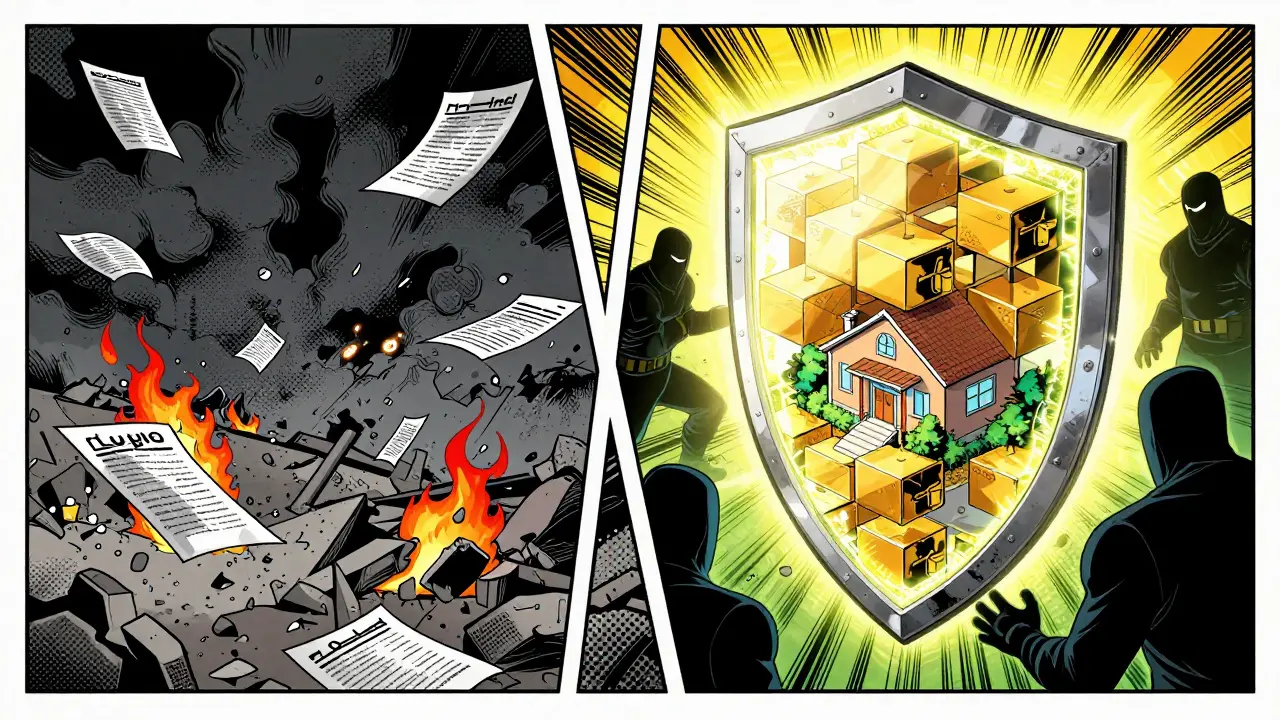
Imagine losing your home not because you couldn't pay the mortgage, but because a fire destroyed the paper deed proving you owned it. This isn't a hypothetical nightmare; it’s what happened to over a million people in Haiti after the 2010 earthquake wiped out sixty years of land-registry archives. For decades, property ownership has relied on centralized, fragile systems-paper files or single-server databases-that are vulnerable to natural disasters, hacking, and human error. But a new technology is changing the game. By moving property titles on blockchain, we can create an unbreakable chain of ownership that is transparent, secure, and impossible to forge.
What Is a Blocktitle System?
To understand how this works, we need to look at the concept of "blocktitle." A Blocktitle system is a digital land registry that uses distributed ledger technology to verify, transfer, and record property ownership directly on a blockchain. Instead of a local government office holding the only copy of your deed, the record exists across a network of computers. When you buy a house, the transfer agreement is executed on the blockchain and authenticated by network nodes following strict security protocols.
This idea didn't appear overnight. It traces back to Satoshi Nakamoto's Bitcoin whitepaper in 2008, which introduced the world to immutable ledgers. However, practical applications for real estate started gaining traction around 2015 and 2016. The theoretical groundwork was laid even earlier by economist Hernando de Soto, who argued in his 2001 book The Mystery of Capital that broken property rights were stifling economic growth in developing nations. Blockchain offers a technical solution to these systemic issues by creating a permanent, tamper-proof history of every transaction.
How Blockchain Secures Property Ownership
The magic lies in the structure of the blockchain itself. It is a distributed, immutable ledger where each transaction-or "block"-is cryptographically linked to the one before it. Think of it like a digital chain where each link is sealed with a unique code (hash). If someone tries to alter a past record, the code changes, breaking the chain and alerting the entire network. This makes fraud nearly impossible.
In a traditional system, if a hacker compromises a central server, they can change names, erase liens, or create fake deeds. In a blockchain system, there is no single point of failure. Every participant holds a complete copy of the ledger. Here is how a typical transaction flows in a fully implemented blocktitle system:
- Initiation: The buyer and seller agree on terms, often using a smart contract.
- Verification: Network nodes verify the identities of the parties and the validity of the title.
- Recording: The transfer is recorded as a new block on the chain, linking it to the previous owner's record.
- Finality: Once confirmed, the record is permanent. The new owner now holds the cryptographic proof of ownership.
This process eliminates the need for intermediaries like escrow agents or title insurers in many cases. Smart contracts-self-executing code on the blockchain-can automatically release funds and update ownership records once conditions are met, acting as objective third parties.

Real-World Pilots and Performance Data
You might wonder if this is just theory. Several countries have already tested these systems with impressive results. Let’s look at the data from recent pilot programs.
| Country / Region | Key Achievement | Impact Metric |
|---|---|---|
| Georgia | National Agency of Public Registry implementation | Processing times reduced from days to minutes |
| Ghana | Land Administration Project | 70% reduction in title verification time |
| Sweden | Lantmäteriet land registry pilot | Transactions completed in <2 weeks vs. 3-4 months |
In Sweden, the Lantmäteriet pilot showed that transactions taking three to four months could be done in less than two weeks. Real estate agents reported a 92% satisfaction rate with the transparency. In Ghana, rural landowners who were initially skeptical became supportive after seeing how immutable records resolved long-standing boundary disputes. These examples prove that blockchain isn't just faster; it's more reliable.
Tokenization and Fractional Ownership
Beyond securing deeds, blockchain is reshaping how we invest in real estate through Tokenization is the process of converting ownership rights of physical assets into digital tokens stored on a blockchain. J.P. Morgan highlights this as a major shift for commercial real estate. Traditionally, buying property requires huge upfront capital. Tokenization allows you to break a building's value into thousands of small tokens. You can own 0.01% of a skyscraper without needing millions of dollars.
This democratizes investment. As Yi, a payments specialist at J.P. Morgan, noted, fractionalizing assets opens real estate to a broader audience. It also increases liquidity. Selling a physical house takes months; selling digital tokens can happen instantly on secondary markets. This fluidity could fundamentally change the global real estate market, making it behave more like the stock market.

Challenges and Limitations
Despite the benefits, switching to blockchain isn't plug-and-play. There are significant hurdles.
- Onboarding Legacy Data: Getting existing paper records onto the blockchain is difficult. You must ensure the initial data is accurate before it becomes immutable. If you put a wrong address on the chain, it stays wrong forever unless corrected through complex legal processes.
- Legal Recognition: Technology moves faster than law. As of 2025, only 19 countries explicitly recognize blockchain records as legally valid for property titles. Vermont passed its Blockchain Land Records Act in 2016, and Wyoming followed in 2019, but most jurisdictions still lag behind.
- Digital Literacy: Not everyone is tech-savvy. In Sweden's pilot, 37% of participants struggled to understand the verification process. Elderly owners may find digital wallets and private keys confusing or intimidating.
- Cost and Resistance: Implementing these systems is expensive for governments. Plus, established industries like title insurance and legal services face obsolescence, leading to potential resistance.
Additionally, interoperability remains a challenge. Different countries may use different blockchain platforms. Without standard protocols, a title recorded in Georgia might not be easily readable in Sweden. The International Organization for Standardization (ISO/TC 268) launched a standardized protocol in October 2025 to address this, aiming to ensure systems can talk to each other globally.
The Future of Land Registry
Where do we go from here? Industry analysts predict that by 2030, 35% of commercial real estate transactions will use blockchain title systems. Residential adoption is expected to reach 22%. However, a complete replacement of traditional systems is unlikely before 2040 due to institutional inertia.
Future developments include integrating Internet of Things (IoT) sensors to automatically verify boundaries and using artificial intelligence to detect anomalies in title chains. Platforms like RWA.io are already building specialized solutions for land title security. The goal is a world where property rights are as secure as digital currency, accessible to anyone with an internet connection.
For now, the transition is gradual. Governments are testing, private firms are exploring, and standards are being set. If you're involved in real estate, keeping an eye on these developments is crucial. The era of paper deeds is ending; the age of blocktitle is beginning.
Is blockchain property title legally binding everywhere?
No, not yet. As of 2025, only 19 countries explicitly recognize blockchain records as legally valid for property titles. While states like Vermont and Wyoming in the US have passed legislation, most jurisdictions still require traditional paper or centralized digital records for legal enforcement. Always check local laws before relying solely on blockchain records.
Can blockchain prevent property title fraud?
Yes, it is considered the ultimate defense against title fraud. Because blockchain records are immutable and distributed across a network, altering a past transaction would require hacking the majority of the network simultaneously, which is computationally impractical. Any attempt to forge a deed would be immediately detected by the network nodes.
What is tokenization in real estate?
Tokenization converts ownership rights of a physical property into digital tokens on a blockchain. This allows for fractional ownership, meaning multiple people can own small shares of a property. It lowers the barrier to entry for investors and increases liquidity, as tokens can be traded quickly on digital exchanges.
How long does it take to transfer a title on blockchain?
In pilot programs, transfers have been reduced from months to minutes or seconds. For example, Georgia reported processing times dropping from days to minutes, while Sweden saw reductions from three to four months down to less than two weeks. The speed depends on the specific blockchain platform and network congestion.
What happens if I lose my private key to my property title?
This is a critical risk. Unlike a bank account, there is no "forgot password" button for blockchain. If you lose your private key, you may lose access to your property rights. Solutions involve multi-signature wallets (requiring multiple keys to authorize transactions) and secure custodial services, but user education on key management is essential.
 Cryptocurrency Guides