
German Token Classification Tool
Token Classification Assistant
Based on German regulations (MiCAR + Kryptogesetz), determine how your token would be classified by BaFin.
Running a crypto exchange in Germany isn’t just about setting up a website and accepting Bitcoin. It’s a tightly controlled process governed by one of the strictest, most detailed regulatory systems in Europe. If you’re thinking about launching or operating a crypto exchange here, you need to understand the rules - and they’ve changed a lot since the end of 2024.
Germany’s Crypto Rules Are Now EU Rules - But Stricter
As of December 30, 2024, the EU’s Markets in Crypto-Assets Regulation (MiCAR) became law across all member states, including Germany. But Germany didn’t just adopt MiCAR - it layered it on top of its own existing laws. The result? A two-tier system that’s harder to navigate than most other EU countries.
Before MiCAR, Germany already had strict rules under the Kryptogesetz and the Finanzmarktdigitalisierungsgesetz (FinmadiG). These laws required exchanges to get a license from BaFin, the Federal Financial Supervisory Authority. Now, MiCAR adds more layers: white papers for new tokens, stricter KYC rules, and mandatory reporting. BaFin didn’t just accept MiCAR - it turned it into the new baseline for everything.
There’s no gray area anymore. Crypto assets are legally recognized, but only if you’re licensed. Unlicensed platforms are shut down - and they have been. In June 2025, BaFin ordered Ethena GmbH to stop offering its USDe stablecoin in Germany. Holders had until August 6 to redeem their tokens through a BaFin-appointed rep. That’s not a warning. That’s enforcement.
What Exactly Do You Need to Get Licensed?
To operate legally in Germany, you must apply for formal authorization from BaFin. This isn’t a form you fill out online. It’s a months-long process that requires proof of:
- Robust cybersecurity infrastructure - including encryption, access controls, and regular penetration testing
- Clear organizational structure with qualified management
- Adequate financial resources to cover operational risks
- Compliance with anti-money laundering (AML) rules
- A detailed business plan showing how you’ll handle customer assets
And it doesn’t stop there. BaFin doesn’t just approve you once. They monitor you continuously. You must submit quarterly reports, keep all transaction logs for at least 10 years, and allow unannounced audits.
One common mistake? Assuming that if you’re licensed in another EU country, you can operate in Germany. You can’t. MiCAR allows passporting - but only if your home country’s regulator has been deemed equivalent by BaFin. So far, only a handful of countries meet that bar. Most exchanges still need a separate German license.
How Are Crypto Assets Classified? (It Matters a Lot)
Not all crypto assets are treated the same. BaFin classifies them into three main categories, and each triggers different rules:
- Financial instrument tokens - These behave like stocks or bonds. Think tokenized shares or debt instruments. They fall under MiFID II and require full securities licensing.
- Security-like tokens - These promise profit or ownership rights. They’re subject to the German Securities Prospectus Act. You must publish a detailed prospectus and get it approved before offering them.
- Capital investment tokens - These are pooled investment vehicles, like tokenized funds. They’re regulated under the German Capital Investment Act.
What about Bitcoin and Ethereum? They’re considered “utility tokens” - not financial instruments. That means they’re not subject to the same heavy reporting. But if you’re listing a new token that pays dividends, rewards, or has governance rights? You’re likely dealing with a security-like token. That’s a whole different level of paperwork.
Many exchanges get tripped up here. They think, “It’s crypto, so it’s all the same.” But BaFin doesn’t care what you call it. They look at the economic function. If it looks like an investment, it’s treated like one.

AML and the Travel Rule: No Exceptions
Germany implements the FATF’s “travel rule” through the KryptoWTransferV. That means every crypto transfer - whether it’s $5 or $500,000 - must include sender and receiver details.
Here’s how it works in practice:
- When a user sends crypto from your exchange to another wallet, you must collect their full name, address, and ID number
- You must transmit that data to the receiving platform
- If the receiving platform doesn’t comply, you must block the transaction
This isn’t optional. BaFin has fined multiple platforms for failing to transmit this data. In 2024, one German exchange was fined €1.2 million for letting users send crypto without KYC checks. The fine wasn’t for a single user - it was for systemic failure.
On top of that, you need full KYC: government-issued ID, proof of address, and a live selfie for facial recognition. No third-party providers are accepted unless they’re BaFin-approved. Most exchanges use specialized providers like Sumsub or Jumio - but even those need to meet German standards.
What About Taxes? (Yes, They Changed Again in 2025)
Tax rules for crypto in Germany got more complex in March 2025. BaFin and the Federal Ministry of Finance updated their guidelines to clarify how to handle:
- Staking rewards - Active staking (running your own node) is treated as business income. Passive staking (using a platform like Coinbase or Kraken) is considered private capital gains.
- DeFi transactions - Swaps, liquidity provision, and yield farming are now explicitly taxable events. You must track every transaction, even if it’s on an unregulated protocol.
- Valuation - You must use daily market rates from reputable sources (like CoinGecko or CoinMarketCap) to calculate gains and losses. No more “I bought it for $20 and sold it for $25” without proof.
And you have to keep records for 10 years. That’s longer than most corporate tax rules. If you’re audited and can’t produce a complete transaction history, you’ll face penalties - even if you didn’t owe taxes.
Grandfathering: The 2025 Deadline That Almost Passed
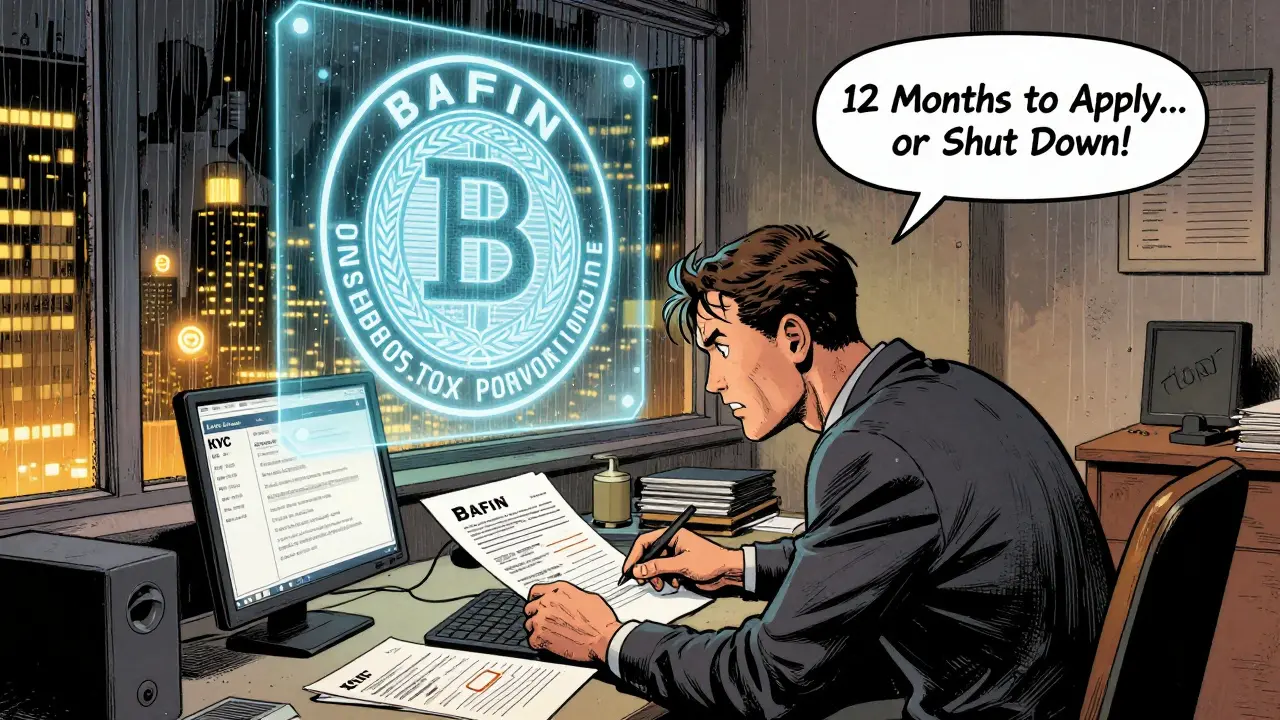
Before MiCAR, some crypto businesses operated without a BaFin license because they fell into a gray zone. The government gave them a grace period - until December 31, 2025.
That deadline is coming fast. If you were offering crypto services before December 29, 2024, and didn’t apply for a license yet, you’re already out of compliance. BaFin has started sending notices to unlicensed platforms. The message is clear: either apply now or shut down.
Existing licensed institutions - like banks or investment firms - can offer crypto services under their current licenses, but they must notify BaFin and comply with MiCAR rules. That’s a big deal. A German bank can now offer crypto custody without getting a new license - but they still need to meet all the same security and reporting standards as a pure crypto exchange.
Why Germany Is Still a Strong Market - If You Play by the Rules
Yes, the rules are tough. But that’s also why Germany is one of the most attractive markets for legitimate crypto businesses.
With 82 million people and one of the highest per-capita incomes in Europe, the demand for regulated crypto services is growing. German investors trust platforms that are licensed. They’re willing to pay higher fees for security.
Plus, Germany has 90 double taxation treaties with other countries. That means international investors can move crypto in and out without worrying about being taxed twice. That’s a huge advantage over countries like the U.S. or UK, where cross-border crypto taxation is messy.
And unlike some countries that ban crypto or treat it like gambling, Germany treats it as a financial asset. That means long-term legal stability. The government isn’t trying to kill crypto - it’s trying to control it. And if you’re compliant, you get access to a massive, stable, and growing market.
What Happens If You Ignore the Rules?
Ignoring BaFin’s rules doesn’t just mean fines. It means:
- Your website gets blocked by German ISPs
- Your bank accounts get frozen
- Your executives can be personally liable for violations
- You can be banned from operating anywhere in the EU
The Ethena case isn’t an outlier. It’s a warning. BaFin is watching. And they’re not afraid to act.
If you’re serious about operating in Germany, don’t cut corners. Hire a German financial lawyer who specializes in crypto. Pay for a compliance consultant. Budget for the licensing fee (which can be €15,000-€50,000 depending on your business model). This isn’t a startup expense - it’s a legal requirement.
Do I need a German license if I’m based outside Germany?
Yes. If you’re offering crypto services to customers in Germany - even if you’re based in the U.S., Singapore, or Switzerland - you need a BaFin license. The location of your server or headquarters doesn’t matter. What matters is where your users are. If German residents are trading on your platform, you’re subject to German law.
How long does the BaFin licensing process take?
On average, it takes 6 to 12 months. Simple exchanges with only Bitcoin and Ethereum may get approved faster - around 6 months. Complex platforms offering staking, derivatives, or tokenized securities can take a year or more. The key is submitting a complete, error-free application. Missing documents or unclear business models cause major delays.
Can I use a third-party custodian to avoid getting a license?
No. If you’re facilitating trades, managing wallets, or offering custody services to customers, you’re providing a regulated crypto service - regardless of whether you hold the keys. Even if you outsource custody to a licensed provider, you still need your own BaFin authorization. The regulator looks at your role, not your technical setup.
What if I only serve German users with stablecoins?
Stablecoins are treated as crypto assets under MiCAR - not as money. If you’re issuing or trading them, you need a license. The Ethena case proves that. Even if your stablecoin is pegged to the U.S. dollar, if German users can buy or trade it, you’re subject to German regulation. No exceptions.
Are decentralized exchanges (DEXs) regulated in Germany?
Currently, pure DEXs that don’t hold user funds or act as intermediaries aren’t directly regulated. But if your DEX has a company behind it that markets the platform, collects fees, or controls smart contracts, BaFin may consider you a service provider. Many DEX operators are being asked to register or shut down. Don’t assume decentralization protects you - BaFin looks at control, not code.
If you’re planning to enter the German crypto market, the path is clear: comply fully, document everything, and don’t assume loopholes exist. The rules are strict, but they’re also stable. And in finance, stability is worth more than flexibility.
 Cryptocurrency Guides
Shane Budge
December 6, 2025 AT 01:47Germany's rules are brutal but fair. If you're serious about crypto, you play by their book.
sonia sifflet
December 7, 2025 AT 02:40Let me break this down for you. MiCAR is just the starting point. BaFin adds layers like an onion that makes you cry. No gray zones. No exceptions. If you're serving German users, you're under their jurisdiction. Period. No excuses. Not even if your server's in Belize. They don't care. They've already shut down Ethena. They'll shut down yours too if you're sloppy.
Lore Vanvliet
December 7, 2025 AT 15:07Oh please. Germany thinks it's the EU's moral police. Meanwhile, the US is building real innovation while they're busy making compliance forms in triplicate. 🤦♀️
Scott Sơn
December 9, 2025 AT 05:23Germany didn't just adopt MiCAR - they turned it into a Kafkaesque opera with footnotes written in bureaucratic Latin. You don't apply for a license here, you enter a five-year trial by paperwork. I swear, BaFin has a secret room filled with red tape and espresso machines. 🎭
Frank Cronin
December 11, 2025 AT 00:25Anyone who thinks this is "strict" is just naive. This isn't regulation - it's financial fascism disguised as consumer protection. You want to run a crypto exchange? Fine. But first, pay €50K, hire a German lawyer who speaks fluent bureaucracy, and pray your CEO doesn't blink wrong during an audit. Pathetic.
Stanley Wong
December 11, 2025 AT 14:39I get that the rules are intense but I think there's a bigger picture here. Germany isn't trying to kill crypto they're trying to make it safe for regular people. Think about it - most users don't care about decentralization they just want to know their money won't vanish overnight. The fact that they're requiring 10-year logs and unannounced audits? That's actually responsible. It's not sexy but it's what finance needs. I've seen too many people lose everything because someone cut corners. This isn't overregulation it's overdue accountability.
miriam gionfriddo
December 12, 2025 AT 06:02Ok so I read this and my brain exploded. Staking rewards are now business income if you run your own node? Wait so if I stake on Kraken it's private cap gain but if I run a node on my rPi it's business income?? That makes no sense. And who the hell has time to track every single DeFi swap for 10 years?? I'm out. 💀
Nicole Parker
December 13, 2025 AT 06:57It's easy to hate the rules but think about why they exist. People got burned. A lot. And now Germany is trying to make sure that doesn't happen again. It's not about controlling crypto - it's about protecting people who don't understand the risks. I've talked to retirees who lost their life savings on shady exchanges. This isn't red tape - it's a safety net. Yeah it's slow. Yeah it's expensive. But would you rather have a slow, safe system or a fast, chaotic one where your coins vanish into thin air?
Kenneth Ljungström
December 13, 2025 AT 19:57Love how Germany treats crypto like real finance now. No more cowboy vibes. 🤝 If you want to play in their sandbox, you gotta wear the right shoes. Licensing is a pain but it's the price of trust. And trust? That's what actually grows markets. Look at how many EU investors now feel safe using German platforms. That's the win. Not the speed - the stability.
Brooke Schmalbach
December 14, 2025 AT 01:34Let’s not pretend this is about consumer protection. This is about protecting traditional banks from disruption. BaFin doesn’t want you to succeed - they want you to quit. The licensing fees alone are designed to crush small players. And don’t get me started on the travel rule. They’re turning every crypto transfer into a surveillance nightmare. This isn’t regulation. It’s financial control.
Cristal Consulting
December 14, 2025 AT 17:07Just remember - if you're building for Germany, treat compliance like your product. Not an add-on. Not a cost center. Your license is your brand. Do it right and you'll earn loyalty. Do it sloppy and you'll be gone by Q3. You got this.
Tom Van bergen
December 14, 2025 AT 23:00Regulation is just the state's way of saying I know better than you. If you can't trust people to manage their own money then why are we even here? Crypto was supposed to be freedom. Now it's just another bureaucratic cage with a fancy EU stamp on it
Sandra Lee Beagan
December 16, 2025 AT 00:58As someone who’s worked with both EU and Canadian crypto firms, I can say this: Germany’s framework is the most mature I’ve seen. The jargon is dense but the logic is sound. The 10-year record retention? That’s not overkill - that’s what institutional investors demand. And the passporting exception? That’s where most startups fail. They assume MiCAR = free pass. It doesn’t. BaFin’s equivalence standards are brutal. But if you clear them? You’ve got access to one of the most sophisticated financial markets in the world.
Ben VanDyk
December 17, 2025 AT 18:24Article is accurate. But the tone is too celebratory. This isn’t a success story. It’s a cautionary tale. Germany didn’t become a crypto hub because they’re smart. They became one because everyone else is too chaotic. That’s not a compliment. It’s a last resort.
michael cuevas
December 19, 2025 AT 02:18They fine you a million for not sending KYC data but let banks launder billions through shell companies? Yeah sure. The system’s rigged. Crypto gets the full Nazi paperwork treatment while the real criminals get tax breaks. 😂
Nina Meretoile
December 19, 2025 AT 10:43It’s scary but also kind of beautiful. Germany’s saying: we don’t need wild west crypto. We want clean, clear, trustworthy finance. And honestly? More people are going to choose that over chaos. It’s not flashy but it’s lasting. The market’s growing because people feel safe. That’s the real win.
Barb Pooley
December 20, 2025 AT 01:35They’re using MiCAR to secretly control the population. You think this is about finance? It’s about tracking every transaction. Soon they’ll link your crypto wallet to your social credit score. The Ethena shutdown? That was a test run. Next it’ll be your DeFi staking rewards. They’re coming for your freedom. Don’t be fooled.
Martin Hansen
December 21, 2025 AT 16:17Only in Germany would you need a PhD in compliance to trade Bitcoin. This isn’t innovation - it’s institutional arrogance. If you can’t move money without 17 forms and a notary, you’re not in finance - you’re in a DMV with a blockchain logo.
Chris Mitchell
December 22, 2025 AT 09:53Germany’s model works because it’s honest. No sugarcoating. No loopholes. If you’re in the game, you pay the price. That’s leadership. Other countries pretend to be open but they’re just lazy. Germany says: if you want to operate here, earn it. And honestly? That’s the kind of clarity the crypto world needs.
rita linda
December 24, 2025 AT 08:57Of course they’re cracking down. Germans don’t do half-measures. You think they’d let some crypto bro from Miami run a platform targeting their pensioners? Please. This is about protecting the middle class. The fact that you see it as oppression shows how out of touch you are.
Regina Jestrow
December 25, 2025 AT 05:35Wait - so if I’m a U.S. exchange and I accidentally get one German user, do I need a license? Or is there a threshold? The article doesn’t say. Anyone know if there’s a de minimis rule? Asking for a friend… who might be a U.S. exchange founder panicking right now.
Mariam Almatrook
December 26, 2025 AT 16:07The entire framework is a monument to bureaucratic overreach. Financial sovereignty should not be contingent upon submitting 47 annexes in triplicate to a government agency that operates on 1980s software. This is not regulation - it is the institutionalization of inefficiency disguised as rigor. The future of finance is not in paper trails - it is in decentralized, auditable, transparent systems. Germany is building a museum - not a market.