
You probably remember the hype cycle of 2021. Everyone was talking about buying digital land, and prices for a single pixelated plot in Decentraland were skyrocketing faster than your rent in Auckland. But here is the reality check: the metaverse didn't disappear; it just got quieter and more technical. If you are looking at Metaverse Platforms Built on Blockchain today, you aren't just looking for a game. You are looking for an economy where you actually own what you build.
Unlike traditional games like Fortnite or Roblox, where your skins belong to Epic Games or Microsoft, blockchain-based worlds give you true ownership. Your avatar, your land, and your items are non-fungible tokens (NFTs) stored on a public ledger. This means you can sell them, trade them, or move them across different applications without asking permission from a central server. It sounds simple, but the technology behind it varies wildly depending on which platform you choose. Let's break down who is leading this space right now and how they work.
The Heavyweights: Decentraland vs. The Sandbox
If you want to dip your toes into this world, you will likely start with one of two names: Decentraland or The Sandbox. These are the old guard, the ones that survived the crash and kept building. They both use Ethereum, but they feel completely different when you log in.
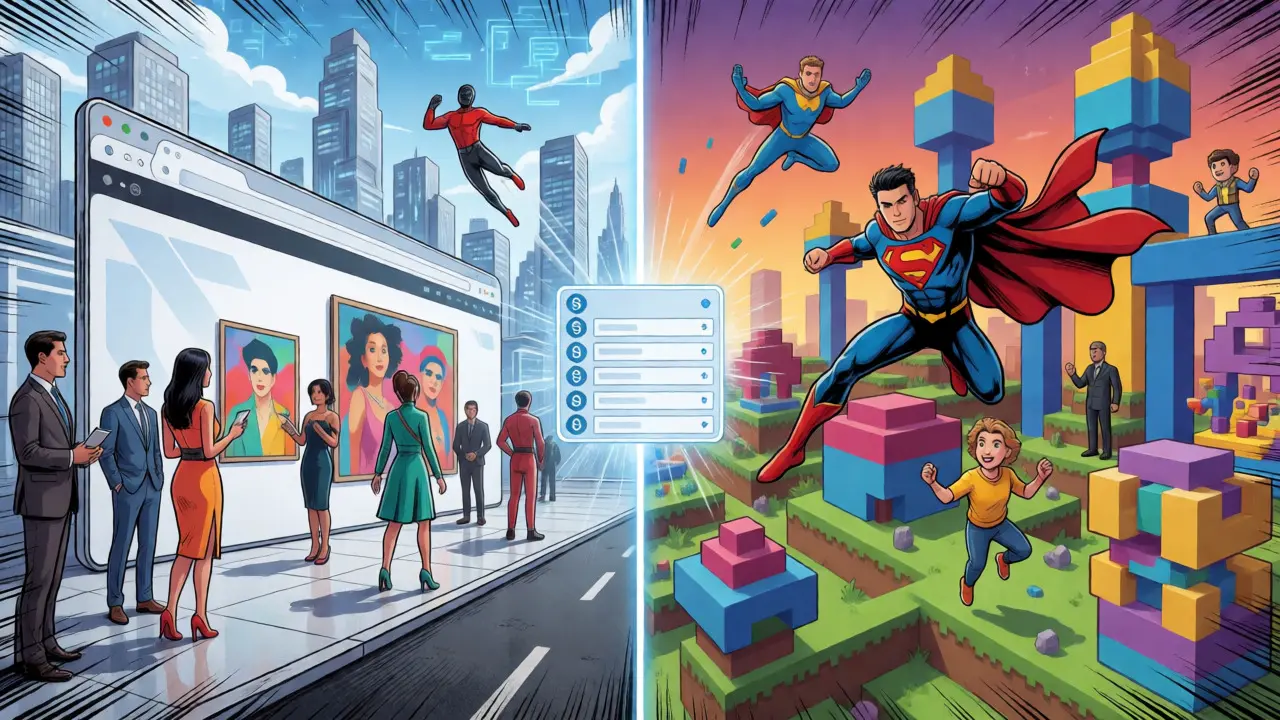
Decentraland is essentially a giant browser-based city. You don't need to download anything heavy; it runs in Chrome or Safari. It launched its public world in February 2020 after raising $24 million in an ICO back in 2017. The vibe here is social and artistic. People buy parcels of land called LAND NFTs, build galleries, host fashion shows, or set up virtual offices. Governance happens through a DAO (Decentralized Autonomous Organization), meaning if you hold MANA tokens, you get a say in how the platform evolves. It’s less about grinding for loot and more about being part of a community hub.
The Sandbox, on the other hand, feels like Minecraft meets a theme park. It uses a voxel-based aesthetic-think blocky, colorful graphics-and focuses heavily on user-generated content. Tools like VoxEdit let you create 3D assets, while Game Maker lets you turn those assets into playable mini-games. Because of this, big brands like Adidas and Snoop Dogg have built massive experiences here. If you want to play games created by other users rather than just walk around, The Sandbox is usually the better pick.
Why Blockchain Matters Here (And Where It Hurts)
So why put these worlds on a blockchain? Mostly for trust and interoperability. In a standard game, if the company shuts down, your items vanish. On a blockchain, your assets exist independently of the app. However, this comes with a cost: transaction fees, known as gas fees.
Most major platforms run on Ethereum. It’s secure, has the most developers, and supports complex smart contracts. But during busy times, moving a single item can cost $15 or more. That’s annoying if you’re trying to buy a cheap sword. To fix this, many platforms now use Layer-2 solutions like Polygon. Polygon acts like a fast lane on the Ethereum highway. It processes transactions almost instantly for fractions of a cent. Decentraland and The Sandbox both integrate with Polygon to keep costs low for regular users, though high-value trades often still settle on the main Ethereum network for maximum security.
| Platform | Primary Blockchain | Best For | Key Token | User Experience |
|---|---|---|---|---|
| Decentraland | Ethereum / Polygon | Social events, art, open-world exploration | MANA | Browser-based, no download required |
| The Sandbox | Ethereum / Polygon | Gaming, brand activations, UGC creation | SAND | Voxel style, requires asset creation tools |
| Axie Infinity | Ronin Sidechain | Play-to-Earn gaming, competitive battling | AXS, SLP | Mobile-friendly, card-game mechanics |
| Illuvium | Immutable X (Layer 2) | High-quality RPG visuals, auto-battler | ILV | AAA graphics, requires stronger hardware |
Beyond the Big Two: New Contenders and Tech Stacks
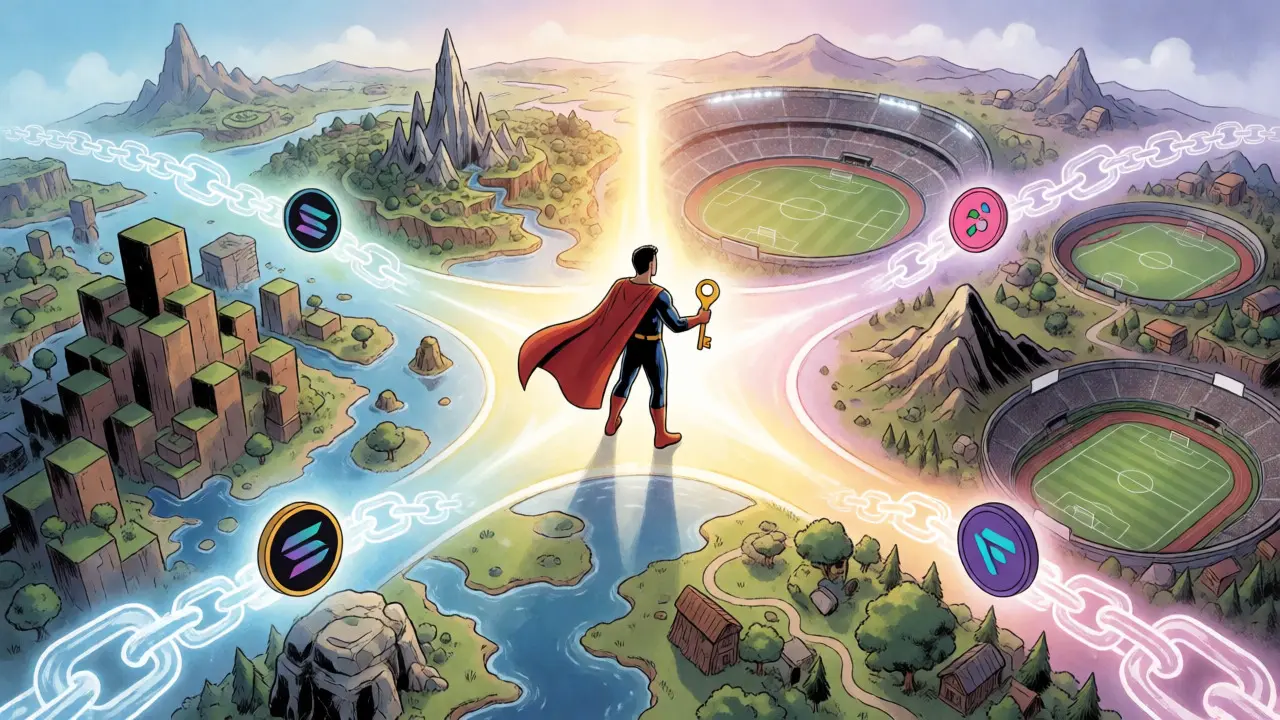
While Decentraland and The Sandbox dominate the headlines, the tech stack is shifting. Solana has become a favorite for newer projects because it handles over 50,000 transactions per second. Remember the Alpenglow upgrade in 2025? It stabilized Solana significantly, making it viable for real-time interactions where lag ruins the immersion. Platforms built on Solana offer near-instant responses, which is critical if you are trying to shoot someone in a virtual arena or trade quickly.
Then there is Polkadot. Its architecture allows different blockchains (parachains) to talk to each other. This is huge for the future of the metaverse. Imagine taking a sword you forged in a Polkadot-based game and using it in a completely different virtual world. Interoperability is the holy grail here. While we aren't fully there yet, projects like Moonbeam are bridging the gap between Polkadot and Ethereum ecosystems, allowing assets to flow more freely.
Don't overlook Flow either. Developed by Dapper Labs, Flow powered NBA Top Shot. It isn't a general-purpose blockchain like Ethereum; it’s optimized specifically for consumer apps and NFTs. If you see a sports-themed metaverse project, it might be running on Flow because it handles high-volume trading without clogging up the network.
How You Actually Make Money (Or Lose It)
Let's talk economics. In these Metaverse Platforms Built on Blockchain, money moves in three ways:
- Virtual Real Estate: Buying land to build on or lease out. Prime locations near popular hubs (like Genesis Plaza in Decentraland) command high rents. You can list your land on marketplaces like OpenSea or Rarible.
- Asset Creation: Designing clothes, weapons, or buildings and selling them as NFTs. In The Sandbox, skilled creators earn SAND tokens by publishing their games and charging entry fees.
- Governance and Yield: Holding platform tokens (like MANA or SAND) often gives you voting rights in the DAO. Some platforms also allow staking, where you lock up tokens to earn rewards, similar to a savings account but with crypto risk.
But be careful. The market is volatile. During the peak of the hype, a small parcel of land could sell for hundreds of thousands of dollars. Today, prices have corrected. Many early buyers are underwater. The lesson? Don't treat virtual land like a guaranteed retirement fund. Treat it like a speculative startup investment. High risk, potentially high reward, but mostly unproven long-term value.
Getting Started: What You Need Before You Log In
If you decide to jump in, you need more than just a web browser. You need a crypto wallet. MetaMask is the standard for Ethereum and Polygon networks. It connects your browser to the blockchain, letting you sign transactions and hold assets. For Solana-based worlds, you’ll likely need Phantom Wallet.
Here is a quick checklist before you spend any real money:
- Fund your wallet: Buy some ETH or SOL and transfer it to your MetaMask or Phantom.
- Understand Gas Fees: Check current network congestion. Use sites like Etherscan to see if fees are spiking. Wait for weekends or late nights if possible to save money.
- Start Small: Don't buy a mansion immediately. Try buying a cheap wearable item first to test the transaction process.
- Explore the DAO: Read the governance proposals. Understanding how decisions are made helps you predict if the platform will stay healthy long-term.
Also, consider your hardware. While Decentraland runs in a browser, high-end platforms like Illuvium require decent graphics cards. If you are on a basic laptop, stick to lighter platforms until you upgrade.
The Future: Interoperability and DeFi Integration
Where is this all going? The next big wave isn't just about pretty graphics; it's about finance. We are seeing DeFi (Decentralized Finance) protocols integrating directly into metaverse environments. Imagine taking out a loan against your virtual land collateral or earning yield on your idle assets while you sleep. This financial layer adds depth to what was once just a playground.
Cross-platform interoperability is the other major frontier. Right now, your avatar in Decentraland can't walk into The Sandbox. But standards like ERC-6551 (Token Bound Accounts) are changing that. These technologies allow NFTs to have their own wallets and capabilities, making it easier to move identities and assets between different virtual worlds. We are years away from a seamless "Ready Player One" experience, but the infrastructure is being laid out piece by piece.
For now, the best approach is curiosity. Pick one platform, learn its economy, and see if the community aligns with your interests. Whether you are into art, gaming, or speculation, there is a corner of the blockchain metaverse waiting for you.
Do I need expensive hardware to access blockchain metaverses?
Not necessarily. Platforms like Decentraland and The Sandbox are designed to run in standard web browsers, so a typical laptop or desktop computer is sufficient. However, if you want to explore high-fidelity VR experiences or graphically intense games like Illuvium, you will benefit from a dedicated GPU and possibly a VR headset like the Meta Quest 3.
Can I really own my virtual land forever?
Yes, in the sense that the NFT representing the land exists on the blockchain independent of the game servers. Even if the platform developers stop maintaining the software, the record of your ownership remains. However, the utility of that land depends on the platform staying active. If the ecosystem dies, the land may lose its economic value, even if you technically still "own" the token.
What are gas fees and how do they affect me?
Gas fees are transaction costs paid to miners or validators to process actions on the blockchain, such as buying an item or transferring land. On Ethereum, these can range from a few cents to over $20 depending on network congestion. Most modern metaverse platforms use Layer-2 solutions like Polygon to reduce these fees to negligible amounts for everyday interactions, reserving mainnet usage for large trades.
Is the metaverse dead since the hype faded?
No, it matured. The speculative bubble burst, removing many low-quality projects. What remains are established platforms with active communities and functional economies. Activity levels are lower than the 2021 peak, but user engagement is more genuine, focusing on utility, gaming, and social connection rather than pure price speculation.
Which blockchain is best for metaverse development?
It depends on your needs. Ethereum offers the highest security and largest developer pool but suffers from higher fees. Solana provides speed and low costs, ideal for real-time gaming but historically faced stability issues. Polygon balances cost and compatibility with Ethereum. Polkadot excels in interoperability between different chains. There is no single "best" option; it is a trade-off between speed, cost, security, and decentralization.
 Cryptocurrency Guides