
Most cryptocurrencies try to be money. Sora, with its native token XOR, tries to be an entire economic system. It’s not just another coin you buy and hope goes up. It’s a project built on the idea that many countries suffer from unstable currencies and lack access to fair capital. Sora aims to fix this by creating a supranational monetary framework-a digital economy that operates above national borders but supports local growth.
If you’ve heard about a decentralized protocol for stable, debt-free economic systems and wondered how it actually works, you’re in the right place. This isn’t Bitcoin. It isn’t Ethereum. It’s something more ambitious: a blockchain designed to help nations manage their money better while giving users a tool for cross-chain transactions.
The Core Idea: Money Without Debt
Traditional economies run on debt. Banks create money when they lend it out. If people don’t borrow, money supply shrinks. This creates boom-and-bust cycles that hurt everyday people, especially in developing nations. Sora flips this script.
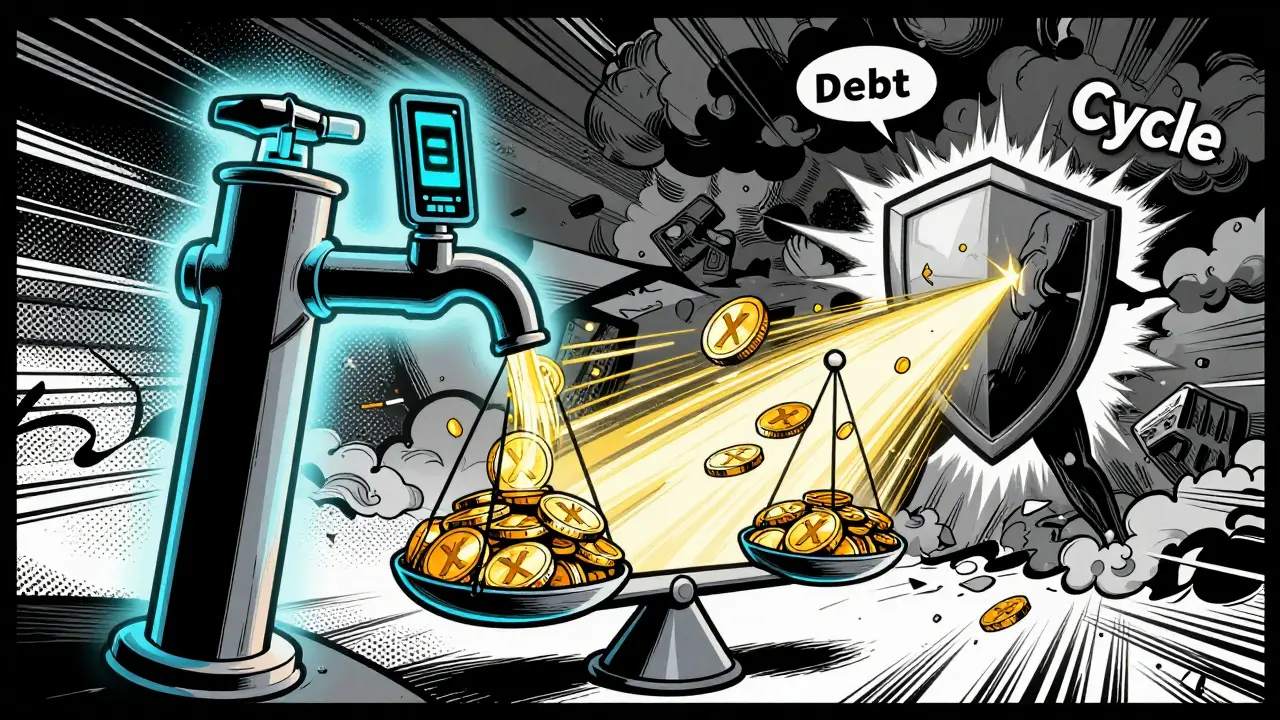
The SORA Network uses a mathematical model called a token bonding curve to control how much XOR enters circulation. Instead of printing money based on loans, new XOR tokens are issued only when there is real economic demand. Think of it like a faucet that opens wider when water is needed and closes when the tank is full. This prevents inflation spikes and ensures money serves production, not speculation.
This approach draws from empirical research in monetary theory. The goal? Stability. For countries facing hyperinflation or currency collapse, a system where money supply responds to actual goods and services-not bank balances-can be a lifeline.
How XOR Fits Into the Polkadot Ecosystem
You can’t understand Sora without understanding Polkadot. Polkadot is a multi-chain network that allows different blockchains to talk to each other. Sora is a parachain on Polkadot, meaning it connects directly to the main relay chain and shares security with other projects in the ecosystem.
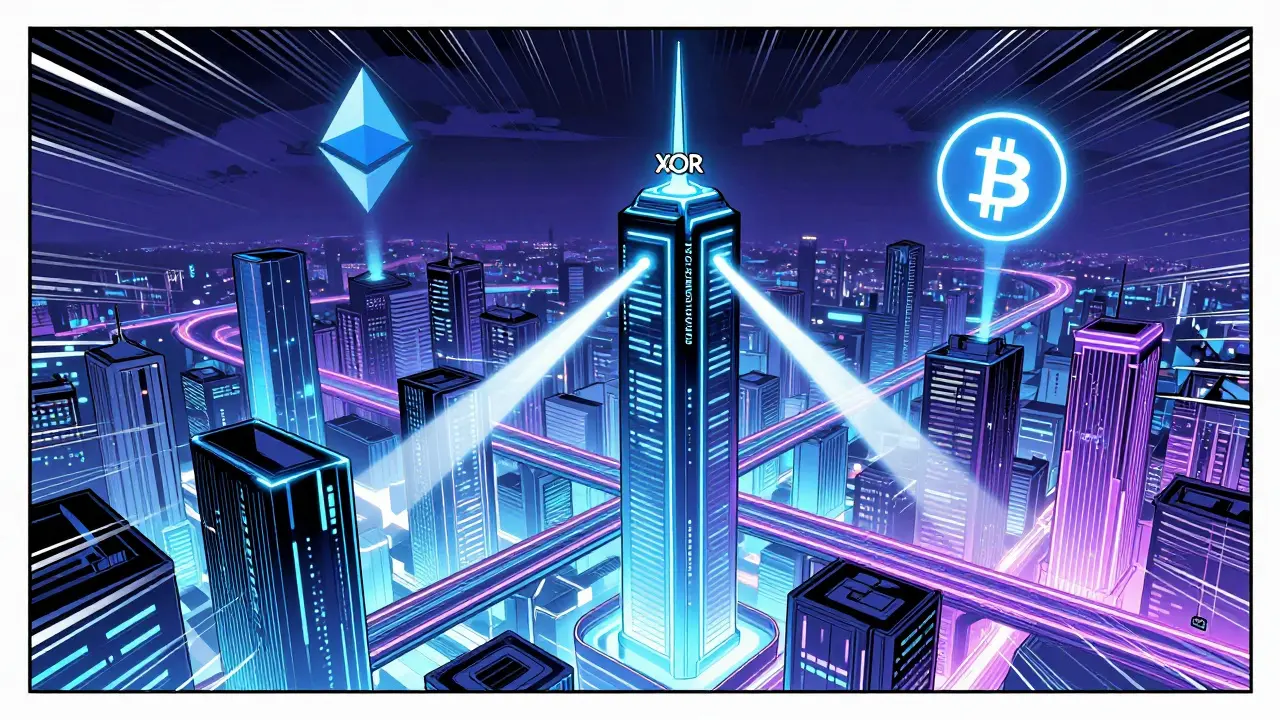
But here’s what makes Sora special: it also bridges to Ethereum and plans to bridge to Bitcoin. This means assets can move between these massive networks through Sora’s infrastructure. You could theoretically swap ETH for XOR, then use XOR to participate in governance or support a real-world project funded by the Sora Parliament.
| Feature | Description |
|---|---|
| Blockchain Type | Parachain on Polkadot |
| Native Token | XOR (used for fees, governance, staking) |
| Cross-Chain Support | Ethereum (active), Bitcoin (planned) |
| Monetary Model | Token bonding curve, non-debt-based issuance |
| Governance | SORA Parliament (Isonomia, Isegoria, Sortition) |
This interoperability is crucial. Most DeFi protocols live in silos. Sora wants to be a connector, allowing value to flow freely between major ecosystems while maintaining its own unique economic rules.
Real-World Use Case: Bokolo Cash CBDC
Talk is cheap. Proof is expensive. That’s why the partnership with the Central Bank of Solomon Islands matters so much. In October 2025, Sora became part of the proof-of-concept for Bokolo Cash, a Central Bank Digital Currency (CBDC) for the Solomon Islands.
Why does this matter? Because it shows Sora isn’t just theoretical. A real government is testing its technology to issue digital currency. The Solomon Islands face challenges with financial inclusion and currency stability. By using Sora’s infrastructure, they aim to create a transparent, efficient way to distribute money and track economic activity.
This integration validates Sora’s core promise: providing monetary stability for financially vulnerable countries. If Bokolo Cash succeeds, other nations may follow. This isn’t just about crypto trading; it’s about global economic development.
Governance: The SORA Parliament
Who decides how XOR is used? Not a CEO. Not a board of directors. The SORA Parliament does.
This democratic system is built on three ancient Greek concepts:
- Isonomia: Political equality. Every citizen has equal weight in decisions.
- Isegoria: Freedom of speech. Anyone can propose ideas or vote.
- Sortition: Random selection. Groups of citizens are chosen at random to make specific decisions, reducing corruption and bias.
Newly minted XOR tokens are allocated to productive projects based on these votes. Countries can appoint liaisons to work with the community, ensuring local needs are met. This model promotes transparency and inclusivity, empowering communities rather than centralizing power.
Imagine a world where funding for clean energy, education, or infrastructure comes from a global pool managed by ordinary people, not politicians or bankers. That’s the vision behind the SORA Parliament.
Trading XOR: What You Need to Know
As of late 2025, XOR trades primarily on decentralized exchanges like Uniswap V3 and Uniswap V4 on Ethereum. The most active pair is XOR/WETH, with daily volumes around $19,760. There’s also a smaller XOR/ETH pair on Uniswap V4.
Price-wise, XOR has been volatile. At one point, it traded near $0.000008240. Technical indicators showed oversold conditions (RSI below 30), suggesting potential bounce opportunities. However, long-term predictions remain mixed. Some analysts forecast modest gains into 2027, but the token’s value depends heavily on adoption and real-world usage, not just speculation.
If you’re considering buying XOR, remember: this isn’t a meme coin. Its value is tied to its utility as a governance token, transaction fee mechanism, and bridge asset. Do your own research. Understand the risks. And never invest more than you can afford to lose.

Competitors and Market Position
Sora doesn’t exist in a vacuum. It competes with other Polkadot parachains like Moonbeam and Acala, which focus on DeFi and smart contracts. But Sora’s niche is broader: it’s an economic operating system.
Compared to traditional CBDC platforms, Sora offers decentralization and community governance. Compared to pure DeFi protocols, it adds real-world nation-state partnerships. This hybrid position makes it unique-but also complex. Adoption hinges on regulatory acceptance and successful pilot programs like Bokolo Cash.
Is Sora Right for You?
If you’re looking for quick profits, probably not. XOR is a long-term play tied to macroeconomic trends and geopolitical shifts. But if you believe in decentralized governance, stable money, and inclusive economic systems, Sora deserves your attention.
Start small. Learn the basics. Join the community on Reddit or Twitter. Watch how the SORA Parliament operates. See how Bokolo Cash develops. Then decide if you want to hold XOR as a bet on a better financial future.
What is the difference between Sora and Bitcoin?
Bitcoin is a decentralized store of value with a fixed supply. Sora is a dynamic economic system with a flexible supply controlled by a bonding curve. Bitcoin focuses on individual ownership; Sora focuses on collective economic stability and governance.
Can I mine XOR tokens?
No. XOR is not mined. New tokens are issued through the token bonding curve based on economic demand and governance decisions. You can acquire XOR by swapping on DEXs like Uniswap or participating in network activities.
Is Sora safe to use?
Like any crypto project, Sora carries risks. It relies on Polkadot’s security and its own smart contracts. Always use reputable wallets and verify contract addresses. The Bokolo Cash partnership adds credibility, but past performance doesn’t guarantee future results.
How does the SORA Parliament work?
The Parliament uses Isonomia (equality), Isegoria (free speech), and Sortition (random selection) to govern. Citizens vote on proposals, and randomly selected groups make final decisions on fund allocation. This reduces corruption and encourages broad participation.
Where can I buy XOR?
XOR is available on decentralized exchanges like Uniswap V3 and V4 on Ethereum. Look for the XOR/WETH pair for best liquidity. Always double-check contract addresses to avoid scams.
What is Bokolo Cash?
Bokolo Cash is a Central Bank Digital Currency (CBDC) for the Solomon Islands, built using Sora’s technology. It’s a real-world test case for Sora’s ability to provide stable, transparent digital money to developing nations.
 Cryptocurrency Guides
Terry Hyland
June 14, 2026 AT 14:55They are trying to replace real money with code. It is a trap for the poor who do not understand how banking works. The elites want to control every penny you spend through this digital leash. Do not trust it.
Tim Lefebvre
June 15, 2026 AT 07:05i think u might be overthinking it a bit but its cool that they are trying to help countries like solomon islands. the bonding curve thing is actually pretty smart if u look at the math behind it. no debt based money supply is a huge deal for inflation control in developing nations. just my two cents tho
Monica Pathammavong
June 15, 2026 AT 09:53Oh please, another 'revolutionary' economic system. Let me guess, it’s going to fix everything because blockchain magic? You people really need to study basic monetary theory before spouting off about 'debt-free' systems. Money IS debt. It always has been. This whole token bonding curve idea is just a fancy way of saying 'we print when we feel like it.' And don't get me started on the governance model. Sortition? Randomly selecting people to decide where billions go? That’s not democracy, that’s chaos wrapped in Greek philosophy. I’ve seen more stable systems in high school student councils. Stop pretending this is sophisticated.
Filbert Reeves
June 17, 2026 AT 08:43You guys are all asleep at the wheel. The fact that they are partnering with a central bank is the biggest red flag ever. They say they are decentralized but then they hook up with the very institutions they claim to hate. It is a honeypot. They let you play around with your little tokens while the big players move the real assets. By the time you realize the bridge is locked, it will be too late. The government wants to track every transaction you make and Sora is giving them the keys. Wake up sheeple.
Nick Rice
June 18, 2026 AT 02:08I believe we can learn from these new models. The integration with Polkadot shows strong technical foundations. We must support innovation that seeks to improve financial inclusion globally. Let us engage with the community and ask thoughtful questions about the Bokolo Cash implementation. Progress requires participation.
Amit Thakur
June 18, 2026 AT 12:45The liquidity metrics are currently suboptimal for institutional entry. However, the cross-chain interoperability via Ethereum bridges provides a unique value proposition for DeFi aggregators. If the TVL increases, the yield farming opportunities could become attractive for risk-tolerant portfolios. Watch the RSI closely.
Eric Scheinberg
June 19, 2026 AT 20:06The theoretical framework presented herein is intriguing yet lacks empirical validation at scale. The assertion that debt-based issuance is inherently flawed ignores the velocity of money dynamics which are critical in modern macroeconomics. Furthermore, the reliance on a single parachain ecosystem introduces systemic risk that cannot be overlooked by prudent investors.
pankaj chawla
June 21, 2026 AT 04:40I agree with the points raised about the risks. However, the potential for aiding developing economies is significant. We should monitor the Solomon Islands pilot closely to see if the promised stability materializes. Collaboration between crypto projects and traditional finance might be the key to mainstream adoption.
Jessica Lane
June 22, 2026 AT 13:57This is a fascinating read. I am particularly interested in how the SORA Parliament handles conflicts of interest during the sortition process. Does the random selection include experts or just any holder? Understanding the governance mechanics is crucial before considering any investment. Please share any additional resources on the voting procedures.
Charles Pawlikowski
June 22, 2026 AT 22:53Why should we care about some island nation's currency problems? Our economy is strong enough without foreign interference. These globalist agendas are designed to weaken our sovereignty. Keep your crypto out of our banks. :)
Andrea Burd
June 24, 2026 AT 00:10Boring. Another whitepaper filled with buzzwords. Bonding curves are old news. Governance by lottery is absurd. I have better things to do than read this fluff. Pass.
Manish Prajapat
June 24, 2026 AT 07:41The philosophical underpinnings of Isonomia and Isegoria are compelling. It mirrors ancient Athenian ideals adapted for the digital age. However, one must question whether human nature has changed enough to handle such power responsibly. Perhaps technology can enforce fairness where politics failed. A thought experiment worth pursuing.
John Doe
June 26, 2026 AT 03:03It feels like everyone is missing the point. This isn't just about price action. It's about creating a parallel economic structure that operates independently of state control. The volatility is noise. The signal is the infrastructure being built for cross-border value transfer. Stay focused on the long-term vision.
Mekz Wheoki
June 28, 2026 AT 02:20Oh, wonderful. Another project promising to save the world from 'unstable currencies' while running on servers powered by coal. Spare me the utopian rhetoric. Real change doesn't happen in Discord channels. It happens in boardrooms and legislative halls. Go touch grass.
Sonya O'Brien
June 29, 2026 AT 19:42I find myself torn between skepticism and hope. On one hand, the history of CBDCs is fraught with surveillance concerns and centralization tendencies, which makes the partnership with the Central Bank of Solomon Islands deeply unsettling for privacy advocates. On the other hand, the sheer ingenuity of using a token bonding curve to manage supply without relying on fractional reserve banking is intellectually stimulating and potentially transformative for regions suffering from hyperinflation, provided that the governance mechanisms remain truly decentralized and resistant to capture by special interests, which is a tall order given the complexities of implementing sortition at scale without introducing vulnerabilities that could be exploited by bad actors seeking to manipulate the outcome for personal gain.
Akeem Whittaker
July 1, 2026 AT 15:49We need to look at the data. The trading volume is low, which indicates limited liquidity. Before anyone puts money in, check the contract addresses carefully. Scams are rampant in this space. Protect yourself first.
Skm Shubham
July 3, 2026 AT 07:41The fundamental flaw here is the assumption that a mathematical algorithm can solve political problems. Economic instability is rarely just about money supply; it is about corruption, resource misallocation, and institutional weakness. Sora treats the symptom, not the disease. The governance model is naive. Expect failure.
Rob Aronson
July 3, 2026 AT 13:26From a technical standpoint, the cross-chain bridging capabilities are impressive. 🌉 The ability to swap ETH for XOR and utilize it for governance creates a closed-loop ecosystem that enhances utility. However, security audits are paramount. Ensure you are interacting with verified contracts only. 🔒
Kwon Bill
July 3, 2026 AT 21:32In Asia, we see similar attempts at digital yuan integration. The difference here is the open-source nature. If Sora can maintain neutrality, it could serve as a neutral settlement layer for emerging markets. The jargon is heavy, but the use case is clear: financial inclusion through technological abstraction.