

Imagine a digital notebook that everyone can read, but no one can erase or alter. That is the core idea behind blockchain technology, which is a decentralized, transparent, and tamper-resistant digital ledger system that records transactions across multiple computers. It was originally introduced with Bitcoin in January 2009 by the pseudonymous creator Satoshi Nakamoto, as documented in the Bitcoin whitepaper published on October 31, 2008. For years, people associated this tech only with crypto coins. But today, it powers supply chains, verifies identities, and even secures medical records. If you are new to this world, the jargon can feel overwhelming. You do not need a computer science degree to get it. You just need to understand how trust works without a middleman.
How Does Blockchain Actually Work?
To grasp blockchain, think of it as a chain of blocks. Each block holds data-like a list of transactions-and is linked to the previous one using complex math called cryptography. This creates a chronological record that is incredibly hard to break. According to LondonBlockchain.net's beginner guide, modern blockchain architectures operate through four fundamental components: data blocks storing transactions like spreadsheet cells, cryptographic hash functions (primarily SHA-256 algorithm producing 64-character hexadecimal outputs), block linking creating chronological chains, and distributed ledgers maintained across multiple nodes requiring consensus for validation.
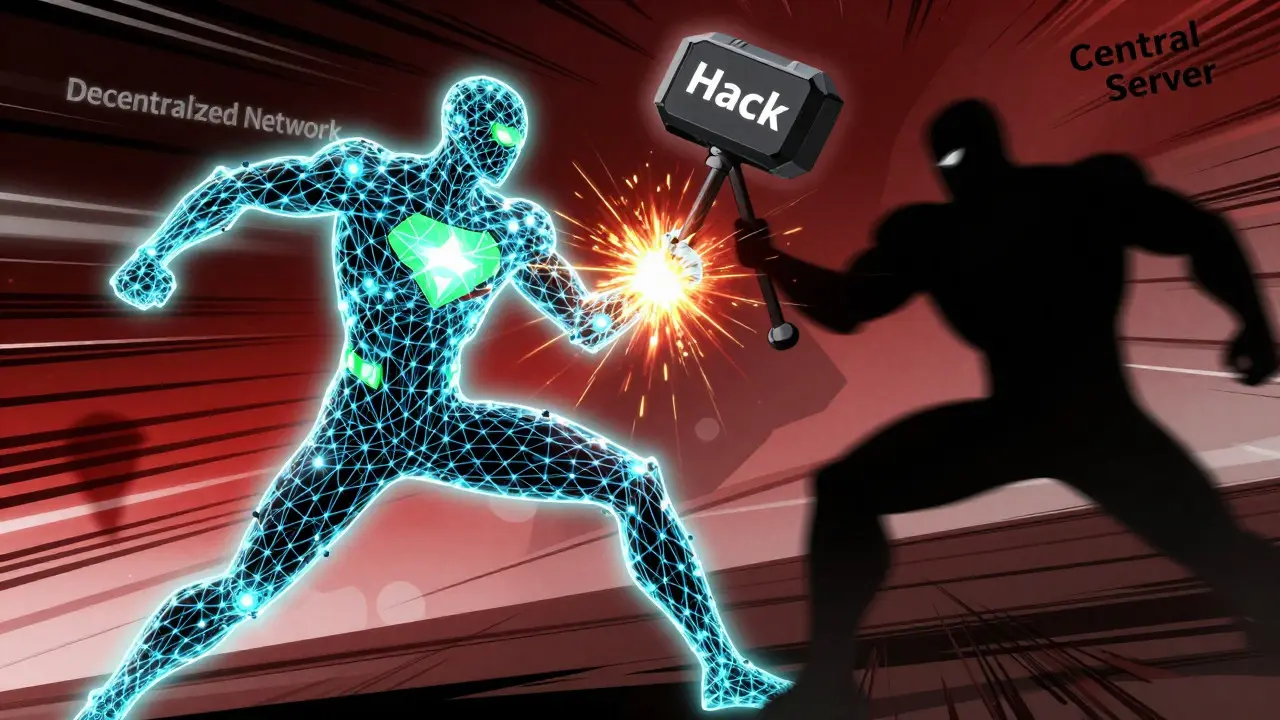
Here is why that matters. In traditional banking, a central server holds your balance. If hackers breach that server, they can change numbers. In a blockchain network, thousands of computers (nodes) hold copies of the same ledger. As of Q2 2025, Bitcoin alone operates through approximately 15,000 active nodes globally, while Ethereum maintains over 8,500 nodes. To cheat the system, a hacker would need to control more than half of all those computers simultaneously-a feat known as a 51% attack. For major networks like Bitcoin, with combined network hashrates exceeding 600 exahashes per second as of March 2025, this is practically impossible.
Why Use Blockchain Instead of Traditional Databases?
You might wonder why we need this complexity when Visa processes 24,000 transactions per second (TPS) smoothly. The answer lies in trust and intermediaries. Traditional systems rely on banks or governments to verify who owns what. Blockchain removes that middleman. Dr. Garrick Hileman, Research Fellow at the Cambridge Centre for Alternative Finance, stated in a March 2025 TechCrunch article that 'blockchain's real value lies in creating institutional trust through technical means, reducing reconciliation costs by up to 30% in financial services.'
Let us look at the trade-offs. Blockchain offers immutability (once recorded, transactions cannot be altered), transparency (all participants can verify transactions), and decentralization (no single point of failure). However, it has limitations. Bitcoin processes only about 7 TPS, compared to Visa’s 24,000. Energy consumption is also higher; the Bitcoin network consumes approximately 121 terawatt-hours annually, comparable to Belgium's national consumption per the Cambridge Bitcoin Electricity Consumption Index Q1 2025. Blockchain excels where trust verification is critical, such as in cross-border payments or supply chain provenance, but it struggles with high-frequency, low-value transactions where speed outweighs the need for heavy verification.
| Feature | Traditional Database (e.g., SQL) | Blockchain (e.g., Bitcoin/Ethereum) |
|---|---|---|
| Control | Centralized (single admin) | Decentralized (distributed nodes) |
| Immutability | Data can be edited/deleted | Data is permanent and unchangeable |
| Speed (TPS) | High (up to 24,000+) | Low to Medium (7-30 for Layer 1) |
| Trust Model | Relies on intermediary authority | Trustless (verified by code/math) |
| Cost Structure | High fees for intermediaries | Lower transfer fees, variable gas costs |
Key Players: Bitcoin, Ethereum, and Beyond
Not all blockchains are the same. Bitcoin was the first, designed primarily as a store of value and peer-to-peer cash. Ethereum, launched later, added a game-changing feature: smart contracts. These are self-executing contracts with the terms directly written into code. By Q2 2025, Ethereum dominated smart contract platforms with 58% market share among programmable blockchains, followed by BNB Chain (15%), Solana (9%), and Polygon (7%), according to DappRadar.
Solana takes a different approach, prioritizing speed. Under optimal conditions, Solana reaches 65,000 TPS. This makes it attractive for gaming and high-frequency trading, though it sacrifices some decentralization for performance. Meanwhile, specialized solutions like Polygon zkEVM achieve 2,000+ TPS by acting as Layer 2 scaling solutions on top of Ethereum. Understanding these differences helps you see why there is not just one "blockchain," but an ecosystem of tools built for specific jobs.
Real-World Applications Beyond Crypto
The hype around buying coins often overshadows the utility. The World Economic Forum's 2025 Blockchain Deployment Index ranked blockchain adoption in supply chain management as the fastest-growing sector. Maersk's TradeLens blockchain platform reduced documentation processing time by 40% across 300+ shipping partners. Imagine tracking a shipment from a factory in Vietnam to a warehouse in Texas, with every handoff recorded permanently. No lost papers, no disputed invoices.
In finance, blockchain enables secure value transfers over the internet while eliminating intermediaries, reducing costs by up to 90% compared to traditional systems. For example, international transfer fees that used to cost $30 can now be mere cents, clearing in minutes rather than days. Texas has emerged as a U.S. leadership hub after passing 12 blockchain-friendly legislative bills between 2022-2025, including House Bill 10 in 2023 that established clear regulatory frameworks for digital asset custody. Even artificial intelligence is merging with blockchain; Andrew Ng, founder of DeepLearning.AI, emphasized in his February 2025 Coursera course update that 'the convergence of blockchain and AI creates unprecedented opportunities for transparent, auditable AI decision-making.'
Getting Started: A Beginner’s Roadmap
If you want to move from reading to doing, start small. Metana.io's 2025 developer roadmap shows that 78% of successful blockchain developers spent 6-9 months mastering foundational skills before building production applications. You do not need to spend that long to just use it, though.
- Set Up a Wallet: Install a non-custodial wallet like MetaMask or Phantom. This gives you control over your keys, unlike an exchange where the company holds your funds.
- Use Testnets: Before spending real money, practice on test networks like Ethereum's Sepolia or Solana's Devnet. These use fake tokens that have no value, allowing you to make mistakes safely.
- Fund Small: Start with $10-20 worth of cryptocurrency. Send it to a friend or another address. Experience the process of paying gas fees and waiting for confirmation.
- Learn Basic Code: If you are interested in development, basic JavaScript or Python knowledge is essential. Platforms like CryptoZombies.io offer free Solidity tutorials and have onboarded 450,000 developers since 2022.
Be aware of pain points. User feedback from Reddit's r/Blockchain subreddit highlights that high gas fees during network congestion can be frustrating. Ethereum average transaction fees peaked at $55 in January 2025 per Etherscan data. Additionally, interfaces can be complex; Trustpilot reviews of MetaMask show 42% of users mentioning a 'steep learning curve' as the primary pain point. Patience is key.
The Future Landscape: Trends for 2025 and Beyond
The global blockchain technology market was valued at $18.7 billion in 2024 and is projected to reach $163.8 billion by 2030 with a 42.8% compound annual growth rate (CAGR), according to Grand View Research's May 2025 industry report. Three major trends are shaping this growth. First, execution layer optimization continues, with Ethereum's Pectra upgrade reducing gas fees by 22% in April 2025. Second, regulatory maturation is happening fast, with MiCA regulations fully implemented across EU member states in June 2025. Third, modular blockchains are gaining traction, separating execution, consensus, and data availability layers to boost performance by 40% compared to older monolithic designs.
Critics remain. Nouriel Roubini, Professor Emeritus at NYU Stern, argued in a January 2025 Bloomberg op-ed that '90% of blockchain use cases are solutions in search of problems.' While harsh, this view reminds us to focus on utility over speculation. Real enterprise adoption is plateauing around 35% of applicable use cases by 2030, according to the Bank for International Settlements. The technology will not replace every database, but it will become the backbone for any system requiring verified, shared truth without a central boss.
Is blockchain technology secure for beginners?
Yes, the underlying technology is highly secure due to cryptographic hashing and decentralized consensus. However, user error is the biggest risk. Losing your private keys means losing access to your assets forever. Always use reputable wallets and enable two-factor authentication.
What is the difference between Bitcoin and Ethereum?
Bitcoin is primarily a digital currency and store of value with limited programming capabilities. Ethereum is a programmable blockchain that supports smart contracts, enabling decentralized applications (dApps) like lending platforms and NFT marketplaces.
Do I need to know coding to use blockchain?
No. You can use blockchain services like sending money or buying NFTs without writing a single line of code. Coding is only required if you want to build decentralized applications or develop smart contracts.
Why are blockchain transactions sometimes slow?
Slowness comes from the consensus mechanism. Every node must verify the transaction to ensure validity, which takes time. Layer 2 solutions like Polygon or Arbitrum are being developed to speed this up by processing transactions off the main chain.
What are smart contracts?
Smart contracts are self-executing agreements with the terms directly written into code. They automatically enforce and execute actions when predefined conditions are met, removing the need for lawyers or intermediaries to oversee the deal.
 Cryptocurrency Guides
Matt Kay
August 13, 2026 AT 12:09too much text. just tell me how to get rich.
Dave Kjendal
August 15, 2026 AT 02:34the whole concept is a bit of a philosophical paradox really. we trust the code because we do not trust people, yet the code was written by people. it feels like we are just shifting the locus of faith rather than eliminating it entirely. very interesting but also kinda suspicious if you think about it too hard.
Kat Bennett
August 15, 2026 AT 06:19i actually found this guide super helpful and i am so glad someone took the time to break it down in such a clear and accessible way for those of us who are not tech wizards or computer science experts because honestly the jargon can be so intimidating at first glance but once you start seeing the practical applications like supply chains and medical records it really starts to make sense and i think there is so much potential for this technology to improve our daily lives in ways we have not even imagined yet so kudos to the author for making it easy to understand!
Harman Singh
August 15, 2026 AT 17:39why should i care? my bank works fine. stop wasting my time with this hype. nobody needs another database that runs slow and costs more energy than belgium. typical american obsession with new shiny toys that dont work. waste of electricity.
Qolbina Islami
August 16, 2026 AT 06:48This is all a GLOBALIST CONSPIRACY!!! They want to control your money! The FED wants to use this to track every penny you spend!!! Wake up sheeple!!! America First means keeping our banking system under American control not some decentralized anarchy run by hackers in basements!!! #MAGA #StopTheSteal
SUBHAM CHOUDHURY
August 18, 2026 AT 05:18You guys are missing the bigger picture here! It is absolutely fantastic to see so many people engaging with this topic because knowledge is power and when you empower yourself with understanding of these emerging technologies you open up a world of possibilities for financial freedom and innovation so keep learning keep asking questions and never let anyone tell you that you cannot master this space because I believe in you all completely and truly!
Joy Kwant
August 18, 2026 AT 07:34It is just so exhausting how everyone rushes into this without thinking about the moral implications. Who is responsible when the smart contract fails? Who pays for the environmental damage? We are acting like children playing with fire. It lacks basic human empathy and consideration for the planet. Disgusting.
amy miranda
August 19, 2026 AT 06:21The sheer audacity of claiming this is 'transparent' when the developers themselves often hide behind pseudonyms is laughable. It is a house of cards built on sand and greed. Every time I read about blockchain I feel a profound sense of disappointment in humanity’s inability to learn from history. We replace one corrupt middleman with a thousand anonymous ones and call it progress. Tragic.
Subhash Kashyap Dm
August 20, 2026 AT 21:47you idiots think sha-256 is secure against quantum computing? its over. the NSA has been backdooring the algorithms since day one. bitcoin is just a honeypot for retail investors while the real elites move their wealth off-chain using dark pools. wake up. the ledger is a lie. they own the nodes.
Billy Cunningham
August 22, 2026 AT 15:47boring 😐 📉 💤
Ed Wallace
August 23, 2026 AT 06:24I find the metaphor of the digital notebook quite charming, don't you? It paints such a vivid picture of shared truth in a fragmented world. There is something almost poetic about thousands of strangers agreeing on a single version of reality without ever meeting face to face. It reminds me of old town squares where news was spread by word of mouth, only now the gossip is encrypted and immutable. A beautiful dance of mathematics and trust.
Joshua Hofford
August 23, 2026 AT 16:38Hey folks, just wanted to chime in and say that this technology is bridging cultures in ways we never thought possible. In many parts of the world where banking infrastructure is weak, blockchain is becoming a lifeline for families trying to receive remittances from abroad. It is not just about crypto bros in Silicon Valley; it is about real people connecting across borders. Let us celebrate this global connectivity!
Marcia Albert
August 24, 2026 AT 15:30I just sit back and watch the chaos unfold. One day it is the future of finance, the next day it is a scam. The colors of the charts go up and down like a rollercoaster made of pure anxiety. I prefer my databases quiet and obedient. This whole decentralization thing seems like a lot of noise for very little signal.
Emma Smith
August 25, 2026 AT 09:30so you think your private keys are safe? lol. your browser extensions are tracking everything. the metaverse is watching. you are not hiding anything. they know what you bought. they know who you sent it to. privacy is dead. welcome to the panopticon.
Ed Mitchell
August 26, 2026 AT 14:47THE DEEP STATE IS USING BLOCKCHAIN TO TRACK CITIZENS!!! Look at the dates! Look at the funding sources! It is all connected to the Federal Reserve's desire to implement a digital currency that will allow them to freeze your assets if you dissent! You must remain vigilant! Do not trust the narrative! The 51% attack is a myth designed to lull you into a false sense of security while they consolidate power!
Michael Mostyn
August 28, 2026 AT 00:17One must consider the epistemological shift that occurs when we move from institutional trust to algorithmic verification. It raises profound questions about the nature of authority in the digital age. If the code is law, who writes the code, and to whose benefit? These are not merely technical issues but deeply philosophical inquiries into the structure of society itself.
Erica Johnson
August 29, 2026 AT 19:07:) well actually most of you are wrong about the TPS limits. layer 2 solutions are changing the game. but sure, keep complaining about gas fees while ignoring the security benefits. classic reddit behavior. :)
Ken G
August 30, 2026 AT 00:45only the elite understand this. the masses are too dumb to grasp the cryptographic nuances. they just want free money. meanwhile the smart money is moving to privacy coins before the government bans them. you are already late. the ship has sailed. enjoy the matrix.
Lorraine Surringer
August 30, 2026 AT 08:07Oh honey, you really think you can just set up a wallet and be safe? Please. Half of you will lose your seed phrase in a week. It is so sad watching people throw money away because they refuse to listen to advice. But hey, do what you want. Just dont come crying to me when you get rug pulled. Typical.