

Imagine a shared spreadsheet that everyone can see, but no single person can delete or change once the data is entered. That is essentially what blockchain technology is. It is not just the engine behind Bitcoin; it is a new way to build trust on the internet without needing a middleman like a bank or a lawyer. For beginners, the jargon can feel overwhelming. You hear words like "hashing," "nodes," and "consensus" thrown around constantly. But at its core, the concept is surprisingly simple. It is about recording information in a way that makes it nearly impossible to cheat the system.
We are living in an era where digital trust is more valuable than ever. By 2025, the global blockchain market was valued at $18.7 billion, with projections hitting over $163 billion by 2030. This isn't just hype; it is a fundamental shift in how we handle value and data. Whether you want to invest in crypto, understand supply chains, or just grasp the tech news, knowing how this works gives you a massive advantage. Let’s break down the mechanics, the myths, and the real-world uses of this technology.
How Does Blockchain Actually Work?
To understand blockchain, you have to forget traditional databases. In a standard database, one company controls the server. If they get hacked, or if they decide to change the rules, your data is vulnerable. Blockchain flips this model. Instead of one central server, the data is copied across thousands of computers worldwide. These computers are called nodes.
Here is the step-by-step process of how a transaction happens:
- The Request: You send money or data to someone else.
- The Broadcast: Your request is broadcast to all the nodes in the network.
- The Validation: The nodes check if the transaction is valid using a set of rules called consensus mechanisms. For example, do you actually have the funds? Is the signature correct?
- The Block: Once validated, the transaction is grouped with others into a "block." Think of this block as a page in a ledger.
- The Link: This new block is added to the existing chain of blocks. Crucially, each block contains a unique code (a hash) from the previous block. This links them together chronologically.
- The Completion: The transaction is complete, and the record is immutable. It cannot be changed without changing every subsequent block and gaining control of the majority of the network.
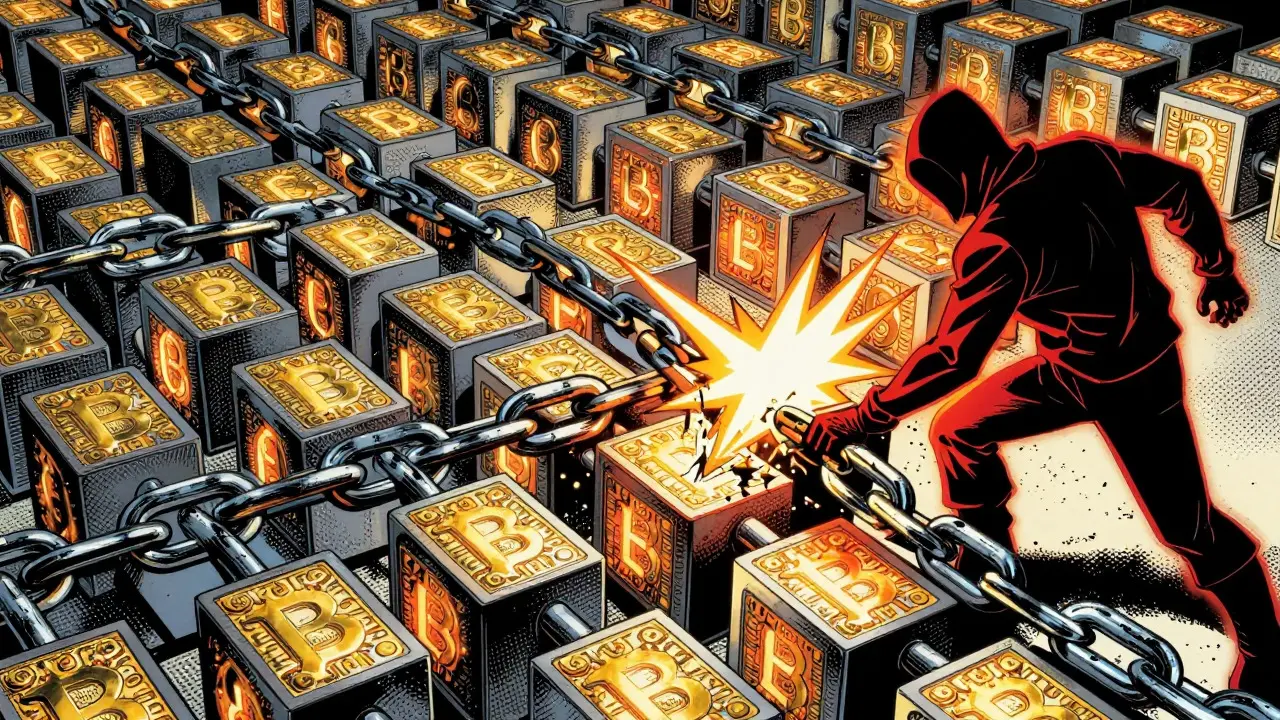
This structure creates a permanent history. If a hacker tries to alter a record from last year, they would need to recalculate the hashes for every block since then and outpace the computing power of the entire network simultaneously. For major networks like Bitcoin, which has over 15,000 active nodes, this is practically impossible.
Key Concepts Every Beginner Needs to Know
You will run into specific terms when exploring this space. Here is what they actually mean in plain English:
- Decentralization: No single entity controls the network. Power is distributed among all participants. This prevents censorship and single points of failure.
- Immutability: Once data is written to the blockchain, it stays there. It cannot be edited or deleted. This provides a high level of transparency and auditability.
- Cryptographic Hashing: This is the digital fingerprint of data. Algorithms like SHA-256 turn any input into a fixed-length string of characters. Even a tiny change in the input creates a completely different hash, alerting the network to tampering.
- Consensus Mechanisms: These are the rules nodes use to agree on the state of the ledger. The two most common types are Proof of Work (PoW) and Proof of Stake (PoS).
Proof of Work requires miners to solve complex mathematical puzzles to validate blocks. This secures Bitcoin but consumes significant energy. Proof of Stake, used by Ethereum, selects validators based on the amount of cryptocurrency they hold and are willing to "stake" as collateral. It is much more energy-efficient and faster.
Why Use Blockchain Over Traditional Systems?
If banks already work, why do we need blockchain? The answer lies in efficiency, cost, and trust. Traditional financial systems rely on intermediaries to verify transactions. These intermediaries charge fees, take time to process records, and introduce human error or fraud risk.
| Feature | Traditional Database | Blockchain |
|---|---|---|
| Control | Centralized (one owner) | Decentralized (shared ownership) |
| Data Security | Vulnerable to single-point hacks | Secured by cryptography and distribution |
| Transparency | Private to the owner | Publicly verifiable (on public chains) |
| Transaction Speed | Fast (Visa processes 24,000 TPS) | Slower (Bitcoin ~7 TPS, Ethereum ~15-30 TPS) |
| Cost for Cross-Border | High fees ($30-$50+) | Low fees (often under $1) |
| Trust Model | Trust the institution | Trust the code/mathematics |
The trade-off is speed and scalability. Visa can process thousands of transactions per second because it is centralized. Bitcoin processes about seven. However, newer solutions like Layer 2 networks (e.g., Polygon zkEVM) are solving this by handling transactions off the main chain and settling them later, achieving speeds of over 2,000 transactions per second while maintaining security.
Beyond Cryptocurrency: Real-World Applications
Most people associate blockchain only with Bitcoin or Ethereum. While these are the most famous applications, the technology is transforming other industries too.
Supply Chain Management is one of the biggest areas of growth. Companies like Maersk have used blockchain platforms like TradeLens to track shipping containers. This reduces documentation processing time by 40% and eliminates lost paperwork. Consumers can scan a QR code on a product and see exactly where it was made, who processed it, and its journey to the store.
Digital Identity is another critical use case. Currently, you give your personal data to dozens of companies, hoping they keep it safe. With blockchain, you could own your digital identity. You would grant temporary access to services without revealing your full history. This puts privacy back in the hands of the user.
Smart Contracts automate agreements. These are self-executing contracts with the terms directly written into code. When conditions are met (e.g., "If package arrives, release payment"), the contract executes automatically. This removes the need for lawyers or escrow agents in many scenarios. Dr. Garrick Hileman from Cambridge notes that this can reduce reconciliation costs in financial services by up to 30%.
Common Misconceptions and Limitations
It is easy to get swept up in the excitement, but blockchain is not a magic bullet. There are legitimate criticisms and limitations you should be aware of.
Energy Consumption is a major concern for Proof of Work chains. The Bitcoin network consumes approximately 121 terawatt-hours annually, comparable to the national electricity consumption of Belgium. However, Ethereum’s switch to Proof of Stake reduced its energy usage by over 99%, showing that the industry is evolving toward sustainability.
Scalability Issues remain a challenge. During peak times, networks like Ethereum can become congested, leading to high transaction fees (gas fees). In January 2025, average Ethereum fees peaked at $55. This makes small transactions impractical. Layer 2 solutions and modular blockchains are addressing this, but it is still a developing area.
User Experience is often clunky. Managing private keys, understanding wallet addresses, and navigating decentralized apps (dApps) can be daunting. Trustpilot reviews for wallets like MetaMask frequently cite a "steep learning curve." Until interfaces become as intuitive as banking apps, mass adoption will face friction.
Finally, the idea that "everything should be on the blockchain" is flawed. As Professor Nouriel Roubini pointed out, many proposed use cases are solutions looking for problems. If you just need a fast, cheap database for internal company records, a traditional SQL database is better. Blockchain shines when you need trust between parties who do not know or trust each other.
Getting Started: A Practical Path for Beginners
If you want to move from theory to practice, here is a safe and effective way to start:
- Learn the Basics: Take a free course like CryptoZombies.io, which teaches Solidity (the language of Ethereum smart contracts) through interactive games. Or try the University of Michigan’s Blockchain Specialization on Coursera.
- Set Up a Wallet: Download a non-custodial wallet like MetaMask or Phantom. This gives you control over your assets. Remember: if you lose your seed phrase (your backup password), you lose your funds forever. Write it down on paper and store it safely.
- Use Testnets: Do not start with real money. Use test networks like Ethereum’s Sepolia or Solana’s Devnet. These allow you to send fake tokens and interact with dApps without financial risk.
- Make a Small Transaction: Once comfortable, buy a small amount of cryptocurrency (e.g., $10-$20) on a reputable exchange. Send it to your wallet. This helps you understand gas fees, confirmation times, and address formats.
- Explore DeFi: Try lending or swapping tokens on a decentralized finance platform. Start small. Understand the risks of smart contract bugs and impermanent loss before committing significant capital.
Patience is key. The ecosystem moves fast, and mistakes can be costly. Focus on understanding the underlying technology rather than chasing price movements.
The Future Outlook: Where Is Blockchain Heading?
By 2026, blockchain is maturing rapidly. Regulatory frameworks are becoming clearer. The EU’s MiCA regulations are fully implemented, providing legal certainty for users and businesses. In the U.S., states like Texas have passed bills establishing clear rules for digital asset custody.
Technological advancements continue to push boundaries. Ethereum’s upcoming upgrades aim to increase throughput to 100,000 transactions per second. The convergence of blockchain and artificial intelligence is creating new opportunities for transparent, auditable AI decision-making. Imagine verifying that an AI model didn’t make a biased decision because its training data and logic were recorded on an immutable ledger.
Enterprise adoption is also accelerating. According to Gartner, 68% of blockchain implementations in 2025 were in business contexts. Companies are using it for secure data sharing, tokenizing real-world assets (like real estate or art), and streamlining cross-border payments.
While skeptics argue that widespread adoption may plateau, the trajectory is clear. Blockchain is moving from a niche technology for cryptographers to a foundational layer of the internet. It may not replace every database, but it will redefine how we establish trust in a digital world.
Is blockchain technology secure?
Yes, blockchain is highly secure due to cryptographic hashing and decentralization. To alter a record, a hacker would need to control more than 50% of the network's computing power, which is computationally expensive and practically impossible for large networks like Bitcoin. However, individual user errors, such as losing private keys or falling for phishing scams, remain common risks.
What is the difference between Bitcoin and blockchain?
Blockchain is the underlying technology-the digital ledger system. Bitcoin is the first and most famous application built on top of blockchain. Think of blockchain as the internet and Bitcoin as email. Many other applications, like Ethereum smart contracts, also run on blockchain technology.
Do I need to know coding to use blockchain?
No, you do not need to code to use blockchain for basic tasks like sending money or buying NFTs. User-friendly wallets and exchanges handle the technical details. However, if you want to build decentralized applications or create smart contracts, knowledge of programming languages like Solidity or Rust is required.
Why is blockchain considered environmentally unfriendly?
Early blockchains like Bitcoin use Proof of Work, which requires massive amounts of electricity to solve mathematical puzzles. This has led to concerns about carbon footprints. However, newer blockchains like Ethereum use Proof of Stake, which reduces energy consumption by over 99%, making them much more sustainable.
Can transactions on blockchain be reversed?
Generally, no. One of blockchain's core features is immutability. Once a transaction is confirmed, it cannot be undone. This means if you send funds to the wrong address, they are likely lost forever. Always double-check addresses before confirming transactions.
What are smart contracts?
Smart contracts are self-executing programs stored on a blockchain. They automatically enforce the terms of an agreement when predefined conditions are met. For example, a smart contract could automatically release payment to a freelancer once a client approves their work, eliminating the need for an intermediary.
 Cryptocurrency Guides