
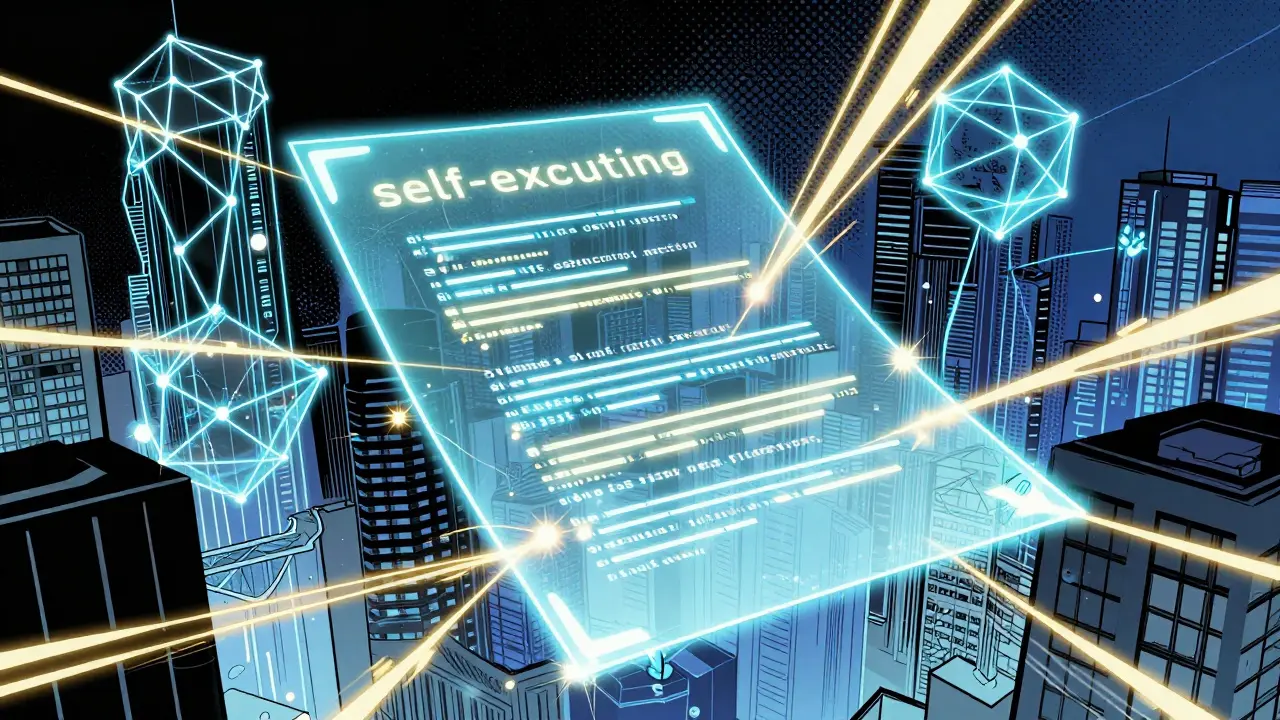
Imagine signing a lease where the landlord cannot change the rules halfway through, and you don't have to pay a middleman just to get your security deposit back. That is the promise of smart contracts, which are self-executing computer protocols designed to facilitate, verify, and enforce agreements without involving a trusted third-party. But we are moving past simple automated leases. By 2026, these programmable agreements have become the beating heart of next-generation decentralized applications (dApps), transforming how digital transactions happen across finance, healthcare, and logistics.
The growth numbers are staggering. The global smart contracts market hit USD 3.69 billion in 2025 and is forecasted to explode to USD 815.86 billion by 2034. That is a compound annual growth rate of over 50%. This isn't just hype; it's a fundamental shift in how we build software. We are seeing smart contracts evolve from basic automation tools into complex systems capable of AI-driven decision-making and cross-chain communication. If you are building or investing in dApps, understanding this evolution is no longer optional-it is survival.
From Static Code to Intelligent Agents
For years, smart contracts were rigid. They followed an "if-then" logic that was hard-coded at deployment. If the data input was wrong, the contract failed or executed incorrectly. In 2026, that rigidity is disappearing. The biggest leap forward is the integration of artificial intelligence into smart contract architecture.
AI-driven smart contracts can now analyze real-time data, make predictive decisions, and optimize workflows on their own. Think about decentralized finance (DeFi). Instead of a static lending protocol with fixed interest rates, an AI-enhanced contract can adjust rates dynamically based on real-time risk assessments from multiple data sources. It can detect unusual trading patterns that might signal fraud and pause transactions automatically before losses occur.
This convergence creates autonomous agents. These agents can exchange data and services using blockchain for coordination, usage tracking, and payments. For example, in supply chain management, an AI agent monitoring IoT sensors can trigger a smart contract to release payment to a supplier the moment goods arrive at a warehouse, verified by temperature and humidity data. No paperwork, no delays, no human error.
Solving the Fragmentation Problem: Cross-Chain Interoperability
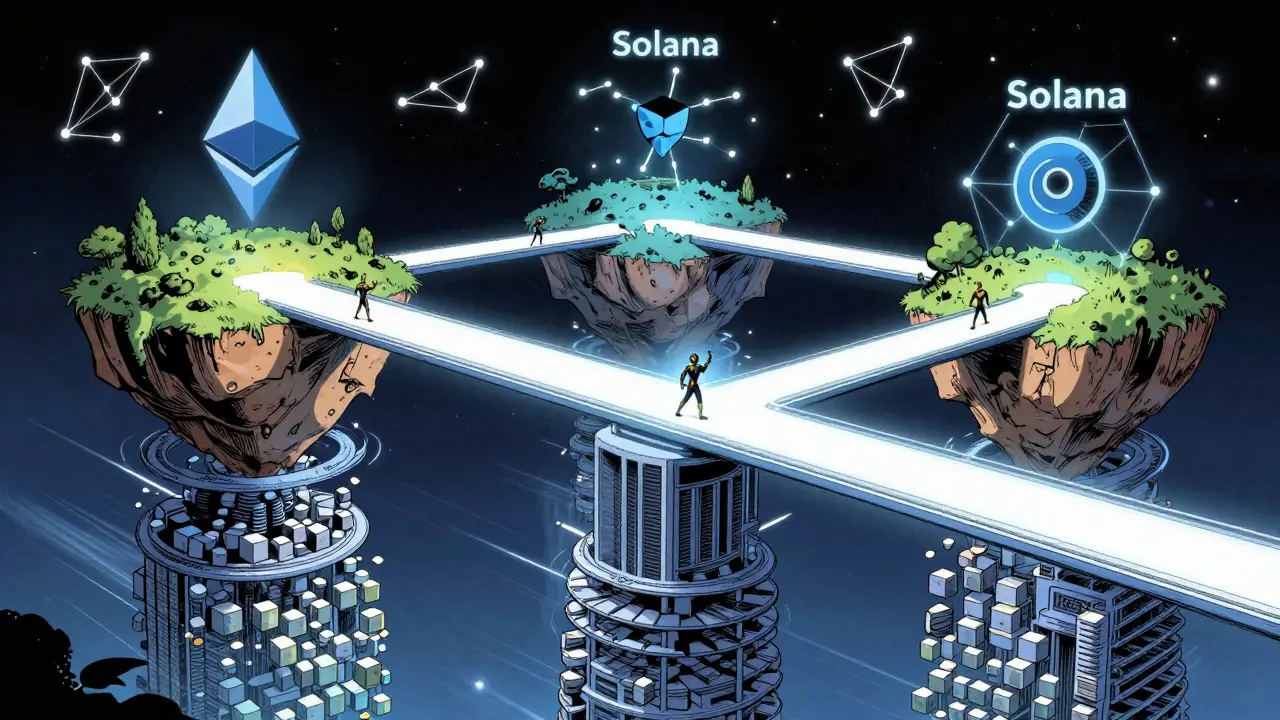
One of the biggest hurdles for dApps has always been fragmentation. Ethereum, Solana, Polkadot-each blockchain is like its own island. Your smart contract on one island couldn't talk to another. This limited adoption because users had to bridge assets manually, often paying high fees and taking on security risks.
Cross-chain interoperability has changed that landscape. Modern smart contracts can now operate seamlessly across different blockchain networks. This doesn't mean they run on all chains simultaneously in a messy way; rather, standardized protocols allow them to communicate and execute actions across boundaries.
Take a user who wants to use a DeFi application on Ethereum but holds assets on Polygon. With modern interoperability standards, the smart contract handles the verification and execution without the user needing to understand the underlying bridging mechanics. This seamless experience is crucial for mass adoption. It removes the friction that turns away non-technical users.
| Feature | Traditional Smart Contracts | Next-Gen Smart Contracts (2026+) |
|---|---|---|
| Logic Execution | Static, pre-defined "if-then" rules | Dynamic, AI-assisted decision making |
| Network Scope | Limited to single blockchain | Cross-chain interoperability |
| Data Input | Relies on centralized oracles | Decentralized oracle networks with real-time validation |
| Scalability | Often bottlenecked by mainnet congestion | Enhanced via ZK-rollups and Layer 2 solutions |
| Governance | Centralized developer control | DAO-based community governance |
Scaling Up: ZK-Rollups and Virtual Machines
You can have the best code in the world, but if the network is too slow or expensive, it won't matter. Scalability remains a critical challenge for blockchains. The solution? Layer 2 technologies, specifically ZK-rollups.
ZK-rollups bundle thousands of transactions off-chain and post a single cryptographic proof to the main blockchain. This drastically reduces gas fees and increases transaction speed. For dApps, this means users can interact with smart contracts almost instantly, similar to traditional web apps. Imagine playing a blockchain-based game where every move is recorded on-chain but costs fractions of a cent. Without ZK-rollups, that game would be unplayable due to high transaction costs.
Another architectural innovation is the split-virtual machine approach. Systems like AlkylVM enable the integration of resource-constrained devices with blockchain systems. This allows Internet of Things (IoT) devices, which typically lack the processing power to run full blockchain nodes, to communicate directly with smart contracts. This opens up massive possibilities for industrial automation, where millions of sensors can trigger smart contract actions without heavy infrastructure overhead.
DAOs: The Governance Engine for dApps
Who decides how a decentralized application evolves? In the early days, developers held the keys. Today, Decentralized Autonomous Organizations (DAOs) are leading the charge. DAOs captured the largest share of the smart contracts market in 2024, and they are becoming the standard governance model for dApps.
A DAO uses smart contracts to manage treasury funds, vote on proposals, and enforce rules transparently. There is no CEO to bypass the system. Every decision is recorded on the blockchain, creating an immutable history of governance. This reduces administrative expenses and eliminates the risk of insider manipulation. For users, this means trust is placed in code and community consensus rather than a corporate boardroom.
However, DAOs are not without challenges. Voter apathy and low participation rates can lead to centralization among a few large token holders. The future of DAOs lies in improving user interfaces and implementing quadratic voting mechanisms to ensure fairer representation. As more companies adopt blockchain-based organizational structures, we will see refinements in how these digital communities operate.
Security and Privacy: The Non-Negotiables
With great power comes great responsibility-and great risk. Smart contracts are immutable, which means once deployed, bugs cannot be easily fixed. This has led to billions of dollars in losses due to exploits. Security is the top concern for enterprise adoption.
In 2026, security practices have matured significantly. Formal verification methods are now standard, where mathematical proofs ensure the code behaves exactly as intended under all conditions. Additionally, private blockchain segments are growing rapidly. Private blockchains offer authorized membership access, providing better administration, enhanced confidentiality, and faster performance compared to public alternatives. For industries like healthcare and finance, this hybrid approach-using public chains for transparency and private chains for sensitive data-is gaining traction.
Privacy-preserving technologies, such as zero-knowledge proofs (ZKPs), are also integral. ZKPs allow a party to prove they know a value without revealing the value itself. This is crucial for identity verification. Platforms like Polygon ID offer self-sovereign identity infrastructure using ZKPs, allowing users to prove their age or creditworthiness without exposing their personal data to the smart contract or the network.
Real-World Adoption: Beyond Finance
While DeFi pioneered smart contracts, the technology is spreading. Here is what you need to know about sector-specific adoption:
- Healthcare: Smart contracts manage patient data consent securely. Patients can grant temporary access to doctors or researchers, with all interactions logged immutably. This ensures compliance with regulations like HIPAA while enabling efficient data sharing for research.
- Supply Chain: Companies track products from raw material to consumer. Each handoff triggers a smart contract event, ensuring authenticity and reducing counterfeiting. IoT integration allows real-time monitoring of conditions like temperature for pharmaceuticals.
- Gaming and Metaverse: Players truly own their in-game assets. NFTs represent items, and smart contracts handle trades, rentals, and royalties. This creates new economies where players can earn income through gameplay.
- Digital Identity: Governments and enterprises are investing in blockchain-based ID systems. The EU's EBSI program supports eID verification across member states, reducing fraud and streamlining bureaucracy.
Implementation Challenges for Developers
If you are looking to build dApps, the learning curve is steep. You need to master blockchain architecture, programming languages like Solidity or Rust, and cross-chain compatibility protocols. Implementation typically takes 3-6 months for initial deployment, depending on complexity.
Key skills include gas optimization to keep transaction costs low, secure coding practices to prevent exploits, and understanding state management across different layers. Documentation quality varies across platforms, so relying on active developer communities and professional auditing services is essential. Never deploy a smart contract without a rigorous audit from a reputable firm. The cost of an audit is far less than the potential loss from a hack.
Looking Ahead: What Comes Next?
The future of smart contracts is bright, but it requires continuous adaptation. We will see deeper integration between AI and blockchain, creating fully autonomous economic agents. Regulatory frameworks will evolve, bringing clarity to legal status and tax implications. Interoperability will become invisible to users, creating a unified digital environment.
For businesses, the question is no longer whether to adopt smart contracts, but how quickly they can integrate them into their operations. For developers, the opportunity lies in solving the remaining puzzles around scalability, privacy, and user experience. The era of trustless, automated interactions is here, and it is only getting started.
What is the difference between a traditional contract and a smart contract?
A traditional contract relies on legal enforcement and intermediaries like lawyers or courts to resolve disputes. A smart contract is self-executing code on a blockchain that automatically enforces terms when predefined conditions are met, eliminating the need for third-party intervention.
Are smart contracts completely secure?
No smart contract is immune to vulnerabilities. While the underlying blockchain is secure, bugs in the code can be exploited. Security depends on rigorous auditing, formal verification, and adherence to best practices. Regular updates and patches are difficult due to immutability, so prevention is key.
How do AI-driven smart contracts work?
AI-driven smart contracts integrate machine learning models that analyze external data feeds (oracles) to make dynamic decisions. Unlike static contracts, they can adjust parameters, predict outcomes, and optimize processes in real-time, enhancing efficiency in sectors like DeFi and supply chain management.
What is cross-chain interoperability?
Cross-chain interoperability allows smart contracts on one blockchain network to communicate and transact with contracts on another network. This solves the problem of fragmented ecosystems, enabling seamless asset transfers and data sharing across different platforms like Ethereum, Solana, and Polkadot.
Why are DAOs important for decentralized applications?
DAOs provide a decentralized governance structure for dApps, allowing token holders to vote on changes and manage treasury funds. This ensures transparent, community-driven decision-making without central authority, aligning incentives and reducing the risk of unilateral control by developers.
 Cryptocurrency Guides