
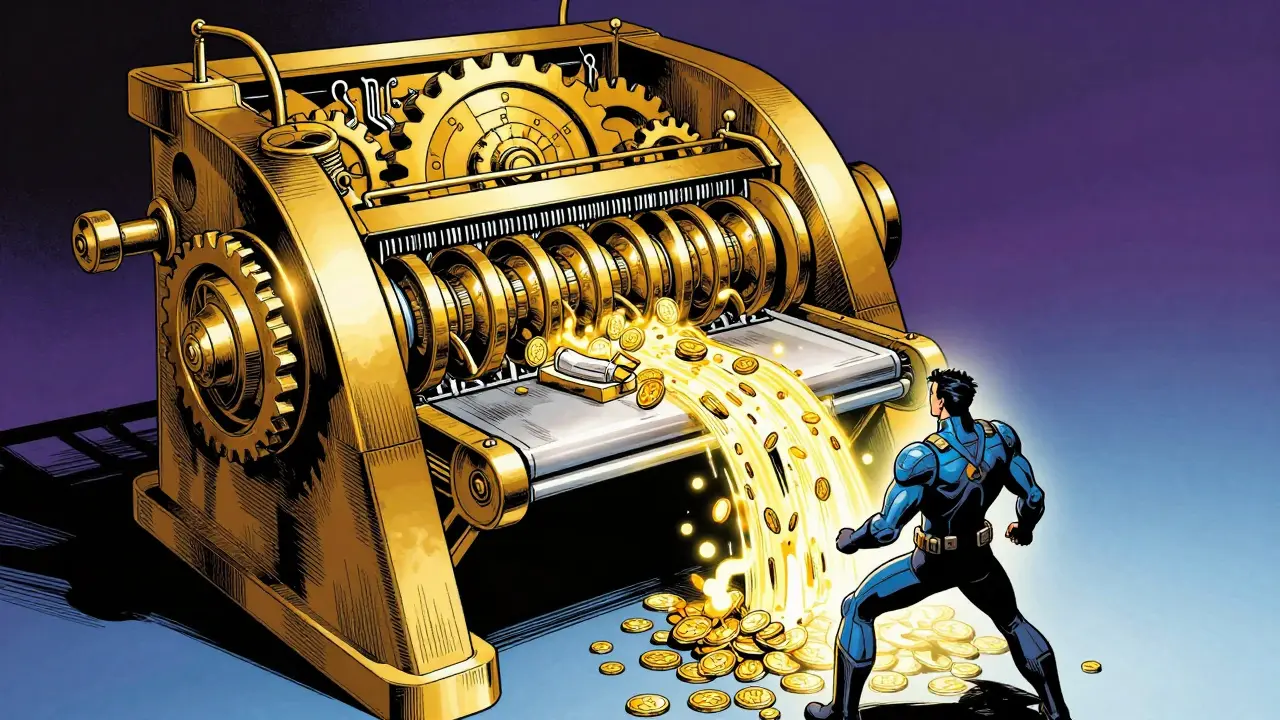
Most people think of blockchain rewards as a simple payment for mining coins. But we're approaching a massive economic shift. For years, the primary incentive for securing a network was the issuance of new tokens-a process that essentially prints money to pay for security. However, as these rewards dwindle, the entire financial foundation of decentralized networks has to change. If the "printing press" stops, what actually keeps the lights on?
The core problem is sustainability. We are moving from an inflationary era, where rewards are guaranteed by the protocol, to a fee-based era, where rewards depend entirely on network usage. This isn't just a technical tweak; it's a total rewrite of the incentive layer that prevents networks from collapsing or becoming centralized.
The Great Transition: From Tokens to Transaction Fees
To understand where we're going, we have to look at the most famous example: Bitcoin is a decentralized digital currency that uses a Proof of Work consensus mechanism to secure its ledger. Its reward system is designed to vanish. Through a process called halving, the amount of new BTC given to miners drops every four years. We've already seen rewards slide from 50 BTC down to 3.125 BTC. By the year 2140, no new coins will be created.
When the block subsidy hits zero, miners will rely solely on transaction fees. This creates a high-stakes gamble: will the volume and value of transactions be high enough to pay for the massive electricity bills and hardware costs? If fees are too low, miners leave. If too many miners leave, the network becomes vulnerable to a 51% attack. The future of block reward systems depends on finding a "Goldilocks zone" where fees are high enough to secure the network but low enough that people actually use it.
| Feature | Inflationary Model (Current) | Fee-Based Model (Future) |
|---|---|---|
| Primary Income Source | Newly minted tokens (Subsidies) | User-paid transaction fees |
| Predictability | High (Fixed schedule) | Low (Based on network traffic) |
| Economic Impact | Increases token supply | Neutral or Deflationary |
| Main Risk | Inflation/Value dilution | Miner exodus due to low revenue |
The Rise of Modular Reward Architectures
We're seeing a shift away from the "one-size-fits-all" blockchain. New modular designs break the network into specialized layers, and each layer has its own reward logic. For example, Celestia is a modular data availability network that allows other blockchains to outsource their data storage. Because it doesn't handle execution (the actual processing of smart contracts), its reward system focuses specifically on the act of making data available to the rest of the network.
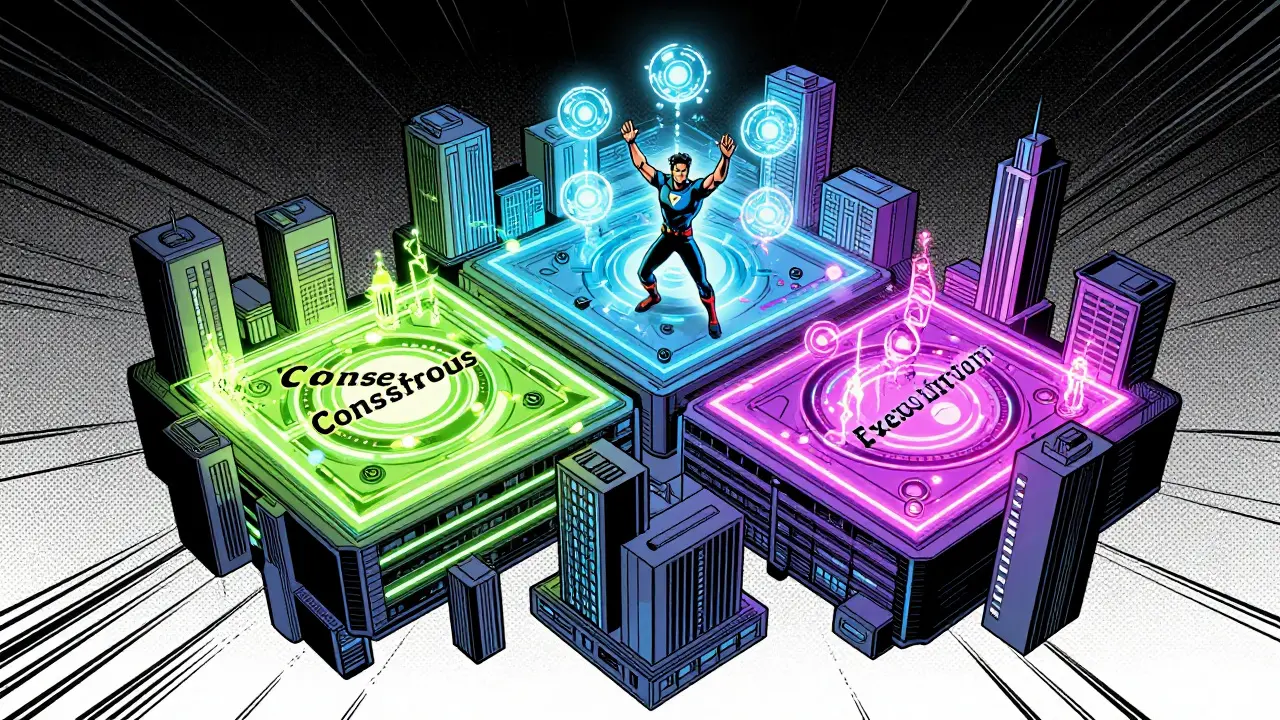
This modularity allows for more surgical incentives. In a modular world, you might have one reward for the consensus layer (the agreement) and a different reward for the execution layer (the processing). Polygon 2.0 has pushed this further by integrating zero-knowledge technology to coordinate multiple chains, which allows them to customize how validators are paid based on the specific function they perform. This means a network can prioritize speed or privacy by adjusting the rewards for the specific modules that handle those tasks.
Liquid Staking and the Restaking Revolution
If you've ever staked coins, you know the pain of "locking" them up. You earn rewards, but your money is stuck. Liquid staking changed that, and now we're entering the era of restaking. EigenLayer is a protocol that allows users to "restake" their Ethereum (ETH) to secure other services beyond the main Ethereum network.
Imagine your ETH is a security guard. In the old days, that guard could only protect one building. With restaking, that same guard can protect five different buildings at once, earning a small fee from each. This creates multiple streams of income for the validator without requiring more capital. It effectively maximizes the yield of the asset while increasing the overall security of the broader ecosystem. This is a massive evolution because it separates "security" from "token issuance." You aren't relying on new coins; you're relying on the value of the existing stake and the fees paid by the services being secured.
Diversifying Income: DeFi, AI, and Real-World Assets
The future won't just be about mining blocks. We're seeing a convergence where block rewards are just one part of a larger income portfolio for network participants. In the Decentralized Finance (DeFi) space, mechanisms like liquidity mining and yield farming provide rewards for providing capital, not just computational power. As the DeFi market grows-potentially reaching $231 billion by 2030-these secondary reward systems will likely outweigh traditional block rewards in terms of total value.
Then there's the AI angle. Decentralized AI platforms are creating rewards for people who share their GPU power or provide clean data for training models. This is a different kind of "block reward"-it's a reward for a tangible resource (compute) rather than just a ledger update. When you combine this with the tokenization of real-world assets (RWA), like real estate or bonds, we get hybrid systems. A validator might earn a block reward in tokens and a dividend in US dollars from a tokenized property, all managed through the same smart contract.
The Regulatory and Institutional Shift
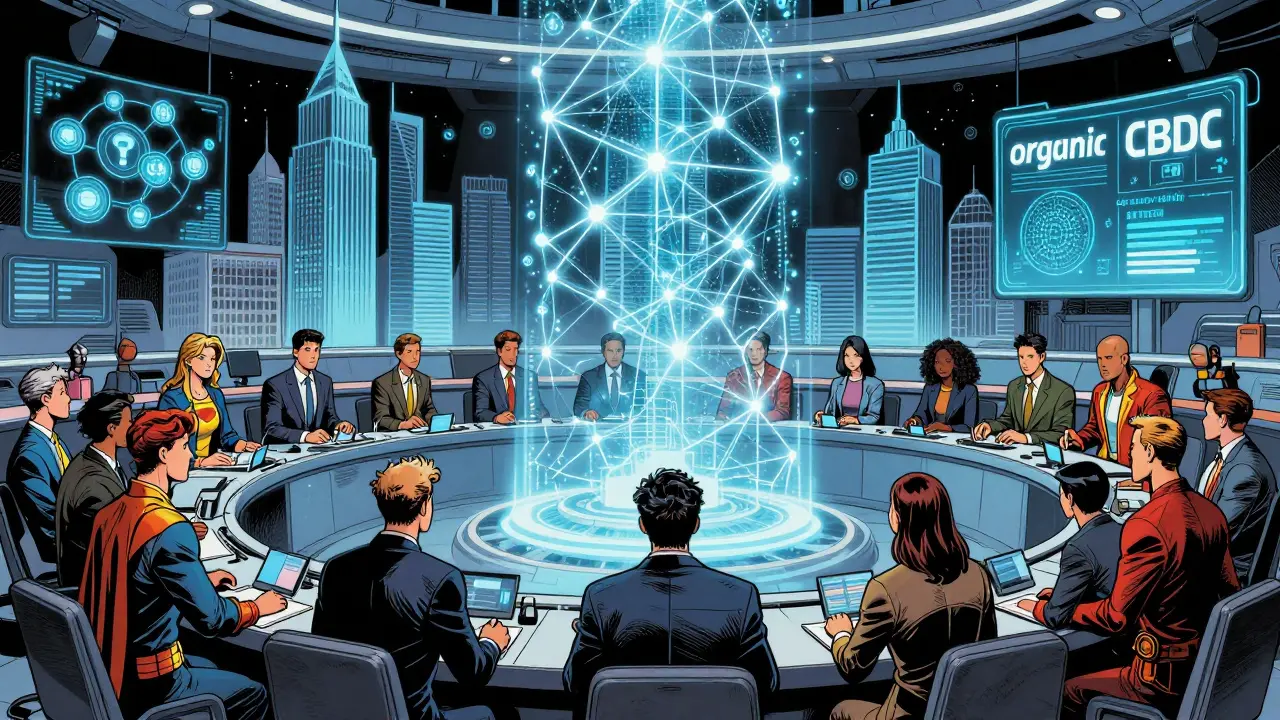
We can't ignore the role of governments. Central Bank Digital Currencies (CBDCs) are introducing a completely different model: government-controlled rewards. Unlike Bitcoin, where rewards are governed by code, a CBDC reward system would be governed by monetary policy. This could mean negative interest rates to encourage spending or targeted incentives to stimulate specific sectors of the economy.
At the same time, the growth of Blockchain-as-a-Service (BaaS) is allowing corporations to build their own private incentive structures. A supply chain consortium might reward nodes not with a tradable token, but with "reputation points" or reduced service fees. As regulations clear up in regions like the EU and potentially the US, more institutional money will flow into these systems, demanding stability over the volatility we see in current mining rewards.
What happens to miners when block rewards reach zero?
Miners will transition to a fee-only model. Their income will come entirely from the transaction fees paid by users. To remain profitable, miners will need to operate in regions with the cheapest electricity or move toward more efficient hardware. If transaction volume is high enough, the network remains secure; if not, the hash rate may drop, potentially making the network less secure.
How does liquid staking differ from traditional staking?
Traditional staking locks your tokens in a contract, making them unavailable for trading or other uses. Liquid staking provides you with a "receipt token" (like stETH) that represents your staked assets. You earn the rewards from the original stake, but you can still trade, lend, or sell the receipt token in the market.
Will modular blockchains make block rewards more expensive?
Actually, the opposite. By splitting functions (like data availability and execution), modular blockchains like Celestia reduce the burden on any single layer. This allows for more efficient reward distributions and generally lowers the cost for the end-user because the network isn't wasting resources on redundant tasks.
Can AI integration replace the need for traditional mining?
It won't replace the need for a consensus mechanism, but it changes what is being "mined." Instead of solving arbitrary math problems (like in Bitcoin), AI-integrated systems reward "useful work," such as training a neural network or processing a complex dataset, making the reward system more economically productive.
Are CBDC rewards similar to crypto block rewards?
No. Crypto rewards are decentralized and algorithmic. CBDC rewards are centralized and discretionary, meaning a central bank can change the reward or interest rate instantly to control the economy, similar to how traditional bank accounts work but with the efficiency of a blockchain.
Moving Forward: What to Watch
If you're following this space, keep an eye on the hash rate of major networks during the next few halving events. If the hash rate stays steady despite dropping rewards, it's a sign that the market is successfully transitioning to a fee-based economy. Also, watch the growth of restaking protocols; if they can maintain security without creating massive systemic risk, they may become the blueprint for all future Layer 1 and Layer 2 networks.
Whether you're a validator, a trader, or just a curious observer, the shift is clear: we are moving from an era of "subsidized growth" to an era of "organic utility." The networks that survive will be the ones that provide enough real-world value to make users *want* to pay the fees that keep the network alive.
 Cryptocurrency Guides
Amanda Faust
April 12, 2026 AT 13:07Everyone knows that transaction fees alone aren't enough to sustain PoW networks long term without some form of layer 2 integration. The math just doesn't add up if we expect the base layer to handle everything
Lela Singh
April 12, 2026 AT 21:10Absolute game changer! Restaking is a total whirlwind of efficiency! Let's get those yields soaring!
EDOZIEM MICHAEL
April 12, 2026 AT 23:52wealth is just a shadow of the value we create together in this digital void
Jessie Tayaban
April 14, 2026 AT 19:57Omg yes!! I totaly agree that modularity is the way to go!! It's just so much more flexable for the users!!
Hope Johnson
April 15, 2026 AT 21:34When we contemplate the shift from inflationary subsidies to organic utility, we are essentially discussing the maturation of a digital species. It is not merely a transition of financial incentives, but a philosophical migration toward a world where value is derived from actual contribution rather than the artificial scarcity imposed by a protocol. If we look at the history of human economic systems, the transition from state-sponsored ventures to market-driven enterprises always creates a period of volatility and instability, yet it is this very instability that clears the path for true innovation and resilience. We must ask ourselves if the current infrastructure can withstand the psychological shock of a zero-subsidy environment. The beauty of the modular approach is that it allows us to diversify our risk, creating a safety net of specialized layers that ensure the network does not collapse under its own weight. By decoupling security from issuance, we are finally moving toward a sustainable equilibrium that respects both the validator and the end-user. This is a journey of collective learning where we must mentor the next generation of nodes to prioritize long-term stability over short-term profit seeking. The intersection of AI and compute rewards further suggests that the blockchain will eventually become the nervous system of a global intelligence, where the rewards are not just tokens, but the very capacity to process information and solve complex problems for the betterment of all sentient beings in the digital age.
Tracie and Matthew Hartley
April 16, 2026 AT 02:10pffft fee based model is just gonna make it a playground for whales again lol.’s not gonna be
Kelly Cantrell
April 17, 2026 AT 08:03The push for CBDCs is just a front for total surveillance. They talk about "rewards" but it's really just a leash to keep us in line with their social credit system. Stay awake people.
Prasanna Shembekar
April 18, 2026 AT 16:21my heart actually hurts thinking about the miners losing everything
Rebecca Violette
April 20, 2026 AT 11:21its so unfair how the big farms laaaaag all the small guys. literally crying for the little guys
Alan Seiden
April 21, 2026 AT 08:05This analysis is utterly pedestrian. The British Empire understood monetary stability far better than these silicon valley dreamers ever will. Absolute rubbish.
Scott Fenton
April 21, 2026 AT 13:19I would suggest that users carefully monitor the liquidity ratios of any restaking protocol before committing significant capital. While the yield is attractive, the systemic risk of slashable stakes across multiple layers is a concern that warrants rigorous due diligence.
Carroll Foster
April 21, 2026 AT 21:50Oh wow, a "Goldilocks zone"! How quaint. I'm sure the MEV bots will just politely wait in line while the network magically balances itself without a massive volatility spike. Pure fantasy.
ssjuul z
April 23, 2026 AT 05:38LFG! Modular is the future! 🚀 Let's build this out and crush the old legacy systems!
logan bates
April 24, 2026 AT 16:53As long as the US leads the hash rate, we control the security. I don't care about the fees as long as we keep the power centered where it belongs.
Omotola Balogun
April 26, 2026 AT 10:58The author fails to mention that the transition to fee-based rewards is essentially an unplanned experiment in monetary policy. Its quite obvious that without a predictable floor, the hash rate will fluctuate wildly.
Jonathan Chamma
April 27, 2026 AT 11:24I really feel for the folks who are confused by the jargon. Just think of it as a garden where we're switching from fertilizer to natural rain. It's a bit scary at first, but it's how things grow strong and healthy for everyone.
Chidinma Sandra okafor
April 29, 2026 AT 01:45Imagine thinking any of these western-designed protocols will actually work for the Global South. Cute. We'll just build our own and leave you to your "Goldilocks" delusions.
Stanly Hayes
April 29, 2026 AT 12:51This is exactly why we need a global standard for blockchain incentives! Let's stop the fighting and actually integrate these systems for the good of all cultures!
Lauren Abrams
April 29, 2026 AT 15:42Interesting perspective on the AI compute rewards.
Lane Montgomery
May 1, 2026 AT 03:41What's your wallet address
Mikayla Murphy
May 2, 2026 AT 19:02It's heartening to see how different communities are adapting these technologies to their own needs. The transition to a fee-based model is a challenge, but it's one we can face together with empathy and understanding.
Akshay Gorad
May 4, 2026 AT 03:37I appreciate the detailed breakdown of the reward models. It provides a clear framework for understanding the risks associated with the subsidy cliff.
Terrance Hausmann
May 4, 2026 AT 22:49Keep pushing forward! The learning curve is steep, but the reward for those who persevere through the volatility will be legendary. Just keep your eyes on the long-term vision and don't let the short-term dips discourage you.
Agnessa Dale
May 4, 2026 AT 23:36Everything always works out in the end! The community is too smart to let the networks fail.
Will Dixon
May 5, 2026 AT 04:41jus gotta hope the fees dont get too crazy or no one will use the thing