
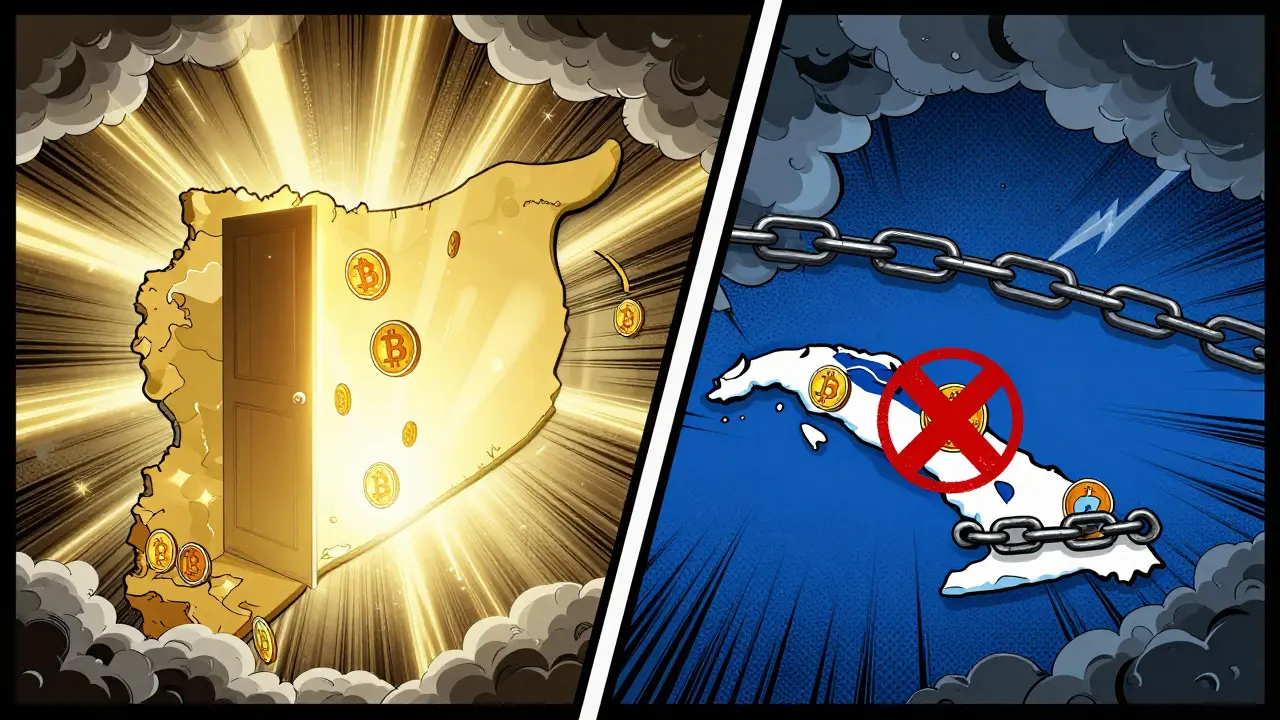
It is July 2026, and the rules of the game for international finance have changed overnight. If you are looking to send money to Syria or trade with Cuban partners, you need to know that the landscape has split into two very different realities. One country just opened its doors; the other slammed them shut. Understanding these shifts isn't just about politics-it’s about whether your transaction goes through or gets frozen.
In late June 2025, the U.S. government made a move that shocked many experts. President Trump issued Executive Order 14312, which effectively wiped out decades of broad sanctions on Syria, a nation previously under comprehensive U.S. economic embargo since 2004. At the same time, the administration doubled down on Cuba, a Caribbean island nation facing intensified U.S. sanctions via National Security Presidential Memorandum 5 (NSPM-5). For anyone using cryptocurrency or traditional banking channels, this divergence creates a complex web of opportunities and risks that you must navigate carefully.
The End of the Syrian Embargo: What Changed?
On July 1, 2025, the broad U.S. sanctions embargo on Syria officially ended. This wasn't a minor tweak; it was a structural overhaul. The Office of Foreign Assets Control (OFAC, the U.S. Treasury department responsible for administering and enforcing economic and trade sanctions) removed all Syrian financial institutions from the Specially Designated Nationals (SDN) List. This includes the Central Bank of Syria. Suddenly, U.S. banks could talk to Syrian banks again. Investments were no longer automatically prohibited. Services could be exported without needing special licenses.
Why did this happen? It aligns with a broader shift in Middle East strategy. Secretary of State Marco Rubio announced in July 2025 that the designation of al-Nusrah Front (HTS) as a foreign terrorist organization would be revoked, citing the group's dissolution and the new Syrian government's counter-terrorism commitments. This political pivot cleared the path for economic re-engagement.
However, do not mistake this for a free-for-all. While the *broad* sanctions are gone, *targeted* sanctions remain. You still cannot do business with:
- The Assad family and former officials of the previous regime.
- Individuals involved in the illicit captagon drug trade.
- Persons accused of serious human rights abuses.
- Entities threatening regional stability.
If you are sending crypto to a Syrian wallet, you assume the risk that the recipient might be linked to one of these blacklisted categories. Enhanced due diligence is no longer optional; it is your primary defense.
Cuba: The Door Slams Shut
While Syria saw relief, Cuba faced the opposite fate. Through National Security Presidential Memorandum 5 (NSPM-5), the U.S. reversed recent liberalizations and reinstated a hardline stance reminiscent of earlier years. The Cuba Assets Control Regime (CACR) remains fully intact and is now enforced with renewed aggression.
Here is the critical difference for businesses: CACR applies to non-U.S. subsidiaries of U.S. persons. This means if you are a U.S. citizen living abroad, or if your company has U.S. ownership, you are bound by these rules even if your operations are based in Europe or Asia. The reach of U.S. law here is exceptionally long.
A recent case illustrates the danger. In July 2025, Key Holding, LLC, a Delaware-based logistics firm, paid a $608,825 penalty to OFAC. Why? Their subsidiary managed freight shipments from Colombia to Cuba. Even though the violation was voluntarily disclosed and deemed non-egregious, the fine was substantial. This sends a clear message: enforcement is active, and penalties are severe.

Cryptocurrency in Syria: A Legal Gray Area
So, can you use Bitcoin or Ethereum in Syria? Technically, yes. But legally, it is murky. As of mid-2025, Syria has no specific laws that explicitly permit or forbid cryptocurrency. This absence of regulation creates a vacuum. Without specific crypto laws, any digital asset activity falls under existing Anti-Money Laundering (AML) and Combating the Financing of Terrorism (CFT) frameworks.
For users, this means accessibility has improved. Major exchanges like Binance allowed easier access to Syrian markets following the sanctions lift in July 2025. You can buy, sell, and transfer assets more freely than before. However, for institutional players, the lack of clarity is a major hurdle. Banks and fintech companies hesitate to process payments involving Syria because they fear triggering secondary sanctions or violating internal compliance policies.
This leads to "operational friction." Your payment might not be rejected outright, but it will likely face delays while compliance teams manually review the transaction. They are checking to ensure neither party is on the remaining targeted sanctions lists. This caution slows down trade and investment flows significantly.
Crypto and Cuba: High Risk, High Penalty
Using cryptocurrency in or with Cuba is extremely risky. The CACR prohibits most transactions with Cuban entities. While individuals can sometimes send remittances to family members, commercial use of crypto is largely off-limits for anyone with U.S. ties.
Because there is no specific ban on crypto *technology* itself, some might argue they can use decentralized networks to bypass sanctions. But remember the Key Holding case. If your actions facilitate trade with Cuba in violation of CACR, you are liable. Using blockchain does not make you invisible to regulators. OFAC actively monitors crypto addresses linked to sanctioned jurisdictions. If you try to use DeFi protocols to move value into Cuba, you are walking into a legal minefield.

Practical Steps for Compliance
If you are operating in these regions, here is how you protect yourself:
- Screen Every Counterparty: Use up-to-date SDN list screening tools. Do not rely on old data. The lists change frequently.
- Know Your Customer (KYC): For Syria, verify that your client is not part of the former Assad regime or involved in drug trafficking. Keep records of this verification.
- Check Subsidiary Ownership: If you are dealing with Cuba, confirm that neither you nor your partner has U.S. persons as owners or controllers. The CACR pierces corporate veils.
- Use Professional Infrastructure: Consider services like Lightspark’s Grid Switch, which uses the Lightning Network for settlement but keeps fiat exposure regulated. This helps mitigate direct crypto risk in ambiguous markets.
- Consult Legal Experts: The rules are complex. A quick chat with a sanctions attorney can save you hundreds of thousands in fines.
| Feature | Syria | Cuba |
|---|---|---|
| Broad Economic Sanctions | Lifted (EO 14312) | Intensified (NSPM-5) |
| Banking Access | Restored for U.S. institutions | Prohibited for U.S. persons/entities |
| Crypto Legal Status | Undefined/Gray Area | Restricted under CACR |
| Key Risk | Targeted sanctions (Assad family, drugs) | Secondary sanctions on subsidiaries |
| Recent Enforcement | Focus on HTS revocation | $608k fine for logistics violations |
The Bigger Picture: Global Sanctions Trends
These changes in Syria and Cuba do not exist in a vacuum. They reflect a broader trend in U.S. foreign policy. While Syria opens up, pressure on Iran and Russia continues. Iran faces maximum pressure sanctions, including recent actions against oil smuggling networks. The EU is also extending its own sanctions regimes. This fragmentation means global businesses must manage multiple, conflicting regulatory environments simultaneously.
For the crypto community, this era demands sophistication. The days of ignoring jurisdiction are over. Exchanges are tightening their KYC processes. Payment processors are adding layers of screening. If you want to participate in cross-border trade with Syria or engage with neighbors of Cuba, you must build compliance into your core operations. Ignorance is not a defense when OFAC is watching.
Can I send cryptocurrency to Syria now?
Yes, broadly speaking. Since July 1, 2025, broad U.S. sanctions on Syria have been lifted, allowing greater access to exchanges like Binance. However, you must ensure the recipient is not on the targeted sanctions list (e.g., former Assad regime officials or those involved in drug trafficking). Syria has no specific crypto laws, so standard AML/CFT rules apply.
Is it legal to use crypto for business in Cuba?
Generally, no. The Cuba Assets Control Regime (CACR) strictly limits transactions with Cuba. Using cryptocurrency to circumvent these sanctions is a violation of U.S. law, especially if you have any U.S. ties. Recent enforcement actions show that penalties are severe, even for non-U.S. subsidiaries of U.S. companies.
Who is still sanctioned in Syria?
While general sanctions are lifted, targeted sanctions remain against the Assad family, former government officials of the Assad regime, individuals involved in the illicit captagon trade, and those accused of serious human rights abuses. Always screen your counterparties against the current SDN list.
What happened to HTS in Syria?
In July 2025, the U.S. revoked the foreign terrorist organization (FTO) designation of al-Nusrah Front (HTS), citing its dissolution and the new Syrian government's counter-terrorism efforts. This political shift facilitated the lifting of broader economic sanctions.
How does NSPM-5 affect Cuba?
National Security Presidential Memorandum 5 (NSPM-5) strengthened U.S. sanctions on Cuba, reversing previous relaxations. It reinforces strict enforcement of travel and economic restrictions, signaling a return to a hardline approach under the current administration.
 Cryptocurrency Guides