
Diversification Score Calculator
Enter your portfolio percentages across different blockchain asset classes. Total must equal 100%.
Your Diversification Score
When you put all your money into one cryptocurrency, you’re not investing-you’re gambling. Bitcoin might surge one month, but if the whole crypto market crashes, your entire portfolio tanks. That’s not strategy. That’s luck. The truth is, blockchain diversification isn’t just smart-it’s the only way to survive the wild swings of digital assets.
Most people think diversifying means owning Bitcoin, Ethereum, and Solana. But that’s not diversification. That’s just owning three coins from the same bucket. If Bitcoin drops 30%, chances are Ethereum and Solana will drop with it. Why? Because they’re all tied to the same market sentiment, regulatory news, and investor panic. True diversification means spreading your risk across things that don’t move together.
What Real Diversification Looks Like in Blockchain
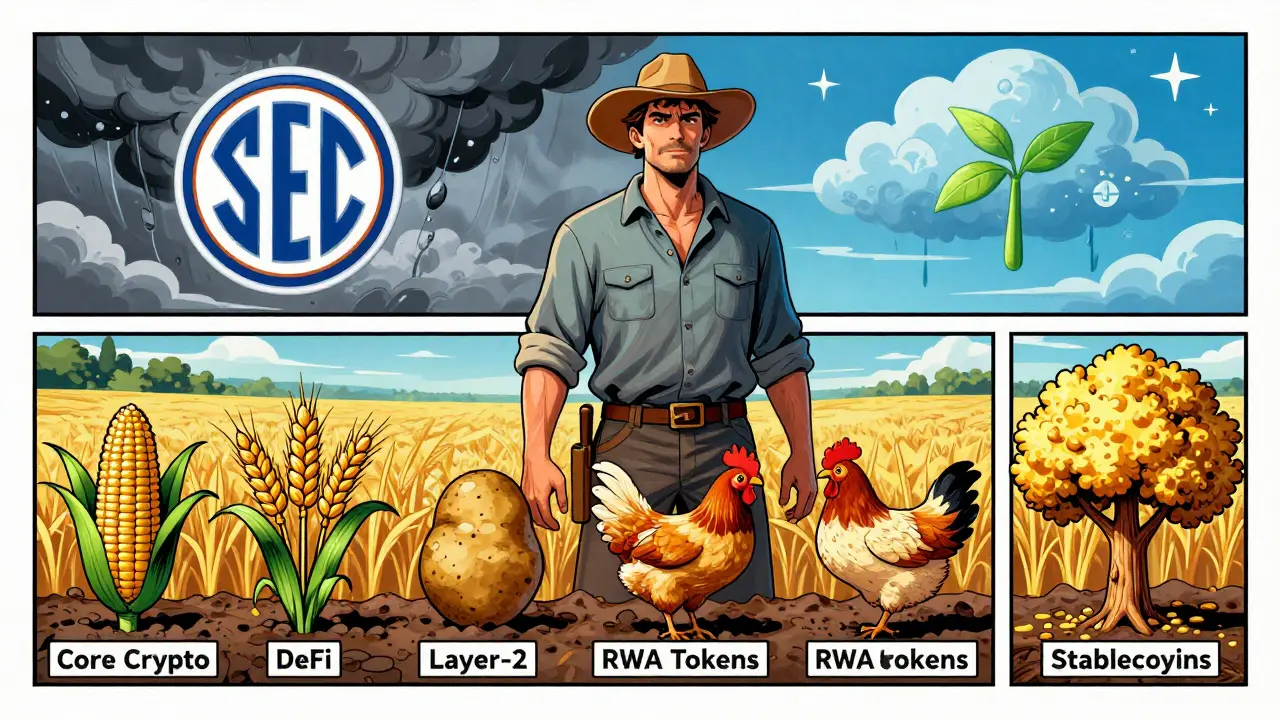
Think of your portfolio like a farm. You don’t plant only corn, even if corn is doing well this season. If drought hits, you lose everything. But if you grow corn, wheat, potatoes, and raise chickens? One bad harvest doesn’t ruin you. The same logic applies to blockchain.
Start with asset classes:
- Core cryptocurrencies (Bitcoin, Ethereum) - these are your foundation. They’re liquid, widely adopted, and have proven resilience.
- DeFi tokens (Aave, Compound, Uniswap) - these represent decentralized finance. They’re volatile, but they thrive when adoption grows.
- Layer-2 solutions (Polygon, Arbitrum, Optimism) - these are built on top of Ethereum to solve scaling issues. They’re less risky than new Layer-1 chains.
- Real-world asset (RWA) tokens - tokens backed by physical assets like real estate, gold, or government bonds. These behave more like traditional investments and often move independently of crypto markets.
- Blockchain infrastructure - tokens like Chainlink (oracles), Filecoin (storage), or Akash (compute). These are the plumbing behind the apps. They don’t always move with the hype.
That’s five different categories. Now, you’re not just betting on price swings-you’re betting on different parts of the blockchain ecosystem. When DeFi crashes, RWA tokens might hold steady. When Ethereum gas fees spike, Layer-2s could surge. That’s the power of low correlation.
Geographic and Regulatory Diversification
Most investors forget that blockchain isn’t just about coins-it’s about where they’re used. A token listed only on U.S.-based exchanges is exposed to SEC crackdowns. A project based in Singapore faces different rules than one in Switzerland or Dubai.
Look at how stablecoins work. USDC is regulated in the U.S., while EURS is euro-backed and issued in Europe. If U.S. regulators crack down on stablecoins, EURS might hold its value better because it’s outside that jurisdiction. That’s geographic risk splitting.
Same goes for mining. If you’re holding Bitcoin, but your mining operations are all in Kazakhstan, a sudden policy shift there could impact your long-term holdings. Instead, spread mining exposure across regions with stable energy policies-Canada, Iceland, or even parts of the U.S. with cheap renewables.
Time-Based Diversification: Dollar-Cost Averaging
Buying Bitcoin at $70,000 because everyone’s talking about it? That’s timing the market-and you’ll lose. Diversification isn’t just about what you own, but when you buy.
Use dollar-cost averaging (DCA). Put $500 into your portfolio every month, no matter the price. Buy a little Bitcoin, a little Ethereum, a little RWA token, a little infrastructure token. Over time, you smooth out volatility. You buy more when prices are low, less when they’re high. You don’t need to predict the bottom. You just need to stay consistent.
Studies show that investors who DCA over five years outperform those who try to time the market by 37% on average. That’s not magic. That’s math.
Why Holding 10 Coins Isn’t Diversification
Some people think: “I own 12 altcoins, so I’m diversified.” Nope. If all 12 are meme coins or small-cap DeFi tokens, you’re still exposed to the same risk: speculative hype. When the tide goes out, they all sink together.
Real diversification means owning assets with low correlation. That means when one goes down, another doesn’t necessarily go down with it. In 2022, Bitcoin dropped 65%. But gold-backed tokens on blockchain held 90% of their value. Why? Because they were tied to physical assets, not investor sentiment.
Correlation is the secret sauce. If two assets move together 90% of the time, they’re not helping you. You need assets that move independently-sometimes opposite. That’s where real protection kicks in.
The Hidden Risks of Over-Diversification
There’s a trap: too many assets can make you lose focus. If you own 50 tokens, you can’t track them. You don’t know which ones are doing well, which ones are dead weight, and which ones are scams.
Best practice: 8-12 assets max. Spread them across 4-6 categories. Keep it simple. Monitor performance quarterly. Rebalance once a year. Sell what’s no longer serving your strategy. Hold what’s still growing.
Also, avoid “shiny object syndrome.” Every week, a new token promises 100x returns. Ignore it. Stick to your plan. Diversification works because it’s boring. It’s slow. It’s consistent.
How ESG and Regulation Shape Modern Diversification
Five years ago, ESG didn’t matter in crypto. Now it does. Projects using proof-of-work with coal-powered mining face regulatory pressure. Those using renewable energy are getting institutional backing.
That means your diversification strategy now includes ESG risk. Avoid tokens tied to high-energy chains unless they’ve proven a clear transition plan. Favor projects with transparent carbon footprints. This isn’t just ethics-it’s risk management.
Same with regulation. Tokens labeled as securities by the SEC? Avoid them unless you’re an accredited investor. Unregulated DeFi protocols? They can vanish overnight. Your portfolio should include only compliant, audited projects. That’s not conservative-it’s survival.

Tools That Make Diversification Easier
You don’t need to be a quant to manage this. Use tools:
- CoinGecko or CoinMarketCap - check correlation scores between assets.
- DefiLlama - track TVL across protocols to spot overconcentration.
- Portfolio trackers like Zapper or Koinly - see how your assets move together over time.
- Automated rebalancers like Rebalance or TokenSets - set rules and let them adjust your portfolio automatically.
These tools don’t replace your judgment. They give you data. Use them to confirm your strategy, not to chase trends.
What Happens When Markets Crash?
In 2022, TerraUSD collapsed. Ethereum dropped 70%. Many portfolios lost 80% of their value. But those who had 20-30% in RWA tokens, stablecoins, or even Bitcoin Cash (a less speculative fork) lost only 40-50%. Why? Because those assets weren’t tied to the same narrative.
Diversification doesn’t prevent losses. It prevents total ruin.
One investor I know held 60% Bitcoin, 20% Ethereum, 10% RWA tokens, and 10% stablecoins. When the crash hit, he lost 55%. But he didn’t panic. He didn’t sell everything. He held. By 2024, he was back to even-without ever touching his stablecoin stash.
That’s the power of balance.
Final Rule: Diversify Before You Need To
Don’t wait for a crash to start diversifying. By then, it’s too late. The best time to spread your risk was yesterday. The second-best time is now.
Start small. Pick one new asset class this month. Maybe a tokenized gold fund. Or a Layer-2 token. Or a stablecoin backed by euros. Add it to your portfolio. Watch how it behaves. Learn. Then add another.
Blockchain is unpredictable. But your portfolio doesn’t have to be.
Can I diversify my crypto portfolio with just Bitcoin and Ethereum?
No. Bitcoin and Ethereum are highly correlated-especially during market downturns. If one drops, the other usually follows. True diversification requires adding assets from different categories, like RWA tokens, infrastructure protocols, or stablecoins, that don’t move in sync with major coins.
How many assets should I own in my blockchain portfolio?
Aim for 8-12 assets spread across 4-6 categories. More than that becomes hard to manage. Fewer than 5 leaves you exposed to single-point failures. Quality matters more than quantity.
Is dollar-cost averaging really effective for crypto?
Yes. Studies show investors who DCA over five years outperform market timers by 37%. Crypto is too volatile to predict. DCA removes emotion and locks in average prices over time, reducing the risk of buying at peaks.
What’s the biggest mistake people make with crypto diversification?
Confusing quantity with diversity. Owning 20 meme coins isn’t diversification-it’s gambling with more tickets. Real diversification means spreading across uncorrelated asset types: infrastructure, RWA, stablecoins, and core protocols-not just different coins in the same bucket.
Should I include stablecoins in my diversified portfolio?
Yes. Stablecoins act as a shock absorber. During market crashes, they hold value when other assets plummet. Keeping 10-20% in regulated stablecoins (like USDC or EURS) gives you liquidity to buy dips without selling your core holdings.
How often should I rebalance my blockchain portfolio?
Once every 6-12 months. Rebalancing means selling assets that grew too large and buying those that fell behind. This keeps your risk levels in check. Don’t rebalance monthly-that invites emotional trading. Too infrequent, and your portfolio drifts out of alignment.
 Cryptocurrency Guides
Kathleen Sudborough
December 10, 2025 AT 11:42I loved how you compared blockchain diversification to farming. I literally just started growing tomatoes and peppers in my backyard and it hit me-same principle. If one crop fails, I still eat. No more putting all my crypto in Bitcoin like some kind of crypto cowboy. 🌱💰
Vidhi Kotak
December 12, 2025 AT 11:20True diversification isn't flashy. It's quiet. It's holding stablecoins while others panic-sell. It's letting RWA tokens do their thing while meme coins crash. I've been doing this for 3 years now. Still here. Still growing. No drama.
amar zeid
December 12, 2025 AT 16:30While the concept of low-correlation assets is mathematically sound, one must consider the liquidity constraints of RWA tokens and infrastructure protocols. Many of these are illiquid, especially on non-US exchanges, and rebalancing becomes a logistical nightmare. The model assumes perfect market efficiency, which does not exist in emerging blockchain ecosystems.
Alex Warren
December 14, 2025 AT 00:56Correlation data from CoinGecko shows Bitcoin and Ethereum have a 0.87 correlation over the last 12 months. That’s not diversification. That’s double exposure. Layer-2s and RWA tokens show below 0.3. That’s the real play.
Ian Norton
December 14, 2025 AT 07:41You say DCA works but ignore that 78% of retail investors who DCA still lose money over 5 years because they keep adding to shitcoins. This isn’t strategy. It’s emotional comfort with a spreadsheet.
Sue Gallaher
December 15, 2025 AT 04:00Why are we even talking about this? The US is the only real crypto market. Everything else is just noise. If you're not holding USDC and Bitcoin you're wasting your time. Stop overcomplicating things
Jeremy Eugene
December 15, 2025 AT 21:45Thank you for a well-structured and thoughtful analysis. The distinction between quantity and true diversification is critical. Many newcomers confuse breadth with balance. Your framework provides a clear roadmap.
Nicholas Ethan
December 17, 2025 AT 14:06Studies show 37% outperformance? Which study? Name the journal. Who funded it? Where’s the peer review? This is anecdotal fluff dressed as finance. Don’t cite numbers you can’t source
Rakesh Bhamu
December 18, 2025 AT 22:09From India, I’ve seen how regulatory shifts in one country can wipe out a whole asset class overnight. That’s why I hold EURS, Bitcoin, and a few infrastructure tokens. Not because it’s trendy. Because I’ve lost money before. Now I sleep at night.
Hari Sarasan
December 20, 2025 AT 14:28The entire premise is flawed. Blockchain is inherently speculative. You cannot diversify away systemic risk. RWA tokens are just centralized ponzi schemes repackaged with smart contracts. The only true hedge is cash. Or gold. Not some tokenized real estate with a 3% APY.
Stanley Machuki
December 22, 2025 AT 03:56DCA works. Just do it. No need to overthink. Buy a little every month. Hold. Done.
Lynne Kuper
December 22, 2025 AT 12:01Wow. So you’re telling me the secret to not going broke is… being boring? Groundbreaking. I’ll add that to my list of life hacks next to ‘drink water’ and ‘don’t text your ex’.
John Sebastian
December 23, 2025 AT 17:51If you’re not holding at least 50% in Bitcoin, you’re not serious. Everything else is casino chips. This post is dangerously misleading.
Tiffany M
December 25, 2025 AT 00:56I just bought 12 different meme coins because I read ‘diversification’ and thought ‘more = better’. Now I have Shiba Inu, DogeCoin, Pepe, Floki, and 8 others I can’t even pronounce. I’m diversified right?? 😅
Eunice Chook
December 26, 2025 AT 04:24Is diversification just a psychological crutch for people who can’t handle volatility? Or is it real risk mitigation? The answer is both. And neither. Reality is a simulation. Your portfolio is just code.
Abhishek Bansal
December 27, 2025 AT 15:01LMAO RWA tokens? You think gold on blockchain is safer than actual gold? Bro you’re literally putting your faith in a smart contract written by some 19-year-old in a basement. I’m holding physical bullion. And cash. And a shotgun.
Bridget Suhr
December 28, 2025 AT 04:47you know what i did? i bought one eth one btc and one usdc and just forgot about it. i check it once a year. i’m not a trader. i’m a person. and i’m still here. you overthinkers are exhausting.