
Remember when you could mine Bitcoin on your laptop from your bedroom? Those days are long gone. In 2025, cryptocurrency mining is no longer a hobby for the casual tech enthusiast; it is an industrial-scale operation dominated by efficiency, cheap energy, and specialized hardware. If you are wondering whether it is still worth starting a mining rig this year, the short answer is: it depends entirely on your access to electricity.
The landscape has shifted dramatically since the April 2024 halving, which cut block rewards in half. While some miners have walked away, others with the right setup are seeing returns that rival traditional investments. This guide cuts through the hype to show you exactly what drives profitability in 2025, how much it costs to enter the game, and why most people lose money while a few make theirs.
The Post-Halving Reality: Why Margins Are Tighter
To understand 2025 mining economics, you first need to grasp the impact of the fourth Bitcoin Halving. Occurring in April 2024, this event reduced the reward miners receive per block from 6.25 BTC to 3.125 BTC. Overnight, revenue for every miner on the network was cut by 50%, regardless of their hash rate.
This forced a massive consolidation. Miners who were running older, inefficient machines simply couldn't cover their electricity bills and shut down. The result? The network became more secure but also more competitive. By late 2025, the global Bitcoin Hash Rate surged to approximately 800 exahashes per second (EH/s). This means that for every new miner entering the space, they are competing against a network that is exponentially more powerful than it was just two years ago.
Key Takeaway: You cannot rely on "luck" or price spikes alone anymore. Profitability in 2025 is a math problem involving three variables: hardware efficiency, electricity cost, and network difficulty.
Hardware Wars: The New Kings of SHA-256
If you are serious about mining Bitcoin today, you need Application-Specific Integrated Circuit (ASIC) miners. Graphics cards (GPUs) are useless for Bitcoin and only viable for specific altcoins like Ethereum Classic, which holds a smaller market share.
In 2025, the market is dominated by next-generation ASICs from major manufacturers like Bitmain and MicroBT. The standout models include the Bitmain S21 XP and the MicroBT Whatsminer M60 series. These machines are engineering marvels designed to squeeze out every last terahash per watt.
| Model | Hash Rate | Power Consumption | Est. Daily Revenue* |
|---|---|---|---|
| Bitmain S21 XP | 1.16 PH/s | 11,020 W | $17.95 |
| MicroBT M60 | 260 TH/s | 5,200 W | $5.94 - $12.00 |
| Innosilicon A12 XP (Scrypt) | 35 GH/s | 5,775 W | $11.28 |
*Revenue estimates based on average BTC prices and difficulty levels as of late 2025. Actual results vary daily.
The good news for new entrants is that hardware costs have plummeted. In 2022, you paid around $80 per terahash (TH). By 2025, that price dropped to approximately $16 per TH. This makes entry cheaper, but it also means more competition because more people can afford to buy these efficient machines.
The Electricity Trap: Your Biggest Expense
Let’s be blunt: if you pay residential electricity rates, you will likely lose money. Electricity accounts for 60-70% of total mining expenses. In 2025, commercial mining operations aim for rates between $0.03 and $0.05 per kilowatt-hour (kWh). Residential users in places like Auckland, New Zealand, or California often pay $0.12 to $0.25 per kWh.
Consider this scenario: A Bitmain S21 XP consumes roughly 11 kW of power. At $0.05/kWh, your daily electricity bill is about $13.20. If your machine generates $17.95 in revenue, you profit $4.75 per day. That sounds decent until you realize you need to recoup the initial $16,000+ hardware cost. It would take over 90 days just to break even on hardware, not counting cooling, internet, or maintenance.
Now, look at the same machine at $0.15/kWh (typical residential rate). Your daily electricity cost jumps to $39.60. You are now losing $21.65 every single day. The machine becomes a heater that burns cash.
Pro Tip: Before buying any hardware, call your local utility provider. Ask about industrial rates or surplus energy programs. Many successful miners in 2025 are located near hydroelectric dams in Canada or Iceland, where they can tap into renewable energy at rock-bottom prices.
Alternative Coins: Litecoin and Scrypt Mining
Not everyone wants to bet everything on Bitcoin. Some miners diversify into Litecoin, which uses the Scrypt algorithm. Litecoin mining is less competitive than Bitcoin but also offers lower absolute rewards. However, many ASIC miners allow you to "solo mine" Litecoin or use merged mining strategies.
In 2025, Litecoin accounts for about 15% of total mining revenue. Machines like the Innosilicon A12 XP are popular here. They generate steady income, but the margins are thinner. For example, a high-end Scrypt miner might bring in $11.28 daily, but its power draw is significant relative to its output compared to top-tier SHA-256 miners.
Ethereum Classic (EtHash) remains an option for those with GPU rigs, but it is a niche market representing only 8% of revenue. Unless you already own GPUs for other purposes, building a new rig specifically for EtHash is rarely profitable in 2025 due to the dominance of ASICs in the broader market.
Regulatory Landmines and Location Strategy
Where you live matters just as much as what you mine. Regulatory environments in 2025 are a patchwork quilt of incentives and bans.
- United States: States like Texas offer tax incentives and grid support for miners, making them hotspots. Conversely, New York has imposed moratoriums on fossil-fuel-based mining.
- Canada: Known for hydro-power, Canada continues to attract sustainable mining operations with favorable policies.
- South America & Russia: These regions have seen stricter regulations tighten throughout 2024 and 2025, increasing compliance risks for operators.
- China: The ban remains strict, forcing miners to relocate globally, which has contributed to the rise in hash rates in North America and Central Asia.
Ignoring local regulations can lead to fines or forced shutdowns. Always check if your region requires environmental permits for high-energy consumption devices. In some areas, running multiple ASICs may trigger fire code violations due to heat output.
Realistic ROI: How Long Until You Make Money?
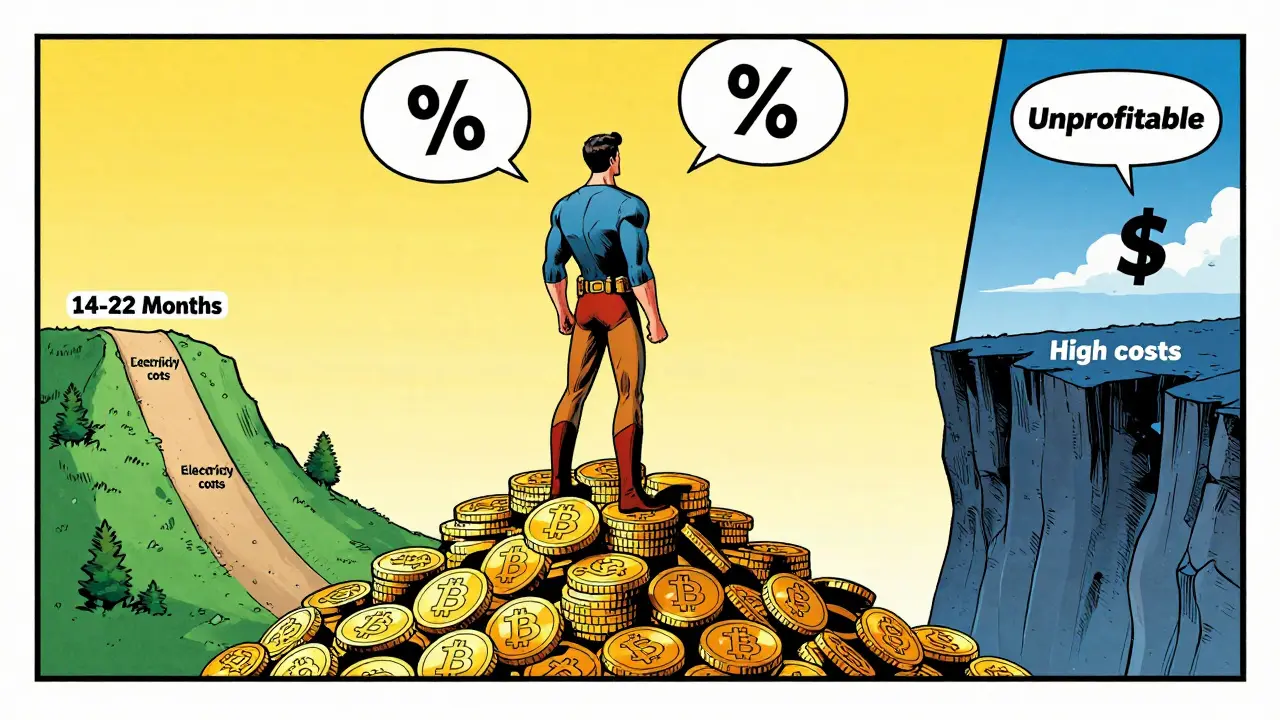
So, when do you see a return on investment (ROI)? Based on data from late 2025, the break-even period for a standard setup ranges from 14 to 22 months.
Here is the breakdown: - Best Case ($0.05/kWh): Break-even in ~14 months. - Average Case ($0.08/kWh): Break-even in ~18 months. - Poor Case ($0.12+/kWh): Likely never breaks even without a massive Bitcoin price surge.
These calculations assume conservative growth: a 50% annual increase in Bitcoin price and a 30% annual increase in mining difficulty. Historical averages show Bitcoin growing 43% annually and difficulty rising 37%. If Bitcoin enters a bear market and drops below $50,000, expect 40% of miners to shut down, leaving the remaining ones with higher rewards but lower total revenue.
Don’t forget hidden costs. About 63% of miners report unexpected hardware failures adding 15-20% to operational costs. Fans burn out, control boards fail, and units need replacement. Factor in a 15% annual failure rate for your ASIC fleet.
Should You Start Mining in 2025?
Mining is no longer a passive income stream for the average person. It is a business venture requiring capital, technical knowledge, and strategic planning. If you have access to sub-$0.06/kWh electricity and can invest $5,000 to $10,000 in modern hardware, it can be a profitable hedge against inflation and a way to accumulate Bitcoin directly.
However, if you are paying standard residential rates, consider buying Bitcoin directly instead. The fees are lower, there is no hardware maintenance, and you avoid the risk of regulatory crackdowns. For those determined to mine, focus on efficiency, join a reputable mining pool to stabilize earnings, and monitor your profitability metrics weekly using tools like the Blockware Marketplace Calculator.
Can I mine Bitcoin with my computer in 2025?
No. Standard CPUs and GPUs are millions of times less efficient than ASIC miners. You will spend more on electricity than you earn in Bitcoin. Mining Bitcoin now requires specialized ASIC hardware like the Bitmain S21 or MicroBT M60.
How much does it cost to start a crypto mining farm?
For a small individual setup with one or two ASICs, expect to spend $5,000 to $10,000 including hardware and basic hosting. Large-scale professional farms require $500,000 or more, covering industrial cooling, legal compliance, and bulk hardware purchases.
What is the best electricity rate for profitable mining?
To remain consistently profitable in 2025, you need electricity costs below $0.06 per kWh. Ideally, aim for $0.03 to $0.05/kWh, which is typical for commercial contracts near hydroelectric or renewable energy sources.
Is Litecoin mining more profitable than Bitcoin?
Generally, no. Bitcoin mining commands the largest market share and highest absolute revenues. However, Litecoin mining (using Scrypt algorithms) can be less volatile and offers a diversified income stream, especially if you use merged mining strategies with certain ASICs.
How long does it take to break even on mining hardware?
With current difficulty levels and hardware costs, break-even periods range from 14 to 22 months. This assumes stable Bitcoin prices and low electricity costs. Higher electricity rates or a drop in Bitcoin price can extend this period indefinitely.
 Cryptocurrency Guides