

Imagine waking up to find your paycheck has lost half its value overnight. For millions of Venezuelans, this isn't a hypothetical nightmare-it’s daily life. With inflation soaring to 229% annually as of May 2024, the bolívar has become nearly useless for saving or even buying basic groceries. In this chaos, cryptocurrency didn’t arrive as a speculative investment trend; it arrived as a lifeline. According to Chainalysis’ 2024 Crypto Adoption Index, Venezuela ranked 13th globally for crypto adoption, with usage jumping 110% year-over-year. This surge wasn’t driven by tech enthusiasts chasing gains, but by ordinary people desperate to protect their livelihoods from a collapsing currency.
The story of crypto in Venezuela is one of necessity, not ideology. When traditional banking systems falter under sanctions and hyperinflation, digital assets offer an alternative path. But how exactly are citizens using these tools? What are the real-world barriers they face? And can cryptocurrencies truly sustain an economy in crisis? Let’s break down the reality on the ground.
Why Cryptocurrency Became Essential
To understand why Bitcoin and stablecoins took root in Venezuela, you have to look at the failure of the traditional financial system. The Venezuelan Finance Observatory (OVF) reported that the bolívar lost over 70% of its value between October 2023 and June 2024 alone. During this period, the government stopped defending the currency, leading to rapid devaluation. Economist Aarón Olmos noted in August 2025 that Venezuelans turned to crypto due to "inflation, low wages, foreign currency shortages, and difficulty opening bank accounts."
It’s not just about holding wealth. It’s about accessing it. U.S. sanctions imposed since 2017 have severely restricted access to international banking networks like SWIFT. This means sending money abroad-or receiving it from family members overseas-became incredibly difficult through traditional channels. Enter cryptocurrency. CoinTelegraph reported in March 2025 that crypto remittances accounted for 9% of the $5.4 billion total remittance flow in 2023, totaling approximately $461 million. For many families, this digital pipeline is the difference between eating and going hungry.
| Feature | Traditional Banking | Cryptocurrency (P2P/Stablecoins) |
|---|---|---|
| Accessibility | Limited by sanctions and account closures | Available via smartphone and internet connection |
| Transaction Speed | Days to weeks for cross-border transfers | Minutes for USDT/Tron; Hours for Bitcoin |
| Inflation Protection | Poor (Bolívar loses value rapidly) | High (USDT pegged to USD; BTC store of value) |
| Regulatory Risk | Government control and capital controls | Sanctions risk and platform dependency |
The Rise of Stablecoins: Why USDT Dominates
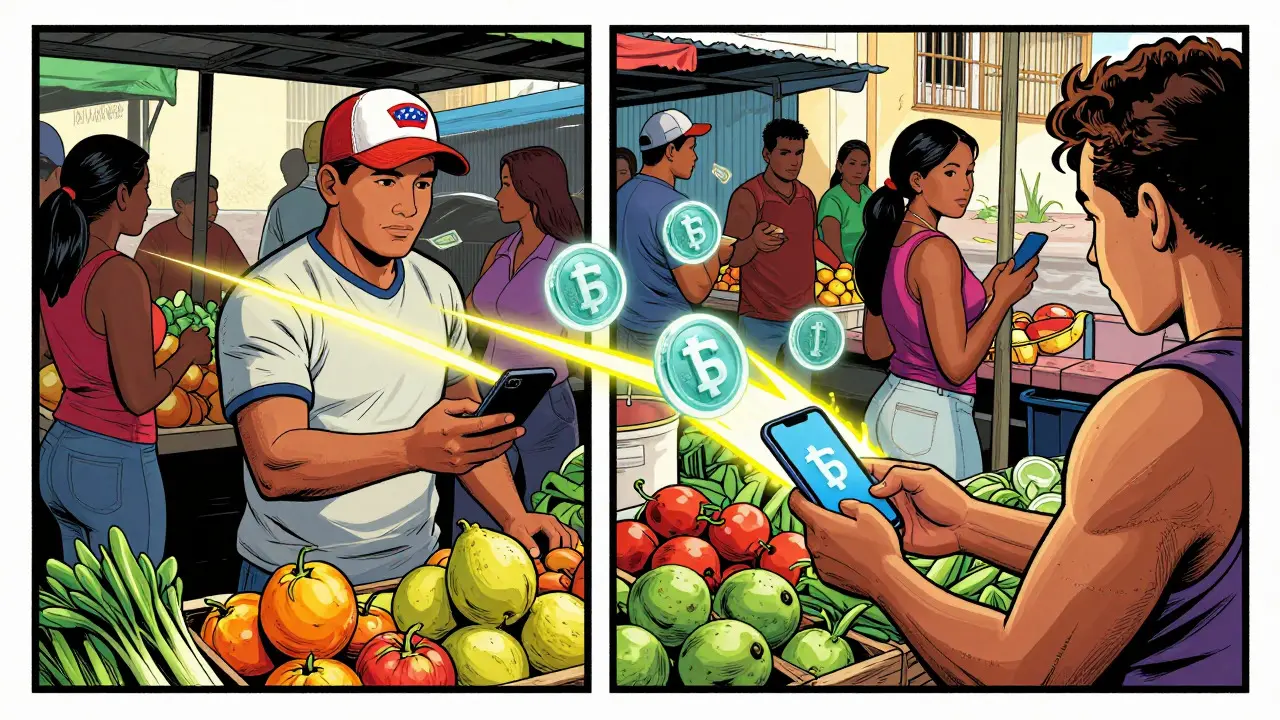
While Bitcoin gets the headlines, Tether (USDT) is the workhorse of Venezuela’s informal economy. Often referred to locally as "Binance dollars," USDT provides the stability of the U.S. dollar without the volatility of Bitcoin. In a market where prices change hourly, merchants and consumers need a predictable unit of account. CoinGape’s April 2025 analysis highlighted that USDT dominates daily transactions because it maintains near-perfect parity with the dollar, unlike the bolívar which fluctuates wildly.
Chainalysis data shows that Tether Limited controls 76% of Venezuela’s stablecoin market. This dominance creates both convenience and risk. On one hand, high liquidity makes it easy to buy and sell. On the other hand, reliance on a centralized issuer means users are vulnerable if Tether faces regulatory issues or freezes assets. Despite this, for a street vendor in Caracas selling fruit, USDT is simply the most reliable tool available. As Carlos, a resident quoted in CoinCentral’s May 2025 feature, explained: "I use USDT for everything-buying food, paying rent. It is much more reliable than the bolivar."
Technical efficiency also plays a role. Bitcoin transactions can take 10-60 minutes to confirm during peak times, which is too slow for buying coffee. USDT transactions on the Tron network, however, typically confirm in under two minutes. This speed is crucial for daily commerce. Markets.com’s August 2025 survey found that over 65% of merchants in Caracas now accept cryptocurrency for routine transactions, largely preferring stablecoins for this reason.
Infrastructure and Barriers: The Digital Divide
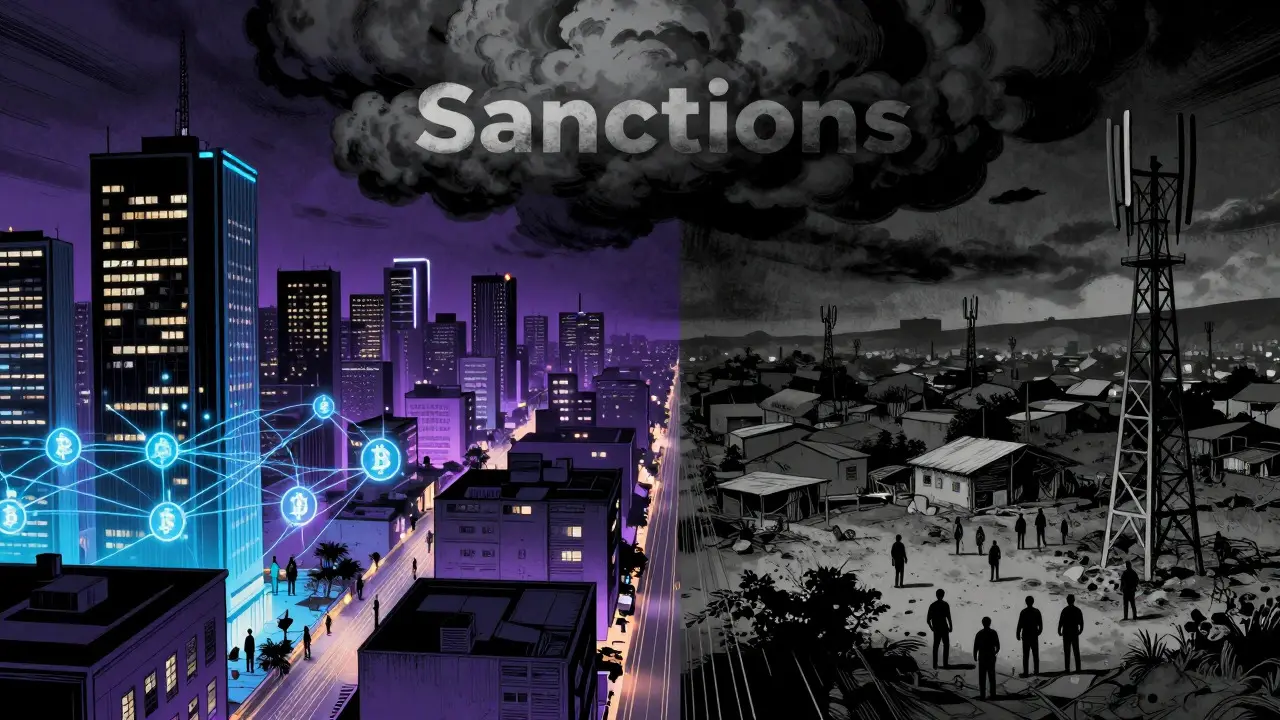
Adopting crypto sounds simple in theory: download an app, connect to Wi-Fi, and trade. In practice, Venezuela’s infrastructure poses significant hurdles. Internet connectivity remains a major bottleneck. Venezuela ranks 153rd globally for internet speed, averaging only 14.79 Mbps download speed in Q2 2025 according to Ookla’s Speedtest Global Index. While 68% of the population has smartphone access, only 45% have reliable internet connectivity, per ITU data from February 2025.
This digital divide affects who can participate in the crypto economy. Urban centers like Caracas and Valencia see high adoption rates, but rural areas lag behind. Without consistent internet, maintaining a digital wallet or executing a P2P trade becomes nearly impossible. Furthermore, U.S. sanctions complicate matters. Binance, which holds a 63% market share in P2P trading volume, restricts services for accounts linked to sanctioned banks. FastBull’s March 2025 reporting documented that approximately 18% of attempted transactions are blocked due to these restrictions.
Community-driven solutions have emerged to fill these gaps. YouTube channels like 'Cripto Para Todos' (127,000 subscribers) provide free education on how to navigate wallets and exchanges. Universities, including Universidad Central de Venezuela, launched mandatory cryptocurrency courses in January 2025 to help students understand this new financial landscape. These efforts lower the learning curve, which University of Carabobo’s March 2025 study showed takes most new users just 2-3 weeks to master.
Regulatory Uncertainty and Government Stance
The Venezuelan government’s relationship with cryptocurrency is contradictory. In 2018, it launched its own state-backed token, the Petro, intended to bypass sanctions and stabilize the economy. However, the Petro collapsed in 2024 following corruption allegations tied to oil-linked transactions. Meanwhile, the government simultaneously cracked down on private crypto activities. The National Superintendence of Crypto Assets and Related Activities (SUNACRIP), established to regulate the sector, was effectively shut down in 2023, creating a vacuum of oversight.
This inconsistency leaves users in a gray area. The 2020 Crypto Assets Law provides minimal practical guidance, and the Central Bank of Venezuela’s 2024 report acknowledged crypto’s role without offering a formal framework. Essentially, the state tolerates crypto as a parallel system while retaining the power to disrupt it. University of Zulia Professor Carlos Hernández warned in April 2025 that "crypto adoption in Venezuela is a symptom of economic failure, not a solution." He argued that while crypto helps individuals survive, it does nothing to fix systemic issues like production shortages or supply chain disruptions.
Despite the lack of clear regulation, the market thrives. Private sector cryptocurrency transactions reached $119 million in July 2025, according to AInvest’s analysis of SUNACRIP data. This volume suggests that grassroots demand outweighs top-down control. However, the absence of legal protections means consumers bear all the risk. In Q1 2025, the Venezuelan Finance Observatory documented 1,247 consumer complaints related to crypto transactions, primarily concerning price volatility during conversion and platform technical failures.
Real-World Impact: Stories from the Ground
Behind the statistics are individual stories of resilience. Victor Sousa, a Caracas resident interviewed by Financial Times, described purchasing phone accessories with USDT: "There's lots of places accepting it now... The plan is to one day have my savings in crypto." For him, crypto isn't just a payment method; it's a savings vehicle in a country where saving in bolívares is futile.
Reddit discussions in r/BitcoinVenezuela (42,700 members as of July 2025) reveal similar themes. User 'CryptoSurvivorVE' posted in June 2025: "Without USDT, I couldn't feed my family after my bolivar salary became worthless overnight." These testimonials highlight the emotional weight of financial instability and the relief crypto provides. Yet, negative experiences exist. Thirty-seven percent of respondents in Markets.com’s August 2025 survey reported connectivity issues affecting transactions, and 22% cited difficulties converting crypto to physical goods during network outages.
Businesses are also adapting. Enterprise adoption expanded significantly, with 28% of surveyed medium-to-large Venezuelan businesses accepting crypto payments in 2025, compared to just 9% in 2023. This shift indicates that crypto is moving beyond peer-to-peer survival tactics into broader commercial integration. However, spread costs remain high. Chainalysis documented that average spread costs during on-ramp/off-ramp processes hit 3.7% during high-demand periods, eating into profits for small traders.
Future Outlook: Sustainability and Risks
Will this model last? Short-term projections suggest crypto will remain essential until bolívar inflation falls below 50% annually-a threshold unlikely before 2027, according to IMF economists in their April 2025 outlook. Long-term viability faces greater challenges. University of Caracas economist Luisa Mendoza warned in May 2025 that "centralized stablecoin risks and U.S. sanctions complicate long-term viability." If Tether were to freeze Venezuelan assets, the impact would be catastrophic for those relying on USDT for daily needs.
However, there are potential pathways forward. Venezuela has participated in BRICS cross-border payment initiative discussions since February 2025, exploring alternative infrastructure less vulnerable to U.S. sanctions. Integration with regional systems could provide more stability. Additionally, the rise of decentralized exchanges like Bisq (holding 8% market share) offers a hedge against centralized platform risks. Bisq operates without a central server, making it harder to sanction or shut down.
The most optimistic scenario, per Chainalysis’ 2025 Emerging Markets Crypto Report, involves crypto transitioning from a survival mechanism to a formalized parallel payment system. In this future, crypto integrates with any stabilized national currency, providing seamless interoperability. The pessimistic view, held by 43% of surveyed economists in the Venezuelan Finance Observatory’s June 2025 poll, suggests adoption will decline rapidly if the bolívar achieves moderate stability. In that case, users might abandon crypto, leaving them exposed to centralized risks without the immediate necessity driving current adoption.
Is Bitcoin legal in Venezuela?
Yes, cryptocurrency is legal in Venezuela under the 2020 Crypto Assets Law. However, the regulatory framework is vague, and enforcement is inconsistent. While the government launched its own failed token (Petro), it generally tolerates private crypto usage as a parallel financial system, though sanctions and occasional crackdowns create uncertainty.
Why do Venezuelans prefer USDT over Bitcoin?
Venezuelans prefer USDT (Tether) because it is pegged to the U.S. dollar, offering stability against hyperinflation. Bitcoin’s volatility makes it risky for daily purchases. Additionally, USDT transactions on networks like Tron are faster (under 2 minutes) and cheaper than Bitcoin’s 10-60 minute confirmation times, making it more practical for buying groceries or paying rent.
How do sanctions affect crypto usage in Venezuela?
U.S. sanctions restrict access to traditional banking, forcing citizens toward crypto. However, sanctions also limit crypto services. Platforms like Binance block accounts linked to sanctioned banks, causing roughly 18% of transactions to fail. Users must carefully navigate these restrictions to avoid frozen funds, often relying on peer-to-peer (P2P) markets to bypass direct bank integrations.
What are the biggest risks of using crypto in Venezuela?
Key risks include reliance on centralized issuers like Tether (which could freeze assets), poor internet connectivity (affecting transaction success), and technical errors. Additionally, high spread costs (averaging 3.7%) reduce purchasing power. There is also no consumer protection if platforms fail or scams occur, given the weak regulatory environment.
Can crypto solve Venezuela's economic crisis?
No. Experts agree that crypto is a survival tool, not a cure. It helps individuals preserve value and receive remittances but does not address root causes like production shortages, corruption, or lack of monetary policy reform. As IMF Advisor David Lipton stated, "digital assets provide tactical relief but cannot substitute for sound monetary policy."
 Cryptocurrency Guides