

Imagine walking into a bank, opening your phone, and proving who you are in three seconds without handing over a physical ID card or typing a password. No forms. No waiting rooms. Just a cryptographic handshake between your device and the bank’s server. This isn’t sci-fi; it’s the current trajectory of digital identity on blockchain technology. While we’ve spent decades trusting central authorities-governments, banks, tech giants-to hold our personal data, the future belongs to systems where you hold the keys. Literally.
If you’re wondering why this shift is happening now, look at the numbers. According to Verizon’s 2022 Data Breach Investigations Report, 81% of data breaches stem from weak or compromised login credentials. We are drowning in passwords, yet we remain insecure. Traditional identity management relies on centralized databases that act as honeypots for hackers. If one company gets breached, your email and password combo might be exposed across dozens of other sites. Blockchain-based identity flips this model. It moves verification from "trust me" to "prove it." By using cryptographic proofs instead of stored records, you share only what’s necessary, when it’s necessary, without exposing your entire life history to every service provider.
The Shift From Centralized Trust to Self-Sovereignty
To understand where we’re going, you have to see where we’ve been stuck. For years, the dominant model was centralized identity. You created an account with Facebook, Google, or a government agency. They stored your name, date of birth, and address. Every time you logged into a new app, you either reused those credentials (risky) or created new ones (annoying). The problem? You never actually owned that data. You had permission to use it, but the platform held the power.
Self-sovereign identity (SSI) changes the power dynamic. In this model, you control your own decentralized identifier (DID), which acts like a unique username anchored on a blockchain. But unlike a Twitter handle, a DID doesn’t store your personal info. It points to a set of verifiable credentials that you hold in your own digital wallet. When a service needs to know if you’re over 18, you don’t send them your driver’s license scan. You send them a cryptographic proof generated by a trusted issuer (like the DMV) that says "Yes, this person is over 18," without revealing your actual birthdate.
This concept gained serious traction around 2016-2017 when the Decentralized Identity Foundation (DIF), backed by Microsoft and IBM, began standardizing these protocols. Today, we aren’t just talking about theory. We’re seeing real-world deployments. Estonia’s digital system, which integrated blockchain components in 2023, has processed over 2 million cross-border transactions and reduced fraud by 92%. That’s not a small pilot program; that’s national infrastructure evolving.
How It Actually Works: DIDs and Verifiable Credentials
Let’s strip away the jargon. How does a blockchain identity system function day-to-day? It relies on two core technical pillars: Decentralized Identifiers (DIDs) and Verifiable Credentials (VCs). A DID is essentially a public key paired with metadata, recorded on a distributed ledger. It’s immutable and globally resolvable. Think of it as a permanent, tamper-proof pointer to your identity data.
Then there are VCs. These are digital equivalents of paper documents, signed by issuers using cryptography. If your university issues a degree, they sign a VC containing your name, degree type, and graduation date. You store this VC in your encrypted wallet. When you apply for a job, you present the VC. The employer checks the signature against the university’s public key on the blockchain. If the signature matches, the credential is valid. No need to call the registrar. No need to mail transcripts. Verification happens in seconds.
| Feature | Traditional Centralized ID | Blockchain SSI |
|---|---|---|
| Data Storage | Centralized servers (honeypots) | User-controlled wallets + Blockchain anchors |
| Verification Time | 30-60 seconds (manual/database lookup) | 2-5 seconds (cryptographic proof) |
| Privacy Model | All-or-nothing data sharing | Selective disclosure (share only needed attributes) |
| Single Point of Failure | Yes (server outage = no access) | No (distributed network) |
| User Control | Low (platform owns data) | High (user holds private keys) |
Performance metrics from early implementations back this up. Polygon ID, a leading solution in this space, reported 99.99% uptime in their 2024 pilot programs. More importantly, verification processes dropped from nearly a minute to under five seconds. For businesses, this speed translates directly to cost savings. Enterprise users report 40-60% reductions in identity verification costs after switching to blockchain systems. One healthcare administrator noted their patient onboarding time fell from 45 minutes to just 8 minutes. That’s a massive efficiency gain.
Key Technologies Driving Adoption in 2026
You might be thinking, "Blockchains are slow and expensive. How can this work for global identity?" That was a valid concern five years ago. Not anymore. The rise of Layer-2 scaling solutions and specialized identity chains has solved most throughput issues. Systems now handle 50-100 transactions per second easily, with newer architectures pushing higher. But the real game-changer is Zero-Knowledge Proofs (ZKPs). ZKPs allow one party to prove to another that a statement is true without revealing any information beyond the validity of the statement itself.
For example, if you want to prove you earn more than $50,000 a year for a loan application, you don’t show your tax return. You generate a ZKP that confirms the fact. The lender knows you qualify, but they never see your exact income. This preserves privacy while satisfying regulatory requirements. Platforms like Polygon ID are optimizing ZK-proofs for mobile devices, aiming for sub-second verification times by late 2025. This makes the user experience seamless-no clunky desktop software required.
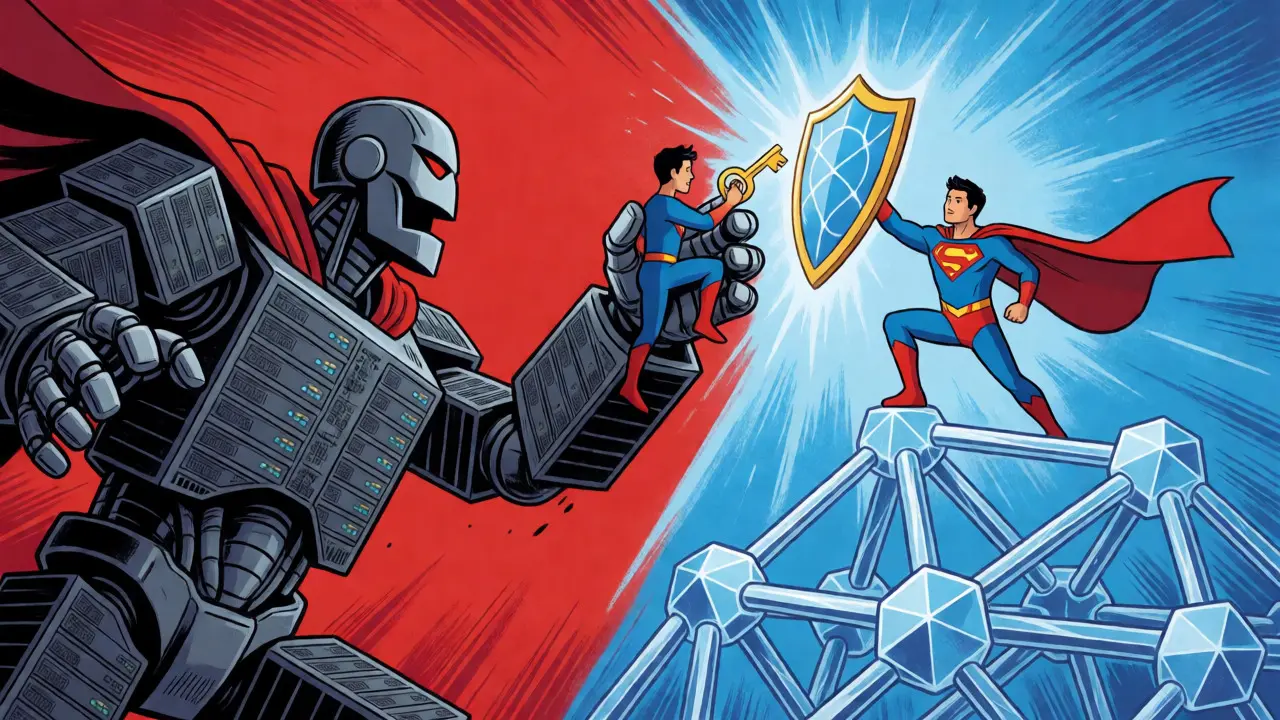
Interoperability is the other critical piece. The W3C finalized the Decentralized Identifier specification in July 2022, creating a universal standard. Now, major platforms like Ethereum, Polygon, and Hyperledger Fabric can talk to each other. Microsoft’s Entra Verified ID already connects to over 1,200 enterprise applications. This means your digital identity isn’t locked into one ecosystem. You can use the same credential for banking, healthcare, and travel, regardless of which blockchain backend supports the specific service.
Regulatory Landscape: The EU Leads, The US Catches Up
Technology alone doesn’t drive adoption; laws do. Here, the European Union is far ahead. The eIDAS 2.0 regulation, effective June 2026, establishes a legal framework for blockchain-based identities across all member states. This means a digital ID issued in France is legally recognized in Germany, Spain, and Italy. The European Blockchain Services Infrastructure (EBSI) has already processed 1.2 million verified credentials across borders by December 2024. Students use it to verify degrees; citizens use it for cross-border healthcare access.
In contrast, the United States remains fragmented. As of 2025, only 17 states have specific digital identity legislation. This patchwork creates uncertainty for multinational companies. However, pressure is mounting. The World Economic Forum and various industry groups argue that without clear federal guidelines, the US risks falling behind in the global digital economy. Companies like Civic and SelfKey are navigating this complexity by offering compliance-ready solutions that adapt to local regulations while maintaining a consistent user experience.
Gartner analysts predict mainstream adoption will hit its stride by 2025, driven partly by Sustainable Development Goal 16.9, which mandates legal identity for all by 2030. Governments worldwide are realizing that blockchain offers a scalable way to provide IDs to unbanked populations who lack traditional documentation. India’s Aadhaar system is exploring blockchain integration to enhance security, while smaller nations like Estonia continue to serve as blueprints for efficient digital governance.
Challenges and Pitfalls to Avoid
It’s not all smooth sailing. The biggest hurdle remains usability. Managing private keys is terrifying for non-technical users. If you lose your key, you lose your identity. There’s no "forgot password" link in a purely decentralized system. Early adopters report significant friction here. A 2024 usability study found that 62% of non-technical users struggled with key management, and 34% experienced lockouts in their first six months.
Solutions are emerging, though. Social recovery mechanisms allow trusted friends or family members to help restore access if you lose your key. Biometric integration is also growing. Instead of memorizing a seed phrase, you unlock your wallet with your fingerprint or face scan. The biometric data stays on your device; only the resulting hash interacts with the blockchain. This balances security with convenience.
Another challenge is scalability during peak loads. While Layer-2 solutions help, high-volume events can still cause delays. Enterprises need robust fallback options. Additionally, regulatory acceptance varies wildly. A credential valid in one jurisdiction might not be recognized in another until treaties are updated. Privacy advocates also warn against surveillance creep. Dr. Jane Smith from MIT’s Digital Identity Lab cautions that unregulated biometric collection could create unprecedented tracking capabilities. Balancing transparency with anonymity is an ongoing tension.
What the Future Looks Like: AI Meets Blockchain Identity
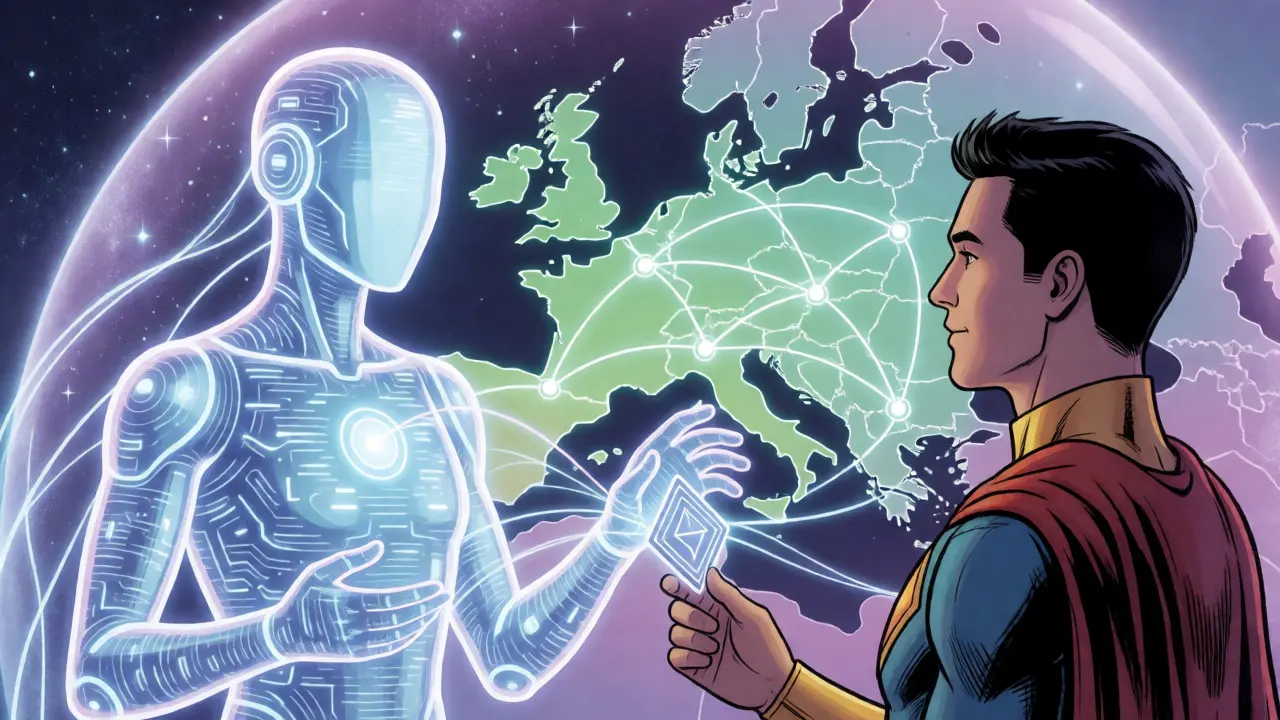
Looking past 2026, the convergence of AI and blockchain identity will reshape how we interact online. Imagine an AI agent acting on your behalf. It monitors your digital footprint, optimizes privacy settings, and automatically shares credentials when appropriate. But how do you trust an AI with your identity? Blockchain provides the answer. By anchoring AI actions in verifiable logs, we can audit exactly what data was shared and when. Binariks’ 2025 trends report notes that blockchain will track data provenance and verify agent behavior, ensuring AI doesn’t misuse your personal info.
We’re also moving toward multi-modal biometrics. Passwords are dying. Facial recognition, fingerprint scanning, and iris detection are becoming standard layers of authentication. Worldcoin’s "proof-of-personhood" protocol, which uses iris scanning, has already registered 2.3 million users across 37 countries. While controversial, it highlights the demand for secure, human-centric verification in an age of deepfakes and bots.
By 2030, 83% of identity management professionals expect blockchain-based systems to become the dominant model. The transition won’t happen overnight, but the direction is clear. We are moving from an era of data brokers to an era of data owners. Your digital identity will finally be yours to keep, share, and protect.
Frequently Asked Questions
Is my personal data stored on the blockchain?
No. Personal data like your name or address is typically stored off-chain in your encrypted digital wallet. The blockchain only stores a unique identifier (DID) and cryptographic hashes used to verify the integrity of that data. This ensures privacy while maintaining security.
What happens if I lose my private key?
In strict decentralized systems, losing your private key means losing access to your identity. However, modern implementations use social recovery or biometric backups to mitigate this risk. Some wallets allow you to designate trusted contacts who can help restore access if you lose your primary key.
Can governments still monitor my activities?
Governments can issue credentials and verify them, but they cannot view your entire activity log unless you explicitly share it. Zero-knowledge proofs allow you to prove attributes (like age or residency) without revealing underlying data, limiting surveillance potential compared to centralized databases.
Which blockchains support digital identity standards?
Major platforms include Ethereum, Polygon, Hyperledger Fabric, and Solana. Interoperability standards developed by the W3C allow these different chains to communicate, enabling cross-platform identity verification.
How long does verification take with blockchain identity?
Verification typically completes in 2-5 seconds using cryptographic proofs. This is significantly faster than traditional manual checks or database queries, which can take 30-60 seconds or longer depending on system load.
 Cryptocurrency Guides