
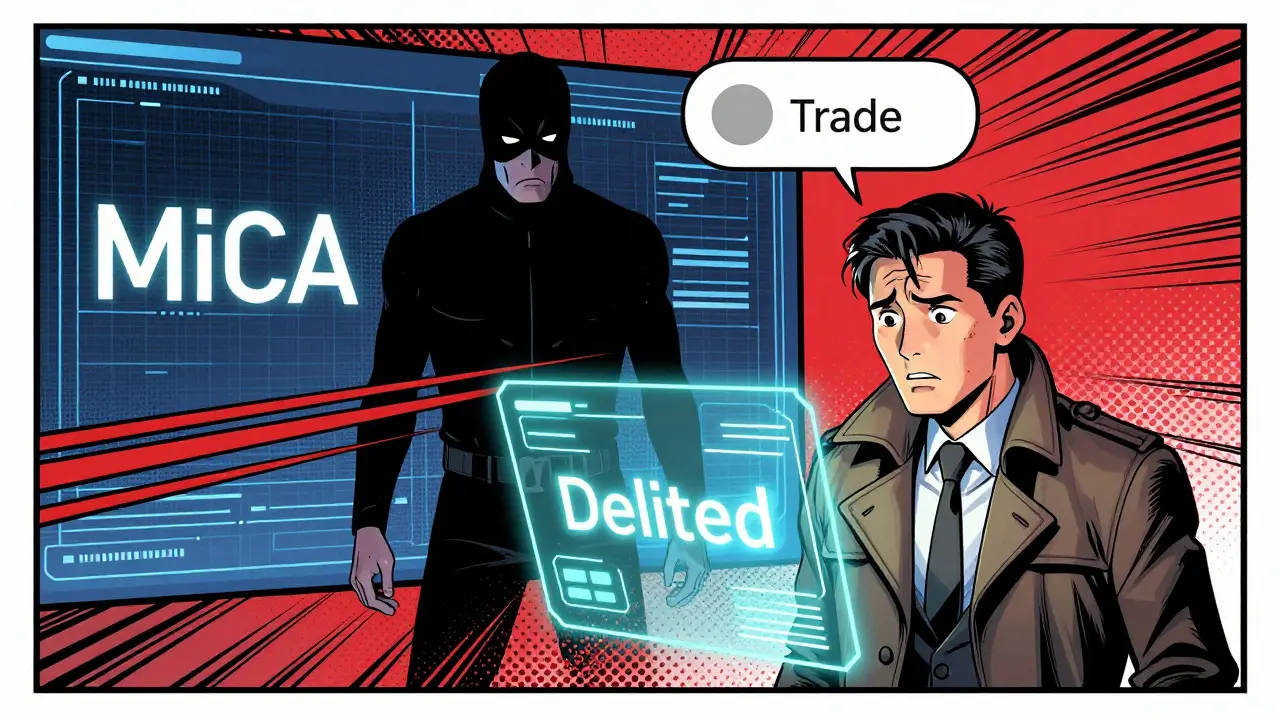
If you tried to trade Tether (USDT) is the world's most widely used stablecoin, pegged to the US dollar on a European exchange recently, you likely hit a wall. The button was greyed out, or worse, your account prompted you to convert your holdings immediately. This isn't a glitch. It’s the result of the Markets in Crypto-Assets Regulation (MiCA) is a comprehensive regulatory framework introduced by the European Union to govern crypto assets, a massive legal overhaul that fundamentally changed how digital money works in Europe.
By early 2025, the landscape had shifted dramatically. Exchanges operating under EU law were forced to delist non-compliant stablecoins. If you are holding USDT, USDC, or other major tokens that haven’t fully adapted to these new rules, you need to understand exactly what changed, why it happened, and what your options are now. Let’s break down the reality of living with MiCA in 2026.
The Core Problem: Why USDT Was Banned from Trading
To understand why your favorite stablecoin disappeared from the order book, we have to look at how the EU classifies digital assets. Before MiCA, the rules were murky. You could buy almost any token on almost any platform. Now, the European Securities and Markets Authority (ESMA) is the central regulatory authority for securities markets across the European Union has drawn a hard line in the sand.
MiCA splits stablecoins into two specific buckets:
- E-Money Tokens (EMTs): These are pegged 1-to-1 to a single fiat currency, like the Euro or the US Dollar. They must hold reserves in highly liquid, safe assets (like cash or government bonds) and offer instant redemption at par value.
- Asset-Referenced Tokens (ARTs): These try to maintain stability by referencing a basket of currencies or other assets. They face even stricter scrutiny because their value can fluctuate more easily.
Here is the catch: To operate as an EMT in the EU, the issuer needs authorization from a national competent authority. Many major issuers, including Tether (the company behind USDT), have not secured this specific license for the European market within the required timeframe. Consequently, Crypto-Asset Service Providers (CASPs) are entities authorized to provide services related to crypto-assets, such as exchanges and custodians-which includes all major centralized exchanges like Binance, Kraken, and Coinbase when serving EU customers-are legally prohibited from facilitating the *trading* of these non-compliant tokens.
This doesn’t mean USDT is illegal to own. It means you cannot use regulated European platforms to buy, sell, or swap it against other assets. The market-making function has been severed.
What Can You Actually Do With Your Non-Compliant Stablecoins?
Panic is unnecessary if you still hold USDT or similar tokens. MiCA distinguishes between *trading* and *custody*. While exchanges stopped listing them for active trading pairs, they generally still allow you to hold them in your wallet or withdraw them to a private address.
However, the utility has dropped significantly. Here is the practical reality for users in 2026:
- No Easy Conversion: You can’t simply click "Swap" to turn USDT into Euros or Bitcoin on a compliant exchange. You will often be forced to withdraw to a self-custody wallet first.
- Liquidity Squeeze: Because EU-based traders can’t easily offload USDT, the local liquidity pool has dried up. If you want to exit, you might find yourself relying on peer-to-peer (P2P) markets or offshore exchanges, which carry higher risks and fees.
- Redemption Rights: Compliant EMTs guarantee you can redeem your tokens for real cash at face value. Non-compliant tokens do not offer this protection under EU law. If the issuer fails, you have no legal recourse through European courts.
For many users, the path of least resistance became converting remaining balances into compliant alternatives before the January 2025 deadline. Those who didn’t are now navigating a fragmented ecosystem where their preferred asset is treated as a legacy technology.
The Rise of Compliant Alternatives: Who Is Winning?
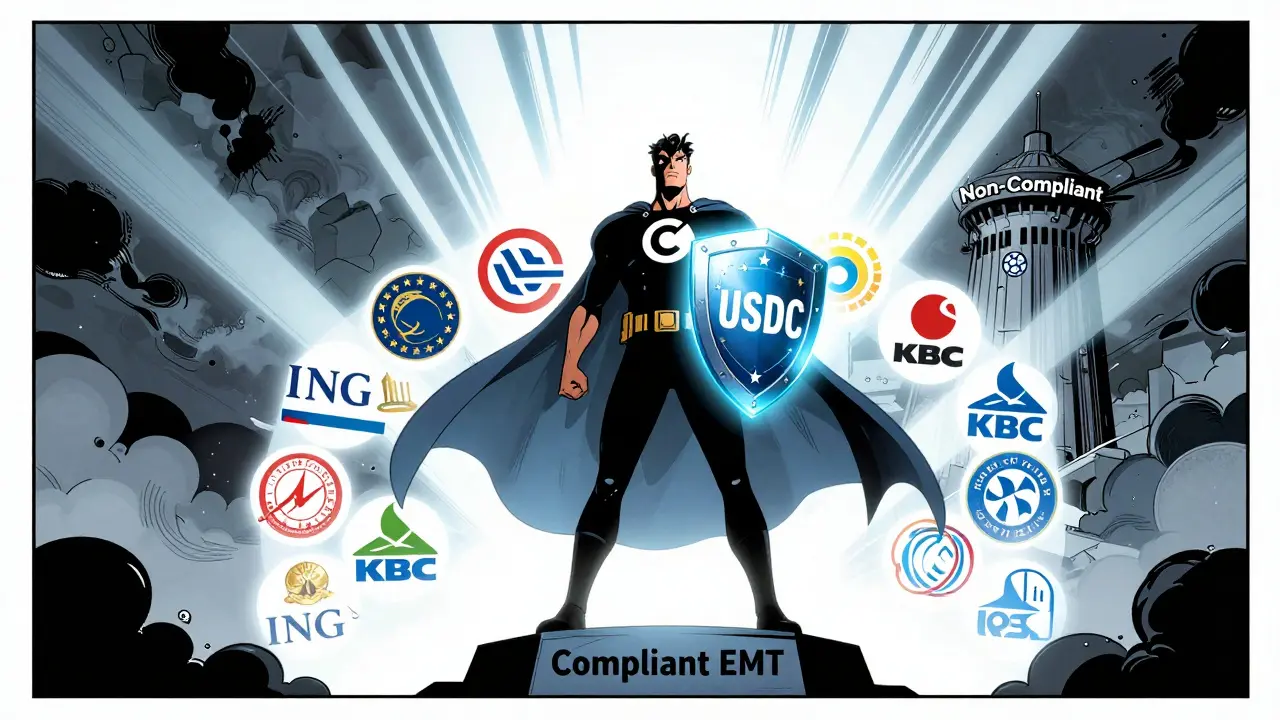
Regulation creates winners and losers. While USDT lost its easy access to the EU retail market, compliant stablecoins stepped into the void. The most prominent beneficiary has been USD Coin (USDC) is a fully reserved stablecoin issued by Circle Internet Financial. Circle moved aggressively to secure necessary licenses and transparency reports, positioning USDC as the "safe" choice for European investors.
But the biggest story isn’t just about US dollars. It’s about the Euro. A consortium of nine major European banks-including ING, KBC, and UniCredit-formed a joint venture to launch a native Euro-denominated stablecoin. Expected to go live in late 2026, this token aims to solve the fragmentation issue entirely. By being issued directly by trusted banking institutions and supervised by the Dutch Central Bank, it offers a level of trust that crypto-native issuers struggle to match.
| Stablecoin | MiCA Compliance Status | Trading on EU Exchanges | Primary Risk |
|---|---|---|---|
| USDT (Tether) | Non-Compliant | Banned (Delisted) | Reserve transparency, lack of legal recourse |
| USDC (Circle) | Compliant (EMT) | Allowed | Lower liquidity than pre-regulation era |
| EURC / Euro Stablecoins | Compliant (EMT) | Allowed & Promoted | New entrants, limited track record |
| Dai (DAI) | Complex (ART-like) | Limited/Restricted | Crypto-collateral volatility |
EU vs. USA: The Regulatory Divergence
While Europe tightened its screws, the United States took a different approach. In mid-2025, the US passed the GENIUS Act (Guiding and Establishing National Innovation for U.S. Stablecoins Act). On paper, both laws sound similar: they demand 1:1 reserves and bankruptcy protection. But the execution differs sharply.
The US framework treats stablecoins more like traditional electronic money, offering a clearer, faster path to approval for established players. This has created a strange dynamic. Major payment processors like Visa and Mastercard are integrating stablecoins into their global networks, but they are prioritizing US-issued or compliant assets. Meanwhile, European firms feel they are playing on hard mode.
This divergence is causing capital flight. Institutional investors who previously used USDT for cross-border settlements within Europe are moving those operations to jurisdictions with lighter touch regulations, or switching entirely to bank-backed Euro stablecoins. The Bank for International Settlements (BIS) is an international organization for central banks warned in 2025 that this fragmentation could undermine monetary sovereignty, suggesting that the EU’s strict stance might inadvertently push innovation offshore rather than securing it at home.
Impact on DeFi and Decentralized Finance
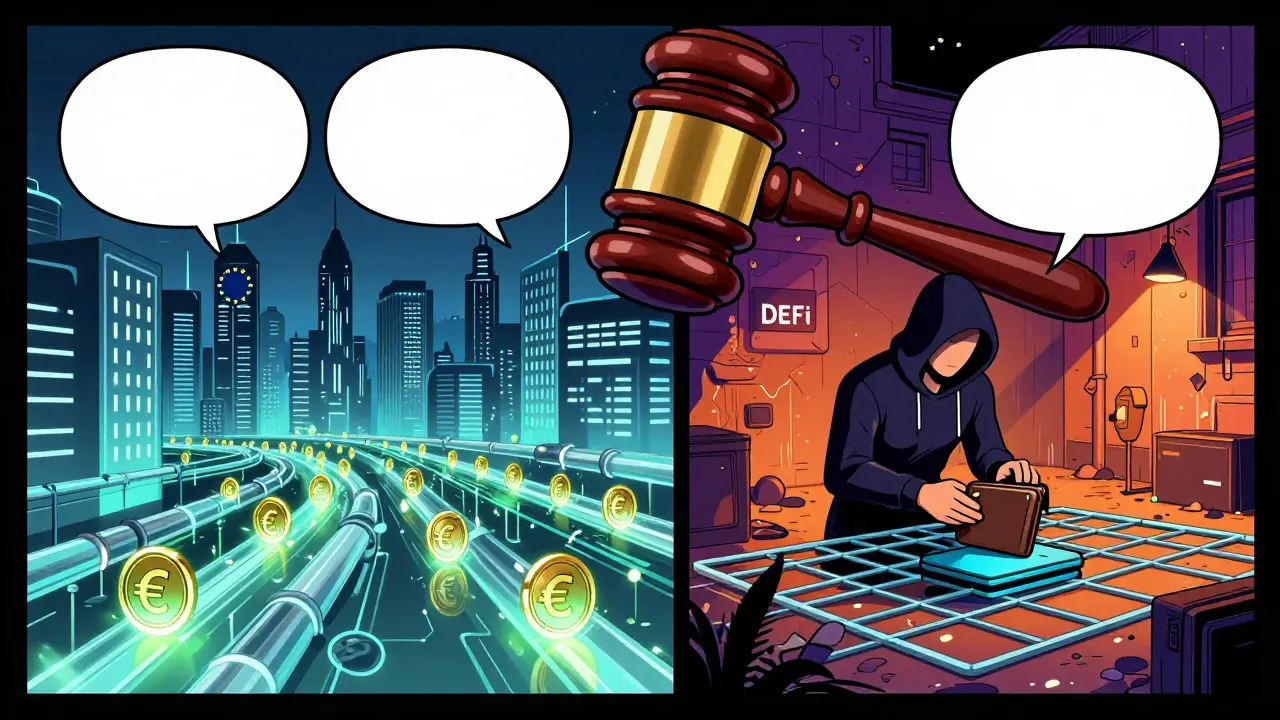
If you are a user of decentralized finance (DeFi) protocols, the impact is nuanced. MiCA primarily regulates *service providers*-the centralized exchanges and custodians. It does not ban you from connecting your MetaMask wallet to Uniswap or Aave.
Technically, you can still swap USDT for ETH on a decentralized exchange (DEX) if you are physically located in the EU. However, the bridges are burning. Getting fiat into crypto is harder because on-ramps (services that let you buy crypto with credit cards) are strictly regulated CASPs. They will only sell you compliant assets.
This creates a "walled garden" effect. New users entering the crypto space in Europe are funneled exclusively toward compliant EMTs. They never encounter USDT. As a result, the organic growth of non-compliant stablecoins in the region has stalled. For DeFi protocols relying on USDT liquidity, this means a significant portion of the European user base is effectively locked out unless they go through complex workarounds.
How to Navigate the New Landscape
So, what should you do? If you are based in the EU, here is a practical checklist for managing your stablecoin exposure in 2026:
- Audit Your Holdings: Identify which stablecoins you hold. If it’s not explicitly listed as MiCA-compliant on your exchange, assume it’s restricted.
- Switch to Compliant Assets: Move funds to USDC or emerging Euro-denominated stablecoins. This ensures you retain full trading functionality and legal protection.
- Understand Custody Limits: If you must hold USDT for specific DeFi strategies, keep it in a self-custody wallet. Do not leave it on a centralized exchange expecting to trade it later; the option may vanish without warning.
- Watch for the Euro Stablecoin Launch: Keep an eye on the consortium led by ING and others. When their token launches in late 2026, it will likely become the default settlement layer for European crypto transactions.
The era of wild west stablecoin trading in Europe is over. The transition has been painful for some, but it has also brought clarity. You now know exactly which assets are protected by law and which are operating in the shadows. The key is to adapt your strategy to the rules, not fight them.
Is USDT illegal in the EU?
No, owning USDT is not illegal. However, regulated exchanges in the EU are banned from listing it for trading. You can still hold it in a private wallet, but you cannot easily buy or sell it on compliant platforms like Binance or Kraken within the jurisdiction.
When did MiCA stablecoin rules take effect?
The core provisions of MiCA regarding stablecoins became enforceable in 2025. Exchanges were required to delist non-compliant tokens by the end of January 2025, with full regulatory oversight established by Q1 2025.
Which stablecoins are compliant with MiCA?
Currently, USD Coin (USDC) is the most prominent compliant stablecoin available in the EU. Additionally, several Euro-denominated stablecoins issued by licensed e-money institutions are compliant. Look for tokens that explicitly state they are authorized as E-Money Tokens (EMTs) under MiCA.
Can I still use DeFi with USDT in Europe?
Yes, technically. MiCA regulates service providers, not individual wallet holders. You can connect a self-custody wallet to decentralized exchanges (DEXs) and use USDT. However, getting fiat currency into crypto to buy USDT is difficult because on-ramps only sell compliant assets.
What happens if my stablecoin issuer goes bankrupt?
If you hold a MiCA-compliant EMT, you have legal rights to redeem your tokens at par value, and the issuer must hold reserves in bankruptcy-protected structures. If you hold a non-compliant token like USDT, you have no such protections under EU law, and recovery of funds in case of issuer failure is unlikely.
 Cryptocurrency Guides
Mauricio Contreras Loredo
June 14, 2026 AT 11:33Oh great, another layer of red tape to make my life harder. I guess the EU really loves its paperwork more than actual innovation. :-/
Kumaran sowkarpet
June 15, 2026 AT 13:49Hello friends! Just wanted to share that in India we are still enjoying the freedom of USDT for now :D But yes, MiCA is very strict indeed. Hope everyone stays safe and compliant!
Annemarie Fitzgerald
June 16, 2026 AT 13:09It is truly tragic how they try to control our digital souls with these laws. The essence of crypto was freedom, not compliance. Now it is just banking 2.0 with extra steps. Why do we even bother if they just want to turn it into another regulated asset class? It feels like a betrayal of the original vision. We are losing the spirit of decentralization bit by bit. It makes me sad to see the wild west being tamed by bureaucrats who don't understand the technology at all.
Kenneth Riley
June 17, 2026 AT 06:38typical eu overreach again. they think they can regulate the internet out of existence. usdt will just move offshore and leave europe behind in the dust. smart money always finds a way around stupid laws. you guys are just hurting yourselves by chasing this phantom security. the banks are laughing at you while they take your fees.
Abby Sivertsen
June 17, 2026 AT 08:22I actually switched to USDC last month and honestly it's been smoother than I expected. Less drama, more stability. Not saying USDT was bad but sometimes rules help too.
Grace Newman
June 17, 2026 AT 09:27One must consider the deeper implications of this regulatory shift. Is it merely about financial stability, or is there a coordinated effort to monitor and control individual transactions through centralized entities? The requirement for KYC on compliant stablecoins suggests a panopticon-like surveillance state is emerging under the guise of consumer protection. We should be wary of trusting these 'safe' assets when they are issued by entities beholden to government oversight. True privacy is dead in Europe.
ravi mahla
June 17, 2026 AT 13:39Haha, look at them trying to ban USDT like it's some kind of crime. You can't stop the signal! People will just use P2P or DEXs. The regulators are running after their tails. Nice try though lol.
Mark Brunschwiler
June 18, 2026 AT 22:59why does everyone care so much about rules anyway. i just want to trade. this whole thing feels like a game designed to keep us poor. the system is rigged against normal people. i feel drained just thinking about all the forms i have to fill out. it sucks.
Filbert Reeves
June 19, 2026 AT 15:47i dont buy any of this compliance hype. its just a way for big banks to crush competition. usdc is owned by circle which is basically a bank front. they say its safe but where is the proof? probably same shady reserves as tether just with better marketing. i am keeping my coins in cold storage and ignoring these exchanges entirely. let them delist whatever they want. i will trade on darknet markets if i have to. this is all part of a grand plan to eliminate cash and crypto alike. wake up sheeple.
Amit Thakur
June 20, 2026 AT 02:39The liquidity squeeze mentioned here is critical for institutional players. If you are running high-frequency arbitrage strategies relying on USDT pairs, you need to pivot immediately to USDC or EURC. The spread widening on non-compliant assets is unsustainable. Do not sleep on this transition because the slippage costs will eat your alpha alive. Adapt or die in this new regulatory landscape.
Benjamin Eisen
June 21, 2026 AT 03:20hey man, i know it seems annoying but maybe its good for long term adoption? less scams right? i mean sure its hard now but later it might be easier for grandma to invest. what do you think?
Eric Scheinberg
June 21, 2026 AT 11:05The regulatory framework delineates a clear path forward for compliant entities. One must adhere strictly to the E-Money Token guidelines to ensure operational continuity within the European jurisdiction. Failure to comply results in immediate delisting. This is not a matter of preference but of legal necessity. Investors are advised to review their holdings promptly.
sreeja boora
June 22, 2026 AT 05:19This regulation is necessary for maintaining economic sovereignty. The unregulated flow of foreign-backed tokens poses a significant risk to national financial systems. It is imperative that citizens support measures that protect the integrity of local currencies and banking institutions. Compliance is a duty.
Sonya O'Brien
June 24, 2026 AT 01:32I have been following this situation closely and I think it is important to recognize that while the transition has been difficult for many users who were accustomed to the ease of using USDT across various platforms, the introduction of MiCA brings a level of transparency and accountability that was previously lacking in the market, which ultimately benefits the average investor by reducing the risk of fraud and ensuring that stablecoin issuers maintain adequate reserves, although I acknowledge that the initial confusion and inconvenience caused by the sudden delisting of popular tokens on major exchanges was frustrating for many people who had to quickly adjust their portfolios and find alternative solutions for storing and trading their digital assets during this period of uncertainty.
Nick Rice
June 25, 2026 AT 00:34Let's stay positive everyone. Change is hard but progress is inevitable. We can learn from this and build better systems together. Stay strong and keep learning!