

If you're operating in or moving money into Egypt, you need to understand that the government doesn't just discourage cryptocurrency; they've criminalized it. This isn't about a lack of licenses or a "gray area" in the law. It's a full-scale prohibition backed by severe financial and carceral penalties.
The Legal Hammer: Law No. 194 of 2020
The primary source of this crackdown is Law No. 194 of 2020. This isn't just a set of guidelines; it's a legislative hammer that effectively outlawed the entire cryptocurrency ecosystem within the country. Under Article 206 of Law No. 194 of 2020, it is strictly illegal to issue, trade, promote, or operate any cryptocurrency exchange without direct authorization from the government.
The stakes here are astronomical. If you're caught violating these rules, the law allows for a combination of imprisonment and massive fines. Specifically, violators can be fined anywhere from 1 million to 10 million Egyptian pounds (EGP). Depending on the exchange rate, that's roughly $51,600 to over $516,000 USD. For the average citizen, this isn't just a penalty-it's a life-altering financial catastrophe.
Who is Enforcing These Rules?
Two main powerhouses are driving this enforcement: the Central Bank of Egypt CBE and the Egyptian Financial Regulatory Authority FRA. These agencies aren't just waiting for people to get caught; they are actively hunting for illegal activity.
The CBE's stance is rooted in a deep distrust of digital assets. Since 2018, they've argued that assets like Bitcoin lack tangible backing and are prone to extreme volatility. They view crypto as a tool for financial crimes and electronic piracy rather than a legitimate investment. Meanwhile, the FRA focuses on the "marketing" side of things. They've warned that any company promoting virtual assets without an approved prospectus is breaching Capital Market Law No. 95 of 1992.
| Authority | Primary Focus | Legal Basis | Key Concern |
|---|---|---|---|
| Central Bank of Egypt (CBE) | Monetary Stability & Trading | Law No. 194 of 2020 | Financial crime, volatility, lack of tangible assets |
| Financial Regulatory Authority (FRA) | Market Promotion & Licensing | Law No. 95 of 1992 | Fraud, unlicensed investment schemes, cyber piracy |

The Paradox: High Usage vs. Strict Bans
Here is where things get weird. Despite the threat of million-pound fines, Egypt is actually one of the biggest crypto hubs in the Middle East and Africa. Data from a 2022 TripleA report showed that Egypt had over 1.7 million crypto owners, accounting for about 1.75% of the population. This puts Egypt second in the Arab world, trailing only Morocco.
Why is this happening? It's a classic clash between government control and public demand. Many Egyptians see cryptocurrency as a hedge against inflation or a way to bypass slow, expensive traditional banking channels. When the local currency fluctuates, a digital asset-even a volatile one-can feel like a safer bet than a bank account. This create a dangerous "underground" economy where people trade in secret, hoping they don't trigger a red flag at the CBE.
How the Ban Hits Businesses and Trade
The impact isn't just on individual traders. If you're a business owner trying to conduct cross-border trade, these restrictions are a nightmare. By eliminating crypto as a payment rail, the government has forced everyone back into traditional banking. This means slower transaction times and higher fees for international transfers.
Furthermore, this creates a massive "innovation gap." While other countries are experimenting with blockchain for logistics or smart contracts, Egypt's comprehensive ban kills that growth in the cradle. Any international company considering an office in Egypt has to be incredibly careful; an accidental exposure to crypto payments could lead to criminal charges for the company's local directors.
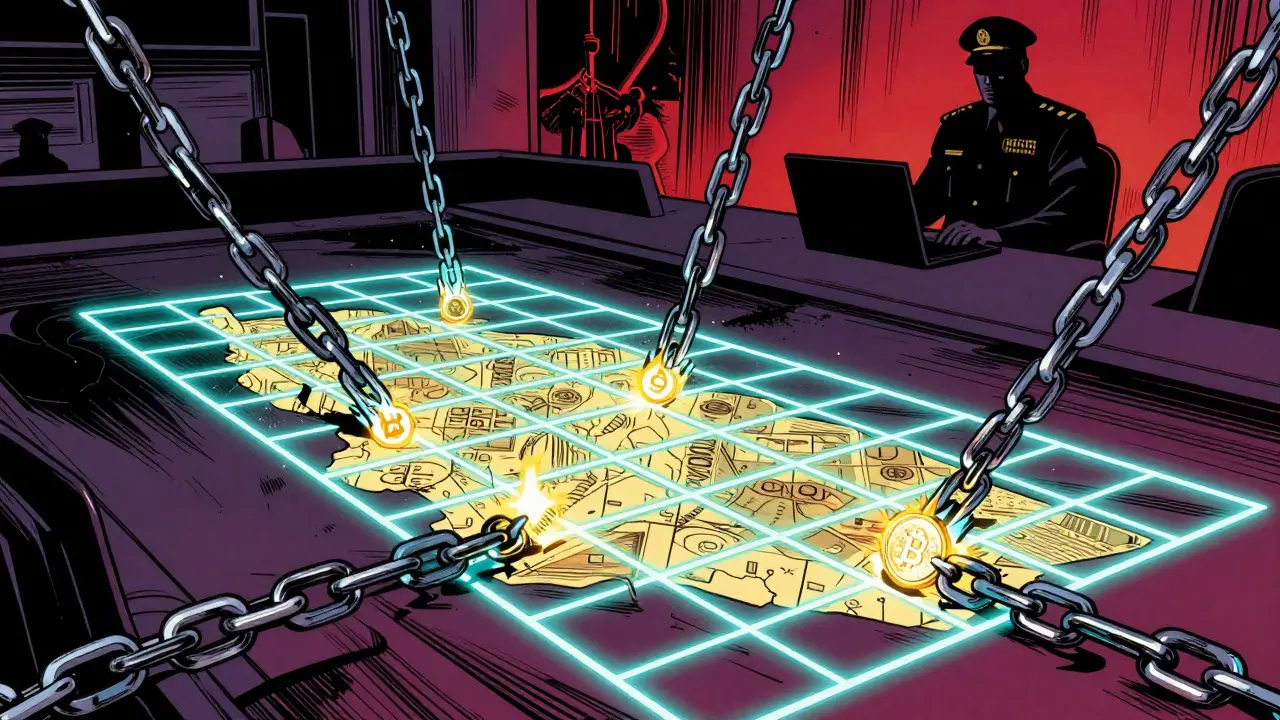
Red Flags and Enforcement Tactics
The FRA isn't just issuing warnings; they're building a "negative list." This is essentially a blacklist of unlicensed entities offering non-bank financial services. They're also actively encouraging citizens to report anyone who solicits investments in encrypted currencies via social media or websites.
If you're seeing an ad on Facebook or Telegram promising "guaranteed returns" on a crypto project in Egypt, remember that the FRA views that ad as a crime. They are monitoring these platforms to identify promoters, and the trail usually leads straight back to the bank accounts used to fund the trades.
The Bottom Line for Residents and Investors
Is it worth the risk? With fines reaching 10 million pounds and the very real possibility of jail time, the answer for most is a resounding no. The Egyptian government has made it clear that they prioritize financial stability and state control over the flexibility of decentralized finance.
For those already holding assets, the challenge is liquidity. Moving funds from a digital wallet to a local bank account is the moment of highest risk. Since the CBE monitors large or unusual transfers, the "on-ramp" and "off-ramp" process is where most people get caught in the regulatory dragnet.
Can I be fined for just holding Bitcoin in Egypt?
While the law focuses heavily on trading, promoting, and operating exchanges, the broad language of Law No. 194 of 2020 makes any cryptocurrency-related activity risky. The Central Bank of Egypt views these assets as illegal, and the process of converting them to Egyptian Pounds can trigger a legal investigation.
What is the maximum fine for crypto trading in Egypt?
The maximum financial penalty is 10 million Egyptian pounds. This can be applied in addition to, or instead of, a prison sentence, depending on the severity of the violation and the discretion of the court.
Does the ban apply to blockchain technology in general?
The law specifically targets the issuance and trading of cryptocurrencies and the operation of exchanges. However, because the regulatory environment is so restrictive, any blockchain project that involves a token or a financial element is likely to be viewed as a violation of the law.
Who is the FRA and why should I care?
The Financial Regulatory Authority (FRA) oversees non-banking financial markets. They are the ones who police the promotion of crypto. If you are marketing a virtual asset or running an unlicensed investment scheme, the FRA is the agency that will likely initiate the legal action against you.
Are there any legal ways to trade crypto in Egypt?
Currently, there are no legal ways for individuals to trade cryptocurrency within Egypt. The law requires prior authorization from the relevant governmental bodies, which is not being granted to private traders or exchanges.
 Cryptocurrency Guides
JERRY ORTEGA
April 5, 2026 AT 15:26wild how they try to ban it when everyone's already using it anyway. once the cat is out of the bag you can't really put it back in especially with p2p trading
Arlen Medina
April 6, 2026 AT 08:11This is exactly why a strong state is necessary to maintain order! You can't have people gambling with digital air and then crashing the whole economy. My country knows how to handle assets and Egypt is just doing what any serious government would do to stop total financial anarchy. These 'investors' are just gamblers looking for a shortcut and they deserve the fines if they think they're above the law.
vijendra pal
April 7, 2026 AT 07:26lol they think a ban will stop us 🤣🤣🤣 its just making the black market bigger and better!! 🚀📈
david head
April 9, 2026 AT 01:00true that 💯 the irony is real
shubhu patel
April 10, 2026 AT 20:40It is quite fascinating to observe how the tension between the centralized authority and the decentralized nature of blockchain manifests in such a rigid legal framework, although one has to wonder if the government is simply reacting to the fear of losing control over the national currency's valuation in a way that might actually accelerate the very instability they are trying to prevent by pushing a large portion of the population into an unregulated underground market where there is absolutely no consumer protection at all.
Lauren Gilbert
April 11, 2026 AT 21:13There is a deep philosophical irony here because the very essence of cryptocurrency is the removal of the trusted intermediary, yet the state insists on being the only trusted entity for value. When a government makes the cost of a mistake ten million pounds, they aren't just regulating a market, they are fundamentally altering the risk-reward calculus of an entire generation of tech-savvy citizens who see the traditional system as a sinking ship. I wonder if the pressure from the youth will eventually force a pivot toward a CBDC, which would be the ultimate paradox-a government-controlled version of the technology they currently criminalize just to keep the data and the control in their hands while pretending to embrace innovation.
Alexandra Lance
April 12, 2026 AT 18:03Oh please, as if this is about 'stability' 🙄 it's obviously about tracking every single cent and keeping the populace under a thumb. They just hate that they can't print more Bitcoin to fix their inflation problems 💅✨ the 'negative list' is just a fancy way of saying 'people we can't control' 🤡
June Coleman
April 14, 2026 AT 07:28Right because a 10 million pound fine is totally a 'reasonable' deterrent and not at all a complete overreaction to people trying to save their life savings from inflation. Truly a masterclass in governance here.
Sonya Bowen
April 15, 2026 AT 08:30Focus on the off-ramps. That's the danger zone.
Robert Coskrey
April 16, 2026 AT 16:07I concur with the sentiment that the risks are excessive!!! It is quite concerning that such severe penalties exist for a financial activity that is legal in so many other jurisdictions!!!!
Emily 2231
April 18, 2026 AT 15:55THIS IS A TRAP. The CBE is likely using these 'bans' to identify high-net-worth individuals and seize their assets under the guise of law enforcement. It is all part of a larger globalist agenda to phase out private ownership of wealth and force everyone into a digital ledger monitored by the state. Be careful with your bank accounts because the trail is already there and they are just waiting for the right moment to strike.
Hugo Lopez
April 20, 2026 AT 01:00It's really sad to see such a gap between the people and the law 😊 Hope they find a middle ground soon! 🕊️
Brooke Herold
April 21, 2026 AT 18:25The cultural divide between the digital natives and the policymakers is so apparent here.
gladys christine
April 22, 2026 AT 13:49imagine the stress of just checking your app and knowing you could lose everything it's actually insane
Carmelita Gonzales
April 23, 2026 AT 15:28so scary for the people just trying to survive inflation
Taylor Meadows
April 25, 2026 AT 06:40People are so naive thinking they can hide from the CBE. You're just begging to be caught if you think a VPN and a burner phone will save you from a government that actually wants your money.
Carol Prates
April 27, 2026 AT 05:06Omg can you imagine the drama when some random person gets hit with a 10M fine just for a few trades? The tea would be absolutely boiling! ☕️ I love how this is basically a real-life thriller movie at this point.
sekhar reddy
April 29, 2026 AT 04:16I cant even believe how bad the law is’!! This is absolute madness and totaly unnecessery in a modern world where everyones tradin crypto 😱
Susan Payne
April 29, 2026 AT 08:29It is a regrettable state of affairs when the only viable financial hedge for a population is one that carries the risk of imprisonment. The lack of foresight in these regulations is truly appalling.