
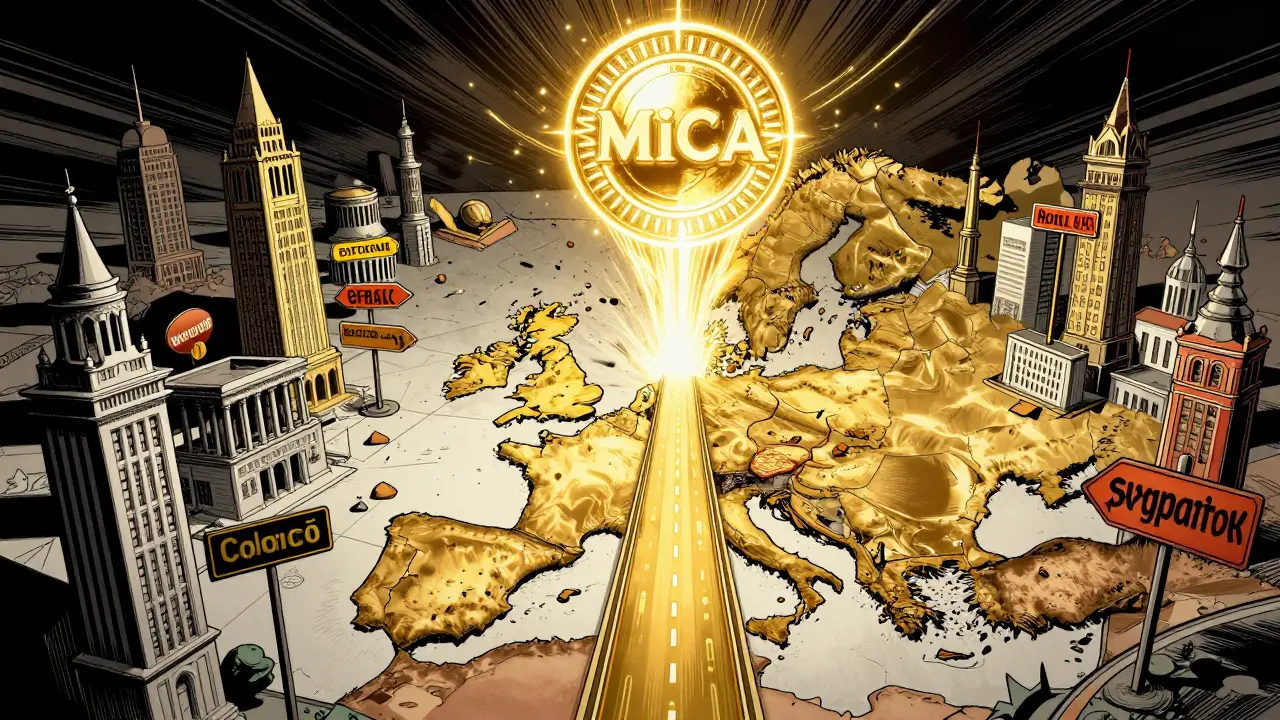
If you've ever tried to launch a crypto business in Europe, you know the nightmare of dealing with 27 different sets of rules. One country wanted a specific type of audit, another required a local director, and a third barely had a regulatory framework at all. That fragmented mess is officially over. The Markets in Crypto-Assets Regulation is a comprehensive EU framework, also known as MiCA, designed to create a single set of rules for crypto-assets across all member states. It represents the first major attempt by a global power to bring the "wild west" of digital assets under a unified legal umbrella.
For any firm wanting to operate legally in the EU, obtaining a Crypto Asset Service Provider license is no longer optional-it's the ticket to the entire European market. The real game-changer here is "passporting." In plain English, this means once you get your license from one EU country (like France or Lithuania), you can offer your services in every other member state without needing to apply for separate permits. It's a massive shift that cuts down compliance costs by up to 60% for firms that previously had to juggle multiple national regimes.
What Exactly is a CASP?
Under MiCA, a Crypto-Asset Service Provider (or CASP) is essentially any legal entity that provides crypto services to clients on a professional basis. If your business does any of the following, you're likely in the CASP category:
- Custody and administration of crypto-assets (holding keys for users).
- Operating a trading platform (running an exchange).
- Exchanging crypto for fiat currencies (on-ramps and off-ramps).
- Executing orders on behalf of clients.
- Providing professional advice on crypto-assets.
It's worth noting that MiCA focuses on "identifiable legal entities." This is a major sticking point for the DeFi world. Because most Decentralized Finance (DeFi) protocols operate via smart contracts without a central company, they don't fit the CASP mold. This has led a huge portion of DeFi projects to stay outside the EU market entirely, as they simply cannot meet the requirement of having a registered office and a board of directors.
The Licensing Requirements: What You'll Need
Getting a license isn't as simple as filling out a form. It's a rigorous process that requires significant capital and organizational structure. You can't just run a global exchange from a laptop in a beach house; you need a physical and legal presence in the EU.
First, you need a registered office in an EU member state and at least one director who actually lives there. Second, you have to meet minimum operational capital requirements. Depending on what you do, the price of entry varies:
| Service Type | Minimum Capital Value |
|---|---|
| Custody and Administration | €125,000 |
| Exchange Services (Fiat-to-Crypto) | €150,000 |
| Operating a Trading Platform | €730,000 |
Beyond the money, you'll need to prove your house is in order. This means implementing AML (Anti-Money Laundering) procedures that align with the EU's 6th AML Directive and meeting the data security standards of the NIS2 Directive. You also have to tackle something relatively new: environmental reporting. You'll need to quantify the energy consumption of the assets you support, a requirement that has caused some headaches for mid-sized exchanges due to the technical complexity.

The 'Significant CASP' Trap
Not all licenses are treated equally. If your business grows too fast, you might trigger a move into a higher bracket of scrutiny. If you have an average of more than 15 million EU users, you are classified as a significant CASP (or sCASP).
Once you hit this threshold, the training wheels come off. You move from standard supervision to a heightened regime. This includes mandatory third-party audits and quarterly stress testing to ensure you won't collapse during a market crash. You'll also need real-time transaction monitoring systems, which often require an investment of over €1 million to implement correctly. For a startup, this is a looming milestone that requires a very different financial plan than a small-scale operation.
Choosing Your Home Base: Which Regulator?
Since you only need one license to access the whole EU, where you apply matters. Different National Competent Authorities (NCAs) have different speeds and styles. For example, Germany's BaFin is known for providing incredibly detailed guidance, which makes the application clearer but the process can take up to 6 months. On the other hand, some smaller jurisdictions are struggling with backlogs, with processing times in places like Estonia stretching up to 11 months.
France's AMF has become a popular choice for larger firms. We've seen established players like Kraken use the French route to quickly expand across the continent. The general rule of thumb is: if you want a predictable, high-standard process, go for the bigger hubs; if you're looking for potentially more flexible interpretations, look at the emerging crypto hubs in the Baltics, but be prepared for potential delays.

Common Pitfalls and Reality Checks
Many non-EU firms make the mistake of thinking MiCA is just a "paperwork exercise." It's not. According to industry reports, about 73% of applicants underestimate the organizational complexity. The biggest shocks usually come from the requirement for EU-based management and the sheer volume of documentation needed for the risk management framework.
Another hurdle is the "transitional period." Until July 1, 2026, there's a bit of a grey area where some firms are still operating under old national rules while transitioning to MiCA. This has created some uncertainty, but for most, the push is toward full compliance as soon as possible to avoid being shut out of the market.
Finally, be wary of the user experience impact. MiCA requires mandatory risk warnings for users. While these protect the company legally, many users find them annoying and "excessive," which can lead to a drop in conversion rates on your platform. It's a trade-off between regulatory safety and a slick user interface.
How long does it take to get a CASP license?
While the official guideline is often around 6 months, the reality varies by country. In Germany (BaFin), it's typically around 6 months, but in other jurisdictions like Estonia, it has been reported to take up to 11 months due to resource constraints at the national authorities.
Can a non-EU company apply for a MiCA license?
Yes, but you must establish a legal entity with a registered office within the EU and employ at least one director who resides in the EU member state where you are seeking authorization.
What is the "passporting" mechanism?
Passporting allows a CASP authorized in one EU member state to provide its services across all other 26 member states. This removes the need to apply for separate licenses in every country you wish to operate in.
Does MiCA apply to DeFi protocols?
Generally, no. MiCA is designed for legal persons and undertakings. Because truly decentralized protocols lack a central legal entity, they struggle to meet the authorization requirements. Many DeFi projects currently operate outside the scope of MiCA, though future updates (MiCA 2.0) may address this.
What happens if I exceed 15 million users?
You will be classified as a "significant CASP" (sCASP). This brings you under stricter supervision, including mandatory quarterly stress tests, real-time transaction monitoring, and more frequent third-party audits.
Next Steps for Business Owners
If you're planning to enter the EU market, don't wing it. Start by conducting a gap analysis: look at your current capital reserves and your management structure. If you don't have someone based in the EU, that's your first priority. Next, determine which specific services you are providing so you know exactly which capital requirement applies to you.
For those already operating under national regimes, check your deadline for the transitional period. Moving to a MiCA license early doesn't just keep you legal; it allows you to scale across the entire continent instantly via passporting, which is a massive competitive advantage over firms sticking to a single-country model.
 Cryptocurrency Guides
Deepak Prusty
April 6, 2026 AT 02:12The mention of the transitional period is the most critical part here because most people ignore how the grandfathering clauses actually work in practice across different NCAs.
Emma Pease-Byron
April 7, 2026 AT 15:47How quaint that we believe a "unified legal umbrella" actually protects anyone when the regulators are merely centralizing their ability to seize assets efficiently.
Siddharth Bhandari
April 9, 2026 AT 07:40If you're looking at the Baltics, just be aware that the backlog isn't just about staffing, it's about the quality of the documentation they're demanding now compared to two years ago.
Erica Mahmood
April 9, 2026 AT 07:44The sCASP threshold is a total liquidity trap for mid-caps since the OpEx for real-time monitoring just nukes your runway if you aren't already printing money
Lauren Gilbert
April 9, 2026 AT 22:45It's quite fascinating to consider how the push for centralization in the EU mirrors a broader human desire for order and predictability, even when that order comes at the cost of the very decentralization that gave birth to blockchain technology in the first place, and I wonder if we are simply trading one form of systemic fragility for another by placing so much trust in a single regulatory framework that might not be able to evolve as fast as the code it attempts to govern.
Earnest Mudzengi
April 9, 2026 AT 23:58This is just another layer of the globalist surveillance state trying to leash the only tool we have for financial sovereignty while the US just watches and waits to implement their own version of this nightmare so they can track every single satoshi moving across borders 🙄
Diana Martín Prieto
April 11, 2026 AT 04:01For anyone struggling with the gap analysis, I'd suggest focusing on the governance part first. It's way harder to find a qualified EU director who actually knows the space than it is to raise the capital.
Krystal Moore
April 12, 2026 AT 06:28Omg the fact that they're making DeFi projects just leave the market is honestly so typical. Like, just admit you can't regulate it and move on instead of pretending this is for "consumer protection" when it's clearly just about control!
Sharhonda Walker
April 12, 2026 AT 09:04i think the enviromental reportign part is going to be the biggest pain for smaller teams because most of the tools to track carbon footprints are way too expnsive for a startup
Emily 2231
April 13, 2026 AT 03:09THE EU IS BUILDING A DIGITAL PRISON AND YOU ALL THINK PASSPORTING IS A BENEFIT. OBVIOUSLY THEY WANT EVERY SINGLE TRANSACTION LOGGED IN A CENTRAL DATABASE FOR THE GLOBALIST AGENDA TO MONITOR OUR WEALTH
Manisha Sharma
April 13, 2026 AT 08:57Imagine thinking EU regulations are the gold standard when India's approach is far more dynamic though the bureaucracy is a beast of its own haha. MiCA is just a slow death for inovation in the west
Adriana Gurau
April 14, 2026 AT 01:02The UI/UX trade-off mentioned is so basic. Only a true amateur would think a few risk warnings could actually drop conversion rates for a product that actually provides value. 🙄
Alexandra Lance
April 15, 2026 AT 10:11Oh please, let's be real here. The "registered office" is just a fancy way of saying "give us a throat to choke" so the regulators can threaten a few mid-level managers in a rented office in Vilnius. 💅✨
Sonya Bowen
April 16, 2026 AT 12:56Focus on the capital reserves first.
Suzanne Robitaille
April 18, 2026 AT 02:35It's just so heartbreaking to see the wild spirit of crypto being boxed into these rigid tables and capital requirements! The beauty of the early days was the freedom, and now it's all just... accounting!
Susan Wright
April 18, 2026 AT 11:04Honestly, if you're a small shop, just look at Lithuania. It's a lot more friendly for the actual setup phase than trying to fight with BaFin for six months.
Susan Payne
April 18, 2026 AT 18:08The audacity of some firms to think they can just "transition" without a complete overhaul of their risk management framework is truly staggering. It's a recipe for a regulatory disaster.
gladys christine
April 20, 2026 AT 14:51YOU GOT THIS!! Just take it one step at a time and the EU market will be yours!! Keep pushing through the paperwork!!!
June Coleman
April 22, 2026 AT 12:33Sure, let's all just trust the regulators to make everything "simple" and "unified" while they take their sweet time processing applications. Truly a masterpiece of efficiency.
Robert Coskrey
April 23, 2026 AT 23:18I completely agree with the assessment regarding the passporting mechanism; it is an exceptionally efficient way to scale... provided the initial authorization is achieved!
alex rodea
April 24, 2026 AT 23:52This is great info. Just keep going and stay positive!
Patty Levino
April 25, 2026 AT 15:19If anyone is feeling overwhelmed by the documentation, maybe just try breaking it down into weekly goals. It's a lot, but it's doable if you don't rush it.
Brooke Herold
April 26, 2026 AT 05:32The way different cultures handle these rules is so interesting to see.
Emma Pease-Byron
April 26, 2026 AT 18:05I find the naive optimism in these replies absolutely exhausting. The regulation isn't a "ticket" to a market; it's a leash.