
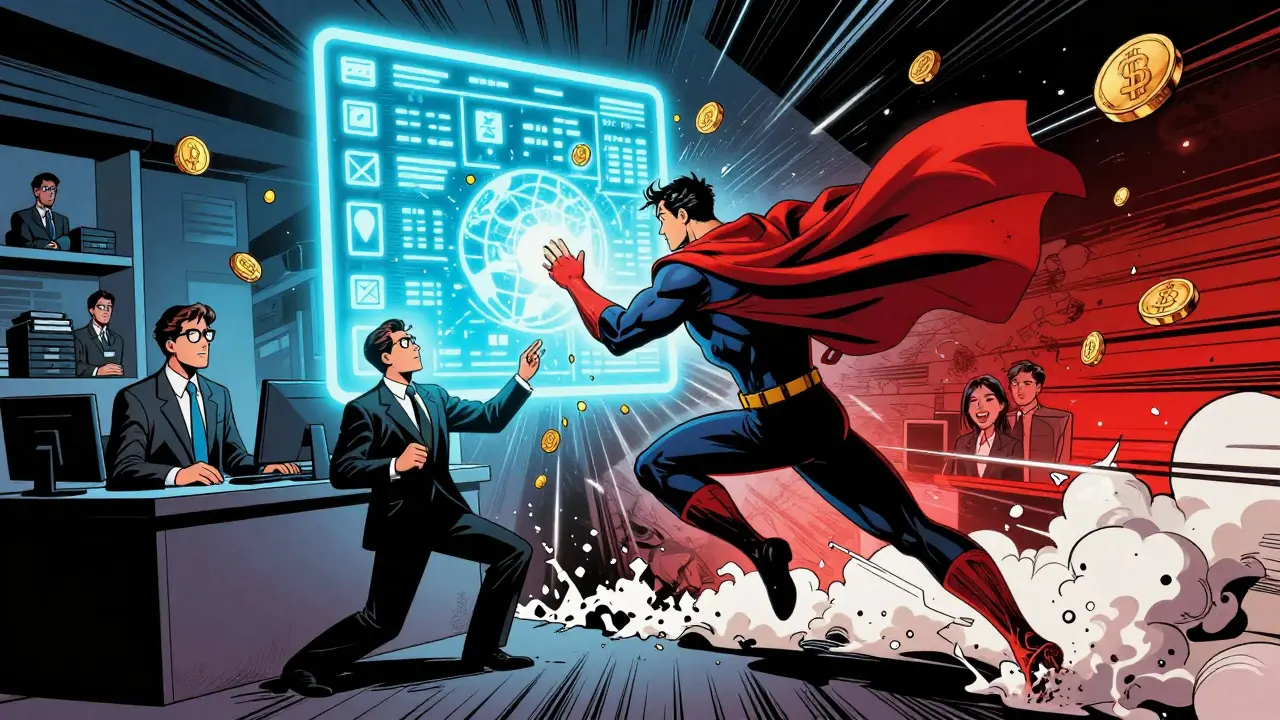
For decades, middlemen have been the glue holding together how we buy, sell, and exchange value. Banks processed payments. Lawyers held escrow. Ad platforms took 30% of your ad spend. Record labels waited months to pay artists. These intermediaries didn’t create value-they just charged for access to it. Blockchain changes that. It doesn’t just make transactions faster. It makes middlemen obsolete in many cases.
What Blockchain Actually Replaces
Think about sending money overseas. Traditionally, your bank sends it to a correspondent bank, which sends it to another, which finally delivers it to the recipient. Each step adds fees, delays, and paperwork. It can take days. With blockchain, you send directly from your wallet to theirs. No bank in between. No intermediary markup. The transaction settles in minutes. That’s not a tweak-it’s a rewrite of the rulebook. The same thing happens in digital advertising. Right now, Google and Facebook take a cut of every dollar advertisers spend. They decide who sees your ad, how much you pay, and when you get paid. Blockchain-based ad networks like Basic Attention Token or AdsWizz remove them. Advertisers pay users directly for attention. Publishers get paid faster. No middleman takes 25% just for being in the way. In music, artists used to wait 18 months to get paid for streams. Royalties passed through labels, distributors, collecting societies, and payment processors. Each took a cut. Now, platforms like Tune.fm use smart contracts on blockchain to pay artists automatically when a song is streamed. No waiting. No middlemen. One indie artist earned $2,300 from 47,000 streams in March 2023-up from $800 under Spotify’s old system.How Smart Contracts Kill the Need for Middlemen
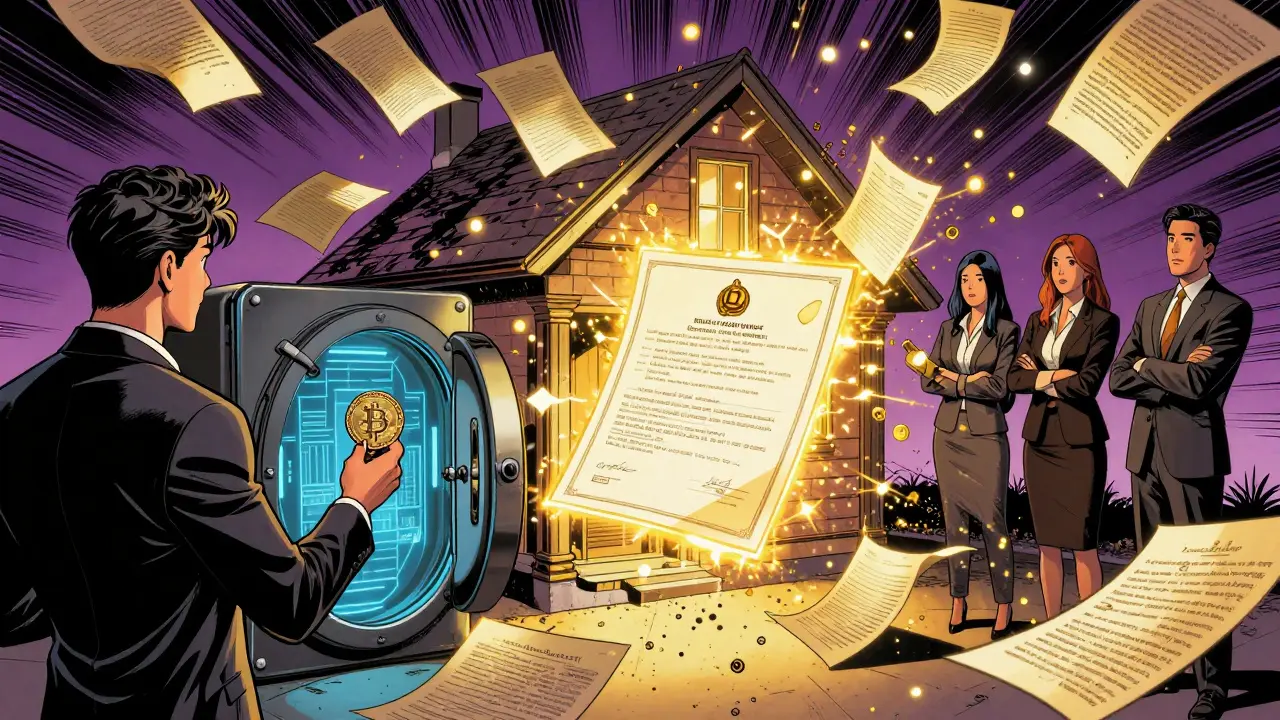
The real engine behind this shift isn’t just the ledger-it’s smart contracts. These aren’t legal documents. They’re self-executing code. Once you set the rules, the code runs automatically. No lawyer needed. No escrow agent. No broker. Imagine buying a house. Traditionally, you need a realtor, a title company, a lawyer, a bank, and an inspector. Each one charges you. With blockchain, you put the property details and payment terms into a smart contract. When the buyer sends the exact amount of crypto to the wallet, the deed transfers automatically. The contract checks: Is the money there? Is the buyer verified? Is the property registered? If yes-done. No human steps. No delays. No fees. Ethereum made this possible. Launched in 2015, it introduced a programmable blockchain. Developers write contracts in Solidity. These contracts live on the network. They can’t be changed. They can’t be stopped. They just execute. That’s why companies like DeFi platforms can lend money without banks. Borrowers lock crypto as collateral. The contract releases funds if conditions are met. If they default, the collateral is sold automatically. No loan officer. No credit check. No branch.Real-World Savings: Numbers That Matter
The cost of middlemen isn’t abstract. It’s in your wallet. - Cross-border payments: Traditional systems charge 6.5% on average. Blockchain cuts that to under 1%. That’s $1.6 trillion saved annually, according to McKinsey.- Music royalties: Industry standard fees are 25-40%. Blockchain platforms charge under 5%.
- Digital ads: Google and Facebook take 20-35% of ad spend. Blockchain-based systems cut that to 5-10%.
- Supply chain documentation: Blockchain reduces paperwork processing time by 35-50%. One logistics firm cut 900 hours of manual work per month. These aren’t projections. They’re real results from companies already using blockchain. In 2023, 73% of financial institutions implemented blockchain for payment disintermediation. 61% of supply chain firms use it for procurement. It’s not theory. It’s happening.
Why Middlemen Don’t Just Disappear-They Transform
Here’s the catch: blockchain doesn’t eliminate all middlemen. It replaces the ones that just collect fees. The ones that add real value? They adapt. JPMorgan’s JPM Coin isn’t trying to kill banks. It’s using blockchain to make internal payments faster between corporate clients. The bank still acts as a trusted entity-but now it’s a validator, not a gatekeeper. In real estate, title companies aren’t vanishing. They’re becoming blockchain auditors. Instead of manually checking records, they verify on-chain data. Their role shifts from paperwork processor to trust enforcer. The same is true for lawyers. Smart contracts handle routine agreements. But complex disputes? They still need human judgment. The lawyer’s job isn’t gone-it’s upgraded. They’re no longer drafting standard contracts. They’re designing smart contract logic and handling edge cases the code can’t solve. This is the real future: not a world without intermediaries, but a world where intermediaries earn trust by adding value-not by controlling access.The Hidden Costs of Removing Middlemen
It’s not all smooth sailing. When you remove the middleman, you don’t remove responsibility-you redistribute it. In traditional banking, if you send money to the wrong account, the bank can often reverse it. On blockchain? Once it’s sent, it’s gone. Over 3.7 million ETH has been lost forever because users forgot their passwords or sent to the wrong address. No customer service line. No human to call. Smart contracts aren’t perfect. The DAO hack in 2016 drained $60 million because of a coding flaw. No middleman to stop it. No regulator to freeze funds. Just code doing exactly what it was told. And then there’s the learning curve. Using a wallet, managing private keys, understanding gas fees-it’s not intuitive. A 2023 ConsenSys study found users need 80-120 hours of training to use blockchain tools confidently. That’s not a barrier for tech-savvy users. But for most people? It’s a wall. Regulation is still messy. The EU has MiCA. The US has a patchwork of state and federal rules. In 87 countries, blockchain’s legal status is unclear. Businesses can’t fully rely on it until the rules are stable.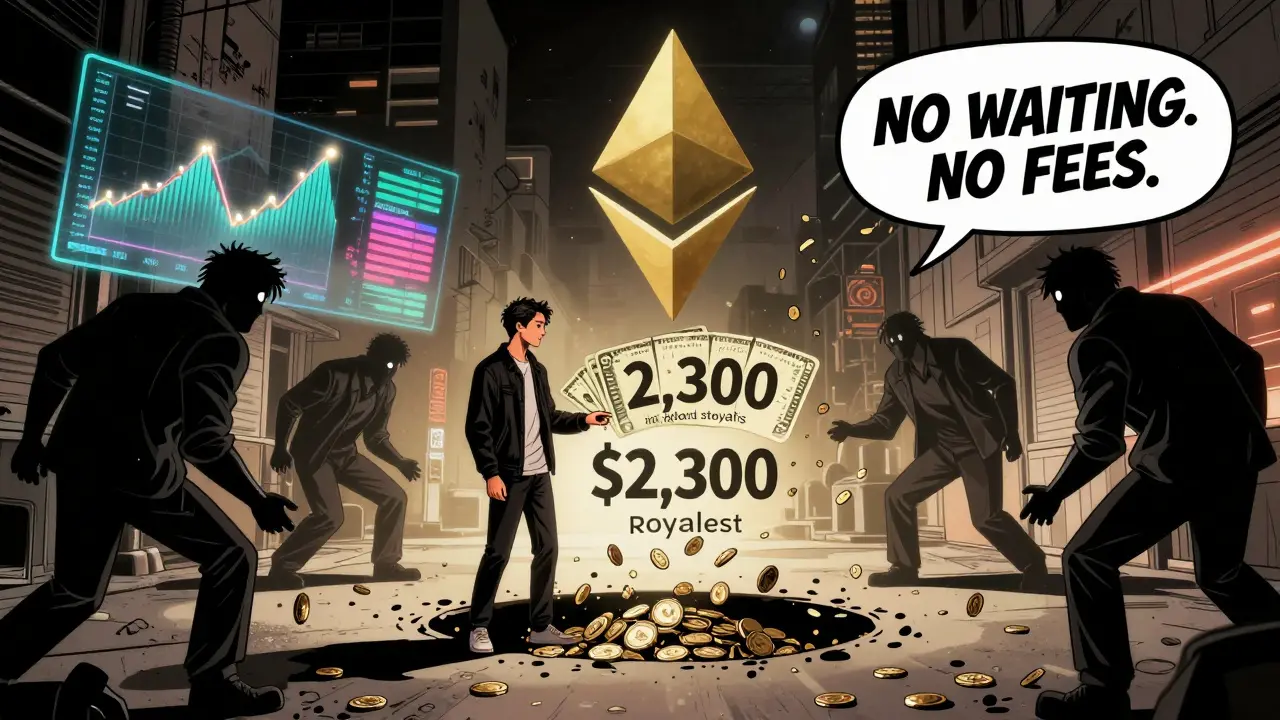
Who Benefits Most?
Not everyone wins equally. Blockchain’s biggest impact is in high-friction, multi-party systems where trust costs are high. - Artists and creators: Get paid faster, keep more of their earnings.- Small businesses: Avoid bank fees on international payments.
- Advertisers: Pay less for reach, get better data.
- Supply chain managers: Track goods in real time without paper trails. But for average consumers? The benefits are still behind the scenes. You won’t notice blockchain when you buy coffee. But you might notice when your favorite indie band gets paid within 24 hours instead of waiting a year.
Getting Started: What You Need to Know
If you’re curious about using blockchain to cut out middlemen, here’s how to begin:- Get a wallet: MetaMask or Trust Wallet are the easiest for beginners.
- Understand gas fees: On Ethereum, average transaction cost is around $0.42 (as of Q2 2023).
- Try a dApp: Use a decentralized exchange like Uniswap to swap tokens without a bank.
- Test a royalty platform: Upload a track to Tune.fm and see how fast you get paid.
- Learn the basics: Spend 2 hours on Ethereum’s official documentation. It’s clear, free, and well-structured.
What’s Next?
By 2027, the World Economic Forum predicts 10% of global GDP will be stored on blockchain. But that doesn’t mean banks are gone. It means they’ll be different. They’ll be faster. Cheaper. More transparent. The middlemen who survive won’t be the ones who cling to control. They’ll be the ones who use blockchain to serve better-to reduce friction, not add it. Blockchain doesn’t remove middlemen because it’s cool. It removes them because they’re expensive, slow, and unnecessary. And now, we have a better way.Can blockchain completely eliminate all middlemen?
No. Blockchain eliminates intermediaries that exist only to collect fees or slow down transactions. But roles that require human judgment-like legal dispute resolution, customer support, or complex risk assessment-still need people. The future isn’t zero middlemen. It’s smarter, leaner intermediaries who add real value instead of just taking a cut.
Is blockchain safe if there’s no middleman to fix mistakes?
It’s safer in terms of fraud and tampering-blockchain records are immutable and cryptographically secured. But it’s riskier if you make a mistake. Sending crypto to the wrong address or losing your private key means permanent loss. There’s no customer service hotline. You’re responsible for your own security. That’s why education and tools like hardware wallets matter.
What industries benefit the most from blockchain disintermediation?
Finance (cross-border payments), digital advertising (removing Google/Facebook as middlemen), music royalties (instant payouts to artists), and supply chain (real-time tracking without paperwork) see the biggest gains. These are industries where multiple parties, high fees, and delays are the norm. Blockchain cuts through that noise.
Do I need to be tech-savvy to use blockchain to remove middlemen?
Not anymore. Wallets like MetaMask and apps like Tune.fm or Uniswap are designed for non-technical users. You don’t need to understand hashing or consensus. You just need to know how to send and receive crypto. The learning curve is still steep for deeper use, but basic disintermediation-like sending money or getting paid-is now as simple as using Venmo.
Why aren’t more companies using blockchain if it saves so much money?
Integration is hard. Legacy systems don’t talk to blockchains easily. Regulatory uncertainty scares big institutions. And many companies fear losing control. JPMorgan uses blockchain, but only internally. They still run their own bank. The biggest barrier isn’t the tech-it’s changing how people think about trust and control.
 Cryptocurrency Guides
george haris
January 22, 2026 AT 01:39Man, I remember when I first sent crypto to a friend overseas. Took 7 minutes and cost me 40 cents. My bank said it’d take 5 days and $50. I cried a little. Then I cried harder when I realized I’d been paying middlemen my whole life for nothing.
Blockchain ain’t magic-it’s just honest math.
Paru Somashekar
January 22, 2026 AT 21:06While the potential of blockchain technology is indeed remarkable, it is imperative to acknowledge the critical role of regulatory frameworks and user education in ensuring sustainable adoption.
Without standardized protocols and accessible literacy, the promise of disintermediation may remain confined to technologically privileged demographics.
Let us not overlook the human element in the pursuit of innovation. 🙏
Steve Fennell
January 24, 2026 AT 04:29Real talk: I used to think blockchain was just crypto bros being weird.
Then I saw a small bakery in Portland pay their supplier in crypto-no bank, no fee, instant. They saved $800/month.
Now I get it. It’s not about tech. It’s about fairness.
Also, MetaMask is easier than Venmo now. Try it. 😊
Heather Crane
January 25, 2026 AT 22:08Okay, but what about the people who lose their keys??
And the grandma who just wants to send money to her grandkid without reading a 10-page guide??
And the fact that 90% of blockchain apps still use centralized servers??
Don’t get me wrong-I’m all for it-but stop acting like it’s a utopia. It’s a tool. A powerful one. But it’s not magic. And people are still people. 😅
Catherine Hays
January 27, 2026 AT 00:50Blockchain is a scam. The only people getting rich are the ones selling the dream.
You think some guy in India is getting paid $2,300 from 47k streams? Nah. He got $800 and the platform took 90% in gas fees.
And don’t even get me started on Ethereum. It’s just a glorified PayPal with more steps and no customer service.
Wake up. The middlemen just changed their suits.
HARSHA NAVALKAR
January 27, 2026 AT 04:25I have seen many friends in India try to use blockchain for remittances. Many failed. Some lost money. Some got confused. The system is not ready for everyone. It is good for those who already understand technology. For others, it is dangerous.
Perhaps one day. But not now.
Jessica Boling
January 27, 2026 AT 23:53So let me get this straight-instead of paying a bank 6.5% to send money, now I pay a guy in Ukraine 30 bucks in gas fees to send it to my cousin in Mexico?
Oh wait, no-I just lost my wallet password and now my crypto’s in some hacker’s pocket.
Thanks for the upgrade, Elon.
Also, I still need a lawyer to sue someone who scammed me. So… what did we really change?
Tammy Goodwin
January 29, 2026 AT 10:46My cousin runs a small Etsy shop. She started using a blockchain royalty platform for digital art. Got paid in 2 hours. No waiting. No ‘processing delays.’
She cried. Not because it was hard-because it was finally fair.
That’s the real win. Not the tech. The dignity.
Nadia Silva
January 30, 2026 AT 01:40It’s amusing how the American tech elite treat blockchain as some revolutionary panacea while ignoring that 95% of the world’s population can’t afford a smartphone, let alone a hardware wallet.
Disintermediation is a luxury good. Not a human right.
Also, Ethereum’s energy consumption is still obscene. But sure, let’s keep pretending this is green innovation.
Jonny Lindva
January 30, 2026 AT 11:48Used to work in logistics. We used blockchain to track shipments. No more lost paperwork. No more ‘who signed for this?’
Saved us 1200 hours a month. Boss didn’t believe it until he saw the reports.
Now he’s obsessed. We’re rolling it out to all our warehouses.
It’s not sexy. But it works. And that’s all that matters.
Jen Allanson
February 1, 2026 AT 03:55It is deeply concerning that the article romanticizes the elimination of intermediaries without adequately addressing the erosion of consumer protections, legal recourse, and institutional accountability.
When a smart contract executes erroneously, who bears the burden of loss? The individual. Not the institution. Not the developer. The individual.
This is not progress. It is regression under the guise of innovation.
Harshal Parmar
February 2, 2026 AT 22:48Look, I’m not a tech guy, but I’ve been uploading my music to Tune.fm for a year now. I used to get paid every 3 months, and they’d say ‘we’re processing’ and then take 30%.
Now? Every time someone plays my song, I get paid-like, instantly. Like, within minutes. I got $147 last week from 12,000 plays. That’s more than I made in 6 months on Spotify.
And I didn’t even have to do anything. Just uploaded it. The code did the rest.
People say blockchain is complicated. I say it’s the first time in my life someone didn’t take half my money just for breathing.
So yeah. I’m all in.
Darrell Cole
February 3, 2026 AT 10:22Blockchain doesn’t remove middlemen. It just makes them invisible.
The miners are the new bank clerks. The validators are the new auditors. The devs are the new lawyers.
You think you’re free? You’re just paying in computational power now.
And don’t forget-the blockchain is owned by whoever controls the majority hash rate.
It’s not decentralized. It’s just a different kind of oligopoly.
Wake up. You’re still being played.
Arnaud Landry
February 3, 2026 AT 17:47Blockchain? More like ‘block-chain of lies.’
Remember the DAO hack? $60M gone. No one got punished. No one got refunded.
And now we have ‘decentralized’ exchanges that are just frontends for centralized servers.
And gas fees? Bro, I paid $18 to send $5.
It’s not innovation. It’s a Ponzi scheme with better graphics.
And you’re all drinking the Kool-Aid. Sad.
Arielle Hernandez
February 4, 2026 AT 10:17One thing people overlook: blockchain doesn’t eliminate trust-it redistributes it.
Instead of trusting a bank, you trust code. Instead of trusting a lawyer, you trust audit trails.
That’s not bad. It’s just different.
And yes, mistakes are permanent. But so are the frauds that used to happen behind closed doors.
Transparency is the real upgrade. Not speed. Not cost. Visibility.
That’s why governments are slowly adopting it-for accountability, not efficiency.
Kevin Pivko
February 5, 2026 AT 19:31Let’s be real. The only reason blockchain is ‘disrupting’ anything is because legacy systems are ancient, bloated, and corrupt.
But guess what? The same people who built those systems are now the ones selling blockchain solutions.
JPMorgan’s JPM Coin? That’s not disintermediation. That’s rebranding.
They’re not removing middlemen. They’re just charging them more to do the same job with less paperwork.
This isn’t revolution. It’s PR with a whitepaper.
Mathew Finch
February 6, 2026 AT 04:20Blockchain is a Western tech fantasy. In the real world, people need help. They need someone to call when things go wrong.
You think a farmer in Bihar can use MetaMask? He needs a clerk. A guide. A human.
Calling this ‘empowerment’ is colonial nonsense.
Stop pretending tech fixes inequality. It just hides it better.
Shamari Harrison
February 7, 2026 AT 08:23My uncle runs a small construction biz in Ohio. He started using blockchain invoices last year.
Client pays in crypto. Smart contract releases funds when project milestones are verified by photos and timestamps.
No more ‘I’ll pay you next week.’ No more ‘we’re waiting on approval.’
He got paid 12 days faster on average.
He doesn’t know what a blockchain is. He just knows he’s not getting screwed anymore.
That’s all that matters.
Ashok Sharma
February 8, 2026 AT 02:23In India, many small businesses are using blockchain for payments. It reduces fraud and increases transparency. But the challenge is internet access and digital literacy.
Government and NGOs must work together to provide training.
Technology alone cannot solve social problems.
But it can help, if used wisely.
Barbara Rousseau-Osborn
February 9, 2026 AT 02:48Of course blockchain removes middlemen. That’s why it’s dangerous.
Who’s going to regulate it? Who’s going to stop the scammers? Who’s going to protect the elderly?
You think people are ready for this? No. They’re just excited because they saw a YouTube video.
It’s like giving a toddler a flamethrower and calling it ‘freedom.’
Wake up. This isn’t progress. It’s chaos with a blockchain logo.
Sara Delgado Rivero
February 10, 2026 AT 17:43Blockchain is just crypto with extra steps and more hype
Everyone who says it’s the future is either selling something or never had a job that actually paid them
Mike Stay
February 11, 2026 AT 09:11I’ve spent the last 18 months working with a supply chain startup using blockchain for pharmaceutical tracking.
Real story: A batch of insulin was diverted in Nigeria. Under the old system? Took 3 weeks to trace. By the time they found it, the medicine was spoiled.
With blockchain? In 17 minutes, they tracked every stop, every temperature, every signature.
Found the thief. Got the medicine back. Saved lives.
That’s not hype. That’s healthcare.
And yeah, it’s still clunky. But it works.
That’s more than I can say for half the systems we still use.
Ryan Depew
February 13, 2026 AT 08:28My friend’s band used to get paid $120 a month on Spotify.
Now they use a blockchain platform. Got $900 last month.
Same fans. Same songs.
Only difference? No one took 80% of their money.
So yeah. I’m not mad at blockchain.
I’m mad at the people who let the middlemen steal for 20 years.
tim ang
February 15, 2026 AT 02:45just sent 5 bucks to my buddy in canada using crypto
took 3 mins
no fee
he got it
my bank woulda charged 15 and took 3 days
so yeah
i think i get it now
Andy Simms
February 16, 2026 AT 06:59Most people don’t realize blockchain doesn’t remove middlemen-it upgrades them.
The bank becomes a validator. The lawyer becomes a contract auditor. The distributor becomes a node operator.
The difference? They’re now accountable. Transparent. Paid by value, not gatekeeping.
It’s not about eliminating humans. It’s about eliminating exploitation.
And that’s not just tech. That’s justice.