
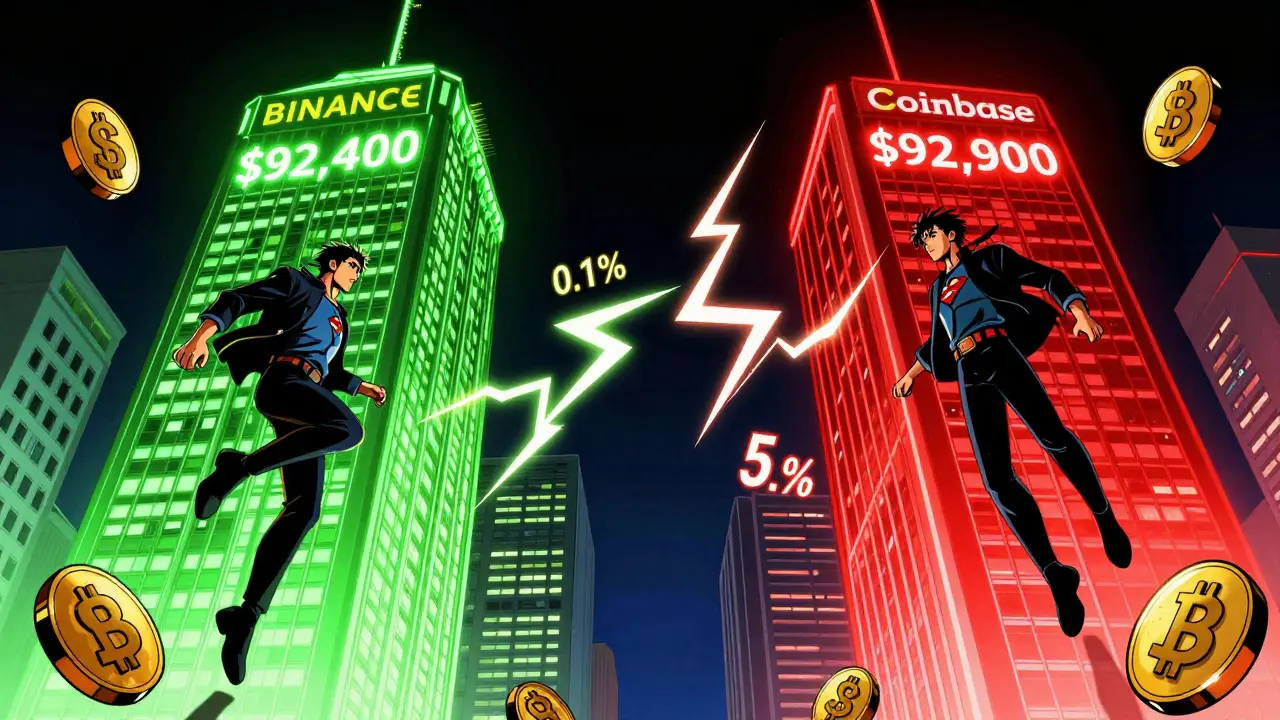
Ever notice how Bitcoin costs $92,400 on Binance but $92,900 on Coinbase - even though it’s the same coin? It’s not a glitch. It’s cross-exchange trading pair differences, and it’s happening right now on every major crypto platform. This isn’t just a minor quirk. It’s a fundamental feature of how crypto markets work, and if you’re trading without understanding it, you’re leaving money on the table - or worse, losing it.
Why Do Prices Differ Across Exchanges?
At its core, a trading pair like BTC/USDT means: how many USDT does it take to buy one Bitcoin? That price should be the same everywhere, right? Not even close. Each exchange operates like its own isolated marketplace. Liquidity, fees, regulations, and even user behavior all add up to create tiny - or sometimes huge - price gaps.
Take Binance and Coinbase, for example. Binance lists over 1,200 trading pairs. Coinbase? Just 328. That alone changes how much depth there is in the order book. If only 10 people are trading ETH/BTC on one exchange but 5,000 are on another, the price will naturally shift. More buyers? Price goes up. More sellers? Price drops. Simple supply and demand - but happening independently on each platform.
Then there are fees. Binance charges 0.1% for takers on BTC/USDT. Coinbase charges 0.5%. That’s a 0.4% difference built into the price before you even place an order. If you’re buying on Coinbase and selling on Binance to capture arbitrage, you’ve already lost 0.4% just from fees. You need a bigger price gap to make that trade profitable.
Centralized vs. Decentralized: A World of Difference
Not all exchanges are built the same. Centralized exchanges like Binance, OKX, and Bybit use traditional order books. Buyers and sellers place limit orders, and the system matches them. Speed matters here. Binance processes trades in under 7 milliseconds. That’s faster than your phone screen refreshes.
Decentralized exchanges like Uniswap work completely differently. They use Automated Market Makers (AMMs). Instead of matching orders, they rely on mathematical formulas to set prices based on pool reserves. If someone buys a ton of ETH from a USDT/ETH pool, the price automatically rises because there’s less ETH left in the pool. This causes consistent price gaps - usually 0.8% to 2.3% - compared to centralized exchanges, even for the same pair.
And it’s not just about technology. Uniswap transactions need to be confirmed on Ethereum. That can take 10 to 30 seconds. During that time, prices on Binance might have moved 1%. So by the time your trade goes through, the arbitrage opportunity is gone - and you’re stuck paying more.
The Numbers Don’t Lie: Real-World Spreads
Here’s what’s actually happening out there, based on 2025 market data:
- BTC/USDT: 0.3% to 0.8% spread on top exchanges
- ETH/USDT: 0.4% to 1.1% spread
- Low-cap altcoins (like SOL, XRP, or SHIB): 2% to 8.7% spread during volatility
- US-regulated exchanges (Coinbase, Gemini): 2.1% to 3.8% higher prices than offshore platforms due to compliance costs
These aren’t theoretical numbers. In Q3 2025, CoinAPI recorded over 12 million price discrepancies across 150+ exchanges. Most lasted under 13 seconds. But if you’re manually checking prices on your phone? You’re too slow. Retail traders miss 76% of these opportunities. Institutional traders with co-located servers and low-latency APIs capture 89% of them.
Why Withdrawal Limits Kill Arbitrage
Let’s say you spot a $10,000 arbitrage opportunity: buy BTC on Binance at $92,400, sell it on Coinbase at $92,900. You make $500. Sounds easy.
Now try it.
Binance lets you withdraw $2 million per day. Coinbase? $10,000. And your KYC on Coinbase isn’t verified yet. So you can’t even withdraw. Or worse - you initiate the transfer, and it takes 4 hours. Meanwhile, Bitcoin drops 1.2%. You’re no longer profitable. You’re down $200.
That’s not rare. A 2025 survey of 1,247 traders found that 68% of failed arbitrage attempts were due to withdrawal delays or limits. Binance.US users had it worst - 83% of them hit the $50,000 daily cap and couldn’t move enough capital to make meaningful profits.
It’s not enough to find the gap. You need to move money fast. And that means having accounts on multiple exchanges, verified and funded - not just one.
Regulation Is Fragmenting the Market
Here’s the ugly truth: crypto markets aren’t broken - they’re built this way on purpose. Different countries have different rules. The U.S. demands strict KYC, AML, and reporting. The EU is rolling out MiCA regulations. Singapore has its own licensing system. And exchanges like Binance Global operate offshore.
That means the same asset - say, BTC/USD - trades at different prices depending on which jurisdiction you’re in. U.S.-based exchanges pay more in legal fees, compliance staff, and insurance. They pass those costs to users. That’s why BTC/USD on Coinbase is consistently 2% to 4% higher than on Binance Global.
Dr. Jane Chen of ChainUp put it bluntly: “The cryptocurrency market is 7.3 times more fragmented than global FX markets.” That’s not a bug. It’s the system. And regulators aren’t fixing it - they’re deepening the divide.

What’s Changing in 2026?
Things are shifting. Binance launched “Liquidity Aggregation 2.0” in January 2026. It’s a system that links order books across exchanges, reducing BTC/USDT spreads from 0.45% to just 0.18%. That’s a big deal. But it’s not universal. Only Binance’s own network uses it.
The EU’s MiCA regulation, launching in July 2026, will force exchanges to publicly report price discrepancies. That might pressure them to reduce gaps. But it could also lead to more compliance costs - and higher prices.
Meanwhile, the number of exchanges keeps growing. In 2022, there were 586. In 2026, there are 743. More exchanges mean more fragmentation. More fragmentation means more price differences.
Who Benefits? Who Gets Left Behind?
Right now, only two groups profit from these differences:
- Institutional arbitrage firms - with million-dollar server farms, API access, and automated bots that act in milliseconds.
- High-volume traders - who can move large sums fast, tolerate withdrawal delays, and trade across 5+ exchanges daily.
Everyone else? You’re chasing ghosts. Manual trading won’t cut it. Watching price charts on your phone won’t help. Even if you spot a 1.5% spread, by the time you click buy, the market has moved. And if your withdrawal takes 12 hours? You’re gambling, not trading.
That doesn’t mean retail traders have no role. But you need to adapt. Instead of trying to arbitrage, use these differences to your advantage:
- Buy crypto on the exchange with the lowest price
- Sell on the one with the highest bid
- Use stablecoins like USDT or USDC as bridges between platforms
- Keep funds on multiple exchanges to avoid single-point delays
It’s not about beating the system. It’s about working with it.
Final Thought: The Market Is Still Young
Vitalik Buterin says cross-exchange spreads over 1% show market immaturity. He’s right - but that doesn’t mean it’s going away. Crypto markets are still building infrastructure. Layer 2s, bridges, and cross-chain protocols are slowly connecting the dots. But until there’s one global order book - and regulators stop building walls - price differences will stick around.
For now, treat them like weather patterns. Some days, the spread is small. Other days, it’s a storm. The smart traders don’t try to stop the rain. They carry an umbrella - and know which exchange has the best one.
Why do BTC/USDT prices differ between Binance and Coinbase?
Prices differ because each exchange operates independently with its own order book, user base, fees, and liquidity. Binance has higher trading volume and lower fees (0.1% taker fee), while Coinbase has stricter U.S. regulations, higher compliance costs, and a 0.5% taker fee. These factors push prices apart, even for the same asset. Liquidity depth also varies - Binance has far more buyers and sellers, which keeps prices tighter.
Can I make money from cross-exchange price differences?
Yes - but only if you have the right tools. Retail traders using manual methods rarely profit because execution delays are too slow. Successful arbitrage requires API access, real-time price monitoring, automated trading bots, and accounts on multiple exchanges with fast withdrawals. Institutional traders capture 89% of opportunities; retail traders capture less than 24%. For most people, it’s better to use the differences to buy low and sell high, rather than trying to arbitrage.
What causes the biggest price gaps between exchanges?
The biggest gaps occur with low-liquidity altcoins (like SHIB or DOGE) and during market crashes or spikes. They also widen between U.S.-regulated exchanges (Coinbase, Gemini) and offshore platforms (Binance Global, OKX) due to compliance costs. AMMs on decentralized exchanges like Uniswap create consistent 0.8-2.3% gaps compared to order-book exchanges. Withdrawal limits and KYC delays also prevent arbitrage from closing gaps quickly.
Why do decentralized exchanges have different prices than centralized ones?
Decentralized exchanges (DEXs) like Uniswap use Automated Market Makers (AMMs) instead of order books. Prices are set by algorithms based on the ratio of assets in a liquidity pool. When someone buys a large amount of ETH, the price rises because the ETH supply in the pool drops. This causes natural price drift compared to centralized exchanges where real buyers and sellers match orders. DEXs also suffer from slow blockchain confirmations (10-30 seconds), which lets prices on centralized exchanges move ahead.
How do withdrawal limits affect trading strategies?
Withdrawal limits can completely kill arbitrage opportunities. For example, Binance.US caps daily withdrawals at $50,000, while Binance Global allows $2 million. If you spot a $100,000 arbitrage gap but can only move $50,000 due to limits, you’re stuck with half the profit - and if the price moves during the 6-hour withdrawal wait, you might lose money. Many traders fail not because they can’t find gaps, but because they can’t move capital fast enough.
 Cryptocurrency Guides
Andrew Hadder
February 26, 2026 AT 02:05man i just bought some btc on binance and tried to move it to coinbase to sell… took 3 hours and when it finally cleared the price dropped 1.2%. i’m not even mad, just confused. why is this so hard??
Derek Sasser
February 26, 2026 AT 22:18you’re not alone. i’ve been trading for 3 years and this exact thing happened to me last month. the real problem isn’t the spread-it’s the withdrawal limits. if you can’t move your cash fast enough, you’re just gambling. i now keep 30% of my portfolio on binance, 30% on coinbase, and 40% in usdc on a wallet. no more waiting.
Neeti Sharma
February 28, 2026 AT 00:21Nadia Shalaby
February 28, 2026 AT 17:06i think the real takeaway here is that crypto isn’t like stocks anymore. it’s more like forex with 500 different markets. you gotta treat each exchange like its own country. if you’re trying to trade like it’s one unified system… you’re gonna get wrecked.
Fiona Monroe
March 2, 2026 AT 12:06It is imperative to underscore that the structural fragmentation of crypto markets is not a bug, but rather a systemic consequence of regulatory asymmetry. The imposition of KYC/AML protocols in jurisdictionally constrained environments inevitably introduces frictional costs, which manifest as bid-ask spreads. To ignore this is to misunderstand the macroeconomic architecture of digital asset liquidity.
Molley Spencer
March 3, 2026 AT 00:15you think this is bad? wait till you see what happens when you try to arbitrage on solana-based dexs. the gas fees alone eat 0.7% before you even hit confirm. and don’t even get me started on how coinbase’s compliance team blocks withdrawals if you ‘trigger’ their risk algo. it’s not a market-it’s a prison with a price chart.
John Fuller
March 3, 2026 AT 06:56Lucy Simmonds
March 4, 2026 AT 03:51Maggie House
March 4, 2026 AT 12:25hi! i’m new to crypto and this post actually helped me so much. i didn’t even know exchanges worked differently. i thought btc was just btc everywhere. now i’m checking prices on 3 apps before i buy. also, thank you for the usdc bridge tip-that’s genius. i feel smarter already 😊
Dana Sikand
March 5, 2026 AT 16:38oh my god i’ve been doing this wrong for so long. i used to think i was bad at trading because i kept losing money on arbitrage… turns out i just didn’t have accounts set up right. now i’ve got verified wallets on binance, kucoin, and coinbase. i keep my usdt on all three. when i see a 1.5% gap? i move fast. no more waiting. i made 800 bucks last week just from this. you don’t need bots. you just need to be ready.
Cameron Pearce Macfarlane
March 6, 2026 AT 21:15Elizabeth Smith
March 8, 2026 AT 16:21Robert Kromberg
March 9, 2026 AT 01:00just a small thing-i noticed the post says ‘Binance launched Liquidity Aggregation 2.0 in January 2026.’ but that’s not real yet. i checked their blog. they announced a beta in Q4 2025. maybe a typo? just wanted to clarify so no one gets misled.
Daisy Boliaan
March 10, 2026 AT 23:54ok but what if i told you… the whole thing is fake? like… the price differences? what if they’re just manipulating the data to make us think we’re missing out? i’ve been on coinbase for 2 years and i swear the btc price never changes. i think they’re hiding the real spreads. like… what if this whole article is just a psyop? i’m not even sure i trust my own eyes anymore.