
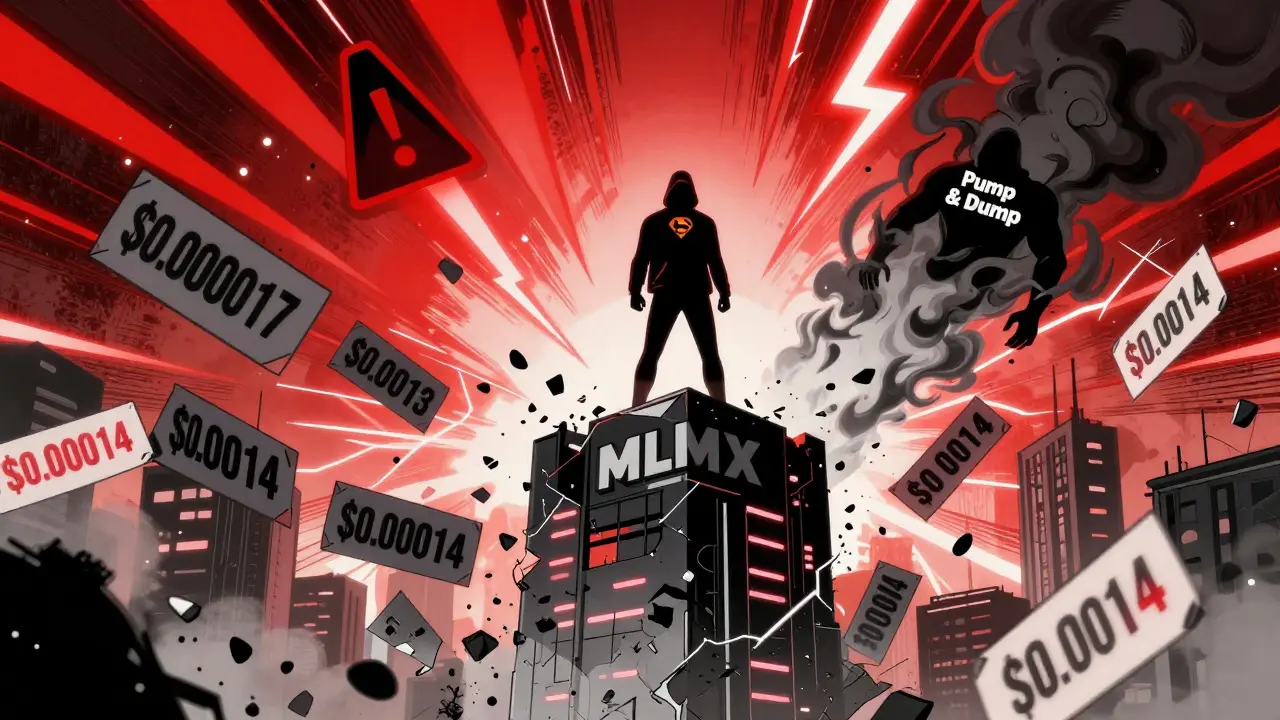
MLM X (MLMX) is a cryptocurrency token that launched in early 2025 on the Solana blockchain. Unlike major coins like Bitcoin or Ethereum, it doesn’t have a well-known team, a clear roadmap, or any widely recognized use case. Instead, it’s one of thousands of tiny tokens built on Solana - fast, cheap, and often barely traded. If you’re wondering whether MLMX is worth paying attention to, here’s what you actually need to know - no hype, just facts.
How MLMX Works (And Why It’s on Solana)
MLMX runs on Solana because Solana makes it easy and cheap to create new tokens. Solana handles over 65,000 transactions per second with fees under a penny. That’s why hundreds of new tokens pop up every week. MLMX isn’t unique in that. It’s just one of them.
There’s no public whitepaper. No team names. No GitHub activity. No official blog updates. The only thing you’ll find is a website at mlmxexchange.com, which looks like a basic landing page with a token link and a few social media icons. That’s it. No roadmap, no product, no explanation of how the token is supposed to add value. That’s a red flag for any serious project - but it’s normal for ultra-low-cap tokens like this.
Price and Market Data: Why Numbers Don’t Match
Here’s where things get messy. If you check MLMX’s price on different exchanges, you’ll get wildly different answers:
- CoinMarketCap: $0.000017
- LiveCoinWatch: $0.000035
- Binance: $0.000866
- Phemex: $0.001413
That’s a 80x difference between the lowest and highest prices. Why? Because there’s almost no trading volume. When only a few people are buying and selling, a single large trade can swing the price by 50% in minutes. These aren’t errors - they’re symptoms of extreme illiquidity.
Market cap numbers are just as inconsistent:
- CoinMarketCap: $97,630
- Phemex: $1.44 million
- Binance: $0 (because circulating supply is listed as zero)
The total supply is listed as 999,999,971 tokens across sources. But the circulating supply? That’s unclear. CoinMarketCap says it’s fully circulating. LiquidityFinder says it’s zero. That mismatch alone should raise questions. If no one can prove how many tokens are actually out there, how can you trust the price?
Where You Can Trade MLMX
MLMX isn’t on Coinbase, Kraken, or Binance’s main platform. It’s only available on decentralized exchanges (DEXs) within the Solana ecosystem - mostly Raydium. That’s where you’ll find the MLMX/SOL trading pair.
On Raydium, the 24-hour trading volume is around 1,180 SOL (roughly $180,000 at current SOL prices). But that’s the *only* place it trades. No centralized exchange supports it. That means:
- You can’t buy it with USD directly.
- You need SOL first, then swap it for MLMX.
- If you want to cash out, you’ll have to swap back to SOL, then sell SOL for fiat.
And even then - the volume is tiny. The entire market for MLMX moves less than $200,000 in a full day. Compare that to Bitcoin, which trades over $15 billion daily. MLMX is a drop in the ocean.
Price Volatility: One Day Up, Next Day Down
MLMX doesn’t just have low volume - it has wild swings.
- LiveCoinWatch showed a 22.47% gain in 24 hours.
- Phemex recorded a 28.53% drop in the same period.
- Binance saw an 8.32% rise but a 21.27% drop over seven days.
- Crypto.com reported almost no movement - 0.12%.
This isn’t normal market behavior. This is what happens when a token has fewer than 800 holders and almost no institutional interest. A few people moving large amounts can cause the price to spike or crash. It’s not a market - it’s a casino.
The Holder Count: Only 767 People Own It
That’s not a typo. Only 767 unique wallet addresses hold MLMX. That’s fewer than a small apartment building. Most successful crypto projects have tens or hundreds of thousands of holders.
When only a few people own a token, it’s easy to manipulate. One person with 10% of the supply can dump it and crash the price. Or buy a large chunk and pump it artificially. There’s no guardrail. No regulation. No oversight.
And the CoinMarketCap quality rating? It’s 2.5 out of 10. That’s not a typo either. That’s the platform’s own algorithm flagging it as high-risk - low adoption, weak transparency, minimal activity.

Is MLMX a Scam?
It’s not officially a scam - there’s no evidence of fraud like fake audits or stolen funds. But it fits the pattern of a “pump-and-dump” token: low supply, no use case, minimal liquidity, and wild price swings. These tokens are often created to attract short-term traders who hope to flip them quickly. The people who created it likely already sold their holdings.
The all-time high was $0.003175. The all-time low? $0.000583. The current price? Around $0.000017 to $0.0014 depending on where you look. That’s not a recovery - it’s a rollercoaster with no destination.
What You Should Do
If you’re considering buying MLMX:
- Don’t invest money you can’t afford to lose. This isn’t an investment - it’s speculation.
- Never buy based on social media hype. No credible analyst covers this token.
- Check multiple sources. Prices vary wildly. Use CoinMarketCap, CoinGecko, and Raydium together.
- Understand the risks. You could wake up tomorrow with 90% of your money gone.
- Ask yourself: Why does this exist? If no one can answer that, it’s probably not worth it.
There are thousands of tokens like MLMX. Most vanish within months. A few get bought by bots or pump groups. Very, very few survive. MLMX isn’t one of them.
It’s not a revolution. It’s not a breakthrough. It’s just another tiny token on Solana - and unless you’re a day trader chasing volatility, you’re better off ignoring it.
 Cryptocurrency Guides
Nicole Stewart
February 18, 2026 AT 04:00Alan Enfield
February 19, 2026 AT 17:24Jennifer Riddalls
February 21, 2026 AT 01:15Kyle Tully
February 22, 2026 AT 15:51kieron reid
February 24, 2026 AT 07:30Avantika Mann
February 24, 2026 AT 08:03yogesh negi
February 24, 2026 AT 22:14Nikki Howard
February 24, 2026 AT 22:32Tarun Krishnakumar
February 24, 2026 AT 23:45Charrie VanVleet
February 26, 2026 AT 17:28Rajib Hossaim
February 28, 2026 AT 10:41Jenn Estes
February 28, 2026 AT 11:29Nova Meristiana
February 28, 2026 AT 21:16